Paper II — Q2
(a) What are the major debates related to the concept of jajmani system ? (20 marks) (b) ‘Dharti Aaba Janjatiya Gram Utkarsh…
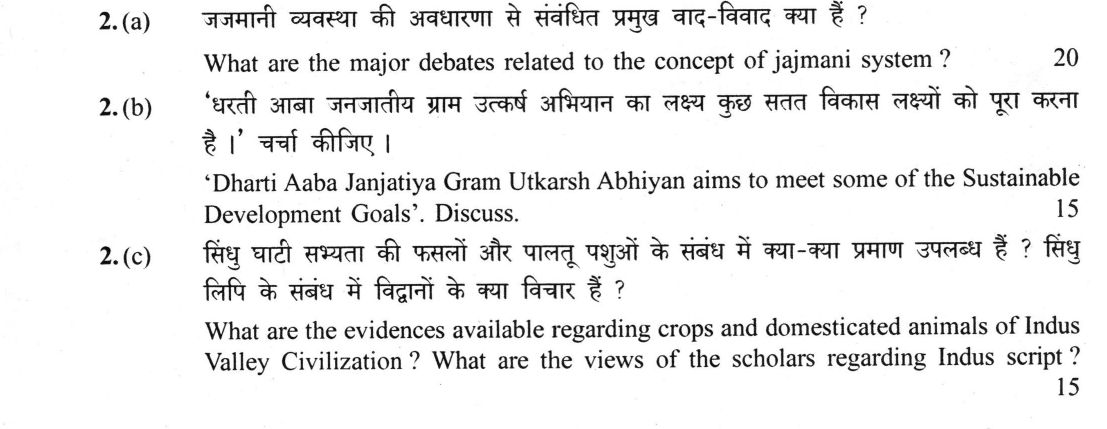
What are the major debates related to the concept of jajmani system ? 20 marks
‘Dharti Aaba Janjatiya Gram Utkarsh Abhiyan aims to meet some of the Sustainable Development Goals’. Discuss. 15 marks
What are the evidences available regarding crops and domesticated animals of Indus Valley Civilization ? What are the views of the scholars regarding Indus script ? 15 marks
हिंदी में प्रश्न पढ़ें
जजमानी व्यवस्था की अवधारणा से संबंधित प्रमुख वाद-विवाद क्या हैं ? (20 अंक)
‘धरती आबा जनजातीय ग्राम उत्कर्ष अभियान का लक्ष्य कुछ सतत विकास लक्ष्यों को पूरा करना है ।’ चर्चा कीजिए । (15 अंक)
सिंधु घाटी सभ्यता की फसलों और पालतू पशुओं के संबंध में क्या-क्या प्रमाण उपलब्ध हैं ? सिंधु लिपि के संबंध में विद्वानों के क्या विचार हैं ? (15 अंक)
Model answer
Drafted with AI by UPSC Answer Check against this question's marking rubric, to the expected length. UPSC does not publish answers for Mains — this is one way to score well, not an official key. How we build rubrics and answers.
(a) Major debates on the jajmani system
Introduction: W. H. Wiser's 'The Hindu Jajmani System' (1936), from Karimpur in Mainpuri district, Uttar Pradesh, defined it: hereditary ties binding landowning jajmans (yajamana, the sacrificer) to kamin serving castes, paid from the grain heap, not in wages. Five debates follow.
Debate 1, reciprocity versus exploitation: Wiser read mutual obligation and 'security' for every caste. T. O. Beidelman (1959) saw a coercive, asymmetric order resting on the landholding caste's monopoly of land and force. Oscar Lewis and Victor Barnouw found at Rampur (Delhi) fewer and thinner ties than claimed, and Jan Breman's 'Patronage and Exploitation' (1974) showed Gujarat's hali tie as bondage.
Debate 2, ritual versus economic basis: Harold Gould held that jajmani ties transfer pollution and express the ritual division of labour, and Louis Dumont's 'Homo Hierarchicus' subsumed them under pure/impure hierarchy. Beidelman, Pauline Kolenda (1963) and agrarian historians instead saw surplus distribution anchored in land control; M. N. Srinivas's 'dominant caste' locates the real power.
Debate 3, is it a 'system' at all? C. J. Fuller's 'Misconceiving the Grain Heap' (1989) and Peter Mayer's 'Inventing Village Tradition' (1993) call it a late-colonial reification: jajmani properly denotes only the yajamana-purohit tie, while wages, rents and service tenures were lumped together and pan-Indian antiquity assumed.
Debate 4, ubiquity and nomenclature: Parallel institutions were balutedari in Maharashtra, mirasi and vetti in the Tamil country, halipratha in Gujarat; strongest in the Gangetic plain and weak in tribal, hill and coastal India, so Karimpur cannot stand for 'the Indian village'.
Debate 5, decline versus transformation: Monetisation, land reform, Green Revolution wage labour, migration, education and Dalit assertion dissolved the hereditary tie; whether jajmani vanished or mutated into insecure contractual dependence (Breman's 'footloose labour') remains open.
Conclusion: Wiser's institution was real but historically and regionally limited; 'jajmani' now survives less as a description of Indian villages than as a lesson in how anthropological categories are made.
(b) DAJGUA and the Sustainable Development Goals
Introduction: Dharti Aaba Janjatiya Gram Utkarsh Abhiyan (DAJGUA), launched on 2 October 2024 at Hazaribagh in Birsa Munda's ('Dharti Aaba') 150th birth-anniversary year, is the Ministry of Tribal Affairs' saturation mission for tribal-majority villages.
Architecture: Outlay about Rs 79,156 crore; about 63,000 villages and 5 crore tribal people; 25 interventions converged through 17 ministries under four pillars: infrastructure, economic empowerment, education, and healthy lives. It is a convergence umbrella over existing schemes, not a new funding stream.
SDG mapping:
- SDG 1: pucca houses under PMAY-G and livelihood saturation.
- SDG 3: Ayushman Bharat cards, mobile medical units and sickle-cell screening.
- SDG 4: Eklavya Model Residential Schools and hostels.
- SDG 6: Jal Jeevan Mission tap connections.
- SDG 7: household electrification and solar.
- SDG 8: skilling, SHGs and Van Dhan Vikas Kendras.
- SDG 9: PMGSY roads and telecom.
- SDG 15: forest-produce value addition and Forest Rights Act titling.
- SDG 10 and 17: targeting those furthest behind operationalises 'leave no one behind'; 17-ministry convergence is partnership.
Wider architecture: It extends PM-JANMAN (15 November 2023, about Rs 24,104 crore) for the 75 PVTGs, alongside DAPST, Article 275(1) grants and the Sickle Cell Anaemia Elimination Mission.
Critique: A target-driven saturation model risks bypassing Gram Sabha consent under PESA, 1996 and the Forest Rights Act, 2006, and the imposition Nehru's Panchsheel warned against; the SDG India Index lacks ST-disaggregated indicators; state matching shares and inter-ministry sequencing are weak, as the Xaxa Committee (2014) found of earlier schemes.
Conclusion: The claim holds in design; it will hold in outcome only through Gram Sabha-anchored, integration-without-imposition delivery.
(c) Harappan crops, animals and the Indus script
Introduction: For the Harappan civilisation, subsistence evidence is cumulative while the script remains unread.
(i) Crops: Evidence comes from carbonised grain, impressions on pottery and brick, flotation, phytoliths, bones, seals and fields. Staples were winter barley (Hordeum vulgare) and wheat (Triticum aestivum, T. sphaerococcum) at Mehrgarh, Harappa and Kalibangan, with pea, chickpea, lentil, sesame, mustard and linseed. Cotton (Gossypium arboreum) appears first at Mehrgarh. Rice husk impressions at Lothal and Rangpur and African-derived ragi, jowar and bajra at Rojdi mark a Gujarat summer-crop regime. Kalibangan's pre-Harappan criss-cross ploughed field and Banawali's terracotta plough attest cross-ploughing.
Domesticated animals: Humped zebu (Bos indicus) dominates bones and seals, with buffalo, sheep, goat, pig, dog and fowl; a Chanhudaro brick preserves cat and dog footprints. Camel and elephant are doubtful domesticates. The horse rests on Surkotada, where Bokonyi read Equus caballus and Meadow and Patel the wild half-ass Equus hemionus; no seal shows a horse, so it is unresolved.
(ii) Indus script: About 4,000 inscribed objects carry roughly 400-450 signs (Mahadevan's 1977 concordance: 417); texts average five signs (longest seventeen), run right to left, and are undeciphered. Asko Parpola (1994) and Iravatham Mahadevan argue proto-Dravidian through rebus readings such as fish = min. S. R. Rao reads Indo-Aryan; others propose a Munda substrate. Farmer, Sproat and Witzel (2004) deny it encodes language at all, contested by Rajesh Rao et al. (Science, 2009) on entropy grounds. No bilingual inscription, very short texts and an unknown language defeat decipherment.
Subsistence is firmly established; the script stays open, and the two levels of certainty must be kept apart.
How this answer will be evaluated
Evaluation rubric
Each sub-part is marked on its own, against the marks and word limit printed on the paper.
- (a) Set out the scholarly controversies surrounding the jajmani concept - not merely describe the institution. The answer must present the debates as debates, naming the opposed positions and their authors: harmony versus exploitation, ritual versus economic basis, whether 'jajmani' is a valid analytical category at all, its regional ubiquity, and whether it has declined or merely transformed. 20 marks
Must cover
- W. H. Wiser, 'The Hindu Jajmani System' (1936), Karimpur
- jajman and kamin (yajamana)
- T. O. Beidelman (1959)
- Harold Gould
- Pauline Kolenda (1963)
- Louis Dumont, 'Homo Hierarchicus'
- C. J. Fuller, 'Misconceiving the Grain Heap' (1989)
- Peter Mayer, 'Inventing Village Tradition' (1993)
- Jan Breman, 'Patronage and Exploitation' (1974)
- balutedari (Maharashtra) / mirasi (Tamil Nadu) / halipratha (Gujarat)
- M. N. Srinivas's dominant caste
- Oscar Lewis and Victor Barnouw (Rampur)
Loses marks
- Describing the jajmani system at length (who serves whom, what the barber and washerman do) and never stating a single debate - the directive is 'what are the major debates'.
- Naming no scholar except Wiser; at 20 marks the examiner expects at least four or five named positions in opposition.
- Presenting the harmony view and the exploitation view without attributing them to Wiser and Beidelman respectively.
- Missing the most contemporary debate - Fuller's and Mayer's argument that the category itself is a construct - which is what distinguishes a top answer.
- Assuming jajmani was pan-Indian and ancient, and ignoring the regional variants and the colonial-period dating.
- Ending with a flat 'it has now disappeared' instead of engaging the decline-versus-transformation argument.
Earns more
- Debate on the validity of the category itself: C. J. Fuller's 'Misconceiving the Grain Heap' (1989, in Parry and Bloch's 'Money and the Morality of Exchange') and Peter Mayer's 'Inventing Village Tradition' (1993) argue that 'the jajmani system' is an anthropological reification of late-colonial origin - the term properly denotes only the yajamana-purohit ritual tie, heterogeneous transactions (wages, rents, gifts, service tenures) have been lumped together, and the assumed pan-Indian antiquity is unsupported
- Debate on ubiquity, regional variants and nomenclature: parallel institutions were called balutedari (the balutedars of Maharashtra), mirasi/aya and vetti in the Tamil country, and halipratha in Gujarat; the institution was strongest in the Gangetic plain and weak or absent in tribal, hill, coastal and north-eastern India - so generalising Karimpur to 'the Indian village' is itself contested
- Debate on decline versus transformation: monetisation, abolition of intermediaries and land reform, Green Revolution wage labour, urban and circular migration, education, reservation and Dalit assertion have dissolved the hereditary tie - but scholars differ on whether jajmani vanished or mutated into unequal, insecure contractual wage relations and new forms of dependence (Breman's 'footloose labour'), with ritual jajmani surviving mainly for priests and at life-cycle rituals
Extra mark
- Frames the exchange through Mauss's prestation or Polanyi's reciprocity and redistribution
- Simon Commander (1983) on the colonial-era economics of jajmani, or Srinivas's 'The Remembered Village' (1976) on changing service ties
- (b) 'Discuss' a given proposition: show what Dharti Aaba Janjatiya Gram Utkarsh Abhiyan (DAJGUA) is - launch, outlay, coverage, components - and then map its interventions explicitly onto specific Sustainable Development Goals, ending with a reasoned judgement on how far the claim holds. 15 marks
Must cover
- Dharti Aaba Janjatiya Gram Utkarsh Abhiyan, launched 2 October 2024
- Birsa Munda - 'Dharti Aaba'
- about Rs 79,156 crore outlay
- about 63,000 villages and 5 crore tribal people
- 25 interventions, 17 ministries; Ministry of Tribal Affairs nodal
- PM-JANMAN (2023) for the 75 PVTGs
- Jal Jeevan Mission, PMAY-G, PMGSY, EMRS, Van Dhan Vikas Kendra, Ayushman Bharat
- SDG 1, 3, 4, 6, 8, 10 and 15 named explicitly
- 'leave no one behind'
- PESA 1996 and Forest Rights Act 2006 / Xaxa Committee 2014
Loses marks
- Describing the scheme at length but never naming a single SDG by number - the question asks specifically about SDG alignment.
- Naming SDGs generically ('sustainable development') without pairing each with a concrete DAJGUA intervention.
- Confusing DAJGUA with PM-JANMAN: PM-JANMAN (2023) targets the 75 PVTGs; DAJGUA (2024) targets all tribal-majority villages.
- Quoting badly wrong figures - e.g. the outlay in lakh crore, or coverage of 63 lakh villages instead of about 63,000.
- Offering no critique, so the answer reads as a government press note rather than an anthropological discussion.
- Ignoring PESA and FRA, the two statutes that determine whether such a scheme is implemented with or without community consent.
Earns more
- Locates DAJGUA in the wider architecture rather than treating it in isolation: it extends the model of PM-JANMAN (Pradhan Mantri Janjati Adivasi Nyaya Maha Abhiyan, launched 15 November 2023 on Janjatiya Gaurav Diwas, outlay about Rs 24,104 crore, aimed at the 75 PVTGs), and works alongside the Development Action Plan for Scheduled Tribes, Article 275(1) grants, the Eklavya Model Residential School programme, MSP for minor forest produce, and the National Sickle Cell Anaemia Elimination Mission targeting elimination by 2047
- Critical appraisal: a saturation, target-driven delivery model risks bypassing the Gram Sabha consent and self-governance guaranteed by PESA, 1996 and the Forest Rights Act, 2006, and risks cultural erosion of the kind Verrier Elwin warned against and Nehru's tribal Panchsheel sought to avoid (integration without imposition); the Xaxa Committee (2014) and NFHS data document the ST deficit the mission must close; weaknesses include the absence of ST-disaggregated SDG indicators in the SDG India Index, dependence on state matching shares, and convergence across 17 ministries being hard to sequence on the ground
Extra mark
- Coverage and funding detail: about 549 districts in 30 States/UTs; central share Rs 56,333 crore and state share Rs 22,823 crore
- Links to SDG 2 (nutrition through Anganwadi saturation) and SDG 5 (women's SHGs), with a note on goals the scheme does not address
- (c) Two distinct sub-questions must both be answered: (i) the archaeobotanical and archaeozoological evidence for Harappan crops and domesticated animals, with sites named; and (ii) the competing scholarly positions on the Indus script. Answering only one half caps the answer at roughly half marks. 15 marks
Must cover
- barley and wheat (Triticum sphaerococcum)
- cotton at Mehrgarh
- rice at Lothal and Rangpur
- millets at Rojdi
- zebu (Bos indicus)
- the horse controversy - Surkotada, Bokonyi versus Meadow and Patel
- Kalibangan ploughed field
- Chanhudaro brick with animal footprints
- undeciphered; about 400-450 signs; Mahadevan's 417
- Asko Parpola - Dravidian hypothesis
- Iravatham Mahadevan
- S. R. Rao - Indo-Aryan reading
- Farmer, Sproat and Witzel (2004) non-script thesis
- Rajesh P. N. Rao et al., Science (2009)
- no bilingual inscription
Loses marks
- Answering only the subsistence half or only the script half - the question has two explicit parts carrying roughly equal weight.
- Asserting flatly that the Harappans had the domesticated horse (or flatly that they did not) instead of presenting Surkotada as a contested identification.
- Naming no site at all - 'the Harappans grew wheat and barley' without Kalibangan, Mehrgarh, Lothal or Rojdi earns little.
- Claiming the script has been deciphered, or presenting one hypothesis (usually the Dravidian one) as established fact.
- Confusing the script's direction (normally right to left) or inflating the corpus and text length.
- Mixing in Vedic literary evidence as though it were archaeological evidence for Harappan subsistence.
Earns more
- States the categories of evidence and agricultural technology rather than just listing species: carbonised grain, grain impressions on pottery and mud brick, flotation and phytolith recovery, faunal bone assemblages and figurines; the pre-Harappan ploughed field with criss-cross furrows at Kalibangan implying two crops in the same field, terracotta plough models from Banawali, the granaries/'great halls' at Harappa and Mohenjo-daro whose identification as granaries is itself disputed (Wheeler versus Kenoyer), and Gabarbands or bunds for water harvesting in Baluchistan
- Basic facts about the script, correctly stated: undeciphered; a corpus of roughly 4,000 inscribed objects - seals, sealings, copper tablets, pottery graffiti - with sign counts usually put at about 400-450 (Iravatham Mahadevan's concordance of 1977 lists 417 signs); texts are extremely short, averaging about five signs, the longest single-surface text about seventeen, and the Dholavira 'signboard' carrying ten large signs; writing normally runs right to left, with boustrophedon in some longer texts, inferred from sign cramping and overlap
Extra mark
- Recent archaeobotany on multi-cropping and drought-tolerant millets in north-west India (Petrie and Bates)
- The Rakhigarhi genome (Shinde et al., 2019) cited carefully as context for the language debate
What "Explain" is asking you to do
Make the working of something clear — what sets it off, what follows from what, and what it produces. Explain is the Commission's mechanism word: it dominates the technical papers and the “explain why” stems, where the marks sit in the causal chain and not in the label.
Structure that answers it
State what it is → the initiating condition → the chain of cause, step by step → an instance where it plays out → what the chain produces
Where marks are lost
Describing what something looks like instead of why it works that way. Naming the stages without linking them reads as description too.
Practice this exact question
Write your answer and it is marked point by point against the model answer above — what you covered, what you missed, what you got wrong.
Evaluate my answer →More from Anthropology 2026 Paper II
- Q1 Write notes on the following in about 150 words each : (a) Dravidian language family and…
- Q2 (a) What are the major debates related to the concept of jajmani system ? (20 marks) (b)…
- Q3 (a) Critically examine the salience of F. G. Bailey’s study on Bisipara village of Odisha…
- Q4 (a) Write an account on the contribution of Verrier Elwin in developing policies for the…
- Q5 Write notes on the following in about 150 words each : (a) Buddhist tribes of India. (10…