Paper I — Q3
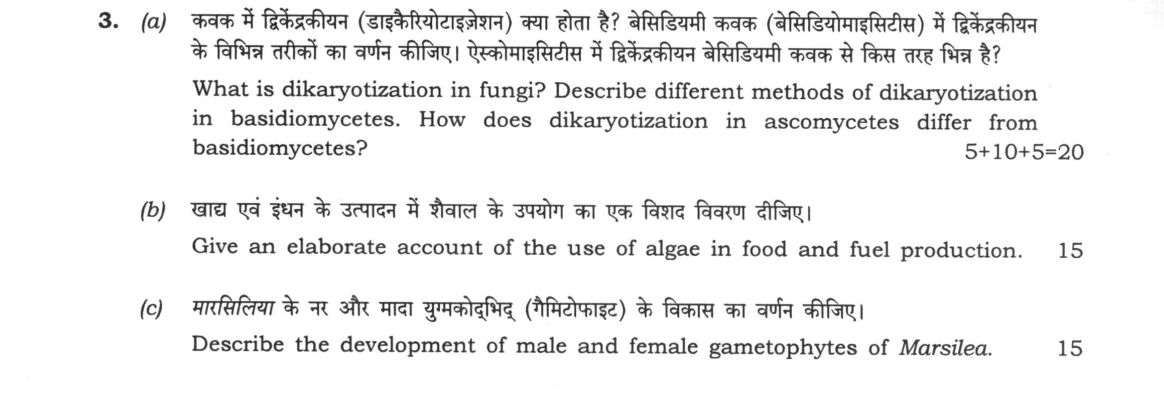
(a) What is dikaryotization in fungi? Describe different methods of dikaryotization in basidiomycetes. How does dikaryotization…
What is dikaryotization in fungi? Describe different methods of dikaryotization in basidiomycetes. How does dikaryotization in ascomycetes differ from basidiomycetes? 5+10+5=20
Give an elaborate account of the use of algae in food and fuel production. 15 marks
Describe the development of male and female gametophytes of Marsilea. 15 marks
हिंदी में प्रश्न पढ़ें
कवक में द्विकेंद्रकीयन (डाइकेरियोटाइजेशन) क्या होता है? बेसिडियमी कवक (बेसिडियोमाइसिटीस) में द्विकेंद्रकीयन के विभिन्न तरीकों का वर्णन कीजिए। ऐस्कोमाइसिटीस में द्विकेंद्रकीयन बेसिडियमी कवक से किस तरह भिन्न है? 5+10+5=20
खाद्य एवं ईंधन के उत्पादन में शैवाल के उपयोग का एक विस्तृत विवरण दीजिए। 15
मार्सिलिया के नर और मादा युग्मकोद्भिद (गैमेटोफाइट) के विकास का वर्णन कीजिए। 15
Model answer
Written by UPSC Answer Check against this question's marking rubric, to the expected length. UPSC does not publish answers for Mains — this is one way to score well, not an official key.
Dikaryotization and Algal/Marsilea Biology
Dikaryotization in Fungi Dikaryotization is the process in fungi where two haploid nuclei from different mating types fuse within a single cell, resulting in a dikaryotic condition (n+n). Unlike karyogamy, the nuclei remain distinct and do not fuse immediately. In Basidiomycetes, this condition is maintained for a prolonged period, forming the secondary mycelium.
Basidiomycetes employ three primary methods for dikaryotization:
- Somatogamy: This is the most common method. It involves the fusion of two compatible vegetative hyphae (plasmogamy) without the involvement of specialized sex organs. The cytoplasm of the two hyphae fuses, and the nuclei from both parents coexist in the resulting cells.
- Spermatization: Here, a specialized male structure called a spermatium (or spermatial cell) is produced on a receptive hypha. The spermatium fuses with the receptive cell, transferring its nucleus. This is seen in genera like Puccinia.
- Hyphal Fusion (Buller’s Phenomenon): In some species, such as Clavaria, two hyphae approach each other. A bulge (Buller’s body) forms at the contact point, and the nuclei migrate into this structure before the cytoplasms fuse, establishing the dikaryon.
A critical feature of Basidiomycete dikaryons is the presence of clamp connections. These are hook-like structures formed during nuclear division that ensure each daughter cell receives one nucleus from each parent, maintaining the n+n state. The hyphae are also characterized by dolipore septa, which have a central pore surrounded by a torus.
In contrast, Ascomycetes exhibit a brief dikaryotic phase. Dikaryotization occurs via the fusion of an antheridium and an ascogonium. However, unlike Basidiomycetes, Ascomycetes lack clamp connections. Instead, they often form a crozier (hooked structure) during nuclear division, but this does not guarantee the same strict alternation of nuclei. Crucially, the dikaryon in Ascomycetes is short-lived; karyogamy occurs promptly within the ascus, leading to meiosis. Thus, while Basidiomycetes maintain a long-lived dikaryotic mycelium, Ascomycetes transition quickly to the diploid stage.
Algae in Food and Fuel Production Algae are increasingly vital for sustainable food and energy security.
Food Production: Microalgae like Spirulina (Arthrospira) and Chlorella are rich in protein, vitamins, and essential fatty acids. Spirulina is used in dietary supplements and fortified foods to combat malnutrition. Macroalgae such as Porphyra (nori) and Laminaria (kelp) are consumed directly or processed into agar, alginate, and carrageenan, which serve as thickeners and stabilizers in the food industry. In India, the Central Food Technological Research Institute (CFTRI) in Mysore has pioneered the cultivation of Spirulina and Chlorella for rural nutrition programs, integrating them into local diets to address protein-energy malnutrition.
Fuel Production: Algae are promising feedstocks for biofuels due to their high lipid and carbohydrate content.
- Biodiesel: Botryococcus braunii is a key species for biodiesel production due to its high hydrocarbon content.
- Bioethanol: Carbohydrate-rich algae like Chlorella can be fermented to produce bioethanol.
- Biogas: Macroalgae can be anaerobically digested to produce methane.
Algae offer significant advantages over terrestrial crops: they do not compete for arable land, require less water, and can grow in saline or wastewater. In India, the NITI Aayog has launched the Algae Biofuel Mission to promote algae-based biofuels, aiming to reduce fossil fuel dependency and enhance energy security. Challenges remain in scaling up cultivation and reducing production costs, but the potential for sustainable energy is substantial.
Gametophyte Development in Marsilea Marsilea, a aquatic fern, exhibits unique gametophyte development within the sporocarp.
Male Gametophyte: The male gametophyte develops from the microspore. The microspore germinates to form a prothallial cell. This cell divides to produce an antheridial initial. The antheridial initial undergoes division to form a jacket initial and a primary androgonial cell. The primary androgonial cell then divides to form androcyte mother cells, which further divide to produce androcytes. These androcytes differentiate into multiflagellate antherozoids. The entire process results in a single antheridium per microspore, typically containing 16 antherozoids. The antheridium is enclosed by a jacket layer derived from the jacket initial.
Female Gametophyte: The female gametophyte develops from the megaspore. The megaspore germinates to form an archegonial initial. This initial divides to form the neck canal cells, ventral canal cell, and the egg. The development is endosporic, meaning the gametophyte remains enclosed within the spore wall (sporocarp). This protection is crucial for the aquatic habitat, ensuring the gametes are released in a controlled manner. The archegonium is typically bicellular in its final stage, with a neck and a venter containing the egg.
Conclusion The reproductive strategies of fungi and ferns like Marsilea highlight the evolutionary adaptations to diverse environments. The dikaryotic phase in fungi facilitates genetic recombination and survival, while the endosporic gametophyte development in Marsilea ensures reproductive success in aquatic conditions. Understanding these mechanisms is essential for both biological classification and the application of these organisms in food and energy sectors.
What "Describe" is asking you to do
Give a full, ordered account of the thing named — its parts, stages or mechanism — in the sequence in which it actually exists or occurs. Most describe questions come from the science optionals, where the marks sit in correct technical detail and, where the stem says so, a labelled diagram.
Structure that answers it
One-line identification of the subject → the parts or stages in their real order, each with its defining detail → labelled diagram where the subject is structural → closing line on function or significance
Where marks are lost
Loose general prose where the examiner is ticking named parts, correct terminology and their sequence; and in the General Studies papers, turning to evaluation before the description is finished.
How this answer will be evaluated
Approach
Framework: Botany Mains: Define > Process > Diagram > Significance. (a) describe: definition > process in order > labelled diagram > significance | (b) describe: definition > process in order > labelled diagram > significance | (c) describe: definition > process in order > labelled diagram > significance Full marks: Precise definitions, detailed processes, labelled diagrams, specific species names, clear comparisons.
Key points expected
- Dikaryon (n+n) definition
- Basidiomycete methods: somatogamy, anastomosis, plasmogamy
- Clamp connection diagram
- Ascomycetes vs Basidiomycetes dikaryotization
- Algae food: *Spirulina*, *Wakame*, *Kelp*, *Agar-Agar*
- Algae fuel: Bio-oil, biogas, biodiesel
- *Marsilea* male gametophyte development
- *Marsilea* female gametophyte development
- Labelled diagrams for all parts
Evaluation rubric
Each sub-part is marked on its own, against the marks and word limit printed on the paper.
- (a) Define dikaryotization, detail basidiomycete methods, and contrast with ascomycetes. 20 marks
describe— definition → process in order → labelled diagram → significance
Must cover
- Definition of dikaryon (n+n) and dikaryotization
- Methods: somatogamy, anastomosis, plasmogamy
- Labelled diagram of clamp connection formation
- Comparison: Ascomycetes (n+n short) vs Basidiomycetes (n+n long)
Loses marks
- Unlabelled diagrams of clamp connections
- Confusing dikaryon with diploid (2n) stage
Earns more
- Mention of *Agaricus bisporus* or *Puccinia graminis*
- Explanation of nuclear migration in clamp
- Distinction between plasmogamy and karyogamy timing
Extra mark
- Reference to specific fungal life cycle stages
- (b) Elaborate on algae applications in food and fuel production. 15 marks
describe— definition → process in order → labelled diagram → significance
Must cover
- Food uses: *Spirulina*, *Wakame*, *Kelp*, *Agar-Agar*
- Fuel production: Bio-oil, biogas, biodiesel
- Specific species names for food and fuel
- Process of extraction or cultivation
Loses marks
- Loose common names without binomials
- Vague statements without specific species
Earns more
- Mention of *Chlorella* or *Dunaliella* for fuel
- Nutritional value of *Spirulina* (protein content)
- Diagram of algal bioreactor or extraction process
Extra mark
- Recent biotech application in algal fuel
- (c) Describe development of male and female gametophytes of *Marsilea*. 15 marks
describe— definition → process in order → labelled diagram → significance
Must cover
- Development of male gametophyte (antheridium)
- Development of female gametophyte (archegonium)
- Labelled diagram of *Marsilea* gametophytes
- Mention of *Marsilea* species name
Loses marks
- Unlabelled diagrams of gametophytes
- Confusing male and female gametophyte development
Earns more
- Details of spore germination
- Structure of antheridium and archegonium
- Comparison with other ferns
Extra mark
- Reference to specific *Marsilea* species
Practice this exact question
Write your answer and it is marked point by point against the model answer above — what you covered, what you missed, what you got wrong.
Evaluate my answer →More from Botany 2022 Paper I
- Q1 Answer the following in about 150 words each : 10×5=50 (a) What is mycoplasma? Describe i…
- Q2 (a) What is brown spot disease of rice? Describe its causal organism, symptoms, disease c…
- Q3 (a) What is dikaryotization in fungi? Describe different methods of dikaryotization in ba…
- Q4 (a) What are the characteristic features of the family Orchidaceae? How did the classific…
- Q5 Answer the following in about 150 words each : 10×5=50 (a) Mention the role of embryo res…
- Q6 (a) Write a detailed account of homospory, anisospory, incipient heterospory and heterosp…