Paper I — Q4
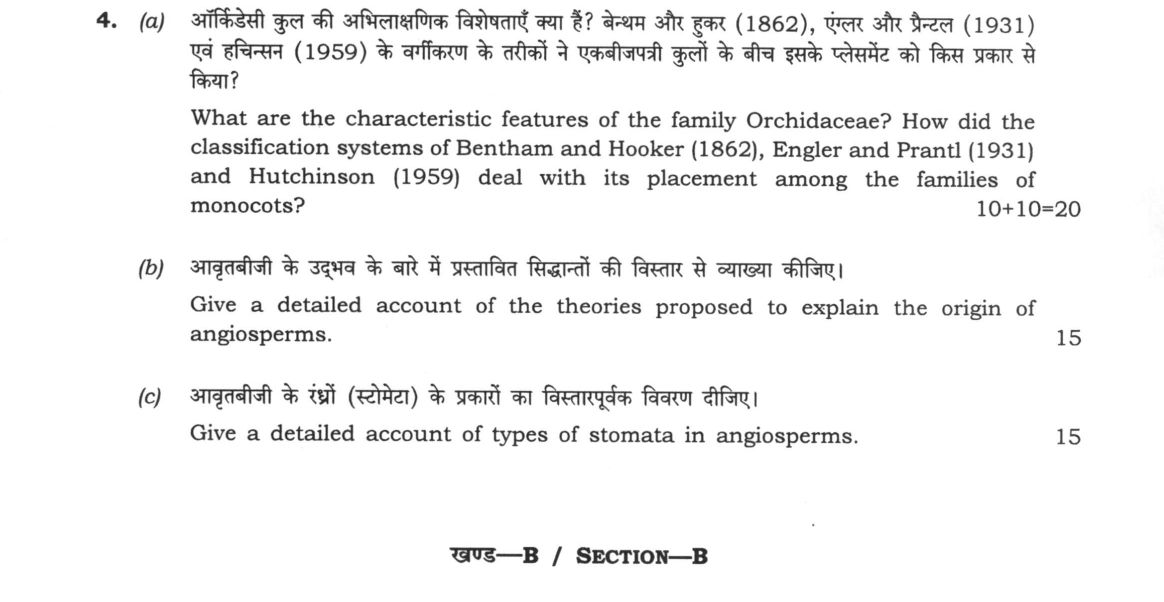
(a) What are the characteristic features of the family Orchidaceae? How did the classification systems of Bentham and Hooker…
What are the characteristic features of the family Orchidaceae? How did the classification systems of Bentham and Hooker (1862), Engler and Prantl (1931) and Hutchinson (1959) deal with its placement among the families of monocots? 10+10=20
Give a detailed account of the theories proposed to explain the origin of angiosperms. 15 marks
Give a detailed account of types of stomata in angiosperms. 15 marks
हिंदी में प्रश्न पढ़ें
आर्किडेसी कुल की अभिलाक्षणिक विशेषताएं क्या हैं? बैंथम और हुकर (1862), एंग्लर और प्रैन्टल (1931) एवं हचिंसन (1959) के वर्गीकरण के तरीकों ने एकबीजपत्री कुलों के बीच इसके प्लेसमेंट को किस प्रकार से किया? 10+10=20
आवृतबीजी के उद्भव के बारे में प्रस्तावित सिद्धांतों की विस्तार से व्याख्या कीजिए। 15
आवृतबीजी के रंध्र (स्टोमेटा) के प्रकारों का विस्तारपूर्वक विवरण दीजिए। 15
Model answer
Written by UPSC Answer Check against this question's marking rubric, to the expected length. UPSC does not publish answers for Mains — this is one way to score well, not an official key.
Orchidaceae: Morphology, Classification, and Angiosperm Origins
Part (a): Orchidaceae Features and Taxonomic Placement
The family Orchidaceae is the most species-rich family of angiosperms, characterized by extreme floral specialization. Its diagnostic features include: (1) Zygomorphic flowers, which are bilaterally symmetrical, facilitating specific pollinator interactions; (2) the Gynostemium (or androgyne), a unique fusion of the stamens and the gynoecium into a single column, ensuring precise pollen deposition; (3) Pollinia, compact masses of pollen grains attached to a viscidium, which are transferred as a unit rather than as loose grains; (4) the Labellum, a modified petal often enlarged and colored to attract pollinators, sometimes bearing nectar spurs; (5) an Inferior Ovary, which is tricarpellary, trilocular, and unilocular due to the abortion of septa; and (6) Minute, dust-like seeds with a thin testa and no endosperm, requiring symbiotic mycorrhizal fungi for germination.
Historically, the placement of Orchidaceae has shifted with taxonomic philosophy. Bentham and Hooker (1862) placed the family in the order Orchidales within the sub-class Microspermae (Monocotyledones), grouping it with other advanced monocots like Scitamineae based on floral complexity. Engler and Prantl (1931) adopted a more phylogenetic approach, placing Orchidaceae in the order Orchidales but emphasizing its derived status within the Monocotyledoneae, often separating it from more primitive families due to its specialized reproductive structures. Hutchinson (1959) classified it in the order Orchidales within the sub-class Calyciferae (or Liliatae), recognizing it as a highly advanced family where the perianth is distinct, contrasting it with families having a calyx-like structure.
Part (b): Theories on the Origin of Angiosperms
The origin of angiosperms remains a subject of debate, with several major theories proposed:
- Glossopterid Theory: Proposed by R. Melville and supported by D.D. Pant, this theory suggests that angiosperms evolved from the Permian-Gondwanan Glossopteridales. The presence of double fertilization in some Glossopterids and their widespread distribution support this view, though the fossil record is incomplete.
- Caytonia Theory: Advanced by W. A. Thomas, this theory posits that angiosperms originated from the Bennettitalean order Caytoniales. Caytonia exhibits features like double fertilization and a reduced perianth, bridging the gap between gymnosperms and angiosperms.
- Bennettitalean Theory: Proposed by A. J. W. Skellon and others, this theory argues that angiosperms evolved from the Bennettitales, a group of gymnosperms with complex flowers and double fertilization. The similarity in floral structure and reproductive biology provides strong evidence for this lineage.
- Herbaceous Origin Theory: Suggested by A. J. W. Skellon and Bessey, this theory proposes that angiosperms originated from herbaceous ancestors, possibly related to the Pteridosperms. This view emphasizes the early dominance of herbaceous forms in the fossil record.
- Pseudanthial Theory: Proposed by A. Wettstein, this theory suggests that angiosperms evolved from pseudanthial gymnosperms, where the flower was a composite structure of multiple sporophylls. This theory highlights the evolutionary transition from separate sporophylls to a unified floral structure.
Part (c): Types of Stomata in Angiosperms
Stomata in angiosperms are classified based on their developmental origin and structural arrangement.
Developmental Types:
- Mesogenous: Guard cells and subsidiary cells originate from the same initial cell.
- Perigenous: Guard cells and subsidiary cells originate from different initial cells.
- Mesoperigenous: A combination of both, where some cells are mesogenous and others perigenous.
Structural Types:
- Anomocytic: No subsidiary cells; guard cells are surrounded by ordinary epidermal cells. Example: Nymphaea.
- Anisocytic: Three subsidiary cells of unequal size. Example: Nerium (Apocynaceae).
- Paracytic (Gramineous): Two subsidiary cells parallel to the guard cells. Example: Oryza (Rice) and Triticum (Wheat). These are characteristic of grasses (Poaceae) and feature dumbbell-shaped guard cells.
- Diacytic: Two subsidiary cells perpendicular to the guard cells. Example: Cicer (Chickpea).
- Actinocytic: More than two subsidiary cells radiating around the guard cells. Example: Mangifera (Mango).
- Tetracytic: Four subsidiary cells, two parallel and two perpendicular. This type is rare in angiosperms.
- Cyclocytic: A ring of subsidiary cells surrounding the guard cells.
Conclusion
The classification of Orchidaceae reflects the evolution of taxonomic systems from morphological to phylogenetic approaches. The theories on angiosperm origin highlight the complex interplay between gymnosperms and angiosperms, with the Bennettitalean and Caytonia theories offering the most robust fossil evidence. Stomatal diversity in angiosperms, from anomocytic to gramineous types, underscores the adaptive radiation of this group, with specific types like paracytic stomata in Oryza and Triticum being crucial for understanding crop physiology and evolutionary history.
What "Describe" is asking you to do
Give a full, ordered account of the thing named — its parts, stages or mechanism — in the sequence in which it actually exists or occurs. Most describe questions come from the science optionals, where the marks sit in correct technical detail and, where the stem says so, a labelled diagram.
Structure that answers it
One-line identification of the subject → the parts or stages in their real order, each with its defining detail → labelled diagram where the subject is structural → closing line on function or significance
Where marks are lost
Loose general prose where the examiner is ticking named parts, correct terminology and their sequence; and in the General Studies papers, turning to evaluation before the description is finished.
How this answer will be evaluated
Approach
(a) describe: define > structure or process in order > labelled diagram > significance | (b) account for: state the phenomenon > the causes in order of weight > conclusion | (c) describe: define > structure or process in order > labelled diagram > significance Full marks: Precise definitions, clear distinction between systems/theories, and accurate terminology.
Key points expected
- Resupinate flower with labellum and pollinia
- Bentham & Hooker: placed in Liliiflorae
- Engler & Prantl: placed in Zygopetalae
- Hutchinson: placed in Orchidales
- Ginkgo theory (origin from Ginkgoales)
- Bennettitales theory (origin from Bennettitales)
- Cycad theory (origin from Cycadales)
- Polyphyletic origin (multiple origins)
Evaluation rubric
Each sub-part is marked on its own, against the marks and word limit printed on the paper.
- (a) List diagnostic features of Orchidaceae and compare its placement in three classification systems. 20 marks
describe— define → structure or process in order → labelled diagram → significance
Must cover
- Resupinate flower with labellum and pollinia
- Bentham & Hooker: placed in Liliiflorae
- Engler & Prantl: placed in Zygopetalae
- Hutchinson: placed in Orchidales
Loses marks
- Confusing Orchidaceae with Liliaceae features
- Failing to distinguish the three systems
- Omitting the specific order names
Earns more
- Mention of fused carpels (syncarpous)
- Reference to specific subfamilies (e.g., Orchidoideae)
- Note on the 'resupination' mechanism
- Mention of the 'staminode' in the flower
Extra mark
- Reference to specific genera like *Dendrobium* or *Vanda*
- Mention of the 'pollen mass' structure
- (b) Detail the theories explaining the origin of angiosperms. 15 marks
account for— state the phenomenon → the causes in order of weight → conclusion
Must cover
- Ginkgo theory (origin from Ginkgoales)
- Bennettitales theory (origin from Bennettitales)
- Cycad theory (origin from Cycadales)
- Polyphyletic origin (multiple origins)
Loses marks
- Treating theories as facts rather than hypotheses
- Omitting the key fossil evidence
- Confusing angiosperm origin with gymnosperm origin
Earns more
- Mention of the 'Ginkgo-Bennettit' link
- Reference to fossil evidence (e.g., *Archaefructus*)
- Discussion of the 'Ginkgo-Bennettit' link
- Mention of the 'Cycad-Bennettit' link
Extra mark
- Reference to molecular phylogenetic data
- Mention of the 'Ginkgo-Bennettit' link
- (c) Describe the types of stomata in angiosperms. 15 marks
describe— define → structure or process in order → labelled diagram → significance
Must cover
- Anomocytic (irregular) type
- Paracytic (cyclocytic) type
- Diacytic (actinocytic) type
- Anisocytic (unequal) type
Loses marks
- Confusing stomatal types with guard cell types
- Omitting the definition of 'subsidiary cells'
- Failing to distinguish between the four main types
Earns more
- Description of subsidiary cell arrangement
- Mention of 'Crassulacean' stomata
- Reference to 'sun' vs 'shade' leaves
- Mention of 'hydrophytic' stomata
Extra mark
- Reference to specific families (e.g., *Ranunculaceae* for anomocytic)
- Mention of 'stomatal index' calculation
Practice this exact question
Write your answer and it is marked point by point against the model answer above — what you covered, what you missed, what you got wrong.
Evaluate my answer →More from Botany 2022 Paper I
- Q1 Answer the following in about 150 words each : 10×5=50 (a) What is mycoplasma? Describe i…
- Q2 (a) What is brown spot disease of rice? Describe its causal organism, symptoms, disease c…
- Q3 (a) What is dikaryotization in fungi? Describe different methods of dikaryotization in ba…
- Q4 (a) What are the characteristic features of the family Orchidaceae? How did the classific…
- Q5 Answer the following in about 150 words each : 10×5=50 (a) Mention the role of embryo res…
- Q6 (a) Write a detailed account of homospory, anisospory, incipient heterospory and heterosp…
- Q7 (a) Write the uses, botanical name, family and morphology of useful parts of the followin…