Paper I — Q5
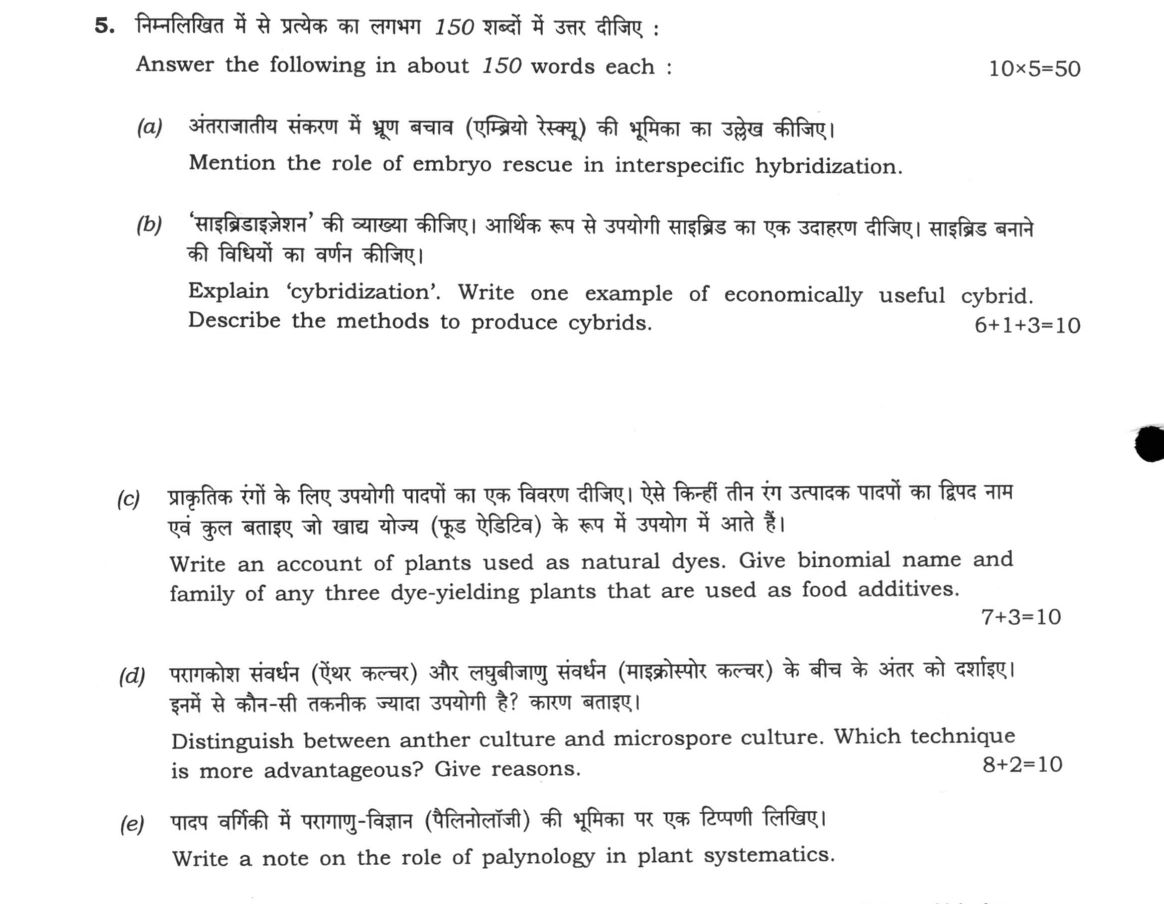
Answer the following in about 150 words each : 10×5=50 (a) Mention the role of embryo rescue in interspecific…
Answer the following in about 150 words each : 10×5=50
Mention the role of embryo rescue in interspecific hybridization.
Explain 'cybridization'. Write one example of economically useful cybrid. Describe the methods to produce cybrids. 6+1+3=10
Write an account of plants used as natural dyes. Give binomial name and family of any three dye-yielding plants that are used as food additives. 7+3=10
Distinguish between anther culture and microspore culture. Which technique is more advantageous? Give reasons. 8+2=10
Write a note on the role of palynology in plant systematics.
हिंदी में प्रश्न पढ़ें
निम्नलिखित में से प्रत्येक का लगभग 150 शब्दों में उत्तर दीजिए : 10×5=50
अंतरजातीय संकरण में भ्रूण बचाव (एम्ब्रियो रेस्क्यू) की भूमिका का उल्लेख कीजिए।
'साइब्रिडाइजेशन' की व्याख्या कीजिए। आर्थिक रूप से उपयोगी साइब्रिड का एक उदाहरण दीजिए। साइब्रिड बनाने की विधियों का वर्णन कीजिए। 6+1+3=10
प्राकृतिक रंगों के लिए उपयोगी पादपों का एक विवरण दीजिए। ऐसे किन्हीं तीन रंग उत्पादक पादपों का द्विपद नाम एवं कुल बताइए जो खाद्य योज्य (फूड एडिटिव) के रूप में उपयोग में आते हैं। 7+3=10
परागकोश संवर्धन (एन्थर कल्चर) और लघुबीजाणु संवर्धन (माइक्रोस्पोर कल्चर) के बीच के अंतर को दर्शाइए। इनमें से कौन-सी तकनीक ज्यादा उपयोगी है? कारण बताइए। 8+2=10
पादप वर्गिकी में परागाणु-विज्ञान (पैलिनोलॉजी) की भूमिका पर एक टिप्पणी लिखिए।
Model answer
Written by UPSC Answer Check against this question's marking rubric, to the 150-word length. UPSC does not publish answers for Mains — this is one way to score well, not an official key.
Role of Embryo Rescue in Interspecific Hybridization
In wide crosses between distantly related species, post-zygotic barriers often lead to embryo abortion due to genetic incompatibility or failure of endosperm development. Embryo rescue overcomes this by excising the immature embryo from the ovule and culturing it on a nutrient-rich medium. This bypasses the maternal tissue's inability to support the hybrid, allowing the embryo to develop into a plant. A classic example is the cross between Lycopersicon esculentum (tomato) and Solanum lycopersicoides, where rescue enabled the production of fertile hybrids that would otherwise abort, facilitating the introgression of desirable traits like disease resistance.
Cybridization: Mechanism, Example, and Methods
Cybridization, or cytoplasmic hybridization, involves the transfer of cytoplasmic components, such as mitochondria or chloroplasts, from one species to another while retaining the nuclear genome of the recipient. This is crucial for introducing cytoplasmic male sterility (CMS), a trait essential for hybrid seed production. An economically useful example is the Nicotiana tabacum cybrid carrying CMS from Nicotiana glauca, which allows for the efficient production of hybrid tobacco seeds without manual emasculation.
The primary methods to produce cybrids are protoplast fusion, electrofusion, and microinjection. In protoplast fusion, cells are treated with enzymes to remove cell walls, and the resulting protoplasts are fused using polyethylene glycol (PEG) or electric pulses. Iodoacetate is often used as a metabolic inhibitor to block protoplast division and proliferation during the fusion process, ensuring that only fused cells survive. Microinjection involves directly injecting donor cytoplasts or organelles into an intact recipient cell that retains its nucleus, allowing for the incorporation of cytoplasmic traits without nuclear exchange.
Plants Used as Natural Dyes
Plants have been used for centuries to produce natural dyes for textiles, cosmetics, and food. These dyes are derived from pigments such as anthocyanins, carotenoids, and flavonoids. Three dye-yielding plants used as food additives are:
- Turmeric (Curcuma longa, Family: Zingiberaceae): The rhizomes yield curcumin, a yellow pigment used to color rice, butter, and cheeses.
- Saffron (Crocus sativus, Family: Iridaceae): The stigmas provide crocin, a red-orange dye used in rice dishes and confectionery.
- Indigo (Indigofera tinctoria, Family: Fabaceae): While primarily used for textiles, indigo extracts are sometimes used in food coloring for specific traditional preparations, though its use is less common than turmeric and saffron in modern food additives.
Anther Culture vs. Microspore Culture
Anther culture involves the in vitro cultivation of whole anthers to induce androgenesis, where microspores develop into haploid plants. However, this method often results in contamination by diploid somatic cells from the anther wall, leading to a mixture of haploid and diploid regenerants. In contrast, microspore culture involves the isolation of individual microspores from the anther and their direct culture on a medium. This technique is more advantageous because it ensures a pure haploid origin, eliminating diploid contamination. It allows for direct embryogenesis from the microspore, resulting in a population of independently derived haploid lines. Upon chromosome doubling, these lines become homozygous doubled haploids, which are genetically stable and uniform within each line, accelerating breeding programs for crop improvement.
Role of Palynology in Plant Systematics
Palynology, the study of pollen and spores, plays a significant role in plant systematics due to the chemical stability of sporopollenin, the outer wall layer of pollen grains. This stability allows for the preservation of pollen morphology over geological time, making it valuable for phylogenetic reconstruction and fossil calibration. Exine ornamentation patterns, such as reticulate, echinate, or smooth surfaces, serve as taxonomic markers that help distinguish between genera and species. While aperture types like tricolpate or monosulcate provide supportive evidence for grouping angiosperms, they are variable and not absolute separators. Palynological characters are thus used alongside molecular data to refine evolutionary relationships and understand the biogeographical history of plant groups.
What "Explain" is asking you to do
Make the working of something clear — what sets it off, what follows from what, and what it produces. Explain is the Commission's mechanism word: it dominates the technical papers and the “explain why” stems, where the marks sit in the causal chain and not in the label.
Structure that answers it
State what it is → the initiating condition → the chain of cause, step by step → an instance where it plays out → what the chain produces
Where marks are lost
Describing what something looks like instead of why it works that way. Naming the stages without linking them reads as description too.
How this answer will be evaluated
Approach
Framework: Botany Paper 1: Define > Structure/Process > Labelled Diagram > Significance. (a) explain: definition/context > points in order > small example > short close | (b) explain: definition/context > points in order > small example > short close | (c) discuss: intro > 3-4 dimensions > example > balanced close | (d) discuss: intro > 3-4 dimensions > example > balanced close | (e) discuss: intro > 3-4 dimensions > example > balanced close Full marks: Precise definitions, correct binomials, clear distinctions, and specific examples throughout.
Key points expected
- Embryo rescue overcomes embryonic abortion
- Cybridization involves cytoplasmic transfer
- Natural dyes include *Curcuma longa* and *Bixa orellana*
- Microspore culture is often more advantageous than anther culture
- Palynology uses pollen morphology for classification
Evaluation rubric
Each sub-part is marked on its own, against the marks and word limit printed on the paper.
- (a) Explain how embryo rescue overcomes embryonic abortion in interspecific crosses. · 150 words
explain— definition/context → points in order → small example → short close
Must cover
- Define embryo rescue (in vitro culture)
- Explain rescue of aborted embryos
- Link to overcoming reproductive barriers
- Mention somaclonal variation or hybrid vigor
Loses marks
- Confusing with somatic hybridization
- No mention of embryonic abortion
Earns more
- Specific example (e.g., *Nicotiana* or *Brassica*)
- Mention of auxin (2,4-D) in medium
- Distinction from somatic hybridization
Extra mark
- Diagram of embryo excision and culture
- Mention of specific cultivar
- (b) Define cybridization, give one economic example, and describe production methods. 10 marks · 150 words
explain— definition/context → points in order → small example → short close
Must cover
- Define cybrid (cytoplasmic hybrid)
- Name one economically useful cybrid
- Describe protoplast fusion method
- Describe cytoplasmic transfer method
Loses marks
- Confusing with nuclear hybridization
- No specific example of cybrid
Earns more
- Mention of *Nicotiana* or *Brassica* cybrids
- Explanation of uniparental cytoplasmic inheritance
- Mention of PEG or electrofusion
Extra mark
- Diagram of protoplast fusion
- Mention of specific cybrid cultivar
- (c) Account of natural dye plants; binomial and family of three food additive dyes. 10 marks · 150 words
discuss— intro → 3-4 dimensions → example → balanced close
Must cover
- General account of natural dye plants
- Binomial name of three dye plants
- Family name of three dye plants
- Identification as food additives
Loses marks
- Missing binomial or family names
- Listing non-food dye plants
Earns more
- Mention of *Curcuma longa* (Zingiberaceae)
- Mention of *Bixa orellana* (Bixaceae)
- Mention of *Rubia cordifolia* (Rubiaceae)
Extra mark
- Mention of specific dye molecule (e.g., curcumin)
- Mention of extraction method
- (d) Distinguish anther vs microspore culture; state which is more advantageous and why. 10 marks · 150 words
discuss— intro → 3-4 dimensions → example → balanced close
Must cover
- Define anther culture
- Define microspore culture
- State which is more advantageous
- Give reasons for advantage
Loses marks
- No clear distinction between the two
- No justification for advantage
Earns more
- Mention of haploid plant production
- Mention of double haploids
- Comparison of contamination rates
Extra mark
- Diagram of anther vs microspore
- Mention of specific species
- (e) Note on the role of palynology in plant systematics. · 150 words
discuss— intro → 3-4 dimensions → example → balanced close
Must cover
- Define palynology
- Explain use in taxonomic classification
- Mention pollen grain characters
- Link to phylogenetic studies
Loses marks
- No link to systematics
- Confusing with phytogeography
Earns more
- Mention of pollen morphology
- Mention of stratigraphic correlation
- Mention of *Asteraceae* or *Poaceae* examples
Extra mark
- Diagram of pollen grain
- Mention of specific palynological character
Practice this exact question
Write your answer and it is marked point by point against the model answer above — what you covered, what you missed, what you got wrong.
Evaluate my answer →More from Botany 2022 Paper I
- Q2 (a) What is brown spot disease of rice? Describe its causal organism, symptoms, disease c…
- Q3 (a) What is dikaryotization in fungi? Describe different methods of dikaryotization in ba…
- Q4 (a) What are the characteristic features of the family Orchidaceae? How did the classific…
- Q5 Answer the following in about 150 words each : 10×5=50 (a) Mention the role of embryo res…
- Q6 (a) Write a detailed account of homospory, anisospory, incipient heterospory and heterosp…
- Q7 (a) Write the uses, botanical name, family and morphology of useful parts of the followin…
- Q8 (a) Describe the protocol involved in rooting and acclimatization of plants produced usin…