Paper I — Q7
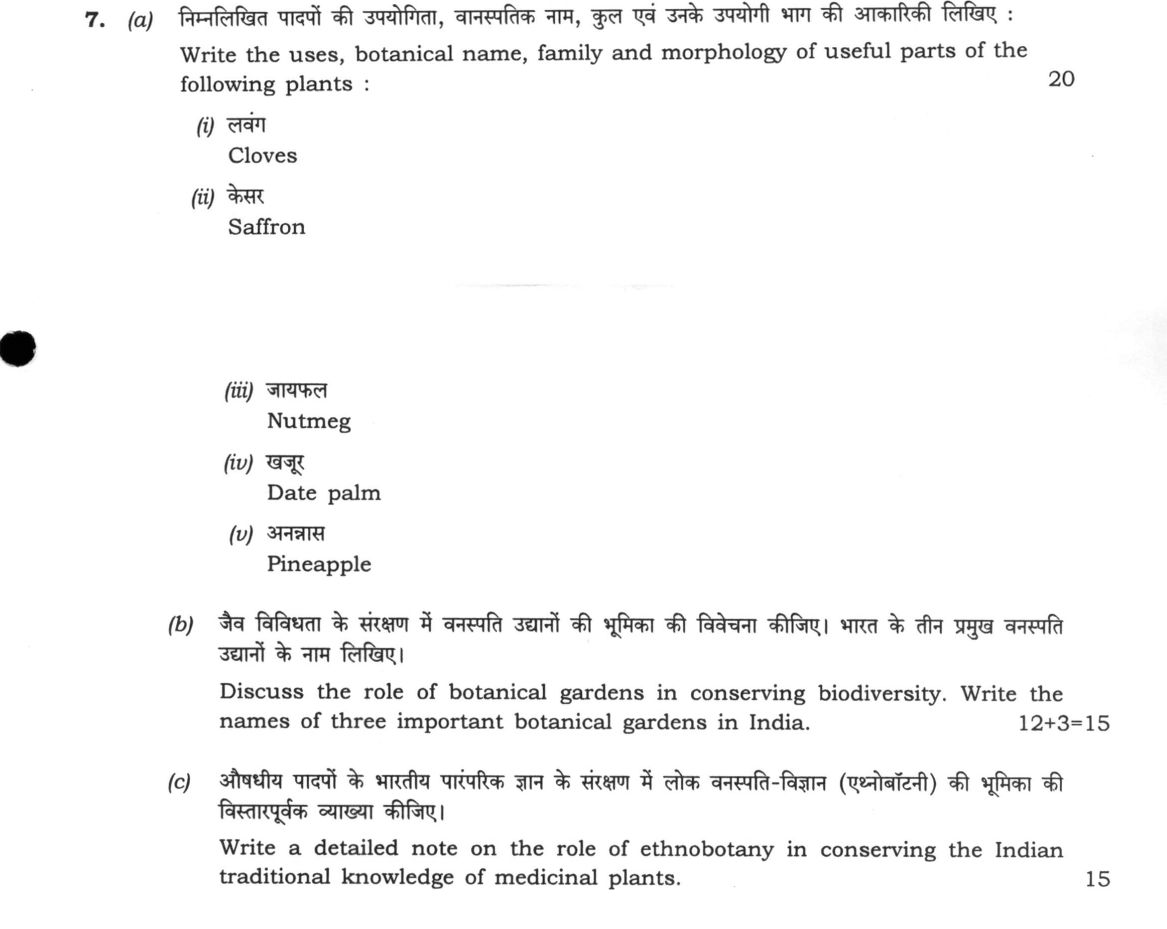
(a) Write the uses, botanical name, family and morphology of useful parts of the following plants : 20 (i) Cloves (ii)…
Write the uses, botanical name, family and morphology of useful parts of the following plants : 20 marks
Cloves
Saffron
Nutmeg
Date palm
Pineapple
Discuss the role of botanical gardens in conserving biodiversity. Write the names of three important botanical gardens in India. 12+3=15
Write a detailed note on the role of ethnobotany in conserving the Indian traditional knowledge of medicinal plants. 15 marks
हिंदी में प्रश्न पढ़ें
निम्नलिखित पादपों की उपयोगिता, वानस्पतिक नाम, कुल एवं उनके उपयोगी भाग की आकृति लिखिए : 20 marks
लवंग
केसर
जायफल
खजूर
अनानास
जैव विविधता के संरक्षण में वनस्पति उद्यानों की भूमिका की विवेचना कीजिए। भारत के तीन प्रमुख वनस्पति उद्यानों के नाम लिखिए। 12+3=15
औषधीय पादपों के भारतीय पारंपरिक ज्ञान के संरक्षण में लोक वनस्पति-विज्ञान (एथ्नोबॉटनी) की भूमिका की विस्तारपूर्वक व्याख्या कीजिए। 15
Model answer
Written by UPSC Answer Check against this question's marking rubric, to the expected length. UPSC does not publish answers for Mains — this is one way to score well, not an official key.
Economic botany bridges the gap between plant resource utilization and biodiversity conservation, a nexus critical for sustainable development. The following analysis addresses the morphological and economic significance of key plants, the role of botanical gardens, and the imperative of ethnobotany in preserving traditional knowledge.
Uses, Botanical Names, Families, and Morphology
(i) Cloves
- Botanical Name: Syzygium aromaticum
- Family: Myrtaceae
- Useful Part: Flower buds
- Morphology: The buds are small, dark brown, and have a characteristic nail-like shape with a long stalk (pedicel) and a bulbous head containing four sepals and unopened petals.
- Uses: Primarily used as a spice in the food industry for flavoring and preservation; also utilized in traditional medicine for analgesic and antimicrobial properties.
(ii) Saffron
- Botanical Name: Crocus sativus
- Family: Iridaceae
- Useful Part: Stigmas
- Morphology: The plant produces three long, thread-like, deep red-orange stigmas from the center of the purple flower. These are harvested manually and dried.
- Uses: High-value spice for coloring and flavoring food; used in perfumery and traditional medicine for its antidepressant and anti-inflammatory effects.
(iii) Nutmeg
- Botanical Name: Myristica fragrans
- Family: Myristicaceae
- Useful Part: Aril and Seed
- Morphology: The fruit is a drupe. The inner seed (nutmeg) is hard, brown, and has a wrinkled surface. It is surrounded by a bright red, lacy, fleshy aril (mace).
- Uses: Both the seed (nutmeg) and the aril (mace) are used as spices. Nutmeg is also used in traditional medicine for digestive issues.
(iv) Date Palm
- Botanical Name: Phoenix dactylifera
- Family: Arecaceae
- Useful Part: Fruit
- Morphology: The fruit is a berry with a fleshy mesocarp (pulp) and a thin, membranous endocarp. The hard, grooved structure inside is the seed, which contains ruminate endosperm.
- Uses: The fruit is consumed fresh or dried as a staple food source in arid regions; also used for date syrup and in traditional medicine.
(v) Pineapple
- Botanical Name: Ananas comosus
- Family: Bromeliaceae
- Useful Part: Fruit
- Morphology: The edible part is a syncarp (multiple fruit) formed from the fusion of many individual flowers. It has a tough, segmented rind and a central core.
- Uses: Consumed as fresh fruit, juice, or in processed forms; the leaves are used for fiber extraction (abacá) and in traditional medicine.
Role of Botanical Gardens in Conserving Biodiversity
Botanical gardens play a pivotal role in ex-situ conservation by maintaining living collections of plant species, serving as germplasm banks for genetic diversity. They facilitate research on plant physiology, ecology, and breeding, which supports in-situ conservation efforts through reintroduction programs and habitat restoration. Furthermore, they act as centers for education and public awareness, fostering a culture of environmental stewardship. Three important botanical gardens in India are the Indian Botanical Garden (Howrah), Lloyd Botanical Garden (Darjeeling), and the National Botanical Garden (Lucknow/Pune).
Role of Ethnobotany in Conserving Traditional Knowledge
Ethnobotany is the interdisciplinary study of the relationship between people and plants. Its role in conserving Indian traditional knowledge of medicinal plants is multifaceted. First, it involves the systematic documentation of indigenous knowledge, which is crucial for the Traditional Knowledge Digital Library (TKDL) to prevent biopiracy and patenting of traditional remedies by foreign entities. Second, ethnobotany facilitates bioprospecting and benefit-sharing under the Convention on Biological Diversity (CBD) and the Nagoya Protocol, ensuring that local communities receive fair compensation for their knowledge. Third, it supports community-based conservation models, where local knowledge guides the sustainable harvesting and cultivation of medicinal plants. Integration with modern pharmacology validates traditional uses, leading to the development of new drugs while preserving the cultural context. Specific examples include the documentation of tribal knowledge in the Western Ghats, Northeast India, and Himalayan regions, where unique plant species and their uses are recorded.
Conclusion
In conclusion, the conservation of biodiversity is inextricably linked to the sustainable utilization of plant resources and the preservation of traditional knowledge. Botanical gardens provide the scientific infrastructure for ex-situ conservation, while ethnobotany ensures that the cultural and ecological values of medicinal plants are recognized and protected. A holistic approach, integrating economic botany, institutional conservation, and indigenous knowledge, is essential for the long-term preservation of India’s rich botanical heritage.
What "Discuss" is asking you to do
Lay the issue out from more than one side — how it arose, what is claimed for it, what is held against it, and where it now stands. UPSC attaches discuss to broad topics with several live dimensions, so coverage of the dimensions earns more than the strength of your opinion.
Structure that answers it
Set the issue up → the case as it is made → the case against → the dimension both sides leave out → where the balance now lies
Where marks are lost
Listing facts with no thread between them, or arguing one side throughout and calling it a discussion.
How this answer will be evaluated
Approach
(a) explain: definition/context > points in order > small example > short close | (b) discuss: intro > 3-4 dimensions > example > balanced close | (c) explain: definition/context > points in order > small example > short close Full marks: Precise binomials, clear morphology, specific Indian examples, and strong conservation links
Key points expected
- Syzygium aromaticum (Cloves)
- Crocus sativus (Saffron)
- Myristica fragrans (Nutmeg)
- Phoenix dactylifera (Date palm)
- Ananas comosus (Pineapple)
- Ex-situ conservation
- Seed banking
- Indian Botanical Garden, Kolkata
- Banaras Hindu University Botanical Garden
- Documentation of indigenous knowledge
- Biopiracy prevention
Evaluation rubric
Each sub-part is marked on its own, against the marks and word limit printed on the paper.
- (a) Tabulate uses, binomial, family, and morphology for 5 specified plants 20 marks
explain— definition/context → points in order → small example → short close
Must cover
- Correct binomial and family for all 5 plants
- Morphology of specific useful part (e.g., bud, stigma)
- Specific uses (culinary, medicinal, industrial)
- Clear distinction between parts (e.g., aril vs seed)
Loses marks
- Unlabelled or missing diagrams
- Loose common names instead of binomials
- Confusing morphology of different plant parts
Earns more
- Mention of specific chemical constituents (e.g., eugenol)
- Geographical origin of the plant
- Conservation status of the species
- Comparison of morphology with similar parts
Extra mark
- Small labelled diagram of the useful part
- Mention of a specific cultivar or variety
- (b) Analyze botanical gardens' role in conservation and name 3 Indian gardens 15 marks
discuss— intro → 3-4 dimensions → example → balanced close
Must cover
- Ex-situ conservation role (living collections)
- Seed banking and germplasm preservation
- Research and education functions
- Names of three specific Indian botanical gardens
Loses marks
- Listing gardens without discussing their role
- Ignoring the 'conservation' aspect for general description
- Vague references to 'some gardens' instead of names
Earns more
- Mention of specific Indian gardens (e.g., IBG, BHU)
- Role in reintroduction programs
- Documentation of local flora
- Public awareness and policy influence
Extra mark
- Reference to a specific conservation success story
- Mention of a specific international agreement (e.g., CBD)
- (c) Detail how ethnobotany conserves traditional knowledge of medicinal plants 15 marks
explain— definition/context → points in order → small example → short close
Must cover
- Documentation of indigenous knowledge systems
- Identification of medicinal plants by local communities
- Prevention of biopiracy through prior knowledge
- Integration of traditional knowledge with modern science
Loses marks
- General discussion of ethnobotany without focus on conservation
- Ignoring the 'Indian' context specified in the question
- Focusing only on medicinal uses without knowledge conservation
Earns more
- Examples of specific medicinal plants and their uses
- Role of tribal communities in knowledge preservation
- Legal frameworks for protecting traditional knowledge
- Challenges in documenting oral traditions
Extra mark
- Mention of a specific ethnobotanical survey or project
- Reference to a specific legal act (e.g., PGRH Act)
Practice this exact question
Write your answer and it is marked point by point against the model answer above — what you covered, what you missed, what you got wrong.
Evaluate my answer →More from Botany 2022 Paper I
- Q4 (a) What are the characteristic features of the family Orchidaceae? How did the classific…
- Q5 Answer the following in about 150 words each : 10×5=50 (a) Mention the role of embryo res…
- Q6 (a) Write a detailed account of homospory, anisospory, incipient heterospory and heterosp…
- Q7 (a) Write the uses, botanical name, family and morphology of useful parts of the followin…
- Q8 (a) Describe the protocol involved in rooting and acclimatization of plants produced usin…