Paper I — Q1
Answer the following questions in about 150 words each: (a) What are prions? How do they differ from viruses? Mention few…
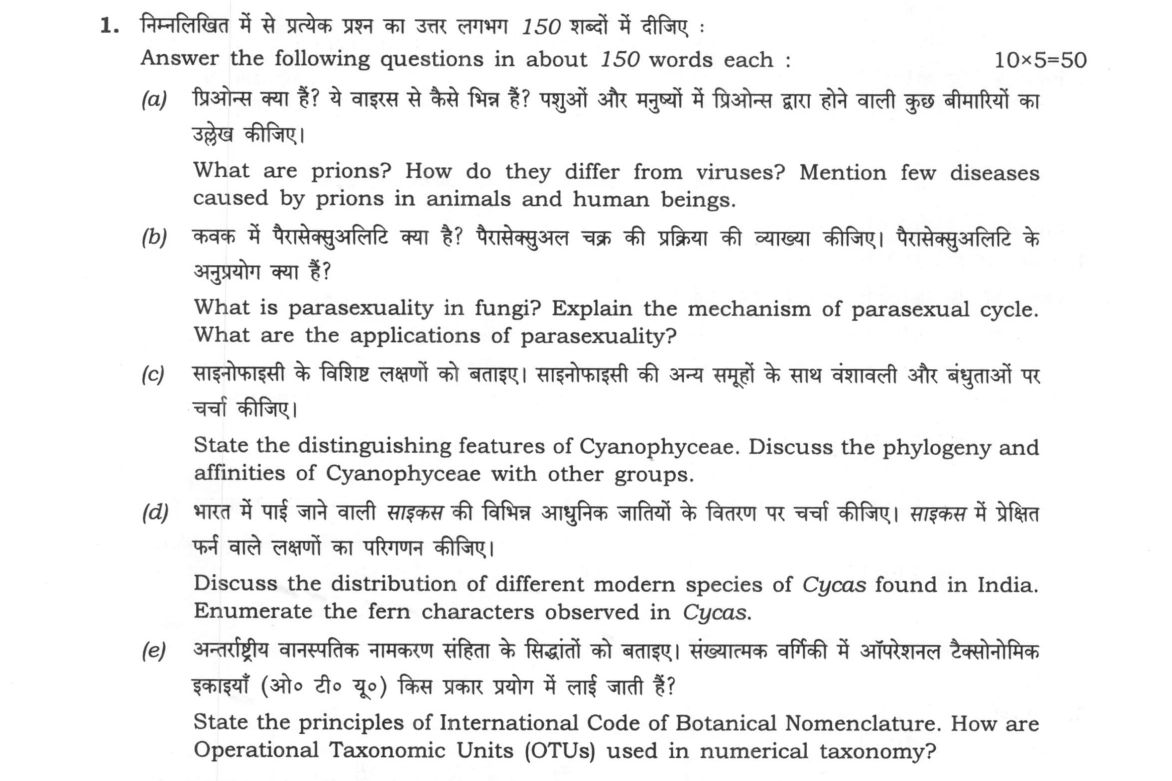
Answer the following questions in about 150 words each:
What are prions? How do they differ from viruses? Mention few diseases caused by prions in animals and human beings. 10 marks
What is parasexuality in fungi? Explain the mechanism of parasexual cycle. What are the applications of parasexuality? 10 marks
State the distinguishing features of Cyanophyceae. Discuss the phylogeny and affinities of Cyanophyceae with other groups. 10 marks
Discuss the distribution of different modern species of Cycas found in India. Enumerate the fern characters observed in Cycas. 10 marks
State the principles of International Code of Botanical Nomenclature. How are Operational Taxonomic Units (OTUs) used in numerical taxonomy? 10 marks
हिंदी में प्रश्न पढ़ें
निम्नलिखित में से प्रत्येक प्रश्न का उत्तर लगभग 150 शब्दों में दीजिए :
प्रियोन्स क्या हैं? ये वाइरस से कैसे भिन्न हैं? पशुओं और मनुष्यों में प्रियोन्स द्वारा होने वाली कुछ बीमारियों का उल्लेख कीजिए। (10 अंक)
कवक में पैरासेक्सुअलिटी क्या है? पैरासेक्सुअल चक्र की प्रक्रिया की व्याख्या कीजिए। पैरासेक्सुअलिटी के अनुप्रयोग क्या हैं? (10 अंक)
साइनोफाइसी के विशिष्ट लक्षणों को बताइए। साइनोफाइसी की अन्य समूहों के साथ वंशावली और बंधुताओं पर चर्चा कीजिए। (10 अंक)
भारत में पाई जाने वाली साइकस की विभिन्न आधुनिक जातियों के वितरण पर चर्चा कीजिए। साइकस में प्रेक्षित फर्न वाले लक्षणों का परिगणन कीजिए। (10 अंक)
अंतर्राष्ट्रीय वानस्पतिक नामकरण संहिता के सिद्धांतों को बताइए। संख्यात्मक वर्गिकी में ऑपरेशनल टैक्सोनोमिक इकाइयाँ (ओ. टी. यू.) किस प्रकार प्रयोग में लाई जाती हैं? (10 अंक)
Model answer
Written by UPSC Answer Check against this question's marking rubric, to the 150-word length. UPSC does not publish answers for Mains — this is one way to score well, not an official key.
Prions and Viral Distinctions Prions are proteinaceous infectious particles composed solely of misfolded PrP^Sc proteins, lacking any nucleic acid. They differ fundamentally from viruses, which are obligate intracellular parasites containing DNA or RNA enclosed in a protein capsid. While viruses replicate by hijacking host machinery to synthesize new genetic material and proteins, prions propagate by inducing the conformational change of normal cellular PrP^C proteins into the pathogenic PrP^Sc form, leading to accumulation and neurodegeneration. This template-directed conversion allows prions to persist in the environment and resist standard sterilization. In animals, prions cause Scrapie in sheep, BSE (mad cow disease) in cattle, and Transmissible Spongiform Encephalopathy in deer. In humans, they cause Creutzfeldt-Jakob Disease (CJD), Kuru, and Fatal Familial Insomnia. Unlike viral infections, prion diseases invariably progress to fatal spongiform encephalopathy without an immune response, as the immune system does not recognize the misfolded host protein as foreign.
Parasexuality in Fungi Parasexuality is a mechanism of genetic recombination in fungi that occurs without meiosis or the formation of specialized sexual structures. It is significant in both imperfect fungi (Deuteromycetes) and perfect fungi (Ascomycetes/Basidiomycetes) that lack active sexual cycles under laboratory conditions. The mechanism involves four stages: first, heterokaryosis, where hyphae of different genotypes fuse to form a heterokaryon; second, nuclear fusion (karyogamy), creating diploid nuclei; third, mitotic crossing over, which generates genetic recombination in the diploid state; and finally, haploidization, where the diploid nucleus returns to a haploid state through mitotic segregation or aneuploidy. This process allows for the exchange of genetic material and the creation of new genotypes. Applications include industrial strain improvement, such as enhancing penicillin yield in Penicillium chrysogenum and improving enzyme production in Aspergillus niger. It is also used in genetic mapping and the study of gene function in fungi where sexual reproduction is difficult to induce.
Cyanophyceae: Features and Phylogeny Cyanophyceae, or blue-green algae, are prokaryotic organisms distinguished by the absence of a true nucleus and membrane-bound organelles. Their cell walls contain peptidoglycan, and photosynthesis occurs in thylakoids, not chloroplasts. They possess chlorophyll a and phycobilins (phycocyanin and phycoerythrin) as accessory pigments. Many filamentous forms, such as Nostoc and Anabaena, exhibit heterocysts, specialized cells for nitrogen fixation, and akinetes for survival. Phylogenetically, Cyanophyceae are not true algae but are classified within the Bacteria domain (Cyanobacteria). They are considered the most primitive photosynthetic organisms, having evolved before eukaryotes. Their affinity with other groups is best understood through endosymbiotic theory: primary chloroplasts in eukaryotic algae and plants originated from engulfed cyanobacteria. Thus, they represent a bridge between prokaryotic bacteria and eukaryotic algae, playing a pivotal role in the oxygenation of Earth's early atmosphere.
Cycas in India and Fern Characters Cycas species are widely distributed across India, with significant diversity in the Western Ghats, Northeast, and Andaman Islands. Notable species include Cycas circinalis (Western Ghats), C. beddomei (Andhra Pradesh), C. pectinata (Northeast), C. rumphii (Andaman), C. nathorstii (Kerala), and C. sphaerica (Sri Lanka/India border). Although Cycas is a gymnosperm, it retains several fern-like characters. These include circinate vernation, where young fronds unroll from a coiled tip. The leaves are large, pinnately compound, with pinnae attached to a central rachis, resembling fern fronds. The leaf traces (vascular bundles) enter the leaf base in a pattern similar to ferns. Additionally, the megasporophylls are not clearly differentiated from foliage leaves in some aspects, and the pollen grains are large and saccate, though the presence of a male cone distinguishes it from true ferns. These characters suggest an evolutionary link between ferns and seed plants.
ICBN Principles and Numerical Taxonomy The International Code of Botanical Nomenclature (ICBN) governs the naming of plants. Key principles include: 1) Priority, where the earliest validly published name is accepted; 2) Typification, where each name is linked to a type specimen; 3) Each taxon can bear only one correct name at a given rank; 4) Scientific names are treated as Latin, regardless of their origin; 5) The name of a taxon is based on a type; and 6) The name of a taxon is independent of its rank. Operational Taxonomic Units (OTUs) are fundamental in numerical taxonomy, a phenetic approach that classifies organisms based on overall similarity rather than evolutionary history. In this method, characters are quantified and scored. OTUs are compared using similarity coefficients, and clusters are formed based on statistical algorithms (e.g., UPGMA). This computer-assisted analysis allows for objective, reproducible classification, minimizing subjective bias. OTUs serve as the basic units for data input, enabling the construction of dendrograms that reflect phenetic relationships. This approach is particularly useful for large datasets and groups with complex morphologies, providing a standardized framework for taxonomic revision.
What "Explain" is asking you to do
Make the working of something clear — what sets it off, what follows from what, and what it produces. Explain is the Commission's mechanism word: it dominates the technical papers and the “explain why” stems, where the marks sit in the causal chain and not in the label.
Structure that answers it
State what it is → the initiating condition → the chain of cause, step by step → an instance where it plays out → what the chain produces
Where marks are lost
Describing what something looks like instead of why it works that way. Naming the stages without linking them reads as description too.
How this answer will be evaluated
Approach
Framework: UPSC Botany Paper 1. (a) define: precise definition > the distinguishing feature > one example | (b) explain: definition/context > points in order > small example > short close | (c) describe: define > structure or process in order > labelled diagram > significance | (d) discuss: intro > 3-4 dimensions > example > balanced close | (e) enumerate: list the items in order > one line each > no commentary Full marks: Precise definitions, correct terminology, and specific examples for all parts.
Key points expected
- Prions defined as proteinaceous infectious particles
- Difference: Prions lack nucleic acid (DNA/RNA)
- Animal disease: BSE (Mad Cow) or Scrapie
- Human disease: CJD or Kuru
- Definition: Genetic recombination without meiosis
- Step 1: Plasmogamy (hybrid formation)
- Step 2: Karyogamy (heterokaryon)
- Step 3: Mitotic crossing over and aneuploidy
Evaluation rubric
Each sub-part is marked on its own, against the marks and word limit printed on the paper.
- (a) Definition of prions, comparison with viruses, and list of diseases. · 150 words
define— precise definition → the distinguishing feature → one example
Must cover
- Prions defined as proteinaceous infectious particles
- Difference: Prions lack nucleic acid (DNA/RNA)
- Animal disease: BSE (Mad Cow) or Scrapie
- Human disease: CJD or Kuru
Loses marks
- Confusing prions with viroids
- Failing to mention lack of genetic material
Earns more
- Mention of PrP^C to PrP^Sc conversion
- Resistance to protease digestion
Extra mark
- Mention of Creutzfeldt-Jakob disease specifically
- (b) Definition of parasexuality, stepwise mechanism, and applications. · 150 words
explain— definition/context → points in order → small example → short close
Must cover
- Definition: Genetic recombination without meiosis
- Step 1: Plasmogamy (hybrid formation)
- Step 2: Karyogamy (heterokaryon)
- Step 3: Mitotic crossing over and aneuploidy
Loses marks
- Confusing with sexual cycle (meiosis)
- Missing the aneuploidy step
Earns more
- Mention of *Aspergillus nidulans* as model
- Application in industrial strain improvement
Extra mark
- Mention of *Neurospora crassa*
- (c) Distinguishing features of Cyanophyceae and their phylogenetic affinities. · 150 words
describe— define → structure or process in order → labelled diagram → significance
Must cover
- Feature: Prokaryotic nature (no true nucleus)
- Feature: Photosynthetic pigments (Chlorophyll a, Phycobilins)
- Affinity: Closest to bacteria (Eubacteria)
- Affinity: Distinct from eukaryotic algae
Loses marks
- Classifying them as eukaryotes
- Confusing with Chlorophyceae
Earns more
- Mention of heterocysts or akinetes
- Mention of oxygenic photosynthesis
Extra mark
- Mention of *Nostoc* or *Anabaena* as examples
- (d) Distribution of *Cycas* in India and fern-like characters. · 150 words
discuss— intro → 3-4 dimensions → example → balanced close
Must cover
- Distribution: Western Ghats and Northeast India
- Fern character: Compound leaves (pinnate)
- Fern character: Microsporophylls (staminate cone)
- Fern character: Megasporophylls (ovulate cone)
Loses marks
- Confusing with *Cycas* distribution in Australia
- Missing the cone structure
Earns more
- Mention of *Cycas revoluta* or *C. pumila*
- Mention of archegonia (fern-like)
Extra mark
- Mention of specific species like *C. beddomei*
- (e) Principles of ICBN and use of OTUs in numerical taxonomy. · 150 words
enumerate— list the items in order → one line each → no commentary
Must cover
- Principle: Priority (earliest valid name)
- Principle: Binomial nomenclature
- OTU: Operational Taxonomic Unit definition
- OTU: Used for phenetic clustering
Loses marks
- Confusing ICBN with ICZN (animals)
- Failing to link OTUs to phenetics
Earns more
- Mention of *International Code of Botanical Nomenclature*
- Mention of phenograms or dendrograms
Extra mark
- Mention of Sneath and Sokal
Practice this exact question
Write your answer and it is marked point by point against the model answer above — what you covered, what you missed, what you got wrong.
Evaluate my answer →More from Botany 2023 Paper I
- Q1 Answer the following questions in about 150 words each: (a) What are prions? How do they…
- Q2 (a) What is lichen? With suitable diagrams, describe its types and structure. Write a not…
- Q3 (a) Define microbial biopesticides. What are their types? With suitable examples, evaluat…
- Q4 (a) Diagrammatically present the Geological Time Scale up to 'Epoch'. Write a note on the…