Paper I — Q3
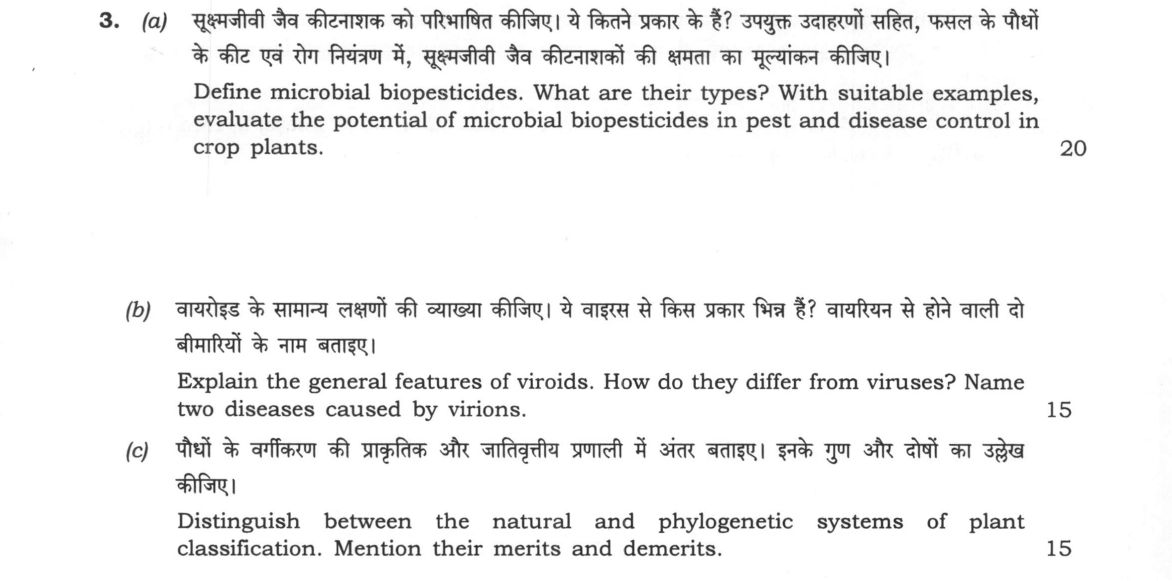
(a) Define microbial biopesticides. What are their types? With suitable examples, evaluate the potential of microbial…
Define microbial biopesticides. What are their types? With suitable examples, evaluate the potential of microbial biopesticides in pest and disease control in crop plants. 20 marks
Explain the general features of viroids. How do they differ from viruses? Name two diseases caused by virions. 15 marks
Distinguish between the natural and phylogenetic systems of plant classification. Mention their merits and demerits. 15 marks
हिंदी में प्रश्न पढ़ें
सूक्ष्मजीवी जैव कीटनाशक को परिभाषित कीजिए। ये कितने प्रकार के हैं? उपयुक्त उदाहरणों सहित, फसल के पौधों के कीट एवं रोग नियंत्रण में, सूक्ष्मजीवी जैव कीटनाशकों की क्षमता का मूल्यांकन कीजिए। (20 अंक)
वायरोइड के सामान्य लक्षणों की व्याख्या कीजिए। ये वाइरस से किस प्रकार भिन्न हैं? वायरियन से होने वाली दो बीमारियों के नाम बताइए। (15 अंक)
पौधों के वर्गीकरण की प्राकृतिक और जातिवृत्तीय प्रणाली में अंतर बताइए। इनके गुण और दोषों का उल्लेख कीजिए। (15 अंक)
Model answer
Written by UPSC Answer Check against this question's marking rubric, to the expected length. UPSC does not publish answers for Mains — this is one way to score well, not an official key.
Microbial Biopesticides: Types and Potential in Crop Protection
Microbial biopesticides are biological control agents derived from naturally occurring microorganisms—such as bacteria, fungi, viruses, and entomopathogenic nematodes—used to suppress pest populations, weed growth, and plant pathogens.
Types and Examples: Bacterial biopesticides include Bacillus thuringiensis var. kurstaki (producing Cry delta-endotoxins against lepidopteran pests like Helicoverpa armigera) and Bacillus sphaericus for dipteran larvae. Fungal biopesticides (entomopathogenic and antagonistic) include Beauveria bassiana and Metarhizium anisopliae targeting sap-sucking pests, alongside Trichoderma viride and T. harzianum, which suppress soil-borne fungal pathogens (Rhizoctonia, Fusarium). Viral biopesticides comprise Baculoviruses such as Helicoverpa armigera Nucleopolyhedrovirus (HaNPV) and Granuloviruses (GV) targeting borers. Entomopathogenic nematodes (EPNs) like Steinernema carpocapsae and Heterorhabditis spp. carry symbiotic bacteria to kill subterranean insect larvae.
Evaluation of Potential: Microbial biopesticides offer high host specificity, preserving beneficial pollinators, parasitoids, and predators. They leave zero toxic residues, decay rapidly without environmental persistence, and exhibit multi-site modes of action that delay pest resistance. In Indian agriculture, integrated pest management (IPM) strategies extensively deploy HaNPV against cotton bollworms and Trichoderma seed treatments against groundnut collar rot and rice sheath blight. However, their potential is constrained by slower knockdown action compared to synthetic chemicals, narrow environmental tolerance (susceptibility to solar UV and desiccation), limited shelf-life, and high formulation costs.
Viroids: Features, Viral Distinction, and Plant Diseases
Viroids are the smallest known infectious plant pathogens, discovered by T.O. Diener.
General Features: They consist exclusively of a single-stranded, covalently closed circular RNA molecule of low molecular weight (246–401 nucleotides) with extensive internal base-pairing resulting in a rod-like secondary structure. They lack a protein capsid or lipid envelope, possess no mRNA activity (do not encode any proteins), replicate autonomously through a rolling-circle mechanism mediated by host enzymes (RNA polymerase II), and some (family Avsunviroidae) exhibit self-cleaving hammerhead ribozyme activity.
Differences between Viroids and Viruses: Viroids possess naked circular ssRNA without a capsid or envelope, have a minute genome (246–401 nt), and do not encode proteins. In contrast, viruses possess a nucleic acid core (ds/ss DNA or RNA) enclosed within a protein coat (capsid) and sometimes a lipid envelope, have larger genomes (3–1000+ kb), and actively direct host machinery to synthesize viral proteins.
Diseases Caused by Viroids: Potato Spindle Tuber Disease (caused by PSTVd) results in severe stunting, erect foliage, and elongated, spindle-shaped, cracked tubers. Coconut Cadang-Cadang Disease (caused by CCCVd) produces progressive leaf chlorosis, non-bearing inflorescences, trunk tapering, and eventual crown death in Cocos nucifera.
Natural versus Phylogenetic Systems of Plant Classification
Natural System: Exemplified by George Bentham and Joseph Dalton Hooker (Genera Plantarum, 1862–1883), this system groups plants based on overall morphological similarities, character correlations, and shared gross diagnostic affinities.
- Merits: Highly practical for immediate identification; excellent keys for herbarium curation (utilized across Indian herbaria such as the Central National Herbarium, Howrah).
- Demerits: Evolutionarily blind; places Gymnospermae between Dicotyledonae and Monocotyledonae; artificially splits closely related taxa based on single artificial floral criteria (e.g., Monochlamydeae).
Phylogenetic System: Exemplified by Arthur Cronquist and the modern Angiosperm Phylogeny Group (APG IV, 2016), this system organizes taxa according to genealogical descent, ancestral lineages, and evolutionary divergence established through cladistic analysis of molecular (rbcL, matK, 18S rDNA) and morphological data.
- Merits: Reflects monophyletic lineages and natural evolutionary history; provides immense predictive value for biochemical and genetic traits.
- Demerits: System is dynamic and subject to frequent reclassifications with new molecular sequencing; less practical for quick field identification by morphology alone.
Verdict
Microbial biopesticides represent a biologically robust substitute for hazardous agrochemicals in sustainable farming, provided formulation stability is optimized. In plant taxonomy, while the natural system remains an enduring diagnostic tool for field herbaria, the phylogenetic system (APG IV) provides the true evolutionary framework, making it the indispensable scientific standard in modern botany.
What "Evaluate" is asking you to do
Judge how well something has performed against the standard it set for itself — its stated aim, mandate or promise — and commit to a verdict. Name the yardstick before you judge; an unanchored judgement reads as opinion.
Structure that answers it
Name the yardstick — stated aim, mandate or benchmark → performance against it → shortfall against it → why the gap exists → verdict
Where marks are lost
Presenting both sides and then declining to decide, or delivering a verdict against a standard you never stated, which makes it look arbitrary.
How this answer will be evaluated
Approach
Framework: UPSC Botany Paper 1. (a) evaluate: criteria > evidence > balanced judgment | (b) explain: definition/context > points in order > small example > short close | (c) compare: paired headings or table > key differences > significance > conclusion Full marks: Comprehensive, accurate, and well-structured with specific examples and recent applications.
Key points expected
- Precise definition of microbial biopesticides
- Classification into bioinsecticides, biofungicides, bioherbicides
- Evaluation of potential with suitable examples
- Link to crop plants and disease control
- General features of viroids (circular RNA, no protein coat)
- Differences from viruses (size, structure, host range)
- Name two diseases caused by viroids
- Clear distinction between viroid and virus
Evaluation rubric
Each sub-part is marked on its own, against the marks and word limit printed on the paper.
- (a) Definition, types, and evaluation of potential in crop pest/disease control. 20 marks
evaluate— criteria → evidence → balanced judgment
Must cover
- Precise definition of microbial biopesticides
- Classification into bioinsecticides, biofungicides, bioherbicides
- Evaluation of potential with suitable examples
- Link to crop plants and disease control
Loses marks
- Vague definition without microbial specificity
- Missing types or classification
- No examples provided for evaluation
Earns more
- Mention of specific microbial agents (e.g., *Bt*, *Trichoderma*)
- Comparison with chemical pesticides
- Mechanism of action (e.g., parasitism, predation)
- Recent biotech applications in agriculture
Extra mark
- Named specific cultivar or crop
- Recent biotech application or statistic
- (b) General features of viroids, differences from viruses, and two diseases. 15 marks
explain— definition/context → points in order → small example → short close
Must cover
- General features of viroids (circular RNA, no protein coat)
- Differences from viruses (size, structure, host range)
- Name two diseases caused by viroids
- Clear distinction between viroid and virus
Loses marks
- Confusing viroids with viruses
- Missing general features or structure
- Failing to name two diseases
Earns more
- Mention of specific viroid names (e.g., PSTVd)
- Explanation of replication mechanism
- Comparison table or structured list
- Link to crop impact or conservation
Extra mark
- Named specific disease or crop
- Recent research or biotech application
- (c) Distinguish natural and phylogenetic systems, with merits and demerits. 15 marks
compare— paired headings or table → key differences → significance → conclusion
Must cover
- Distinguish between natural and phylogenetic systems
- Merits of natural system
- Demerits of natural system
- Merits and demerits of phylogenetic system
Loses marks
- Failing to distinguish between the two systems
- Missing merits or demerits
- Vague or general comparison without specifics
Earns more
- Use of paired headings or table
- Mention of key differences in classification criteria
- Significance of each system in modern botany
- Link to conservation or biotechnology
Extra mark
- Named specific classification system or author
- Recent phylogenetic study or application
Practice this exact question
Write your answer and it is marked point by point against the model answer above — what you covered, what you missed, what you got wrong.
Evaluate my answer →More from Botany 2023 Paper I
- Q1 Answer the following questions in about 150 words each: (a) What are prions? How do they…
- Q2 (a) What is lichen? With suitable diagrams, describe its types and structure. Write a not…
- Q3 (a) Define microbial biopesticides. What are their types? With suitable examples, evaluat…
- Q4 (a) Diagrammatically present the Geological Time Scale up to 'Epoch'. Write a note on the…
- Q5 Answer the following questions in about 150 words each: (a) Alphonse de Candolle classifi…
- Q6 (a) What are the different means of pollination in plants? Which natural devices ensure c…