Paper I — Q4
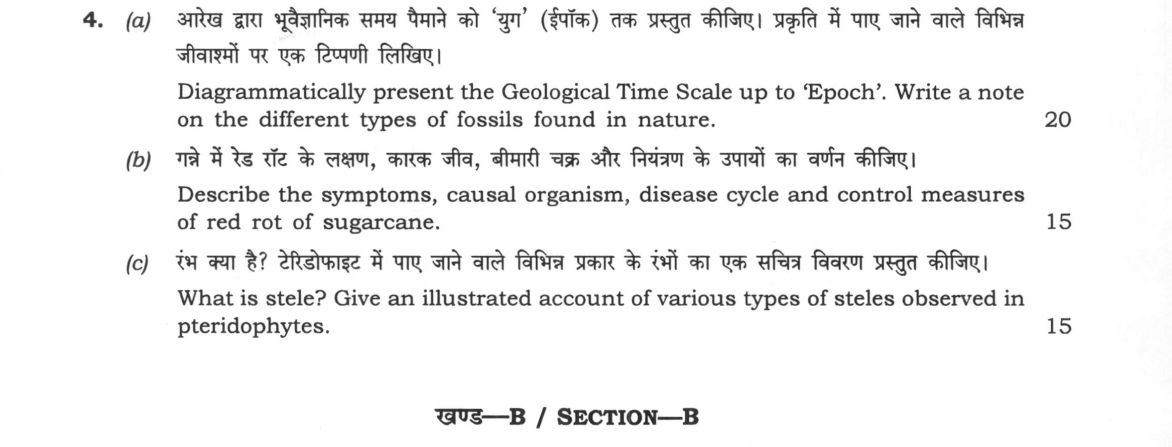
(a) Diagrammatically present the Geological Time Scale up to 'Epoch'. Write a note on the different types of fossils found in…
Diagrammatically present the Geological Time Scale up to 'Epoch'. Write a note on the different types of fossils found in nature. 20 marks
Describe the symptoms, causal organism, disease cycle and control measures of red rot of sugarcane. 15 marks
What is stele? Give an illustrated account of various types of steles observed in pteridophytes. 15 marks
हिंदी में प्रश्न पढ़ें
अरेख द्वारा भूवैज्ञानिक समय पैमाने को 'युग' (ईपॉक) तक प्रस्तुत कीजिए। प्रकृति में पाए जाने वाले विभिन्न जीवाश्मों पर एक टिप्पणी लिखिए। (20 अंक)
गन्ने में रेड रॉट के लक्षण, कारक जीव, बीमारी चक्र और नियंत्रण के उपायों का वर्णन कीजिए। (15 अंक)
रंभ क्या है? टेरिडोफाइट में पाए जाने वाले विभिन्न प्रकार के रंभों का एक सचित्र विवरण प्रस्तुत कीजिए। (15 अंक)
Model answer
Written by UPSC Answer Check against this question's marking rubric, to the expected length. UPSC does not publish answers for Mains — this is one way to score well, not an official key.
(a) Geological Time Scale and Fossils
The Geological Time Scale (GTS) is a hierarchical system for classifying Earth’s history. The highest unit is the Eon, followed by Era, Period, and Epoch. The current eon is the Phanerozoic (541 MYA–present), subdivided into three eras: Cenozoic (66 MYA–present), Mesozoic (252–66 MYA), and Paleozoic (541–252 MYA). The preceding Precambrian is an informal supereon comprising the Hadean, Archean, and Proterozoic eons (4600–541 MYA). For instance, the Cenozoic Era includes the Quaternary and Neogene periods; the Quaternary period comprises the Holocene and Pleistocene epochs.
Fossils are preserved remains or traces of ancient life, crucial for stratigraphy. They are classified into:
- Body Fossils: Preserved hard parts (bones, shells). Example: Dinosaur bones from the Lameta Formation (Gondwana).
- Trace Fossils: Indirect evidence like footprints or burrows. Example: Fossil footprints in the Kutch basin.
- Chemical Fossils: Organic molecules (lipids, amino acids) indicating biological activity.
- Microfossils: Microscopic remains like foraminifera and diatoms, used for high-resolution dating.
Index fossils are geographically widespread, short-lived, and abundant, used to correlate rock layers. In India, Gondwana flora (e.g., Glossopteris) serves as an index for Permian-Carboniferous strata, supporting the theory of continental drift.
(b) Red Rot of Sugarcane
Causal Organism: Colletotrichum falcatum (imperfect stage); Glomerella tucumanensis (perfect stage).
Symptoms:
- Internal: Reddish-brown discoloration of pith and vascular bundles in internodes.
- External: White spots with brown margins on leaf sheaths; "whip-like" appearance of canes due to brittle breaking.
- Top Rot: Premature drying of top leaves.
Disease Cycle:
- Primary Infection: Occurs via infected setts (planting material) or soil-borne conidia.
- Secondary Infection: Spreads through wind-blown conidia entering through wounds or natural openings (lenticels).
- Latency: The fungus remains latent in the pith until environmental stress (heat, drought) triggers sporulation.
Control Measures:
- Cultural: Use of certified disease-free setts; crop rotation with non-hosts (e.g., legumes); removal of infected debris.
- Chemical: Hot water treatment of setts (50°C for 10 mins); soil drenching with carbendazim or thiophanate-methyl.
- Genetic: Cultivation of resistant varieties like Co 1148 and Co 527.
(c) Stele in Pteridophytes
The stele is the central vascular cylinder of the root and stem, bounded by the pericycle. It consists of xylem and phloem. In pteridophytes, steles are primarily protostelic or siphonostelic.
1. Protostele: A solid central core of xylem surrounded by phloem, without a pith.
- Haplostele: Single xylem strand (Lycopodium).
- Actinostele: Radial xylem strands (Selaginella).
- Plectostele: Interlacing xylem strands.
2. Siphonostele: Xylem forms a ring with a central pith.
- Ectophloic Siphonostele: Phloem is external to xylem only.
- Amphiphloic Siphonostele: Phloem is both external and internal to xylem.
- Solenostele: Continuous xylem ring (Pteridium).
- Dictyostele: Xylem broken into discrete bundles (Adiantum).
Evolutionary Trend: According to Jeffrey’s Stele Theory, stelar evolution proceeded from simple protostele to complex siphonostele. This progression reflects increasing complexity in vascular transport and structural support, facilitating the transition from simple lycophytes to complex ferns. The theory emphasizes the role of telome branching in forming the stele, distinct from organ origin theories.
What "Describe" is asking you to do
Give a full, ordered account of the thing named — its parts, stages or mechanism — in the sequence in which it actually exists or occurs. Most describe questions come from the science optionals, where the marks sit in correct technical detail and, where the stem says so, a labelled diagram.
Structure that answers it
One-line identification of the subject → the parts or stages in their real order, each with its defining detail → labelled diagram where the subject is structural → closing line on function or significance
Where marks are lost
Loose general prose where the examiner is ticking named parts, correct terminology and their sequence; and in the General Studies papers, turning to evaluation before the description is finished.
How this answer will be evaluated
Approach
(a) describe: define > structure or process in order > labelled diagram > significance | (b) describe: define > structure or process in order > labelled diagram > significance | (c) describe: define > structure or process in order > labelled diagram > significance Full marks: Comprehensive, accurate, and well-illustrated answers with specific examples and clear explanations.
Key points expected
- Diagrammatic representation of Geological Time Scale
- Hierarchy shown up to 'Epoch' level
- Note on different types of fossils
- Classification of fossils (e.g., body, trace, molecular)
- Description of red rot symptoms
- Identification of causal organism (Colletotrichum falcatum)
- Explanation of disease cycle
- List of control measures
Evaluation rubric
Each sub-part is marked on its own, against the marks and word limit printed on the paper.
- (a) Diagrammatic presentation of Geological Time Scale and a note on fossil types. 20 marks
describe— define → structure or process in order → labelled diagram → significance
Must cover
- Diagrammatic representation of Geological Time Scale
- Hierarchy shown up to 'Epoch' level
- Note on different types of fossils
- Classification of fossils (e.g., body, trace, molecular)
Loses marks
- Unlabelled or missing diagram
- Confusing 'Period' with 'Epoch'
- Vague description of fossil types
Earns more
- Mention of specific fossil examples (e.g., ammonites)
- Reference to index fossils
- Mention of fossilization processes
Extra mark
- Reference to recent dating techniques (e.g., radiocarbon)
- (b) Detailed description of red rot of sugarcane including symptoms, cause, cycle, and control. 15 marks
describe— define → structure or process in order → labelled diagram → significance
Must cover
- Description of red rot symptoms
- Identification of causal organism (Colletotrichum falcatum)
- Explanation of disease cycle
- List of control measures
Loses marks
- Missing causal organism name
- Incomplete disease cycle
- Vague control measures
Earns more
- Mention of specific control methods (e.g., resistant varieties)
- Description of pathogen structure
- Reference to environmental factors
Extra mark
- Mention of specific resistant sugarcane cultivars
- (c) Definition of stele and illustrated account of types in pteridophytes. 15 marks
describe— define → structure or process in order → labelled diagram → significance
Must cover
- Definition of stele
- Illustrated account of stele types
- Specific focus on pteridophytes
- Comparison of different stele types
Loses marks
- Missing illustrations
- Confusing stele types
- Lack of specific pteridophyte examples
Earns more
- Mention of specific pteridophyte examples
- Detailed description of each stele type
- Reference to evolutionary significance
Extra mark
- Mention of specific pteridophyte species
Practice this exact question
Write your answer and it is marked point by point against the model answer above — what you covered, what you missed, what you got wrong.
Evaluate my answer →More from Botany 2023 Paper I
- Q1 Answer the following questions in about 150 words each: (a) What are prions? How do they…
- Q2 (a) What is lichen? With suitable diagrams, describe its types and structure. Write a not…
- Q3 (a) Define microbial biopesticides. What are their types? With suitable examples, evaluat…
- Q4 (a) Diagrammatically present the Geological Time Scale up to 'Epoch'. Write a note on the…
- Q5 Answer the following questions in about 150 words each: (a) Alphonse de Candolle classifi…
- Q6 (a) What are the different means of pollination in plants? Which natural devices ensure c…
- Q7 (a) Describe the botanical features, ecology and propagation of rubber tree. How is rubbe…