Paper I — Q7
(a) Describe the botanical features, ecology and propagation of rubber tree. How is rubber obtained and processed from rubber…
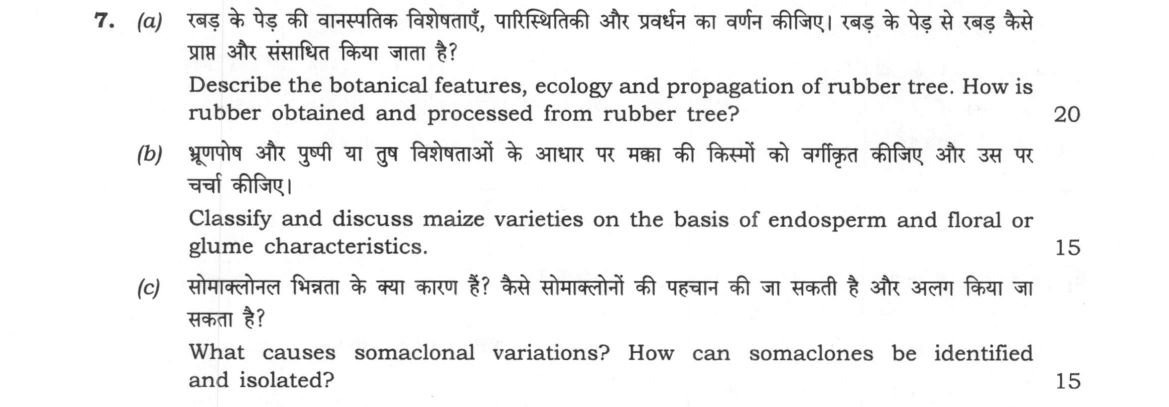
Describe the botanical features, ecology and propagation of rubber tree. How is rubber obtained and processed from rubber tree? 20 marks
Classify and discuss maize varieties on the basis of endosperm and floral or glume characteristics. 15 marks
What causes somaclonal variations? How can somaclones be identified and isolated? 15 marks
हिंदी में प्रश्न पढ़ें
रबड़ के पेड़ की वानस्पतिक विशेषताएं, पारिस्थितिकी और प्रवर्धन का वर्णन कीजिए। रबड़ के पेड़ से रबड़ कैसे प्राप्त और संसाधित किया जाता है? (20 अंक)
भ्रूणपोष और पुष्पी या तुष विशेषताओं के आधार पर मक्का की किस्मों को वर्गीकृत कीजिए और उस पर चर्चा कीजिए। (15 अंक)
सोमाक्लोनल भिन्नता के क्या कारण हैं? कैसे सोमाक्लोनों की पहचान की जा सकती है और अलग किया जा सकता है? (15 अंक)
Model answer
Written by UPSC Answer Check against this question's marking rubric, to the expected length. UPSC does not publish answers for Mains — this is one way to score well, not an official key.
Hevea brasiliensis: Botany, Ecology, and Processing
Hevea brasiliensis, a member of the family Euphorbiaceae, is the primary commercial source of natural rubber. Botanically, it is a medium-sized evergreen tree, though it exhibits a deciduous habit under severe stress. A defining morphological feature is the presence of laticifers in the phloem, which transport latex, a milky emulsion of rubber particles in water. The leaves are palmately compound with three leaflets; notably, the petiole apex (base of the leaflets) bears extrafloral nectaries, which attract ants for protection against herbivores.
Ecologically, Hevea requires a tropical climate with 2000–3000 mm annual rainfall, evenly distributed, and temperatures between 25–28°C. It thrives in well-drained, deep laterite soils with a pH of 5.5–6.5. In India, cultivation is concentrated in Kerala (accounting for ~90% of production), Kanyakumari, and Karnataka. The Rubber Board of India regulates the sector, promoting high-yielding clones such as RRIM 600, PB 260, and RRII 105. Propagation is primarily vegetative via bud grafting on seedling rootstocks to ensure clonal fidelity and early maturity, although seed gardens are used for rootstock production.
Rubber extraction involves tapping the bark to access the laticifer vessels. Common systems include S/2 d/2 (skipping one day, tapping two days). The collected latex is coagulated using acetic acid or formic acid to form rubber blocks. These are processed into crepe rubber by washing and milling, or into smoked sheet rubber by charring and smoking, which imparts a yellowish color and aroma.
Maize Varieties: Endosperm and Floral Classification
Maize (Zea mays) varieties are classified based on endosperm texture and floral/glume characteristics.
Based on endosperm composition, varieties include:
- **Flint Corn (Z. m. indurata):** Hard, glossy kernels with a high ratio of hard starch.
- **Dent Corn (Z. m. indentata):** Kernels develop a depression at the crown due to shrinkage of the soft starch during drying; high yield potential.
- **Floury Corn (Z. m. amylacea):** Soft, chalky kernels with high starch content, susceptible to damage.
- **Sweet Corn (Z. m. saccharata):** Contains a recessive su gene preventing starch accumulation, resulting in high sugar content.
- **Waxy Corn (Z. m. ceratina):** Endosperm is almost entirely amylopectin (high amylopectin, low amylose), giving a translucent, waxy appearance.
- High-Amylose Corn: Varieties with modified starch synthesis resulting in high amylose content, used for industrial applications.
Based on floral and glume characteristics:
- **Pod Corn (Z. m. tunicata):** Kernels are enclosed in a tough, leathery glume (pod), resembling a small ear.
- **Popcorn (Z. m. everta):** Small, dense flint endosperm that traps moisture, causing the kernel to explode upon heating.
- Tunicate Varieties: Characterized by the presence of the tunicate gene, where glumes completely enclose the kernels, differing from glabrous varieties where kernels are exposed.
Somaclonal Variation: Causes, Identification, and Isolation
Somaclonal variation refers to heritable phenotypic or genotypic changes in plants regenerated from tissue culture.
Causes: Variation arises from pre-existing meristematic heterogeneity in the donor tissue and culture-induced mutations. Key mechanisms include changes in DNA methylation patterns, activation of transposable elements, and chromosomal aberrations (aneuploidy, polyploidy) often exacerbated by prolonged callus phases and stress conditions during in vitro culture.
Identification: Somaclones are identified through a combination of phenotypic screening and molecular cytological analysis.
- Phenotypic Screening: Observing changes in plant height, leaf morphology, or flowering time in regenerated plants.
- Cytological Analysis: Chromosome counting and flow cytometry to detect ploidy changes.
- Molecular Markers: Techniques such as RAPD, AFLP, SSR, and ISSR are used to detect DNA polymorphisms. Isozyme profiling can also reveal genetic shifts.
Isolation: Desirable somaclones are isolated through selective subculture, where tissues are subcultured under specific stresses to enrich for variants. Single-cell cloning or protoplast culture allows for the isolation of individual cell lines. Finally, field evaluation of regenerated plants is essential to confirm the stability and agronomic value of the isolated variants.
Conclusion
Understanding the botanical and ecological specifics of Hevea brasiliensis is crucial for sustainable rubber production in India, while precise classification of maize varieties aids in breeding for specific end-use traits. Furthermore, somaclonal variation, though often a challenge, offers a valuable tool for generating genetic diversity in crop improvement programs when properly identified and isolated.
What "Describe" is asking you to do
Give a full, ordered account of the thing named — its parts, stages or mechanism — in the sequence in which it actually exists or occurs. Most describe questions come from the science optionals, where the marks sit in correct technical detail and, where the stem says so, a labelled diagram.
Structure that answers it
One-line identification of the subject → the parts or stages in their real order, each with its defining detail → labelled diagram where the subject is structural → closing line on function or significance
Where marks are lost
Loose general prose where the examiner is ticking named parts, correct terminology and their sequence; and in the General Studies papers, turning to evaluation before the description is finished.
How this answer will be evaluated
Approach
Framework: UPSC Botany Paper 1. (a) describe: define > structure or process in order > labelled diagram > significance | (b) discuss: intro > 3-4 dimensions > example > balanced close | (c) explain: definition/context > points in order > small example > short close Full marks: Comprehensive, accurate, with diagrams and specific examples
Key points expected
- Botanical features of Hevea brasiliensis
- Ecology and propagation methods
- Tapping process and latex collection
- Processing steps to obtain rubber
- Endosperm-based classification (floury, sweet, etc.)
- Floral/glume characteristics
- Specific maize varieties discussed
- Clear classification scheme
Evaluation rubric
Each sub-part is marked on its own, against the marks and word limit printed on the paper.
- (a) Botanical features, ecology, propagation, and processing of rubber from Hevea brasiliensis. 20 marks
describe— define → structure or process in order → labelled diagram → significance
Must cover
- Botanical features of Hevea brasiliensis
- Ecology and propagation methods
- Tapping process and latex collection
- Processing steps to obtain rubber
Loses marks
- Unlabelled diagrams
- Loose common names
- Missing processing steps
Earns more
- Labelled diagram of tapping
- Specific ecological requirements
- Propagation via cuttings/seeds
- Coagulation and drying process
Extra mark
- Recent biotech application in rubber
- Specific cultivar names
- (b) Classification of maize varieties based on endosperm and floral/glume characteristics. 15 marks
discuss— intro → 3-4 dimensions → example → balanced close
Must cover
- Endosperm-based classification (floury, sweet, etc.)
- Floral/glume characteristics
- Specific maize varieties discussed
- Clear classification scheme
Loses marks
- Missing endosperm types
- No floral characteristics
- Vague variety descriptions
Earns more
- Table comparing varieties
- Specific cultivar examples
- Link to crop improvement
- Detailed glume descriptions
Extra mark
- Recent biotech application in maize
- Specific named cultivars
- (c) Causes of somaclonal variations and methods for identification and isolation of somaclones. 15 marks
explain— definition/context → points in order → small example → short close
Must cover
- Causes of somaclonal variations
- Identification methods for somaclones
- Isolation techniques
- Link to tissue culture
Loses marks
- Missing causes
- No identification methods
- Vague isolation description
Earns more
- Specific molecular markers
- Morphological identification
- Biotech applications
- Stepwise isolation process
Extra mark
- Recent biotech application
- Specific named techniques
Practice this exact question
Write your answer and it is marked point by point against the model answer above — what you covered, what you missed, what you got wrong.
Evaluate my answer →More from Botany 2023 Paper I
- Q4 (a) Diagrammatically present the Geological Time Scale up to 'Epoch'. Write a note on the…
- Q5 Answer the following questions in about 150 words each: (a) Alphonse de Candolle classifi…
- Q6 (a) What are the different means of pollination in plants? Which natural devices ensure c…
- Q7 (a) Describe the botanical features, ecology and propagation of rubber tree. How is rubbe…
- Q8 (a) What factors affect in vitro stages of micropropagation? Discuss the applications and…