Paper I — Q5
Answer the following questions in about 150 words each: (a) Alphonse de Candolle classified plants of economic importance into…
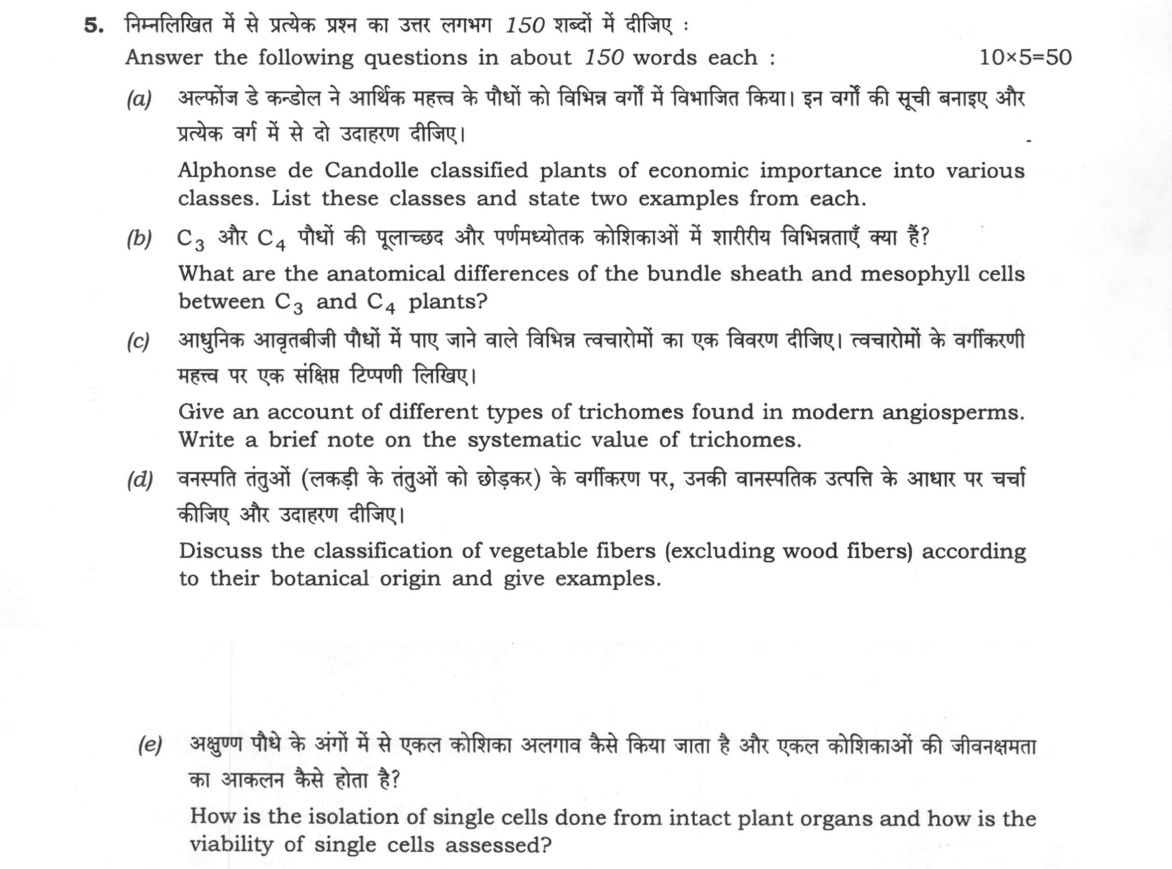
Answer the following questions in about 150 words each:
Alphonse de Candolle classified plants of economic importance into various classes. List these classes and state two examples from each. 10 marks
What are the anatomical differences of the bundle sheath and mesophyll cells between C₃ and C₄ plants? 10 marks
Give an account of different types of trichomes found in modern angiosperms. Write a brief note on the systematic value of trichomes. 10 marks
Discuss the classification of vegetable fibers (excluding wood fibers) according to their botanical origin and give examples. 10 marks
How is the isolation of single cells done from intact plant organs and how is the viability of single cells assessed? 10 marks
हिंदी में प्रश्न पढ़ें
निम्नलिखित में से प्रत्येक प्रश्न का उत्तर लगभग 150 शब्दों में दीजिए :
अल्फोंज डे कंडोल ने आर्थिक महत्व के पौधों को विभिन्न वर्गों में विभाजित किया। इन वर्गों की सूची बनाइए और प्रत्येक वर्ग में से दो उदाहरण दीजिए। (10 अंक)
C₃ और C₄ पौधों की पुलाच्छद और पर्णमध्योतक कोशिकाओं में शारीरिक विभिन्नताएँ क्या हैं? (10 अंक)
आधुनिक आवृतबीजी पौधों में पाए जाने वाले विभिन्न त्वचारोमों का एक विवरण दीजिए। त्वचारोमों के वर्गीकरणी महत्व पर एक संक्षिप्त टिप्पणी लिखिए। (10 अंक)
वनस्पति तंतुओं (लकड़ी के तंतुओं को छोड़कर) के वर्गीकरण पर, उनकी वानस्पतिक उत्पत्ति के आधार पर चर्चा कीजिए और उदाहरण दीजिए। (10 अंक)
अक्षुण्ण पौधे के अंगों में से एकल कोशिका अलगाव कैसे किया जाता है और एकल कोशिकाओं की जीवनक्षमता का आकलन कैसे होता है? (10 अंक)
Model answer
Written by UPSC Answer Check against this question's marking rubric, to the 150-word length. UPSC does not publish answers for Mains — this is one way to score well, not an official key.
Alphonse de Candolle’s Classification and Plant Anatomy
(a) Economic Classes of Plants Alphonse de Candolle’s Traité d'Économie Végétale (1813) established the foundational framework for economic botany, categorizing plants into twelve distinct classes based on their utility. The Cereals class includes staple grains such as Oryza sativa (rice) and Triticum aestivum (wheat). Legumes provide protein and nitrogen fixation, exemplified by Cajanus cajan (pigeon pea) and Lens culinaris (lentil). Starches are tuberous or rhizomatous plants like Manihot esculenta (cassava) and Solanum tuberosum (potato). Sugars include Saccharum officinarum (sugarcane) and Beta vulgaris (sugar beet). Fruits encompass Mangifera indica (mango) and Citrus limon (lemon). Oils are derived from seeds or fruits, such as Arachis hypogaea (groundnut) and Helianthus annuus (sunflower). Textiles provide fibers, notably Gossypium hirsutum (cotton) and Corchorus capsularis (jute). Dyes include Indigofera tinctoria (indigo) and Curcuma longa (turmeric). Tannins are extracted from bark or leaves, e.g., Acacia catechu (katha) and Quercus infectoria (oak galls). Medicinal plants include Cinchona officinalis (quinine source) and Artemisia annua (artemisinin source). Timber provides wood, such as Teak (Tectona grandis) and Shorea robusta (sal). Finally, Miscellaneous includes plants used for other purposes, like Canna indica (ornamental) and Eucalyptus (essential oils). This classification remains the backbone of economic botany studies.
(b) Anatomical Differences in C₃ and C₄ Plants The anatomical distinction between C₃ and C₄ plants is primarily defined by the presence or absence of Kranz anatomy. In C₃ plants, the bundle sheath (BS) cells are typically thin-walled, lack chloroplasts or contain few small chloroplasts, and do not form a distinct ring around the vascular bundle. The mesophyll cells are the primary site of carbon fixation and contain numerous granal chloroplasts. In contrast, C₄ plants exhibit Kranz anatomy, where large, thick-walled bundle sheath cells form a tight, concentric ring around the vascular bundle. These BS cells contain large, agranal chloroplasts that are rich in Rubisco but lack the grana stacks found in mesophyll cells. The mesophyll cells in C₄ plants are arranged radially around the BS and contain granal chloroplasts. It is crucial to note that while PEP carboxylase initiates fixation in the mesophyll, it is a cytosolic enzyme, not a chloroplast enzyme. The BS walls in C₄ plants may possess suberin lamellae in some subtypes, which restricts gas exchange and minimizes CO₂ leakage, although this feature is not universal across all C₄ species. This spatial separation of initial and secondary carboxylation enhances photosynthetic efficiency in hot, dry environments.
(c) Trichomes in Angiosperms Trichomes are epidermal outgrowths that vary significantly in structure and function. They are broadly classified into glandular and non-glandular types. Glandular trichomes are secretory, often unicellular or multicellular, and produce substances like nectar, resins, or volatile oils. Examples include the peltate glands in Mentha (mint) and the stalked glands in Solanum species. Non-glandular trichomes are protective and can be unicellular, multicellular, branched, or unbranched. They may be simple, stellate (star-shaped), or covering. For instance, Malvaceae often possess stellate hairs, while Brassicaceae typically feature simple or branched hairs, not stellate ones. Stinging trichomes, as in Urtica dioica (nettle), contain irritant chemicals. Systematically, trichomes are valuable for identification at the family and genus levels. The presence, shape, and distribution of trichomes help distinguish closely related taxa, such as differentiating Labiatae (now Lamiaceae) by their glandular hairs or identifying Solanaceae by their specific trichome patterns. However, they should be used in conjunction with other morphological characters for accurate classification.
(d) Classification of Vegetable Fibers Vegetable fibers, excluding wood, are classified by their botanical origin into four main groups. Seed fibers are derived from the seed coat or epidermis of seeds. The most prominent example is cotton (Gossypium hirsutum), used for textiles. Kapok (Ceiba pentandra) is another seed fiber used for insulation. Bast fibers are obtained from the phloem (inner bark) of dicotyledonous plants. Jute (Corchorus capsularis) is the primary bast fiber in India, used for bags and ropes. Flax (Linum usitatissimum) and hemp (Cannabis sativa) are other important bast fibers. Leaf fibers are extracted from the leaves of monocotyledonous plants. Sisal (Agave sisalana) and abaca (Musa textilis) are major leaf fibers used in ropes and textiles. Pineapple (Ananas comosus) leaf fiber is also commercially significant. Fruit fibers are obtained from the mesocarp of fruits. Coir, derived from the coconut (Cocos nucifera) husk, is the most important fruit fiber, used for mats, brushes, and ropes. This classification highlights the diverse botanical sources of industrial fibers.
(e) Isolation and Viability of Single Cells The isolation of single cells from intact plant organs involves breaking down the middle lamella and cell walls to release individual cells. Mechanical methods include maceration, where tissues are crushed in a mortar and pestle, and homogenization, using a blender to shear tissues. These methods are rapid but can cause physical damage to cells. Enzymatic methods are more gentle and specific. Enzymes such as cellulase, pectinase, and macerozyme are used to digest the cell wall components. Pectinase breaks down the pectin in the middle lamella, while cellulase digests the cellulose in the primary wall. This method yields higher viability and intact cells. The viability of isolated single cells is assessed using several techniques. Evans blue exclusion is a common method where live cells exclude the dye, while dead cells take it up and appear blue. Fluorescein Diacetate (FDA) is a non-fluorescent ester that is hydrolyzed by esterases in living cells to produce fluorescent fluorescein, observed under blue light (approx. 490 nm excitation). TTC reduction involves the reduction of triphenyl tetrazolium chloride to a red formazan precipitate in metabolically active cells. Plating efficiency is the most definitive test, where cells are cultured on media, and the percentage forming colonies indicates viability. These methods ensure that isolated cells are suitable for downstream applications like protoplast culture.
What "Enumerate" is asking you to do
Produce the complete set of items asked for, countable and correctly named. The examiner marks against a checklist, so a missing item costs and an elaborated one gains nothing — where discussion is wanted the stem asks for it as a separate sub-part.
Structure that answers it
One line naming the basis on which the set is drawn → items numbered, each in a phrase or a single line → the discussion sub-part taken up separately, after the list is complete
Where marks are lost
Treating it as an essay. Six items named in six lines score better than three items explained at length.
How this answer will be evaluated
Approach
Framework: UPSC Botany Paper 1. (a) enumerate: list the items in order > one line each > no commentary | (b) compare: paired headings or table > key differences > significance > conclusion | (c) describe: define > structure or process in order > labelled diagram > significance | (d) discuss: intro > 3-4 dimensions > example > balanced close | (e) explain: definition/context > points in order > small example > short close Full marks: Precise binomials, labelled diagrams, specific examples, clear structure
Key points expected
- List at least 5 distinct classes
- Provide 2 examples per class
- Use exact binomials for examples
- Describe Kranz anatomy in C4
- Contrast chloroplast types (grana vs agranal)
- Mention bundle sheath cell size/arrangement
- List 3-4 types (e.g. glandular, stellate)
- Explain systematic/taxonomic value
Evaluation rubric
Each sub-part is marked on its own, against the marks and word limit printed on the paper.
- (a) List Candolle's classes of economic plants with two examples each. · 150 words
enumerate— list the items in order → one line each → no commentary
Must cover
- List at least 5 distinct classes
- Provide 2 examples per class
- Use exact binomials for examples
Loses marks
- Common names instead of binomials
- Missing examples for listed classes
Earns more
- Mention specific use (e.g. food, fodder)
- Include diverse plant families
Extra mark
- Mention a specific cultivar
- (b) Compare bundle sheath and mesophyll anatomy in C3 vs C4 plants. · 150 words
compare— paired headings or table → key differences → significance → conclusion
Must cover
- Describe Kranz anatomy in C4
- Contrast chloroplast types (grana vs agranal)
- Mention bundle sheath cell size/arrangement
Loses marks
- Unlabelled diagrams
- Confusing mesophyll and bundle sheath roles
Earns more
- Labelled diagram of Kranz anatomy
- Mention specific C4 example (e.g. Zea mays)
Extra mark
- Mention specific C3 example (e.g. Triticum aestivum)
- (c) Describe trichome types and their systematic value in angiosperms. · 150 words
describe— define → structure or process in order → labelled diagram → significance
Must cover
- List 3-4 types (e.g. glandular, stellate)
- Explain systematic/taxonomic value
- Mention specific angiosperm examples
Loses marks
- Unlabelled diagrams
- Vague description of systematic value
Earns more
- Labelled diagram of trichome types
- Mention specific family (e.g. Asteraceae)
Extra mark
- Mention specific species with unique trichomes
- (d) Classify vegetable fibers by botanical origin with examples. · 150 words
discuss— intro → 3-4 dimensions → example → balanced close
Must cover
- Classify by origin (stem, leaf, etc.)
- Provide examples for each class
- Exclude wood fibers as specified
Loses marks
- Including wood fibers
- Common names instead of binomials
Earns more
- Mention specific fiber uses
- Use exact binomials for examples
Extra mark
- Mention specific cultivar or variety
- (e) Explain single cell isolation and viability assessment methods. · 150 words
explain— definition/context → points in order → small example → short close
Must cover
- Describe isolation technique (enzymatic/mechanical)
- Explain viability assessment method
- Mention specific reagents or tools
Loses marks
- Unlabelled diagrams
- Vague description of techniques
Earns more
- Labelled diagram of process
- Mention specific viability test (e.g. TTC)
Extra mark
- Mention specific application (e.g. protoplast culture)
Practice this exact question
Write your answer and it is marked point by point against the model answer above — what you covered, what you missed, what you got wrong.
Evaluate my answer →More from Botany 2023 Paper I
- Q2 (a) What is lichen? With suitable diagrams, describe its types and structure. Write a not…
- Q3 (a) Define microbial biopesticides. What are their types? With suitable examples, evaluat…
- Q4 (a) Diagrammatically present the Geological Time Scale up to 'Epoch'. Write a note on the…
- Q5 Answer the following questions in about 150 words each: (a) Alphonse de Candolle classifi…
- Q6 (a) What are the different means of pollination in plants? Which natural devices ensure c…
- Q7 (a) Describe the botanical features, ecology and propagation of rubber tree. How is rubbe…
- Q8 (a) What factors affect in vitro stages of micropropagation? Discuss the applications and…