Paper I — Q6
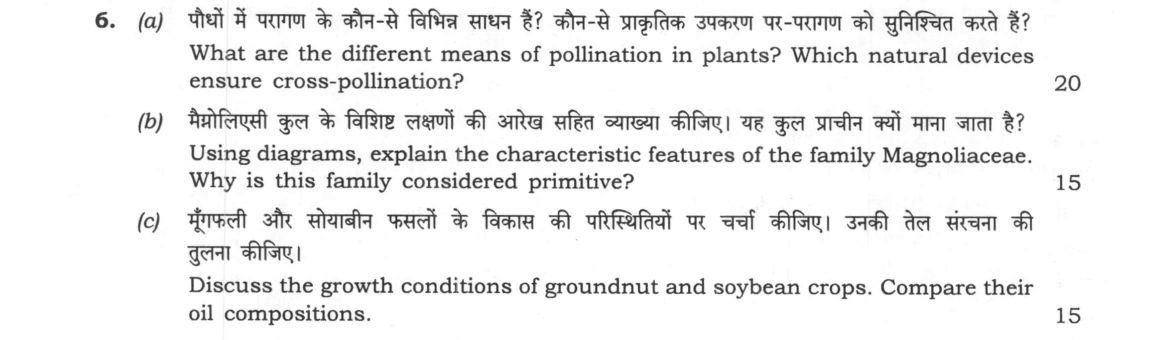
(a) What are the different means of pollination in plants? Which natural devices ensure cross-pollination? (20 marks) (b) Using…
What are the different means of pollination in plants? Which natural devices ensure cross-pollination? 20 marks
Using diagrams, explain the characteristic features of the family Magnoliaceae. Why is this family considered primitive? 15 marks
Discuss the growth conditions of groundnut and soybean crops. Compare their oil compositions. 15 marks
हिंदी में प्रश्न पढ़ें
पौधों में परागण के कौन-से विभिन्न साधन हैं? कौन-से प्राकृतिक उपकरण पर-परागण को सुनिश्चित करते हैं? (20 अंक)
मैग्नोलिएसी कुल के विशिष्ट लक्षणों की आरेख सहित व्याख्या कीजिए। यह कुल प्राचीन क्यों माना जाता है? (15 अंक)
मूंगफली और सोयाबीन फसलों के विकास की परिस्थितियों पर चर्चा कीजिए। उनकी तेल संरचना की तुलना कीजिए। (15 अंक)
Model answer
Written by UPSC Answer Check against this question's marking rubric, to the expected length. UPSC does not publish answers for Mains — this is one way to score well, not an official key.
Pollination is the transfer of pollen from anther to stigma, a critical step for sexual reproduction in angiosperms. The mechanisms are broadly classified into abiotic and biotic vectors.
Abiotic Pollination Anemophily (wind) is common in grasses and conifers, characterized by small, naked flowers with large, feathery stigmas to trap airborne pollen. Examples include Saccharum officinarum (sugarcane) and Zea mays (maize). Hydrophily (water) occurs in aquatic plants like Vallisneria and Hydrilla, where pollen is released into water and guided by filiform extensions or surface tension.
Biotic Pollination Entomophily (insects) is the most prevalent. Bees pollinate Citrus and Brassica species; butterflies visit Papaver somniferum (poppy). Ornithophily (birds) involves nectar-rich, red, tubular flowers like Ixora and Hibiscus rosa-sinensis, pollinated by sunbirds. Chiropterophily (bats) affects large, night-blooming, malodorous flowers such as Cestrum nocturnum and Ficus species. Malacophily (snails) is rare, seen in Impatiens and Cyperus.
Devices Ensuring Cross-Pollination Nature employs several mechanisms to prevent self-fertilization and promote genetic diversity. Dichogamy involves temporal separation of male and female maturity; in protandry, anthers dehisce before the stigma is receptive (e.g., Canna), while in protogyny, the stigma matures first (e.g., Plumbago). Herkogamy is spatial separation, where anthers and stigmas are positioned differently to prevent direct contact. Heterostyly involves floral dimorphism, such as in Primula, where long-styled and short-styled plants ensure cross-pollination. Unisexuality and Dioecy (separate male and female plants, e.g., Musa) inherently prevent selfing. Finally, Self-Incompatibility (SI) is a genetic mechanism where pollen is rejected if genetically similar to the pistil. In sporophytic SI, the pollen tube is arrested in the style; in gametophytic SI, it is arrested in the stigma.
Family Magnoliaceae: Features and Primitiveness Magnoliaceae represents a primitive angiosperm family. The flowers are large, solitary, and actinomorphic. The perianth is typically definite, consisting of 6–18 tepals arranged in whorls, lacking a clear distinction between calyx and corolla. The androecium and gynoecium are numerous and spirally arranged on an elongated, convex receptacle. The carpels are free (apocarpous) and conduplicate, meaning the ovules are attached to the ventral suture. The stamens are magnoliaceous, with the filament and connective fused to the anther.
This family is considered primitive due to its retention of ancestral traits. Unlike advanced families like Ranunculaceae, which often exhibit cyclic phyllotaxy and varying degrees of fusion, Magnoliaceae retains spiral phyllotaxy and numerous, undifferentiated floral parts. The lack of fusion (apocarpous gynoecium) and the presence of a long, elongated receptacle are plesiomorphic features. Pollination is often by beetles, a primitive vector. Fossil evidence, such as Archaeanthus linnenbergeri (approx. 100 mya), supports its ancient origin. Modern phylogeny places Magnoliales within the magnoliid clade, distinct from the basal amborellan and nymphean lineages, yet it retains more ancestral morphological characters than eudicots.
Groundnut vs. Soybean: Growth and Oil Composition Groundnut (Arachis hypogaea) is a tropical legume requiring temperatures of 20–30°C and 50–75 cm rainfall. It thrives in well-drained sandy loam soils, essential for the unique "pegging" mechanism where the fertilized ovary (gynophore) is pushed into the soil for pod development. Soybean (Glycine max) prefers a temperate-warm climate (20–30°C) and 45–65 cm rainfall, growing well in clay loam. Both are nitrogen-fixers via Bradyrhizobium japonicum nodules, but soybean is more sensitive to waterlogging.
Their oil compositions differ significantly. Groundnut oil contains approximately 48% oil and 20% protein. It is rich in oleic acid (50%) and linoleic acid (30%), with low linolenic acid, making it stable for frying. Soybean oil contains about 20% oil but is a superior protein source (40%). Its oil profile is dominated by linoleic acid (55%) and linolenic acid (8%), making it more prone to oxidation. Soybeans also contain anti-nutritional factors like trypsin inhibitors and lectins, which require processing, whereas groundnuts are generally safer for direct consumption.
In conclusion, while pollination mechanisms ensure genetic diversity, the morphological retention in Magnoliaceae highlights evolutionary continuity. In agriculture, understanding the specific growth conditions and lipid profiles of groundnut and soybean is vital for optimizing yield and food safety.
What "Explain" is asking you to do
Make the working of something clear — what sets it off, what follows from what, and what it produces. Explain is the Commission's mechanism word: it dominates the technical papers and the “explain why” stems, where the marks sit in the causal chain and not in the label.
Structure that answers it
State what it is → the initiating condition → the chain of cause, step by step → an instance where it plays out → what the chain produces
Where marks are lost
Describing what something looks like instead of why it works that way. Naming the stages without linking them reads as description too.
How this answer will be evaluated
Approach
Framework: UPSC Botany Paper 1. (a) explain: definition/context > points in order > small example > short close | (b) explain: definition/context > points in order > small example > short close | (c) compare: paired headings or table > key differences > significance > conclusion Full marks: Comprehensive, accurate, with labelled diagrams and specific examples.
Key points expected
- Define autogamy, geitonogamy, and xenogamy
- Explain entomophily with specific floral adaptations
- Explain anemophily with specific floral adaptations
- Describe natural devices preventing self-pollination
- Labelled floral diagram of *Magnolia* or *Lilium*
- List primitive features (e.g., apocarpous, free stamens)
- Explain why family is considered primitive
- Mention evolutionary significance
Evaluation rubric
Each sub-part is marked on its own, against the marks and word limit printed on the paper.
- (a) Define pollination types and detail natural mechanisms ensuring cross-pollination. 20 marks
explain— definition/context → points in order → small example → short close
Must cover
- Define autogamy, geitonogamy, and xenogamy
- Explain entomophily with specific floral adaptations
- Explain anemophily with specific floral adaptations
- Describe natural devices preventing self-pollination
Loses marks
- Unlabelled diagrams
- Confusing geitonogamy with autogamy
- Loose common names for pollinators
Earns more
- Labelled diagram of insect-pollinated flower
- Labelled diagram of wind-pollinated flower
- Mention of dichogamy or herkogamy
- Mention of self-incompatibility mechanisms
Extra mark
- Named species example (e.g., *Zea mays*)
- Reference to biotech application (e.g., hybrid seed production)
- (b) Diagrammatically explain Magnoliaceae features and justify its primitive status. 15 marks
explain— definition/context → points in order → small example → short close
Must cover
- Labelled floral diagram of *Magnolia* or *Lilium*
- List primitive features (e.g., apocarpous, free stamens)
- Explain why family is considered primitive
- Mention evolutionary significance
Loses marks
- Unlabelled diagrams
- Missing evolutionary context
- Confusing with other primitive families
Earns more
- Mention of *Magnolia grandiflora*
- Reference to fossil record
- Comparison with advanced families
- Mention of perianth differentiation
Extra mark
- Specific fossil species name
- Reference to recent phylogenetic study
- (c) Compare growth conditions and oil compositions of groundnut and soybean. 15 marks
compare— paired headings or table → key differences → significance → conclusion
Must cover
- Compare soil and climate requirements
- Compare oil composition (fatty acid profile)
- Mention specific oil percentages
- Highlight key differences in cultivation
Loses marks
- Missing oil composition details
- Confusing growth conditions
- Loose common names
Earns more
- Mention of *Arachis hypogaea*
- Mention of *Glycine max*
- Reference to oil extraction methods
- Mention of nutritional value
Extra mark
- Specific cultivar names
- Reference to recent biotech modification
Practice this exact question
Write your answer and it is marked point by point against the model answer above — what you covered, what you missed, what you got wrong.
Evaluate my answer →More from Botany 2023 Paper I
- Q3 (a) Define microbial biopesticides. What are their types? With suitable examples, evaluat…
- Q4 (a) Diagrammatically present the Geological Time Scale up to 'Epoch'. Write a note on the…
- Q5 Answer the following questions in about 150 words each: (a) Alphonse de Candolle classifi…
- Q6 (a) What are the different means of pollination in plants? Which natural devices ensure c…
- Q7 (a) Describe the botanical features, ecology and propagation of rubber tree. How is rubbe…
- Q8 (a) What factors affect in vitro stages of micropropagation? Discuss the applications and…