Paper I — Q2
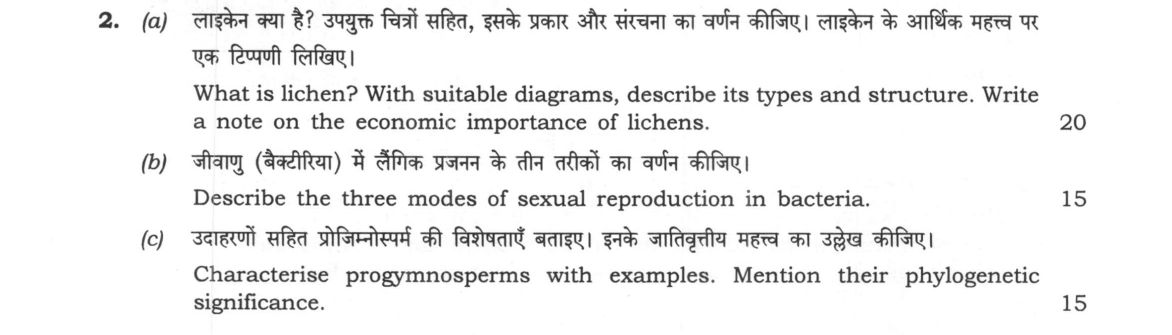
(a) What is lichen? With suitable diagrams, describe its types and structure. Write a note on the economic importance of lichens…
What is lichen? With suitable diagrams, describe its types and structure. Write a note on the economic importance of lichens. 20 marks
Describe the three modes of sexual reproduction in bacteria. 15 marks
Characterise progymnosperms with examples. Mention their phylogenetic significance. 15 marks
हिंदी में प्रश्न पढ़ें
लाइकेन क्या है? उपयुक्त चित्रों सहित, इसके प्रकार और संरचना का वर्णन कीजिए। लाइकेन के आर्थिक महत्व पर एक टिप्पणी लिखिए। (20 अंक)
जीवाणु (बैक्टीरिया) में लैंगिक प्रजनन के तीन तरीकों का वर्णन कीजिए। (15 अंक)
उदाहरणों सहित प्रोजिम्नोस्पर्म की विशेषताएँ बताइए। इनके जातिवृत्तीय महत्व का उल्लेख कीजिए। (15 अंक)
Model answer
Written by UPSC Answer Check against this question's marking rubric, to the expected length. UPSC does not publish answers for Mains — this is one way to score well, not an official key.
Lichen: Concept, Types, Structure, and Economic Importance
A lichen is a stable, self-supporting mutualistic symbiosis between a fungal partner, termed the mycobiont (mostly Ascomycetes), and a photosynthetic partner, termed the photobiont (green algae or cyanobacteria). Unlike casual physical aggregations, the two components form a distinct morphological and physiological entity where the fungus provides anchorage, moisture, and minerals, while the photobiont synthesises carbohydrates.
Morphologically, lichens are classified into three major types:
- Crustose lichens: Form a flat, crust-like thallus tightly adpressed to the substratum without a lower cortex, such as Graphis and Lecanora.
- Foliose lichens: Feature a flat, dorsiventral, leaf-like lobed thallus attached via rhizines, exemplified by Parmelia and Peltigera.
- Fruticose lichens: Exhibit a shrubby, cylindrical, or strap-shaped, branched, erect or pendulous thallus, such as Usnea, Cladonia, and Ramalina.
`` [DIAGRAM: Heteromerous Foliose Thallus Structure] _______________________________ <-- Upper Cortex (dense fungal hyphae) | o o o o o o o | <-- Algal Layer / Photobiont zone | ~ ~ ~ ~ ~ ~ ~ ~ ~ ~ ~ ~ ~ ~ ~ | | ~ ~ ~ ~ ~ ~ ~ | <-- Medulla (loosely interwoven hyphae) |_______________________________| <-- Lower Cortex (compact hyphae) | | | <-- Rhizines (anchoring structures) ``
Internally, a heteromerous thallus displays four distinct zones: an upper cortex of compact, pseudoparenchymatous fungal hyphae offering protection; an algal layer containing active photobiont cells; a central medulla composed of loosely interwoven, air-spaced hyphae serving as a storage zone; and a lower cortex giving rise to rhizines that anchor the thallus to the substrate.
Lichens possess immense ecological and economic value. They act as pioneer organisms in lithosere succession by secreting organic acids that initiate soil formation through pedogenesis. Being highly sensitive to atmospheric sulphur dioxide (SO₂), they serve as biological indicators of air pollution, actively monitored by institutions like CSIR-National Botanical Research Institute (NBRI), Lucknow. Industrially, Roccella tinctoria yields the acid-base indicator litmus; Evernia prunastri and Pseudevernia are used as fixatives in perfumery; and Cladonia rangiferina (reindeer moss) serves as vital fodder in arctic tundras. Medicinally, Usnea species yield usnic acid, a potent broad-spectrum antibiotic.
Modes of Sexual Reproduction in Bacteria
Bacteria lack true eukaryotic syngamy and meiosis; instead, they undergo parasexual genetic recombination via three distinct processes:
Conjugation involves the direct, unidirectional transfer of genetic material from a donor (F⁺ or male) to a recipient (F⁻ or female) cell through a specialised sex pilus. Plasmids such as the fertility factor (F-factor) can replicate and transfer autonomously. When the F-factor integrates into the circular bacterial chromosome, it forms a High-Frequency Recombination (Hfr) strain, facilitating chromosomal transfer. Aberrant excision of the integrated factor produces an F' plasmid containing specific host genes.
Transformation involves the active uptake and integration of naked, extracellular DNA fragments from the surrounding medium by a competent recipient cell. First demonstrated by Frederick Griffith in Streptococcus pneumoniae and molecularly established by Avery, MacLeod, and McCarty, this process incorporates foreign genetic sequences into the recipient genome via homologous recombination.
Transduction is the bacteriophage-mediated transfer of bacterial DNA from one cell to another. In generalized transduction, mediated by lytic phages (e.g., P22 in Salmonella), random fragments of degraded bacterial host DNA are mistakenly packaged into the viral capsid and transferred. In specialized transduction, temperate phages (e.g., Lambda phage in Escherichia coli) integrate into a specific chromosomal locus as a prophage; imprecise excision during induction carries flanking, specific host genes to the recipient cell.
Progymnosperms: Characterisation and Phylogenetic Significance
Progymnosperms represent an extinct group of Mid-Devonian to Early Carboniferous vascular plants that bridge the structural gap between free-sporing pteridophytes and seed plants.
Morphologically and anatomically, progymnosperms are characterised by an arborescent habit exhibiting extensive secondary growth. They possessed a bifacial vascular cambium producing gymnospermous secondary xylem (pycnoxylic in Archaeopteris and manoxylic in Aneurophyton) with bordered pitted tracheids and xylem rays. Their foliage varied from simple, branching axes in the Aneurophytales to broad, fern-like photosynthetic fronds (sphenopterids and archaeopterids) in the Archaeopteridales. Despite advanced, gymnospermous vegetative anatomy, they reproduced exclusively via free-shedding sporangia lacking seeds, exhibiting both homospory (Protopteridium) and advanced heterospory (Archaeopteris).
Phylogenetically, progymnosperms are considered the direct evolutionary ancestors of gymnosperms. They resolve the macroevolutionary enigma of the "seed habit" by demonstrating that modern eustelic organization and bifacial secondary wood evolved prior to the origin of the seed. Furthermore, the transition from homospory to heterospory in taxa like Archaeopteris established the precursor developmental state required for the evolution of the integumented megasporangium (ovule), solidifying progymnosperms as the evolutionary link between trimerophyte pteridophytes and early pteridosperms (seed ferns).
What "Describe" is asking you to do
Give a full, ordered account of the thing named — its parts, stages or mechanism — in the sequence in which it actually exists or occurs. Most describe questions come from the science optionals, where the marks sit in correct technical detail and, where the stem says so, a labelled diagram.
Structure that answers it
One-line identification of the subject → the parts or stages in their real order, each with its defining detail → labelled diagram where the subject is structural → closing line on function or significance
Where marks are lost
Loose general prose where the examiner is ticking named parts, correct terminology and their sequence; and in the General Studies papers, turning to evaluation before the description is finished.
How this answer will be evaluated
Approach
(a) describe: define > structure or process in order > labelled diagram > significance | (b) describe: define > structure or process in order > labelled diagram > significance | (c) highlight: name the salient points > one line of substance each > close Full marks: Comprehensive, accurate, with labelled diagrams and specific examples.
Key points expected
- Definition of lichen as a symbiotic association
- Description of thallus types (crustose, foliose, fruticose)
- Labelled diagram of lichen structure (phycobiont, mycobiont)
- Note on economic importance (indicators, drugs, dyes)
- Description of Conjugation (F+ x F-)
- Description of Transduction (bacteriophage vector)
- Description of Transformation (uptake of naked DNA)
- Definition of Progymnosperms (woody, no flowers/fruits)
Evaluation rubric
Each sub-part is marked on its own, against the marks and word limit printed on the paper.
- (a) Definition, types, structure with diagrams, and economic importance of lichens. 20 marks
describe— define → structure or process in order → labelled diagram → significance
Must cover
- Definition of lichen as a symbiotic association
- Description of thallus types (crustose, foliose, fruticose)
- Labelled diagram of lichen structure (phycobiont, mycobiont)
- Note on economic importance (indicators, drugs, dyes)
Loses marks
- Unlabelled or missing diagrams
- Confusing lichen with algae or fungi alone
Earns more
- Mention of specific lichen species (e.g., *Umbilicus*, *Cladonia*)
- Explanation of chemical products (e.g., usnic acid)
Extra mark
- Reference to specific biotech application (e.g., antibiotic source)
- Mention of specific commercial dye (e.g., litmus)
- (b) Description of the three modes of sexual reproduction in bacteria. 15 marks
describe— define → structure or process in order → labelled diagram → significance
Must cover
- Description of Conjugation (F+ x F-)
- Description of Transduction (bacteriophage vector)
- Description of Transformation (uptake of naked DNA)
Loses marks
- Confusing sexual with asexual reproduction (binary fission)
- Missing one of the three modes
Earns more
- Labelled diagrams for each mode
- Mention of specific bacteria (e.g., *E. coli*, *Streptococcus*)
- Distinction between Hfr and F+ conjugation
Extra mark
- Mention of specific plasmid (e.g., F factor)
- Reference to specific phage (e.g., lambda phage)
- (c) Characteristics of progymnosperms with examples and their phylogenetic significance. 15 marks
highlight— name the salient points → one line of substance each → close
Must cover
- Definition of Progymnosperms (woody, no flowers/fruits)
- Examples of genera (e.g., *Peltandra*, *Ephedra*)
- Phylogenetic significance (link between ferns and gymnosperms)
- Mention of specific features (e.g., ovules, no pollen tubes)
Loses marks
- Confusing progymnosperms with true gymnosperms
- Failing to mention phylogenetic significance
Earns more
- Mention of fossil evidence (e.g., *Archaeopteris*)
- Comparison with modern gymnosperms
Extra mark
- Reference to specific fossil site or era
- Mention of specific reproductive structure (e.g., megasporophyll)
Practice this exact question
Write your answer and it is marked point by point against the model answer above — what you covered, what you missed, what you got wrong.
Evaluate my answer →More from Botany 2023 Paper I
- Q1 Answer the following questions in about 150 words each: (a) What are prions? How do they…
- Q2 (a) What is lichen? With suitable diagrams, describe its types and structure. Write a not…
- Q3 (a) Define microbial biopesticides. What are their types? With suitable examples, evaluat…
- Q4 (a) Diagrammatically present the Geological Time Scale up to 'Epoch'. Write a note on the…
- Q5 Answer the following questions in about 150 words each: (a) Alphonse de Candolle classifi…