Paper I — Q8
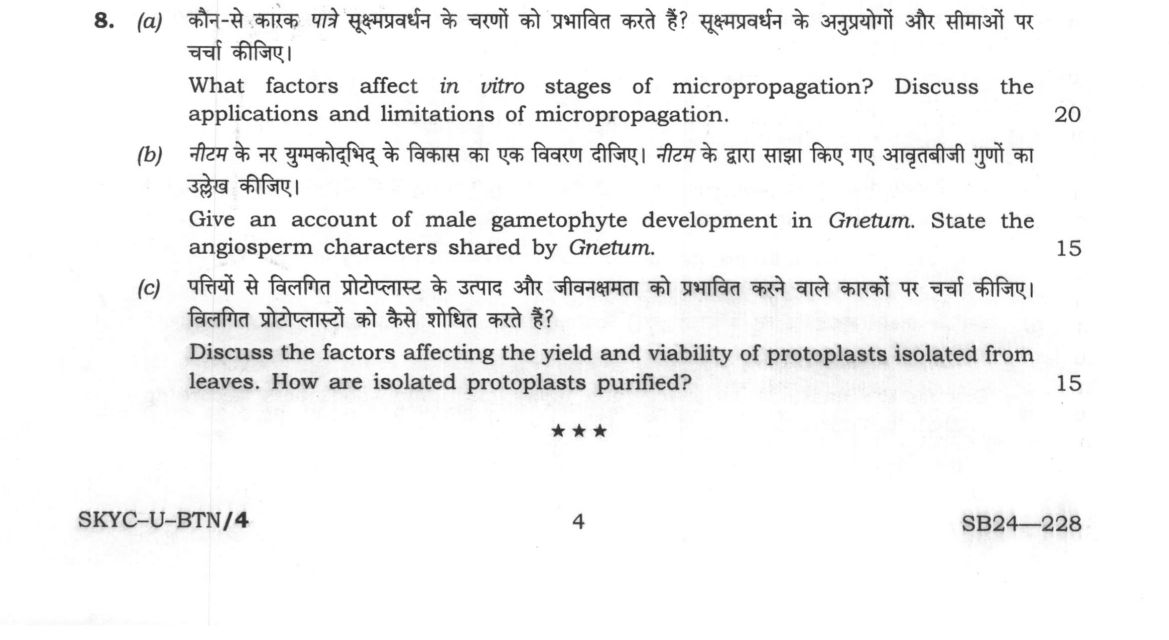
(a) What factors affect in vitro stages of micropropagation? Discuss the applications and limitations of micropropagation. (20…
What factors affect in vitro stages of micropropagation? Discuss the applications and limitations of micropropagation. 20 marks
Give an account of male gametophyte development in Gnetum. State the angiosperm characters shared by Gnetum. 15 marks
Discuss the factors affecting the yield and viability of protoplasts isolated from leaves. How are isolated protoplasts purified? 15 marks
हिंदी में प्रश्न पढ़ें
कौन-से कारक पारे सूक्ष्मप्रवर्धन के चरणों को प्रभावित करते हैं? सूक्ष्मप्रवर्धन के अनुप्रयोगों और सीमाओं पर चर्चा कीजिए। (20 अंक)
नीटम के नर युग्मकोद्भिद के विकास का एक विवरण दीजिए। नीटम के द्वारा साझा किए गए आवृतबीजी गुणों का उल्लेख कीजिए। (15 अंक)
पत्तियों से विलगित प्रोटोप्लास्ट के उत्पाद और जीवनक्षमता को प्रभावित करने वाले कारकों पर चर्चा कीजिए। विलगित प्रोटोप्लास्टों को कैसे शोधित करते हैं? (15 अंक)
Model answer
Written by UPSC Answer Check against this question's marking rubric, to the expected length. UPSC does not publish answers for Mains — this is one way to score well, not an official key.
Micropropagation: Factors, Applications, and Limitations
Micropropagation is the in vitro production of plants from explants under sterile conditions. Its success hinges on precise control of several factors. Explant selection is critical; meristematic tissues (shoot tips, axillary buds) are preferred for their high division rate and lower pathogen load. Media composition typically uses Murashige and Skoog (MS) salts, supplemented with carbon sources (sucrose) and gelling agents (agar). Growth regulators dictate stage-specific outcomes: high cytokinin-to-auxin ratios induce shoot multiplication, while auxin dominance promotes rooting. Culture conditions include temperature (25±2°C), photoperiod (16h light/8h dark), and light quality. Finally, hardening involves acclimatizing plantlets to ex vitro conditions by gradually reducing humidity and increasing light intensity to prevent desiccation.
The applications are vast. It enables rapid clonal propagation of elite genotypes, such as banana and potato, ensuring uniformity. It is vital for virus elimination via meristem tip culture, producing disease-free planting material. Additionally, it facilitates germplasm conservation in cryobanks, preserving endangered species and crop varieties. However, limitations exist. Somaclonal variation—genetic instability during tissue culture—can lead to undesirable traits. The process is costly due to sterile facilities and skilled labor. Many species are recalcitrant, resisting in vitro growth due to complex tissue structures or high polyphenol content.
Male Gametophyte Development in Gnetum
In Gnetum, the male gametophyte develops within microsporangiate strobili. Microsporocytes undergo meiosis to form haploid microspores. Each microspore develops into a pollen grain containing a prothallial cell (vegetative cell) and a generative cell. Upon pollination, the pollen grain germinates on the ovule, forming a pollen tube. The generative cell divides to produce two sperm cells. These sperm are multiflagellate, a characteristic shared with other gymnosperms but distinct from the biflagellate sperm of angiosperms. The pollen tube grows towards the egg apparatus, releasing the sperm cells.
Gnetum exhibits several angiosperm-like characters. Its wood contains vessel elements, facilitating efficient water transport, a trait rare in gymnosperms. It lacks archegonia; instead, the egg cell differentiates directly from cells of the female gametophyte. The pollen tube grows in a manner similar to angiosperms, guiding the sperm to the egg. While Gnetum does not undergo true double fertilization (synchrony of fertilization and endosperm formation is absent), the presence of vessels and the absence of archegonia place it phylogenetically close to angiosperms.
Protoplast Isolation: Yield, Viability, and Purification
Protoplast isolation involves enzymatic removal of the cell wall. Factors affecting yield and viability include leaf age; young, tender leaves yield higher protoplast counts due to thinner walls. The physiological state of the plant (stress, nutrient status) impacts enzyme sensitivity. Osmoticum type and concentration are crucial; high osmolarity (e.g., 0.6 M mannitol) prevents protoplast bursting during wall digestion. Enzyme composition must be optimized; a mix of cellulase (for cellulose), macerozyme (for hemicellulose), and pectinase (for pectin) ensures complete wall removal without damaging the plasma membrane. Incubation conditions (temperature, pH, duration) must be controlled to minimize toxicity. Genotype also plays a role, as some species have thicker or more lignified walls.
Purification of isolated protoplasts is essential to remove debris and unbroken cells. The crude suspension is first filtered through nylon mesh (100-200 µm) to remove large fragments. Centrifugation at low speed (100-200 g) gently pellets protoplasts. For higher purity, floatation on a sucrose gradient (e.g., 0.4 M to 0.8 M) or Percoll gradient is employed, separating protoplasts from denser debris. Viability is assessed using FDA (Fluorescein Diacetate) staining; live cells hydrolyze FDA to fluorescein, which fluoresces green under blue light (450-490 nm). Alternatively, Evans Blue stains dead cells with compromised membranes.
Conclusion
Micropropagation and protoplast technology are pivotal in plant biotechnology. While micropropagation offers scalable clonal propagation, its limitations necessitate genetic stability checks. Gnetum serves as a key evolutionary link, displaying angiosperm-like traits such as vessels and lack of archegonia. Protoplast isolation, though technically demanding, remains indispensable for genetic transformation and cell fusion. Future advancements in media optimization and automation can mitigate current limitations, enhancing the utility of these techniques in crop improvement and conservation.
What "Discuss" is asking you to do
Lay the issue out from more than one side — how it arose, what is claimed for it, what is held against it, and where it now stands. UPSC attaches discuss to broad topics with several live dimensions, so coverage of the dimensions earns more than the strength of your opinion.
Structure that answers it
Set the issue up → the case as it is made → the case against → the dimension both sides leave out → where the balance now lies
Where marks are lost
Listing facts with no thread between them, or arguing one side throughout and calling it a discussion.
How this answer will be evaluated
Approach
Framework: UPSC Botany Paper 1. (a) discuss: intro > 3-4 dimensions > example > balanced close | (b) describe: define > structure or process in order > labelled diagram > significance | (c) discuss: intro > 3-4 dimensions > example > balanced close Full marks: Comprehensive, specific, and well-structured answers with diagrams and examples.
Key points expected
- Factors affecting in vitro stages (e.g., auxin/cytokinin ratio, light, temperature)
- Applications of micropropagation (e.g., rapid clonal multiplication, virus-free plants)
- Limitations of micropropagation (e.g., somaclonal variation, high cost)
- Balanced discussion of the topic
- Stepwise development of male gametophyte in Gnetum
- Identification of angiosperm characters in Gnetum
- Use of exact binomial Gnetum
- Clear distinction between male and female gametophytes
Evaluation rubric
Each sub-part is marked on its own, against the marks and word limit printed on the paper.
- (a) Factors affecting in vitro stages, applications, and limitations of micropropagation. 20 marks
discuss— intro → 3-4 dimensions → example → balanced close
Must cover
- Factors affecting in vitro stages (e.g., auxin/cytokinin ratio, light, temperature)
- Applications of micropropagation (e.g., rapid clonal multiplication, virus-free plants)
- Limitations of micropropagation (e.g., somaclonal variation, high cost)
- Balanced discussion of the topic
Loses marks
- Vague or general statements without specific factors
- Confusing applications with limitations
- Lack of balance in discussion
Earns more
- Mention of specific plant species or cultivars
- Reference to recent biotech applications
- Clear distinction between different in vitro stages
- Practical examples of applications
Extra mark
- Named specific biotech application
- Recent research reference
- (b) Development of male gametophyte in Gnetum and its angiosperm characters. 15 marks
describe— define → structure or process in order → labelled diagram → significance
Must cover
- Stepwise development of male gametophyte in Gnetum
- Identification of angiosperm characters in Gnetum
- Use of exact binomial Gnetum
- Clear distinction between male and female gametophytes
Loses marks
- Unlabelled or missing diagram
- Confusing male and female gametophyte development
- Lack of specific angiosperm characters
Earns more
- Labelled diagram of male gametophyte development
- Comparison with other gymnosperms
- Mention of specific angiosperm-like features (e.g., pollen tube)
- Reference to evolutionary significance
Extra mark
- Named specific angiosperm character
- Recent research on Gnetum
- (c) Factors affecting protoplast yield/viability and purification methods. 15 marks
discuss— intro → 3-4 dimensions → example → balanced close
Must cover
- Factors affecting protoplast yield (e.g., enzyme concentration, pH)
- Factors affecting protoplast viability (e.g., osmotic pressure, temperature)
- Methods of protoplast purification (e.g., centrifugation, filtration)
- Clear explanation of each factor and method
Loses marks
- Vague or general statements without specific factors
- Confusing yield and viability factors
- Lack of specific purification methods
Earns more
- Specific enzyme names (e.g., cellulase, pectinase)
- Mention of specific purification techniques
- Reference to practical applications of protoplasts
- Clear distinction between yield and viability factors
Extra mark
- Named specific purification technique
- Recent research on protoplast isolation
Practice this exact question
Write your answer and it is marked point by point against the model answer above — what you covered, what you missed, what you got wrong.
Evaluate my answer →More from Botany 2023 Paper I
- Q5 Answer the following questions in about 150 words each: (a) Alphonse de Candolle classifi…
- Q6 (a) What are the different means of pollination in plants? Which natural devices ensure c…
- Q7 (a) Describe the botanical features, ecology and propagation of rubber tree. How is rubbe…
- Q8 (a) What factors affect in vitro stages of micropropagation? Discuss the applications and…