Paper II — Q1
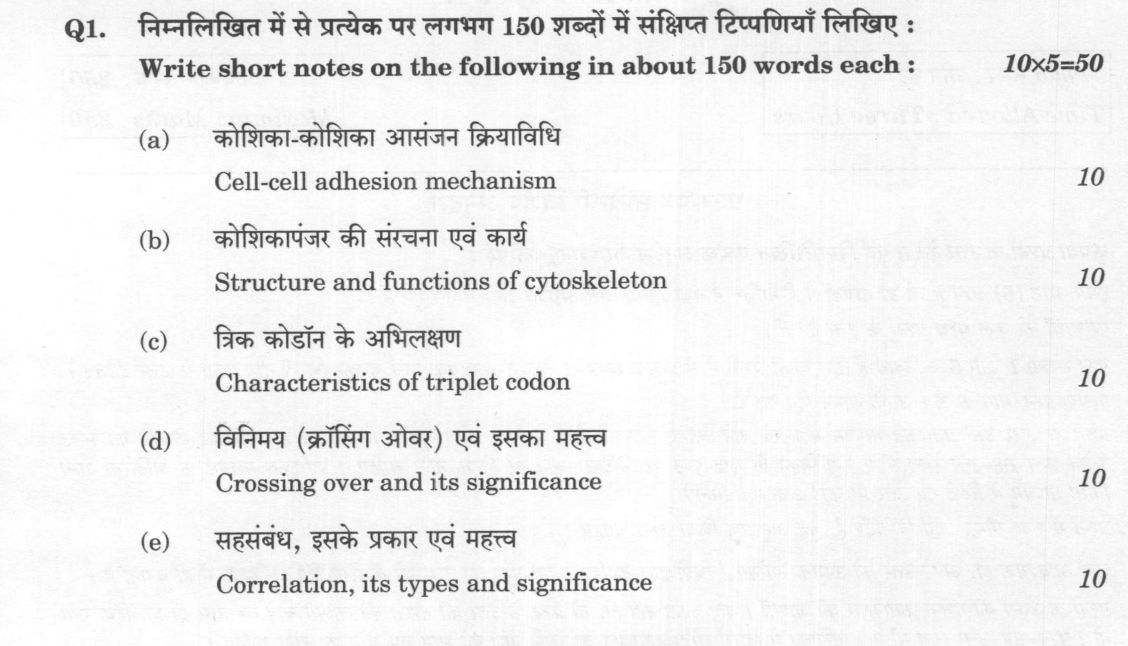
Write short notes on the following in about 150 words each : 10×5=50 (a) Cell-cell adhesion mechanism 10 (b) Structure and…
Write short notes on the following in about 150 words each : 10×5=50
Cell-cell adhesion mechanism 10
Structure and functions of cytoskeleton 10
Characteristics of triplet codon 10
Crossing over and its significance 10
Correlation, its types and significance 10
हिंदी में प्रश्न पढ़ें
निम्नलिखित में से प्रत्येक पर लगभग 150 शब्दों में संक्षिप्त टिप्पणियाँ लिखिए : 10×5=50
कोशिका-कोशिका आसंजन क्रियाविधि 10
कोशिकापंजर की संरचना एवं कार्य 10
त्रिक कोडोन के अभिलक्षण 10
विनिमय (क्रॉसिंग ओवर) एवं इसका महत्व 10
सहसंबंध, इसके प्रकार एवं महत्व 10
Model answer
Written by UPSC Answer Check against this question's marking rubric, to the 150-word length. UPSC does not publish answers for Mains — this is one way to score well, not an official key.
(a) Cell-cell adhesion mechanism Cell-cell adhesion is the process by which cells bind to one another, mediated by specific transmembrane proteins. The primary mechanisms involve cadherins, which are calcium-dependent glycoproteins that form homophilic bonds, creating adherens junctions and desmosomes. These structures provide mechanical strength and organize the actin cytoskeleton. Selectins mediate transient, calcium-dependent adhesion, crucial for leukocyte rolling in blood vessels. Integrins facilitate cell-matrix and cell-cell interactions, linking the extracellular matrix to the intracellular cytoskeleton. Members of the immunoglobulin superfamily, such as NCAM, also contribute to adhesion, particularly in the nervous system. Tight junctions, formed by claudins and occludins, seal the paracellular space, creating a barrier. These adhesion mechanisms are vital for tissue integrity, morphogenesis, and immune response. Disruptions in cadherin expression, for instance, are linked to metastasis in cancers like breast and gastric carcinoma, highlighting the role of adhesion in maintaining tissue architecture and preventing aberrant cell migration.
(b) Structure and functions of cytoskeleton The cytoskeleton is a dynamic network of protein filaments that provides structural support and facilitates movement. It comprises three main components: microfilaments, intermediate filaments, and microtubules. Microfilaments, composed of actin monomers, have a diameter of approximately 7 nm. They are involved in muscle contraction, cell motility, and cytokinesis. Intermediate filaments, such as keratin, vimentin, and neurofilaments, are 10 nm in diameter and provide tensile strength, anchoring the nucleus and organelles. Microtubules, made of tubulin dimers, are 25 nm in diameter and form the tracks for intracellular transport via motor proteins like kinesin and dynein. They are essential for chromosome segregation during mitosis and meiosis. The cytoskeleton maintains cell shape, enables cell division, and facilitates intracellular signaling. In plant cells, the cytoskeleton interacts with the cell wall to regulate growth and division. Its dynamic nature allows rapid reorganization in response to environmental stimuli, ensuring cellular homeostasis and function.
(c) Characteristics of triplet codon The genetic code is triplet, meaning three nucleotides (a codon) specify one amino acid. There are 64 possible codons, of which 61 encode the 20 standard amino acids, and 3 are stop codons (UAA, UAG, UGA) that signal termination of translation. The code is degenerate, as most amino acids are encoded by more than one codon, often differing only in the third position, explained by the wobble hypothesis. It is non-overlapping, meaning each nucleotide is read only once in a triplet frame. The code is unambiguous, with each codon specifying only one amino acid. It is nearly universal, with minor exceptions in mitochondrial genomes and some protists. The start codon is usually AUG, which also codes for methionine. This triplet nature ensures efficient and accurate protein synthesis. The degeneracy provides a buffer against mutations, as changes in the third base often do not alter the amino acid sequence, preserving protein function.
(d) Crossing over and its significance Crossing over is the exchange of genetic material between non-sister chromatids of homologous chromosomes during prophase I of meiosis, specifically at the pachytene stage. This process results in the formation of chiasmata, the physical manifestations of crossover events. The mechanism involves the formation of a Holliday junction, a four-stranded DNA structure, which is resolved to produce recombinant chromatids. Crossing over is significant for generating genetic diversity by creating new combinations of alleles. It is the basis for linkage mapping, where recombination frequency is used to estimate the distance between genes. However, recombination frequency is only approximately proportional to physical distance for short intervals; for larger distances, it plateaus at 50% due to multiple crossovers and interference. Crossing over ensures proper chromosome segregation during meiosis I. It is a key driver of evolution, providing the raw material for natural selection. In plant breeding, understanding recombination patterns helps in marker-assisted selection for desirable traits.
(e) Correlation, its types and significance Correlation is a statistical measure that quantifies the degree of association between two variables. It is denoted by Pearson’s coefficient of correlation, r, which ranges from -1 to +1, inclusive. A value of +1 indicates perfect positive correlation, -1 indicates perfect negative correlation, and 0 indicates no linear correlation. Types of correlation include simple (between two variables), partial (between two variables controlling for a third), and multiple (between one variable and a set of independent variables). Correlation can be linear or non-linear. In plant breeding, correlation analysis is used to identify traits associated with yield, aiding in the development of selection indices. For example, in wheat, positive correlation between grain yield and thousand-kernel weight helps in selecting high-yielding varieties. In ecology, correlation studies reveal relationships between species and environmental factors. However, correlation does not imply causation; further experimental validation is required. It is a fundamental tool in biometrical genetics and agricultural research for optimizing crop improvement strategies.
What "Write short notes" is asking you to do
Five or six self-contained answers, marked separately, typically 10 marks and about 150 words each. Each note must carry its own definition, its two or three defining features and a line on why it matters; a common introduction or conclusion across the notes earns nothing.
Structure that answers it
Per note: one-line definition or identification → two or three features, mechanisms or named examples → one line of significance or Indian application
Where marks are lost
Writing the first two notes at essay length and rationing the rest. Each note is marked on its own, so marks surrendered on a compressed or unattempted note cannot be won back by the long ones.
How this answer will be evaluated
Approach
Framework: Botany Paper 2: Define > Structure/Process > Labelled Diagram > Significance. (a) write short notes: define > 3-4 key features > one example > one-line significance | (b) write short notes: define > 3-4 key features > one example > one-line significance | (c) write short notes: define > 3-4 key features > one example > one-line significance | (d) write short notes: define > 3-4 key features > one example > one-line significance | (e) write short notes: define > 3-4 key features > one example > one-line significance Full marks: Precise definitions, specific examples, labelled diagrams, and clear significance for each part.
Key points expected
- Definition of cell-cell adhesion
- Mention of specific adhesion molecules (e.g., CAMs, integrins)
- Description of the binding mechanism
- One-line significance in tissue formation
- Identification of the three main components (microtubules, microfilaments, intermediate filaments)
- Description of the structural role
- Mention of at least two functions (e.g., motility, division)
- One-line significance
Evaluation rubric
Each sub-part is marked on its own, against the marks and word limit printed on the paper.
- (a) Define cell-cell adhesion and describe the mechanism of attachment. 10 marks · 150 words
write short notes— define → 3-4 key features → one example → one-line significance
Must cover
- Definition of cell-cell adhesion
- Mention of specific adhesion molecules (e.g., CAMs, integrins)
- Description of the binding mechanism
- One-line significance in tissue formation
Loses marks
- Unlabelled diagrams
- Vague description without molecular names
- Confusing adhesion with transport
Earns more
- Labelled diagram of adhesion junctions
- Mention of desmosomes or gap junctions
- Link to plant plasmodesmata or animal tissues
Extra mark
- Specific example of a CAM (e.g., Cadherin)
- Reference to a specific biological process (e.g., embryogenesis)
- (b) Outline the structure of the cytoskeleton and list its key functions. 10 marks · 150 words
write short notes— define → 3-4 key features → one example → one-line significance
Must cover
- Identification of the three main components (microtubules, microfilaments, intermediate filaments)
- Description of the structural role
- Mention of at least two functions (e.g., motility, division)
- One-line significance
Loses marks
- Unlabelled diagrams
- Omitting one of the three main components
- Confusing cytoskeleton with cell wall
Earns more
- Labelled diagram of cytoskeletal elements
- Mention of specific proteins (e.g., tubulin, actin)
- Link to cell division or shape maintenance
Extra mark
- Specific example of a cytoskeletal disease
- Mention of specific motor proteins (e.g., kinesin)
- (c) List the key characteristics of triplet codons in the genetic code. 10 marks · 150 words
write short notes— define → 3-4 key features → one example → one-line significance
Must cover
- Definition of a triplet codon
- Mention of the total number of codons (64)
- Explanation of degeneracy/redundancy
- Mention of start and stop codons
Loses marks
- Incorrect number of codons
- Confusing codons with anticodons
- Vague description without specific examples
Earns more
- Mention of the universal nature of the code
- Example of a specific codon (e.g., AUG)
- Mention of wobble hypothesis
Extra mark
- Specific example of a synonymous codon pair
- Reference to a specific mutation type
- (d) Define crossing over and explain its significance in genetics. 10 marks · 150 words
write short notes— define → 3-4 key features → one example → one-line significance
Must cover
- Definition of crossing over
- Mention of the stage of meiosis (Prophase I)
- Explanation of the exchange of genetic material
- Significance in genetic recombination
Loses marks
- Unlabelled diagrams
- Confusing crossing over with independent assortment
- Vague description without specific stage
Earns more
- Labelled diagram of chiasmata
- Mention of homologous chromosomes
- Link to genetic variation
Extra mark
- Specific example of a crossover event
- Mention of recombination frequency
- (e) Define correlation, list its types, and state its significance. 10 marks · 150 words
write short notes— define → 3-4 key features → one example → one-line significance
Must cover
- Definition of correlation
- Mention of the types (positive, negative, zero)
- Explanation of the correlation coefficient
- Significance in biological data analysis
Loses marks
- Confusing correlation with causation
- Vague description without specific types
- Incorrect definition of correlation
Earns more
- Example of a biological correlation (e.g., height and weight)
- Mention of Pearson's correlation coefficient
- Link to statistical analysis
Extra mark
- Specific example of a correlation study
- Mention of a specific statistical test
Practice this exact question
Write your answer and it is marked point by point against the model answer above — what you covered, what you missed, what you got wrong.
Evaluate my answer →More from Botany 2023 Paper II
- Q1 Write short notes on the following in about 150 words each : 10×5=50 (a) Cell-cell adhesi…
- Q2 (a) Differentiate between polytene chromosomes and normal chromosomes. 15 (b) Describe po…
- Q3 (a) What are the major requirements for a successful back-crossing programme ? Describe i…
- Q4 (a) Describe the structure, kinds, chemical nature, origin and functions of lysosomes. 20…