Paper II — Q3
(a) What are the major requirements for a successful back-crossing programme ? Describe its procedure, advantages and…
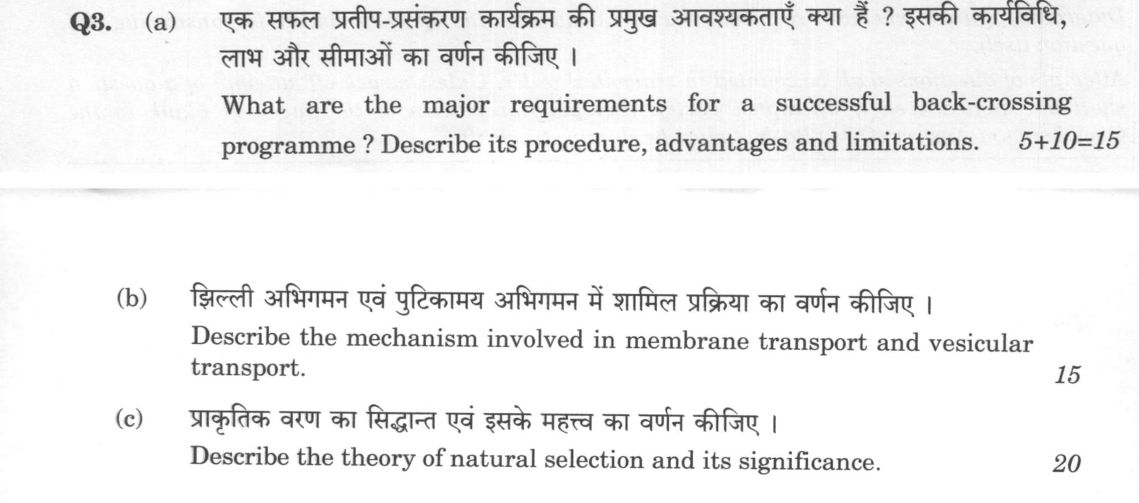
What are the major requirements for a successful back-crossing programme ? Describe its procedure, advantages and limitations. 5+10=15
Describe the mechanism involved in membrane transport and vesicular transport. 15 marks
Describe the theory of natural selection and its significance. 20 marks
हिंदी में प्रश्न पढ़ें
एक सफल प्रतिप-प्रसंकरण कार्यक्रम की प्रमुख आवश्यकताएँ क्या हैं ? इसकी कार्यविधि, लाभ और सीमाओं का वर्णन कीजिए । 5+10=15
झिल्ली अभिगमन एवं पुटिकामय अभिगमन में शामिल प्रक्रिया का वर्णन कीजिए । 15
प्राकृतिक वरण का सिद्धांत एवं इसके महत्व का वर्णन कीजिए । 20
Model answer
Written by UPSC Answer Check against this question's marking rubric, to the expected length. UPSC does not publish answers for Mains — this is one way to score well, not an official key.
Back-crossing is a precise breeding strategy to transfer a specific desirable gene from a donor parent into the genetic background of a superior recurrent parent. The major requirements for a successful programme include the availability of a superior recurrent parent with high agronomic value, a donor parent possessing the target trait, and the trait being controlled by a dominant gene or easily detectable marker. Crucially, a sufficient population size is required to ensure genetic diversity and selection efficiency.
The procedure begins with an initial cross between the recurrent and donor parents. The F1 hybrid is then back-crossed to the recurrent parent. In each subsequent generation, individuals expressing the donor trait are selected and crossed again to the recurrent parent. This cycle is repeated for 5–7 generations (BC1 to BC7). The proportion of the recurrent parent genome in the BCn generation is calculated as 1 - (1/2)ⁿ⁺¹. For instance, after six back-crosses, the progeny retains approximately 99.2% of the recurrent parent’s genome. Advantages include the precise introduction of a single gene into an elite background, maintaining the recurrent parent’s superior yield and quality traits. However, limitations include linkage drag, where undesirable genes linked to the target gene are co-inherited, and the significant time and labor required for multiple generations of crossing and selection. While back-crossing reduces the need for extensive multi-location field trials compared to full hybridization, it does not eliminate the need for phenotypic validation in the field. IRRI’s development of submergence-tolerant rice varieties (e.g., Sub1) exemplifies this, where the Sub1A gene was introgressed into elite cultivars via back-crossing.
Membrane and vesicular transport mechanisms are fundamental to cellular homeostasis. Membrane transport is categorized into passive and active processes. Passive transport, including simple diffusion and facilitated diffusion, moves substances down their concentration gradient without energy input. Facilitated diffusion relies on specific channel proteins, such as aquaporins for water, or carrier proteins. Active transport moves substances against their gradient using energy. Primary active transport, exemplified by the Na+/K+-ATPase pump, directly hydrolyzes ATP to move ions. Secondary active transport uses the electrochemical gradient established by primary pumps to drive the cotransport of other molecules, such as proton pumps in plant cells.
Vesicular transport involves the movement of materials in membrane-bound vesicles. Endocytosis internalizes extracellular material through phagocytosis (solids), pinocytosis (liquids), and receptor-mediated endocytosis. While receptor-mediated endocytosis often utilizes clathrin or caveolin coats, phagocytosis and many forms of pinocytosis are not dependent on these specific coat proteins. Internalized vesicles fuse with endosomes for sorting. Exocytosis releases materials from the cell, such as secretory proteins from the Golgi apparatus. This process is regulated by SNARE proteins, which mediate vesicle fusion with the target membrane, and Rab GTPases, which direct vesicle trafficking. In mangroves, specialized membrane transport mechanisms help manage salt stress, while in crop improvement, understanding these pathways aids in developing stress-tolerant varieties.
The theory of natural selection, proposed by Darwin and Wallace, explains evolution through four key postulates: variation within populations, heritability of traits, overproduction of offspring, and differential survival and reproduction. Individuals with traits better suited to the environment have higher fitness, leading to greater reproductive success. Over generations, these advantageous traits become more common. The modern synthesis integrates genetics into this framework, explaining variation through mutation and recombination. The significance of natural selection is profound. It drives adaptation, as seen in the industrial melanism of the peppered moth, where dark variants survived better in polluted environments. It also drives speciation, such as the adaptive radiation of Darwin’s finches in the Galapagos. In conservation biology, understanding selection pressures helps preserve genetic diversity. In agriculture, natural selection principles guide breeding programs, where human-directed selection mimics natural processes to enhance crop traits. Thus, natural selection is the unifying mechanism of evolutionary biology, linking molecular changes to macroevolutionary patterns.
In conclusion, back-crossing, membrane transport, and natural selection represent interconnected biological principles. Back-crossing is a human-directed application of selection, membrane transport underpins cellular adaptation to stress, and natural selection provides the evolutionary framework for understanding adaptation and diversity. Together, they highlight the integration of genetics, physiology, and evolution in both natural and agricultural contexts.
What "Describe" is asking you to do
Give a full, ordered account of the thing named — its parts, stages or mechanism — in the sequence in which it actually exists or occurs. Most describe questions come from the science optionals, where the marks sit in correct technical detail and, where the stem says so, a labelled diagram.
Structure that answers it
One-line identification of the subject → the parts or stages in their real order, each with its defining detail → labelled diagram where the subject is structural → closing line on function or significance
Where marks are lost
Loose general prose where the examiner is ticking named parts, correct terminology and their sequence; and in the General Studies papers, turning to evaluation before the description is finished.
How this answer will be evaluated
Approach
Framework: Botany Paper 2: Plant Breeding & Cell Biology. (a) describe: define > structure or process in order > labelled diagram > significance | (b) describe: define > structure or process in order > labelled diagram > significance | (c) describe: define > structure or process in order > labelled diagram > significance Full marks: Comprehensive, accurate, well-structured with diagrams and examples.
Key points expected
- Back-crossing requirements and procedure
- Membrane and vesicular transport mechanisms
- Natural selection theory and significance
Evaluation rubric
Each sub-part is marked on its own, against the marks and word limit printed on the paper.
- (a) Requirements, stepwise procedure, advantages, and limitations of back-crossing. 15 marks
describe— define → structure or process in order → labelled diagram → significance
Must cover
- Requirements: recurrent parent, donor, marker
- Procedure: cross, selection, repeated back-crossing
- Advantages: introgression, genetic background
- Limitations: linkage drag, time
Loses marks
- Unlabelled diagram
- Loose common names
- Missing limitations
Earns more
- Diagram of back-crossing generations
- Example: *Triticum aestivum* or *Oryza sativa*
- Mention of molecular markers
- Link to disease resistance
Extra mark
- Specific cultivar name
- Recent biotech application
- (b) Mechanisms of membrane transport and vesicular transport. 15 marks
describe— define → structure or process in order → labelled diagram → significance
Must cover
- Membrane transport: passive, active, facilitated
- Vesicular transport: endocytosis, exocytosis
- Labelled diagram of transport mechanisms
- Significance in plant cells
Loses marks
- Unlabelled diagram
- Loose common names
- Missing vesicular transport
Earns more
- Specific transporters (e.g., H+-ATPase)
- Example: *Arabidopsis thaliana*
- Link to nutrient uptake
- Mention of clathrin-coated vesicles
Extra mark
- Recent biotech application
- Specific protein name
- (c) Theory of natural selection and its significance. 20 marks
describe— define → structure or process in order → labelled diagram → significance
Must cover
- Definition of natural selection
- Key principles: variation, inheritance, selection
- Significance in evolution
- Labelled diagram of selection process
Loses marks
- Unlabelled diagram
- Loose common names
- Missing significance
Earns more
- Example: *Drosophila melanogaster*
- Link to conservation
- Mention of Darwin
- Specific case study
Extra mark
- Recent biotech application
- Specific statistic
Practice this exact question
Write your answer and it is marked point by point against the model answer above — what you covered, what you missed, what you got wrong.
Evaluate my answer →More from Botany 2023 Paper II
- Q1 Write short notes on the following in about 150 words each : 10×5=50 (a) Cell-cell adhesi…
- Q2 (a) Differentiate between polytene chromosomes and normal chromosomes. 15 (b) Describe po…
- Q3 (a) What are the major requirements for a successful back-crossing programme ? Describe i…
- Q4 (a) Describe the structure, kinds, chemical nature, origin and functions of lysosomes. 20…
- Q5 Write short notes on the following in about 150 words each : 10×5=50 (a) Biological signi…
- Q6 (a) What are nastic movements, their types and mechanism ? Explain. 15 (b) How is the tra…