Paper II — Q4
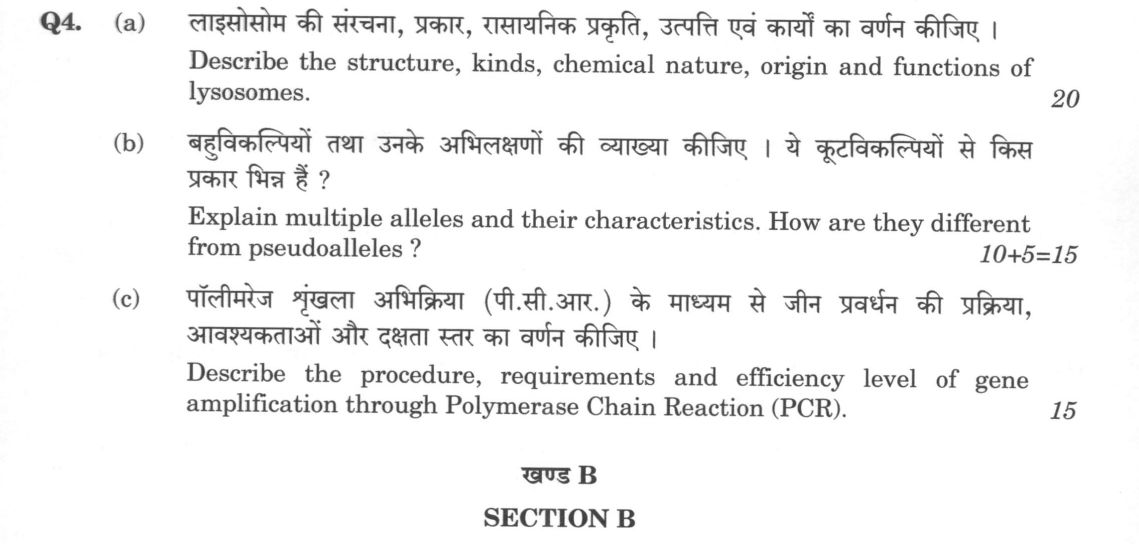
(a) Describe the structure, kinds, chemical nature, origin and functions of lysosomes. 20 (b) Explain multiple alleles and their…
Describe the structure, kinds, chemical nature, origin and functions of lysosomes. 20 marks
Explain multiple alleles and their characteristics. How are they different from pseudoalleles ? 10+5=15
Describe the procedure, requirements and efficiency level of gene amplification through Polymerase Chain Reaction (PCR). 15 marks
हिंदी में प्रश्न पढ़ें
लाइसोसोम की संरचना, प्रकार, रासायनिक प्रकृति, उत्पत्ति एवं कार्यों का वर्णन कीजिए । 20
बहुविकल्पियों तथा उनके अभिलक्षणों की व्याख्या कीजिए । ये कूटविकल्पियों से किस प्रकार भिन्न हैं ? 10+5=15
पॉलीमेरेज श्रृंखला अभिक्रिया (पी.सी.आर.) के माध्यम से जीन प्रवर्धन की प्रक्रिया, आवश्यकताओं और दक्षता स्तर का वर्णन कीजिए । 15
Model answer
Written by UPSC Answer Check against this question's marking rubric, to the expected length. UPSC does not publish answers for Mains — this is one way to score well, not an official key.
(a) Lysosomes
Lysosomes are membrane-bound vesicles, approximately 0.1–1.0 µm in diameter, containing hydrolytic enzymes that function optimally at an acidic pH of 4.5–5.0. They are not storage compartments for inactive zymogens; rather, the enzymes are active at the internal acidic pH but are kept separate from cellular substrates until the lysosome fuses with a target compartment. This compartmentalization prevents the digestion of the cell’s own components.
Structure and Kinds Lysosomes are enclosed by a single lipid bilayer membrane rich in glycoproteins, which protects the cytoplasm from the hydrolytic enzymes within. They are classified into three functional types:
- Primary Lysosomes: Newly formed vesicles budding from the trans-Golgi network, containing enzymes but no substrate.
- Secondary Lysosomes (Digestive Vacuoles): Formed by the fusion of primary lysosomes with phagocytic or autophagic vacuoles. Digestion occurs here.
- Residual Bodies (Lysosomes): Vacuoles containing undigested material that persists after the digestive process, eventually expelled via exocytosis.
Chemical Nature and Origin The enzymes are acid hydrolases, including proteases, lipases, nucleases, and glycosidases. They are synthesized on the rough endoplasmic reticulum and transported to the Golgi apparatus. In the Golgi, mannose-6-phosphate (M6P) tags are added to the enzymes, allowing them to be sorted into vesicles that bud off to form lysosomes. This pathway is part of the Golgi-Endoplasmic Reticulum-Lysosome (GERL) system.
Functions Lysosomes perform two major functions:
- Heterophagy: Digestion of extracellular material taken up by phagocytosis (e.g., bacteria in macrophages) or pinocytosis.
- Autophagy: Digestion of the cell’s own organelles or proteins. This is crucial for recycling nutrients during starvation and removing damaged organelles (mitophagy). Additionally, lysosomes play a role in programmed cell death (apoptosis) and the breakdown of waste products in senescent cells.
(b) Multiple Alleles and Pseudoalleles
Multiple Alleles Multiple alleles refer to the existence of three or more alternative forms of a gene in a population, all occupying the same locus on homologous chromosomes. An individual diploid organism can possess only two of these alleles at a time.
- Characteristics:
- Dominance Hierarchy: Often, a clear dominance series exists (e.g., in Drosophila eye color: w⁺ > w^e > w^c).
- Codominance: Some alleles may be codominant, expressing both phenotypes simultaneously.
- Population Frequency: The frequency of alleles is determined by Hardy-Weinberg equilibrium principles, though selection can alter these frequencies.
- Examples: The human ABO blood group system is a classic example, with alleles I^A, I^B, and i. I^A and I^B are codominant, while both are dominant over i. In Drosophila, the white eye gene has multiple alleles such as w⁺ (wild type), w (white), w^e (eosin), and w^c (coral).
Difference from Pseudoalleles Pseudoalleles are genes located at different loci but so closely linked that they behave like a single unit during inheritance, mimicking multiple alleles.
- Key Distinction: Multiple alleles are alternative forms of the same gene at the same locus. Pseudoalleles are distinct genes at different loci.
- Recombination: Multiple alleles do not recombine with each other (as they are at the same locus). Pseudoalleles can recombine, although the recombination frequency is very low (often <0.5%) due to tight linkage. For example, the star and asteroid mutations in Drosophila are pseudoalleles; they produce similar phenotypes but are located at different positions on the chromosome.
(c) Polymerase Chain Reaction (PCR)
PCR is an in vitro technique used to amplify specific DNA sequences exponentially. It was developed by Kary Mullis in 1983.
Procedure The process involves repeated cycles of temperature changes:
- Denaturation (94–95°C): The double-stranded DNA template is heated to separate it into single strands.
- Annealing (50–65°C): The temperature is lowered to allow short, synthetic primers to bind (anneal) to the complementary sequences flanking the target region.
- Extension (72°C): The temperature is raised to the optimal activity temperature of Taq polymerase, which synthesizes new DNA strands by adding dNTPs to the 3' end of the primers.
Requirements
- Template DNA: The source DNA containing the target sequence.
- Primers: Two short oligonucleotides (18–25 bases) complementary to the 3' ends of the target sequence.
- Taq Polymerase: A thermostable DNA polymerase isolated from Thermus aquaticus, capable of withstanding high temperatures.
- dNTPs: Deoxynucleotide triphosphates (dATP, dTTP, dCTP, dGTP) as building blocks.
- Mg²⁺ Ions: Essential cofactor for polymerase activity.
- Buffer Solution: To maintain optimal pH and ionic strength.
Efficiency and Limitations PCR achieves exponential amplification, theoretically producing 2^ncopies aftern cycles. In practice, 20–30 cycles yield millions to billions of copies.
- Error Rate: Taq polymerase lacks 3' to 5' exonuclease proofreading activity, resulting in an error rate of approximately 10⁻⁴ per base per cycle. This can lead to mutations in the amplified product.
- Limitations: PCR is less efficient with highly degraded DNA or complex mixtures. Non-specific amplification can occur if primer design is poor.
- Applications: PCR is fundamental in forensic science (DNA fingerprinting in criminal cases), medical diagnosis (e.g., RT-PCR for SARS-CoV-2), and phylogenetic studies. Its speed and sensitivity make it indispensable in modern molecular biology.
What "Describe" is asking you to do
Give a full, ordered account of the thing named — its parts, stages or mechanism — in the sequence in which it actually exists or occurs. Most describe questions come from the science optionals, where the marks sit in correct technical detail and, where the stem says so, a labelled diagram.
Structure that answers it
One-line identification of the subject → the parts or stages in their real order, each with its defining detail → labelled diagram where the subject is structural → closing line on function or significance
Where marks are lost
Loose general prose where the examiner is ticking named parts, correct terminology and their sequence; and in the General Studies papers, turning to evaluation before the description is finished.
How this answer will be evaluated
Approach
Framework: UPSC Botany Paper 2. (a) describe: define > structure or process in order > labelled diagram > significance | (b) explain: definition/context > points in order > small example > short close | (c) describe: define > structure or process in order > labelled diagram > significance Full marks: Comprehensive, accurate, with labelled diagrams and specific examples.
Key points expected
- Structure: single membrane, acidic pH, hydrolytic enzymes
- Kinds: primary, secondary, residual bodies
- Origin: Golgi apparatus (Mautner bodies)
- Functions: autophagy, heterophagy, digestion
- Definition: >2 alleles at one locus
- Characteristics: dominance hierarchy, population frequency
- Example: ABO blood group system
- Difference: pseudoalleles are linked, not at same locus
Evaluation rubric
Each sub-part is marked on its own, against the marks and word limit printed on the paper.
- (a) Systematic account of lysosome structure, types, chemistry, origin, and functions. 20 marks
describe— define → structure or process in order → labelled diagram → significance
Must cover
- Structure: single membrane, acidic pH, hydrolytic enzymes
- Kinds: primary, secondary, residual bodies
- Origin: Golgi apparatus (Mautner bodies)
- Functions: autophagy, heterophagy, digestion
Loses marks
- Unlabelled diagrams
- Confusing lysosomes with peroxisomes
- Missing chemical nature (enzymes)
Earns more
- Labelled diagram of lysosome cycle
- Mention of specific enzymes (e.g., lipase, protease)
- Link to plant pathology or biotech applications
Extra mark
- Reference to specific plant species or cultivar
- Recent biotech application of lysosomal enzymes
- (b) Definition and characteristics of multiple alleles; distinction from pseudoalleles. 15 marks
explain— definition/context → points in order → small example → short close
Must cover
- Definition: >2 alleles at one locus
- Characteristics: dominance hierarchy, population frequency
- Example: ABO blood group system
- Difference: pseudoalleles are linked, not at same locus
Loses marks
- Confusing multiple alleles with polygenic traits
- Failing to distinguish from pseudoalleles
- Lack of specific examples
Earns more
- Mendelian inheritance patterns
- Link to crop breeding or conservation
- Clear distinction between true and pseudoalleles
Extra mark
- Named species or cultivar example
- Recent biotech application in allele analysis
- (c) Procedure, requirements, and efficiency of PCR for gene amplification. 15 marks
describe— define → structure or process in order → labelled diagram → significance
Must cover
- Procedure: denaturation, annealing, extension cycles
- Requirements: Taq polymerase, primers, dNTPs, template
- Efficiency: exponential amplification, sensitivity
- Applications: diagnostics, forensics, research
Loses marks
- Unlabelled diagrams
- Missing key requirements (e.g., Taq polymerase)
- Confusing PCR with other amplification methods
Earns more
- Labelled diagram of PCR cycle
- Mention of specific temperatures for each step
- Link to crop biotechnology or conservation
Extra mark
- Named species or cultivar in application
- Recent biotech application of PCR
Practice this exact question
Write your answer and it is marked point by point against the model answer above — what you covered, what you missed, what you got wrong.
Evaluate my answer →More from Botany 2023 Paper II
- Q1 Write short notes on the following in about 150 words each : 10×5=50 (a) Cell-cell adhesi…
- Q2 (a) Differentiate between polytene chromosomes and normal chromosomes. 15 (b) Describe po…
- Q3 (a) What are the major requirements for a successful back-crossing programme ? Describe i…
- Q4 (a) Describe the structure, kinds, chemical nature, origin and functions of lysosomes. 20…
- Q5 Write short notes on the following in about 150 words each : 10×5=50 (a) Biological signi…
- Q6 (a) What are nastic movements, their types and mechanism ? Explain. 15 (b) How is the tra…
- Q7 (a) How can the reaction equilibria and reaction rates be explained by using free energy…