Paper II — Q8
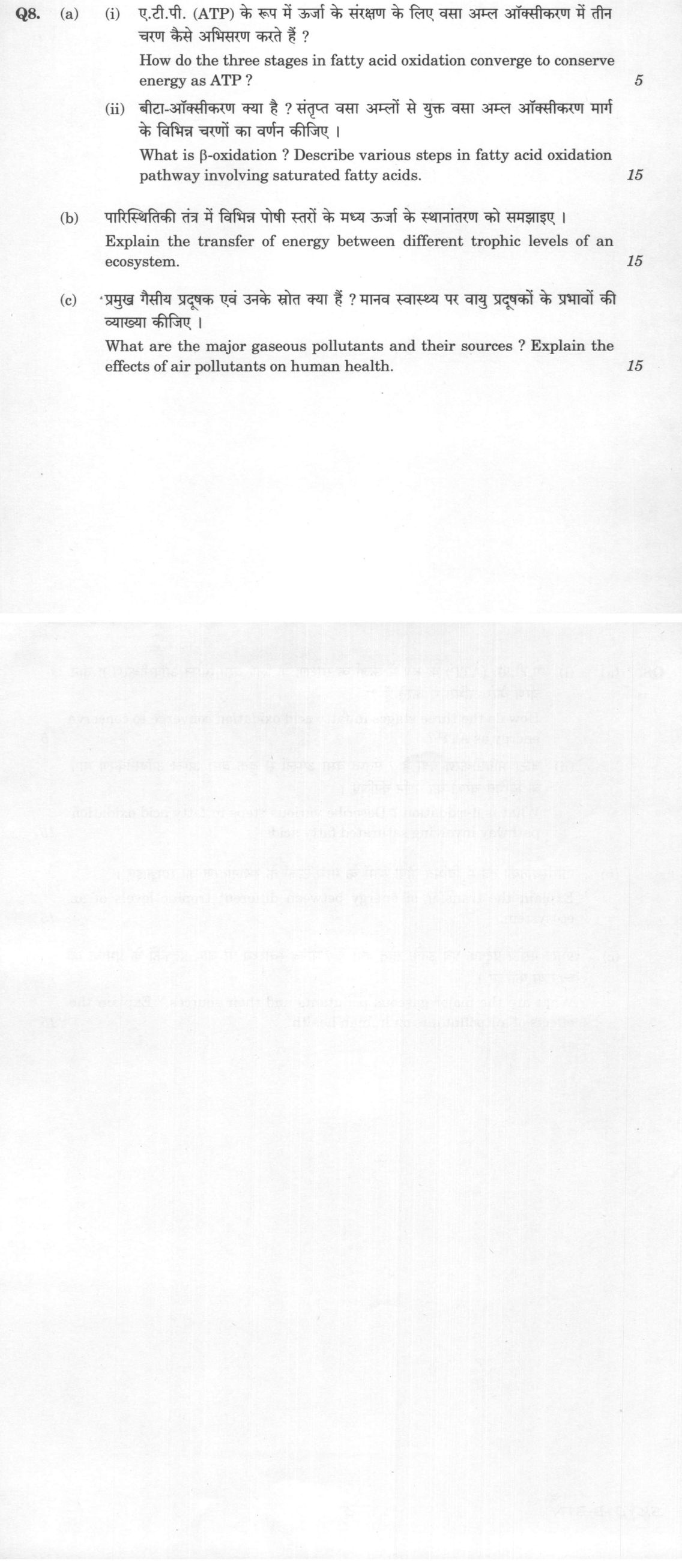
(a) (i) How do the three stages in fatty acid oxidation converge to conserve energy as ATP ? 5 (ii) What is β-oxidation ?…
How do the three stages in fatty acid oxidation converge to conserve energy as ATP ? 5 marks
What is β-oxidation ? Describe various steps in fatty acid oxidation pathway involving saturated fatty acids. 15 marks
Explain the transfer of energy between different trophic levels of an ecosystem. 15 marks
What are the major gaseous pollutants and their sources ? Explain the effects of air pollutants on human health. 15 marks
हिंदी में प्रश्न पढ़ें
ए.टी.पी. (ATP) के रूप में ऊर्जा के संरक्षण के लिए वसा अम्ल ऑक्सीकरण में तीन चरण कैसे अभिसरण करते हैं ? 5 marks
बीटा-ऑक्सीकरण क्या है ? संतृप्त वसा अम्लों से युक्त वसा अम्ल ऑक्सीकरण मार्ग के विभिन्न चरणों का वर्णन कीजिए । 15
पारिस्थितिकी तंत्र में विभिन्न पोषी स्तरों के मध्य ऊर्जा के स्थानांतरण को समझाइए । 15
प्रमुख गैसीय प्रदूषक एवं उनके स्रोत क्या हैं ? मानव स्वास्थ्य पर वायु प्रदूषकों के प्रभावों की व्याख्या कीजिए । 15
Model answer
Written by UPSC Answer Check against this question's marking rubric, to the expected length. UPSC does not publish answers for Mains — this is one way to score well, not an official key.
Convergence of Metabolic Pathways and Ecosystem Dynamics
(a)(i) Convergence to ATP Conservation Fatty acid oxidation is a multi-stage process where energy is conserved through the sequential generation of electron carriers and their subsequent oxidation. The three converging stages are: (1) β-oxidation, which cleaves fatty acyl-CoA into acetyl-CoA, generating NADH and FADH₂; (2) the Krebs Cycle (Citric Acid Cycle), where acetyl-CoA is fully oxidized to CO₂, producing additional NADH, FADH₂, and GTP; and (3) the Electron Transport Chain (ETC), where electrons from NADH and FADH₂ drive proton pumping to establish a gradient for oxidative phosphorylation. For palmitate (C16:0), the net yield is 106 ATP using modern P/O ratios (NADH=2.5, FADH₂=1.5). This is calculated from 7 FADH₂ (10.5 ATP), 14 NADH (35 ATP), 7 GTP (7 ATP), and 8 acetyl-CoA entering the Krebs cycle (80 ATP), minus 2 ATP for activation.
(a)(ii) β-Oxidation Pathway β-oxidation is the mitochondrial catabolic pathway that breaks down saturated fatty acids into two-carbon acetyl-CoA units. The process occurs in the mitochondrial matrix and involves four repeating enzymatic steps:
- Oxidation: Acyl-CoA dehydrogenase catalyzes the removal of two hydrogen atoms from the α and β carbons, forming a trans-Δ²-enoyl-CoA. This reaction reduces FAD to FADH₂, which transfers electrons to electron transfer flavoprotein (ETF) and then to the ETC.
- Hydration: Enoyl-CoA hydratase adds water across the double bond, converting trans-Δ²-enoyl-CoA to L-β-hydroxyacyl-CoA.
- Oxidation: L-β-hydroxyacyl-CoA dehydrogenase oxidizes the hydroxyl group at the β-carbon to a keto group, forming β-ketoacyl-CoA. This step reduces NAD⁺ to NADH.
- Thiolysis: β-Ketothiolase cleaves the bond between the α and β carbons using coenzyme A (CoA-SH). This releases acetyl-CoA and a fatty acyl-CoA shortened by two carbons.
The shortened acyl-CoA re-enters the cycle. For palmitate, this occurs seven times, yielding eight acetyl-CoA molecules. These acetyl-CoA units enter the Krebs cycle, linking fatty acid oxidation to complete aerobic respiration.
(b) Energy Transfer in Ecosystems Energy flow in ecosystems is unidirectional, moving from the sun to producers and up through trophic levels. Producers (autotrophs) capture solar energy via photosynthesis. Primary consumers (herbivores) feed on producers, followed by secondary and tertiary consumers (carnivores).
The transfer of energy between these levels is inefficient, governed by Lindeman’s 10% Law. Only about 10% of the energy from one trophic level is assimilated and stored as biomass in the next level. The remaining 90% is lost primarily as heat during cellular respiration, or remains in undigested matter (feces) and excretory products, which are eventually decomposed by saprotrophs.
This inefficiency shapes ecological structures, visualized through Ecological Pyramids:
- Pyramid of Energy: Always upright, reflecting the continuous loss of energy at each step.
- Pyramid of Biomass: Usually upright but can be inverted in aquatic ecosystems where short-lived phytoplankton support larger zooplankton biomass.
- Pyramid of Number: Can be inverted (e.g., one tree supporting many insects).
In Indian grasslands, for instance, the energy available to top predators like leopards is a tiny fraction of the solar energy fixed by grasses, limiting the population size of higher trophic levels.
(c) Gaseous Pollutants and Health Impacts Major gaseous pollutants include Sulphur Dioxide (SO₂), Nitrogen Oxides (NOₓ), Carbon Monoxide (CO), Ozone (O₃), and Carbon Dioxide (CO₂).
- Sources: SO₂ originates from thermal power plants (e.g., NTPC units) and smelters. NOₓ is emitted by vehicles and industrial combustion. CO results from incomplete combustion in vehicles and biomass burning. O₃ is a secondary pollutant formed by photochemical reactions of NOₓ and VOCs in sunlight, characteristic of photochemical smog in Delhi-NCR. CO₂ is a greenhouse gas from fossil fuel use.
- Health Effects:
- SO₂ and NOₓ: Irritate the respiratory tract, causing bronchitis, asthma exacerbation, and reduced lung function.
- CO: Binds reversibly with hemoglobin to form carboxyhemoglobin (COHb) with an affinity ~200-250 times higher than oxygen. This reduces oxygen-carrying capacity, leading to hypoxia, headaches, and potentially death.
- O₃: A potent oxidant that damages lung tissue, reduces immune response, and aggravates respiratory diseases.
- CO₂: Contributes to climate change, indirectly affecting health through heatwaves and vector-borne disease spread.
In India, the National Ambient Air Quality Standards (NAAQS) set by the CPCB aim to mitigate these risks. The severe air quality in Delhi, often driven by vehicular emissions and stubble burning in Punjab-Haryana, highlights the urgent need for stricter enforcement of emission controls to protect public health.
Conclusion The efficiency of metabolic energy conservation in organisms is mirrored by the rigid constraints of energy transfer in ecosystems. However, human-induced pollution disrupts these natural balances, posing significant health risks. Integrating metabolic understanding with environmental policy is crucial for sustainable health outcomes.
What "Explain" is asking you to do
Make the working of something clear — what sets it off, what follows from what, and what it produces. Explain is the Commission's mechanism word: it dominates the technical papers and the “explain why” stems, where the marks sit in the causal chain and not in the label.
Structure that answers it
State what it is → the initiating condition → the chain of cause, step by step → an instance where it plays out → what the chain produces
Where marks are lost
Describing what something looks like instead of why it works that way. Naming the stages without linking them reads as description too.
How this answer will be evaluated
Approach
Framework: Botany, Paper 2. (a(i)) explain: definition/context > points in order > small example > short close | (a(ii)) describe: define > structure or process in order > labelled diagram > significance | (b) explain: definition/context > points in order > small example > short close | (c) explain: definition/context > points in order > small example > short close Full marks: Comprehensive, accurate, and well-structured answers with labelled diagrams and specific examples.
Key points expected
- Identify the three stages of fatty acid oxidation
- Link acetyl-CoA to the TCA cycle
- Mention electron transport chain (ETC) role
- State ATP yield from oxidative phosphorylation
- Define β-oxidation as the catabolic process
- List the four steps: oxidation, hydration, oxidation, thiolysis
- Include a labelled diagram of the β-oxidation spiral
- Specify the enzymes involved in each step
Evaluation rubric
Each sub-part is marked on its own, against the marks and word limit printed on the paper.
- (a(i)) Explain the convergence of fatty acid oxidation stages into ATP production. 5 marks
explain— definition/context → points in order → small example → short close
Must cover
- Identify the three stages of fatty acid oxidation
- Link acetyl-CoA to the TCA cycle
- Mention electron transport chain (ETC) role
- State ATP yield from oxidative phosphorylation
Loses marks
- Confusing glycolysis with fatty acid oxidation
- Omitting the link to the TCA cycle
Earns more
- Mention NADH and FADH2 as electron carriers
- Reference the mitochondrial matrix location
Extra mark
- Provide a specific ATP yield calculation for a named fatty acid
- (a(ii)) Define β-oxidation and describe the steps of saturated fatty acid oxidation. 15 marks
describe— define → structure or process in order → labelled diagram → significance
Must cover
- Define β-oxidation as the catabolic process
- List the four steps: oxidation, hydration, oxidation, thiolysis
- Include a labelled diagram of the β-oxidation spiral
- Specify the enzymes involved in each step
Loses marks
- Unlabelled or missing diagram
- Incorrect order of the four steps
Earns more
- Mention the role of CoA and FAD
- Reference the specific location (mitochondrial matrix)
Extra mark
- Mention the specific ATP yield per cycle
- (b) Explain the transfer of energy between trophic levels in an ecosystem. 15 marks
explain— definition/context → points in order → small example → short close
Must cover
- Define trophic levels (producers, consumers, decomposers)
- Explain the 10% law of energy transfer
- Include a labelled energy pyramid diagram
- Mention the loss of energy as heat at each level
Loses marks
- Unlabelled or missing energy pyramid
- Confusing biomass with energy flow
Earns more
- Reference specific examples of trophic levels in a named ecosystem
- Mention the role of decomposers in energy recycling
Extra mark
- Reference a specific ecological study or model
- (c) Explain major gaseous pollutants, their sources, and effects on human health. 15 marks
explain— definition/context → points in order → small example → short close
Must cover
- List major gaseous pollutants (e.g., CO, SO2, NOx, O3)
- Identify sources for each pollutant (e.g., vehicles, industries)
- Explain specific health effects (e.g., respiratory issues, cardiovascular)
- Mention the role of particulate matter (PM) if relevant
Loses marks
- Vague or general health effects without specific conditions
- Omitting sources for the listed pollutants
Earns more
- Reference specific health conditions (e.g., asthma, bronchitis)
- Mention the impact on vulnerable populations (e.g., children, elderly)
Extra mark
- Reference a specific air quality index (AQI) or regulation
Practice this exact question
Write your answer and it is marked point by point against the model answer above — what you covered, what you missed, what you got wrong.
Evaluate my answer →More from Botany 2023 Paper II
- Q5 Write short notes on the following in about 150 words each : 10×5=50 (a) Biological signi…
- Q6 (a) What are nastic movements, their types and mechanism ? Explain. 15 (b) How is the tra…
- Q7 (a) How can the reaction equilibria and reaction rates be explained by using free energy…
- Q8 (a) (i) How do the three stages in fatty acid oxidation converge to conserve energy as AT…