Paper II — Q5
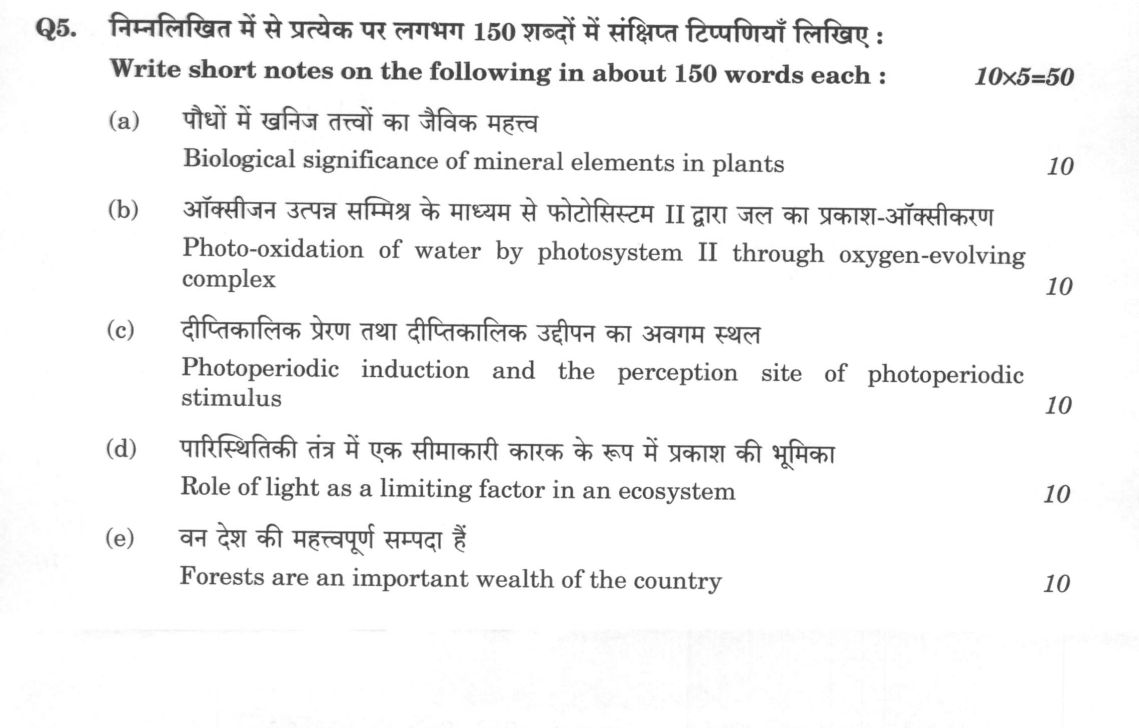
Write short notes on the following in about 150 words each : 10×5=50 (a) Biological significance of mineral elements in plants…
Write short notes on the following in about 150 words each : 10×5=50
Biological significance of mineral elements in plants 10
Photo-oxidation of water by photosystem II through oxygen-evolving complex 10
Photoperiodic induction and the perception site of photoperiodic stimulus 10
Role of light as a limiting factor in an ecosystem 10
Forests are an important wealth of the country 10
हिंदी में प्रश्न पढ़ें
निम्नलिखित में से प्रत्येक पर लगभग 150 शब्दों में संक्षिप्त टिप्पणियाँ लिखिए : 10×5=50
पौधों में खनिज तत्त्वों का जैविक महत्व 10
ऑक्सीजन उत्पन्न सम्मिश्र के माध्यम से फोटोसिस्टम II द्वारा जल का प्रकाश-ऑक्सीकरण 10
दीप्तिकालिक प्रेरण तथा दीप्तिकालिक उदीपन का अवगम स्थल 10
पारिस्थितिकी तंत्र में एक सीमाकारी कारक के रूप में प्रकाश की भूमिका 10
वन देश की महत्वपूर्ण संपदा हैं 10
Model answer
Written by UPSC Answer Check against this question's marking rubric, to the 150-word length. UPSC does not publish answers for Mains — this is one way to score well, not an official key.
Biological Significance of Mineral Elements in Plants
Mineral elements are inorganic nutrients essential for plant growth, metabolism, and reproduction. They are classified into macronutrients (N, P, K, Ca, Mg, S) and micronutrients (Fe, Mn, Zn, Cu, B, Mo, Cl, Ni) based on concentration requirements. Each element plays a specific structural or functional role. Magnesium is the central atom in the chlorophyll molecule, making it critical for photosynthesis. Iron acts as an electron carrier in cytochromes and is essential for chlorophyll synthesis. Molybdenum serves as a cofactor for enzymes like nitrate reductase and nitrogenase, facilitating nitrogen assimilation. Zinc is a component of carbonic anhydrase and auxin synthesis. Deficiency of these elements leads to specific symptoms, such as chlorosis from iron or magnesium deficiency, and stunted growth from nitrogen deficiency. The concept of critical concentration defines the minimum level required for normal growth. Understanding these roles is vital for soil management and crop nutrition, ensuring optimal agricultural productivity and preventing yield losses due to nutrient imbalances.
Photo-oxidation of Water by Photosystem II
Photosystem II (PSII) drives the light-dependent reactions of photosynthesis by splitting water to release oxygen, electrons, and protons. This process occurs at the Oxygen-Evolving Complex (OEC), a cluster of four manganese atoms, one calcium atom, and five oxygen atoms (Mn4CaO5). The OEC operates through the Kok S-state cycle, where four sequential photochemical steps accumulate oxidizing equivalents. In each step, a photon excites the reaction center chlorophyll P680, transferring an electron to the primary acceptor. The resulting positive charge is stabilized by tyrosine Z (YZ), which acts as an electron mediator between the OEC and the reaction center. After the fourth photon absorption (S4 state), the OEC releases one molecule of oxygen, two protons, and four electrons. The reaction is 2H2O → O2 + 4H+ + 4e-. The protons contribute to the proton gradient across the thylakoid membrane, driving ATP synthesis. This process is crucial for maintaining the electron flow in the photosynthetic electron transport chain and replenishing the oxidized P680.
Photoperiodic Induction and Perception Site
Photoperiodism is the physiological response of plants to the relative lengths of day and night, influencing flowering and other developmental processes. Plants are classified based on their response to day length: Short-Day Plants (SDPs) flower when days are shorter than a critical length, Long-Day Plants (LDPs) when days are longer, and Day-Neutral Plants (NDPs) are unaffected. The perception of photoperiodic stimuli occurs primarily in the leaves, not the shoot apex. Phytochrome, a photoreversible pigment, mediates this perception. It exists in two forms: Pr (red-absorbing) and Pfr (far-red-absorbing). At night, Pfr reverts to Pr. The duration of the dark period determines the Pfr/Pr ratio at dawn, which signals the plant's day length. In SDPs, a long night allows Pfr to revert to Pr, triggering flowering. The signal, often identified as the mobile florigen (FT protein), is transported from leaves to the shoot apical meristem via the phloem. There, it activates flowering genes, leading to floral initiation. This mechanism ensures that plants flower under favorable environmental conditions for seed set and dispersal.
Role of Light as a Limiting Factor
Light is a fundamental limiting factor in ecosystems, governing primary productivity and species distribution. According to Liebig’s Law of the Minimum, growth is controlled by the scarcest resource, and in many terrestrial ecosystems, light availability is this limiting factor. In forests, vertical stratification occurs as a result of light competition. The canopy layer captures most sunlight, while the understory and forest floor receive significantly less light, leading to distinct plant communities adapted to low-light conditions. The compensation point, where photosynthesis equals respiration, determines the minimum light required for net growth. Species with lower compensation points, such as shade-tolerant ferns, dominate the understory. Light intensity also influences ecological succession; early successional species are often light-demanding, while late successional species are shade-tolerant. In aquatic systems, light penetration depth limits the photic zone, restricting photosynthetic activity. Thus, light availability shapes community structure, biodiversity, and energy flow within ecosystems.
Forests as Important Wealth of the Country
Forests constitute a vital natural wealth for India, providing ecological, economic, and social benefits. India’s forest cover includes diverse types such as Tropical Wet Evergreen, Moist Deciduous, Tropical Thorn Forest, and Alpine forests. These ecosystems sequester significant amounts of carbon, mitigating climate change. They are biodiversity hotspots, particularly in the Western Ghats and the Himalayas, harboring unique flora and fauna. Forests provide Non-Timber Forest Products (NTFPs) like honey, lac, and medicinal plants, which are crucial for rural livelihoods. They play a critical role in watershed protection, preventing soil erosion, and regulating the water cycle. The Forest (Conservation) Act, 1980, and the National Forest Policy, 1988, aim to conserve and manage these resources. Sustainable forest management is essential to balance economic exploitation with ecological integrity. Protecting forest wealth ensures long-term environmental stability and supports the livelihoods of millions of forest-dependent communities in India.
What "Write short notes" is asking you to do
Five or six self-contained answers, marked separately, typically 10 marks and about 150 words each. Each note must carry its own definition, its two or three defining features and a line on why it matters; a common introduction or conclusion across the notes earns nothing.
Structure that answers it
Per note: one-line definition or identification → two or three features, mechanisms or named examples → one line of significance or Indian application
Where marks are lost
Writing the first two notes at essay length and rationing the rest. Each note is marked on its own, so marks surrendered on a compressed or unattempted note cannot be won back by the long ones.
How this answer will be evaluated
Approach
Framework: Botany Paper 2: Define > Structure/Process > Labelled Diagram > Significance. (a) write short notes: define > 3-4 key features > one example > one-line significance | (b) write short notes: define > 3-4 key features > one example > one-line significance | (c) write short notes: define > 3-4 key features > one example > one-line significance | (d) write short notes: define > 3-4 key features > one example > one-line significance | (e) write short notes: define > 3-4 key features > one example > one-line significance Full marks: All parts have labelled diagrams, specific examples, and clear biological mechanisms.
Key points expected
- Define mineral elements (macro vs micro)
- Explain role in enzyme activation or structure
- Mention specific element function (e.g., Mg in chlorophyll)
- One-line significance for plant growth
- Identify Photosystem II (PSII) and reaction center
- Explain role of Oxygen-Evolving Complex (OEC)
- Mention water splitting (2H2O -> O2 + 4H+ + 4e-)
- Labelled diagram of PSII or OEC
Evaluation rubric
Each sub-part is marked on its own, against the marks and word limit printed on the paper.
- (a) Define mineral elements and list 3-4 key biological functions with one example. 10 marks · 150 words
write short notes— define → 3-4 key features → one example → one-line significance
Must cover
- Define mineral elements (macro vs micro)
- Explain role in enzyme activation or structure
- Mention specific element function (e.g., Mg in chlorophyll)
- One-line significance for plant growth
Loses marks
- Listing elements without biological function
- Confusing macro and micro elements
Earns more
- Mention specific deficiency symptoms
- Reference to specific crop (e.g., rice, wheat)
Extra mark
- Mention specific biotech application (e.g., biofortification)
- (b) Describe photo-oxidation of water by PSII via oxygen-evolving complex. 10 marks · 150 words
write short notes— define → 3-4 key features → one example → one-line significance
Must cover
- Identify Photosystem II (PSII) and reaction center
- Explain role of Oxygen-Evolving Complex (OEC)
- Mention water splitting (2H2O -> O2 + 4H+ + 4e-)
- Labelled diagram of PSII or OEC
Loses marks
- Unlabelled or missing diagram
- Confusing PSII with PSI
Earns more
- Mention specific components (P680, Mn cluster)
- Link to electron transport chain
Extra mark
- Mention specific research on OEC structure
- (c) Define photoperiodic induction and identify the perception site of stimulus. 10 marks · 150 words
write short notes— define → 3-4 key features → one example → one-line significance
Must cover
- Define photoperiodism (short/long day plants)
- Identify leaves as perception site
- Mention phytochrome as photoreceptor
- One example of photoperiodic response
Loses marks
- Confusing perception site with response site
- Missing definition of photoperiodism
Earns more
- Mention specific plant species (e.g., *Nicotiana tabacum*)
- Explain critical day length concept
Extra mark
- Mention recent research on phytochrome signaling
- (d) Explain role of light as a limiting factor in an ecosystem. 10 marks · 150 words
write short notes— define → 3-4 key features → one example → one-line significance
Must cover
- Define light as limiting factor
- Explain light compensation point
- Mention impact on primary productivity
- One example of light limitation in ecosystem
Loses marks
- General description without specific mechanism
- Confusing light with other factors
Earns more
- Mention specific ecosystem (e.g., forest canopy)
- Link to photosynthesis rate
Extra mark
- Mention specific study on light limitation
- (e) Explain why forests are an important wealth of the country. 10 marks · 150 words
write short notes— define → 3-4 key features → one example → one-line significance
Must cover
- Define forest wealth (economic, ecological)
- Mention timber and non-timber products
- Explain ecological services (carbon sequestration)
- One-line significance for national development
Loses marks
- General statements without specific examples
- Ignoring ecological services
Earns more
- Mention specific forest products (e.g., teak, rubber)
- Link to conservation efforts
Extra mark
- Mention specific policy or act (e.g., Forest Rights Act)
Practice this exact question
Write your answer and it is marked point by point against the model answer above — what you covered, what you missed, what you got wrong.
Evaluate my answer →More from Botany 2023 Paper II
- Q2 (a) Differentiate between polytene chromosomes and normal chromosomes. 15 (b) Describe po…
- Q3 (a) What are the major requirements for a successful back-crossing programme ? Describe i…
- Q4 (a) Describe the structure, kinds, chemical nature, origin and functions of lysosomes. 20…
- Q5 Write short notes on the following in about 150 words each : 10×5=50 (a) Biological signi…
- Q6 (a) What are nastic movements, their types and mechanism ? Explain. 15 (b) How is the tra…
- Q7 (a) How can the reaction equilibria and reaction rates be explained by using free energy…
- Q8 (a) (i) How do the three stages in fatty acid oxidation converge to conserve energy as AT…