Paper II — Q2
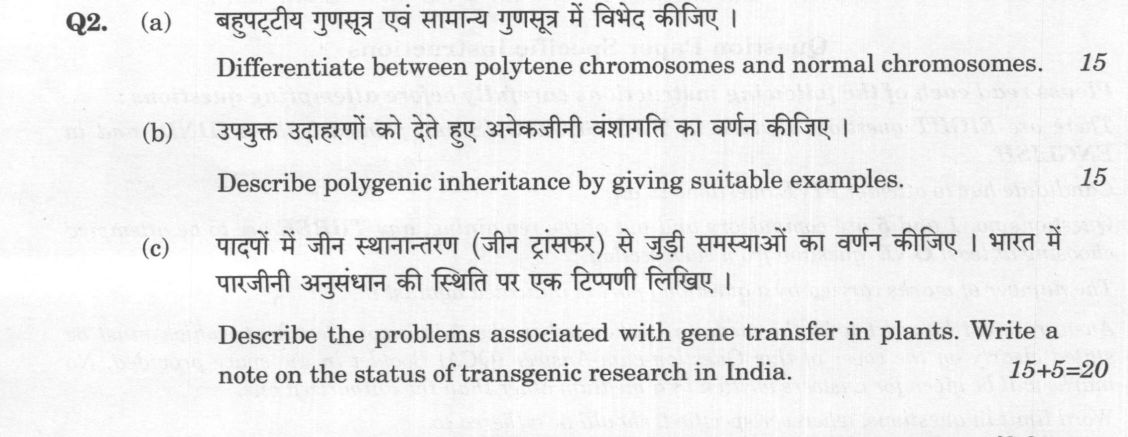
(a) Differentiate between polytene chromosomes and normal chromosomes. 15 (b) Describe polygenic inheritance by giving suitable…
Differentiate between polytene chromosomes and normal chromosomes. 15 marks
Describe polygenic inheritance by giving suitable examples. 15 marks
Describe the problems associated with gene transfer in plants. Write a note on the status of transgenic research in India. 15+5=20
हिंदी में प्रश्न पढ़ें
बहुपट्टीय गुणसूत्र एवं सामान्य गुणसूत्र में विभेद कीजिए । 15
उपयुक्त उदाहरणों को देते हुए अनेकजीनी वंशागति का वर्णन कीजिए । 15
पादपों में जीन स्थानांतरण (जीन ट्रांसफर) से जुड़ी समस्याओं का वर्णन कीजिए । भारत में पारजीनी अनुसंधान की स्थिति पर एक टिप्पणी लिखिए । 15+5=20
Model answer
Written by UPSC Answer Check against this question's marking rubric, to the expected length. UPSC does not publish answers for Mains — this is one way to score well, not an official key.
Differences Between Polytene and Normal Chromosomes
Normal chromosomes consist of single DNA duplexes per chromatid that undergo regular cycles of replication followed by mitotic or meiotic segregation, maintaining standard diploid or haploid ploidy. In contrast, polytene chromosomes are giant, multistranded structures formed through endoreduplication (endomitosis), in which repeated cycles of DNA replication occur without intervening nuclear or cell division. While normal mitotic chromosomes are transiently condensed, dynamic bodies that require artificial chemical staining (such as G-banding) to reveal structural patterns, polytene chromosomes remain permanently in an enlarged interphase state.
Polytene chromosomes exhibit characteristic, highly visible alternating transverse bands (chromomeres with high DNA density) and interbands (low DNA density). Furthermore, active gene transcription in polytene chromosomes manifests as localized decondensations termed chromosomal puffs or Balbiani rings, which do not form in normal condensed mitotic chromosomes. First observed by E.G. Balbiani in Chironomus and widely characterized in the salivary glands of Drosophila melanogaster, polytene chromosomes provide exceptional resolution for physical gene mapping and structural rearrangement studies, contrasting with the lower cytological resolution of standard metaphase chromosomes.
Polygenic Inheritance and Examples
Polygenic inheritance refers to the transmission of a quantitative trait controlled by two or more independent, non-allelic genes (polygenes), where each dominant allele exerts a cumulative, additive effect on the phenotype. Unlike monogenic Mendelian inheritance, which produces discrete, discontinuous phenotypic classes governed by complete dominance, polygenic traits produce continuous phenotypic variation that forms a bell-shaped Gaussian distribution curve and is susceptible to environmental modifications.
A definitive example is kernel colour in wheat (Triticum aestivum), demonstrated by H. Nilsson-Ehle. When dark-red kernel wheat (R₁ R₁ R₂ R₂) is crossed with white kernel wheat (r₁ r₁ r₂ r₂), the F₁ generation produces intermediate medium-red seeds (R₁ r₁ R₂ r₂). In the F₂ generation, additive allele segregation yields a continuous phenotypic distribution of 1 dark-red : 4 medium-dark red : 6 medium red : 4 light red : 1 white (1:4:6:4:1 ratio), dictated by the number of contributing dominant alleles. Other classic manifestations include human skin pigmentation (Davenport model) and corolla length in Nicotiana longiflora (East).
Problems in Plant Gene Transfer and Transgenic Research in India
Gene transfer in plants encounters several technical and biosafety bottlenecks: Position effects, where random illegitimate transgene insertion into heterochromatic or transcriptionally inactive chromosomal regions results in variable, silenced, or unstable transgene expression; Gene silencing, occurring via transcriptional gene silencing through promoter hypermethylation or post-transcriptional gene silencing via RNA interference triggered by multi-copy or inverted transgene arrays; Pleiotropic disruptions, wherein insertion disrupts endogenous open reading frames, leading to altered plant metabolism, somaclonal variation, or yield penalties; Biosafety and ecological hazards, including the persistence of selectable antibiotic/herbicide marker genes, potential allergenicity of expressed proteins, and horizontal pollen-mediated gene flow to sexually compatible wild relatives, creating herbicide-resistant weeds.
In India, transgenic crop research and deployment are governed under the Environment (Protection) Act, 1986 (Rules, 1989) through a regulatory framework comprising the Review Committee on Genetic Manipulation (RCGM) under the Department of Biotechnology (DBT) and the Genetic Engineering Appraisal Committee (GEAC) under the Ministry of Environment, Forest and Climate Change (MoEFCC). Transgenic Bt cotton (Cry1Ac and Cry2Ab), approved in 2002, remains India's sole commercialized genetically modified crop. A moratorium was placed on Bt brinjal in 2010 over ecological and food-safety concerns. More recently, the GEAC recommended the environmental release of transgenic hybrid mustard DMH-11 (utilizing the barnase/barstar system developed by the University of Delhi), though its commercial adoption remains subject to legal review. Ongoing public sector research at ICAR institutes focuses on stress resilience and biofortification in rice, chickpea, and pigeonpea, alongside an increasing shift toward SDN-1 and SDN-2 genome-editing approaches that bypass conventional transgenesis regulations.
Integrating cytogenetic insights derived from chromosome mapping with modern site-specific gene-editing techniques enables precise targeting into genomic "safe harbour" sites. This approach circumvents position effects and transgene silencing, offering a viable path forward for deploying safe and climate-resilient transgenic crops in Indian agriculture.
What "Differentiate" is asking you to do
Fix the criteria on which the two differ and apply each criterion to both, so the pair can no longer be mixed up. Differentiate stems usually carry a further task attached — describe the mechanism, set out the principles, discuss the applications — and that task carries its own marks.
Structure that answers it
Criterion 1 applied to both → criterion 2 → criterion 3 → summary line or table → the attached second demand answered in full
Where marks are lost
Two standalone definitions placed side by side, leaving the reader to extract the difference. The second common loss is running out of space before the attached task, which is often worth as much as the differentiation.
How this answer will be evaluated
Approach
Framework: null. (a) compare: paired headings or table > key differences > significance > conclusion | (b) discuss: intro > 3-4 dimensions > example > balanced close | (c) discuss: intro > 3-4 dimensions > example > balanced close Full marks: Precise terminology, correct examples, clear comparative structure, and specific Indian context.
Key points expected
- Polytene chromosomes: *Drosophila*, endoreduplication, bands
- Polygenic: Cumulative effect, continuous variation, 1:4:6:4:1 ratio
- Gene transfer: Positional effects, silencing, transformation efficiency
- India status: Bt cotton, Bt brinjal, GEAC, Golden Rice
Evaluation rubric
Each sub-part is marked on its own, against the marks and word limit printed on the paper.
- (a) Tabulate structural and functional differences between polytene and normal chromosomes. 15 marks
compare— paired headings or table → key differences → significance → conclusion
Must cover
- Definition of polytene chromosomes
- Mechanism of polyteny (endoreduplication)
- Comparison of size and banding pattern
- Comparison of occurrence (e.g., *Drosophila* vs. somatic cells)
Loses marks
- Unlabelled diagrams
- Confusing polytene with lampbrush chromosomes
- Vague descriptions without specific examples
Earns more
- Mention of *Drosophila* salivary gland
- Reference to chromomeres/bands
- Mention of larval stages
- Comparison of genetic activity
Extra mark
- Labelled diagram of polytene chromosome
- Mention of Balbiani rings
- (b) Explain the mechanism of polygenic inheritance with specific examples and phenotypic ratios. 15 marks
discuss— intro → 3-4 dimensions → example → balanced close
Must cover
- Definition of polygenic inheritance
- Concept of cumulative gene action
- Example: Human skin colour or wheat kernel colour
- Explanation of phenotypic ratio (e.g., 1:4:6:4:1)
Loses marks
- Confusing with epistasis
- Missing phenotypic ratio
- Vague examples without species names
Earns more
- Mention of *Triticum aestivum* (wheat)
- Mention of *Homo sapiens* (skin)
- Reference to continuous variation
- Mention of environmental influence
Extra mark
- Punnett square for two-gene interaction
- Mention of quantitative genetics
- (c) Detail problems of gene transfer in plants and the current status of transgenic research in India. 20 marks
discuss— intro → 3-4 dimensions → example → balanced close
Must cover
- Problems: Positional effects, gene silencing
- Problems: Transformation efficiency, tissue culture
- Status: Bt cotton, Bt brinjal
- Status: Regulatory framework (GEAC)
Loses marks
- Ignoring the 'status in India' part
- Vague problems without specific terms
- Confusing transgenic with hybrid
Earns more
- Mention of *Gossypium hirsutum* (Bt cotton)
- Mention of *Solanum melongena* (Bt brinjal)
- Reference to GEAC (Genetic Engineering Appraisal Committee)
- Mention of Golden Rice
Extra mark
- Mention of CRISPR-Cas9 in India
- Reference to specific Indian research institutes (e.g., IARI, ICRISAT)
Practice this exact question
Write your answer and it is marked point by point against the model answer above — what you covered, what you missed, what you got wrong.
Evaluate my answer →More from Botany 2023 Paper II
- Q1 Write short notes on the following in about 150 words each : 10×5=50 (a) Cell-cell adhesi…
- Q2 (a) Differentiate between polytene chromosomes and normal chromosomes. 15 (b) Describe po…
- Q3 (a) What are the major requirements for a successful back-crossing programme ? Describe i…
- Q4 (a) Describe the structure, kinds, chemical nature, origin and functions of lysosomes. 20…
- Q5 Write short notes on the following in about 150 words each : 10×5=50 (a) Biological signi…