Paper II — Q6
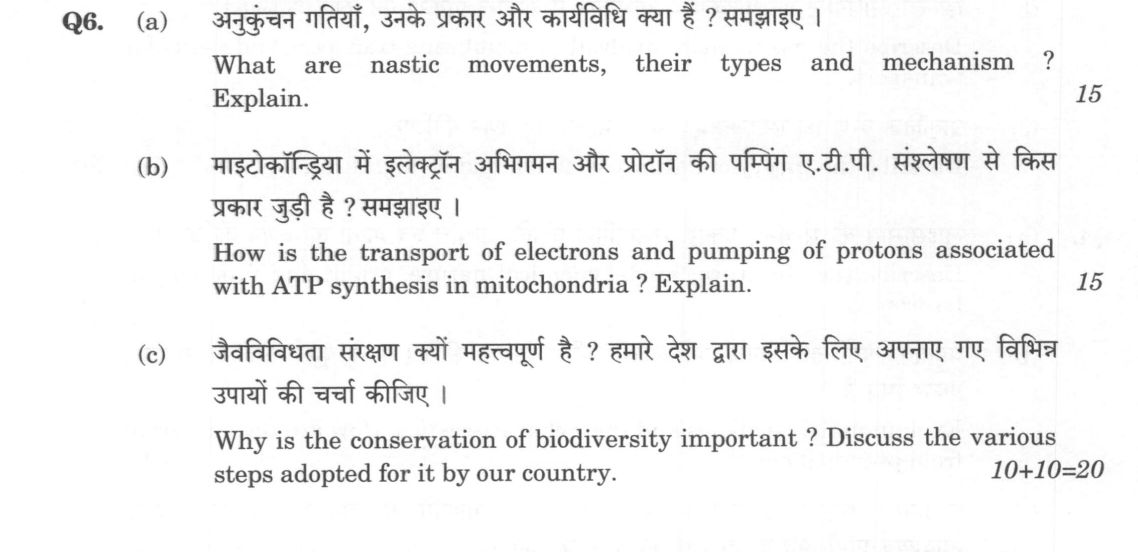
(a) What are nastic movements, their types and mechanism ? Explain. 15 (b) How is the transport of electrons and pumping of…
What are nastic movements, their types and mechanism ? Explain. 15 marks
How is the transport of electrons and pumping of protons associated with ATP synthesis in mitochondria ? Explain. 15 marks
Why is the conservation of biodiversity important ? Discuss the various steps adopted for it by our country. 10+10=20
हिंदी में प्रश्न पढ़ें
अनुकूंचन गतियाँ, उनके प्रकार और कार्यविधि क्या हैं ? समझाइए । 15
माइटोकॉन्ड्रिया में इलेक्ट्रॉन अभिगमन और प्रोटॉन की पम्पिंग ए.टी.पी. संश्लेषण से किस प्रकार जुड़ी है ? समझाइए । 15
जैवविविधता संरक्षण क्यों महत्वपूर्ण है ? हमारे देश द्वारा इसके लिए अपनाए गए विभिन्न उपायों की चर्चा कीजिए । 10+10=20
Model answer
Written by UPSC Answer Check against this question's marking rubric, to the expected length. UPSC does not publish answers for Mains — this is one way to score well, not an official key.
Nastic Movements: Mechanism and Classification
Nastic movements are non-directional, reversible responses of plant organs to stimuli, where the direction of movement is determined by the plant’s internal structure rather than the stimulus vector. Unlike tropic movements, which are directional, nastic movements involve changes in turgor pressure within specialized motor cells. The primary mechanism relies on rapid ion fluxes, particularly potassium (K⁺) and chloride (Cl⁻), across the plasma membrane of motor cells located in pulvini or leaflets.
In seismonasty, exemplified by Mimosa pudica, mechanical stimulation triggers an action potential that opens voltage-gated K⁺ channels in the lower (extensor) motor cells of the pulvinus. The efflux of K⁺ reduces solute concentration, causing water to exit via aquaporins, leading to a drop in turgor pressure. Simultaneously, the upper (flexor) motor cells maintain or increase turgor. This differential turgor causes the leaflet to fold downward. Recovery occurs as K⁺ is actively pumped back into the extensor cells, restoring turgor. Other types include nyctinasty (sleep movements in Cassia and Albizzia, driven by circadian rhythms affecting turgor), thermonasty (flower opening in Tulip due to temperature-induced turgor changes), and chemonasty (response to chemical stimuli).
Mitochondrial ATP Synthesis: Electron Transport and Chemiosmosis
In mitochondria, ATP synthesis is coupled to electron transport through the chemiosmotic theory proposed by Peter Mitchell. Electrons from NADH and FADH₂ enter the Electron Transport Chain (ETC) embedded in the inner mitochondrial membrane. Complex I (NADH dehydrogenase) accepts electrons from NADH, pumping protons from the matrix to the intermembrane space. Electrons then pass to Coenzyme Q and Complex III (Cytochrome bc1 complex), which also pumps protons. Finally, Complex IV (Cytochrome c oxidase) transfers electrons to oxygen, the terminal acceptor, while pumping additional protons.
This sequential transfer establishes a proton gradient (proton-motive force) across the inner membrane, characterized by a higher H⁺ concentration and positive charge in the intermembrane space. The potential energy stored in this gradient drives ATP synthesis via ATP synthase (F_0F₁-ATPase). The F₀ subunit forms a proton channel; as protons flow back into the matrix down their electrochemical gradient, they cause the rotation of the c-ring. This mechanical rotation drives conformational changes in the F₁ head, catalyzing the phosphorylation of ADP to ATP. The P/O ratio (ATP produced per oxygen atom reduced) is approximately 2.5 for NADH and 1.5 for FADH₂, reflecting the number of protons pumped and the stoichiometry of ATP synthase.
Biodiversity Conservation: Importance and Indian Initiatives
Biodiversity conservation is critical for ecosystem services, including pollination, water purification, and climate regulation. It preserves the genetic resource pool necessary for evolutionary potential and crop improvement, while also holding intrinsic ethical and aesthetic value.
India has adopted a multi-faceted approach to conservation. The Wildlife (Protection) Act, 1972, provides the legal framework for protecting endangered species. In-situ conservation is advanced through the establishment of National Parks, Wildlife Sanctuaries, and Biosphere Reserves such as Nilgiri and Nanda Devi. Flagship species programs like Project Tiger (1973) and Project Elephant (1992) have significantly aided population recovery. Ex-situ conservation is managed by the National Bureau of Plant Genetic Resources (NBPGR) and various botanic gardens.
Legally, the Biological Diversity Act, 2002, ensures the equitable sharing of benefits from biological resources and protects traditional knowledge. Policy-wise, India implements the National Biodiversity Action Plan (NBAP) and has proposed the National Mission on Biodiversity and Human Well-being to integrate conservation with development goals. Financial support is provided through the Conservation of Mangroves and Afforestation (CAMPA) funds. Furthermore, as a signatory to the Convention on Biological Diversity (CBD), India commits to the Kunming-Montreal Global Biodiversity Framework, aiming to protect 30% of its territory by 2030.
Conclusion
The physiological mechanisms of nastic movements and mitochondrial respiration illustrate the intricate adaptations that sustain individual plant life. These survival strategies form the biological basis of biodiversity, which India actively protects through robust legal frameworks, in-situ and ex-situ conservation programs, and international commitments, ensuring ecological stability and resource security.
What "Explain" is asking you to do
Make the working of something clear — what sets it off, what follows from what, and what it produces. Explain is the Commission's mechanism word: it dominates the technical papers and the “explain why” stems, where the marks sit in the causal chain and not in the label.
Structure that answers it
State what it is → the initiating condition → the chain of cause, step by step → an instance where it plays out → what the chain produces
Where marks are lost
Describing what something looks like instead of why it works that way. Naming the stages without linking them reads as description too.
How this answer will be evaluated
Approach
Framework: Botany Paper 2: Plant Physiology & Conservation. (a) explain: definition/context > points in order > small example > short close | (b) explain: definition/context > points in order > small example > short close | (c) discuss: intro > 3-4 dimensions > example > balanced close Full marks: Comprehensive, accurate, with labelled diagrams and specific examples.
Key points expected
- Nastic movements: non-directional, growth-dependent
- Mitochondrial ETC: proton gradient, ATP synthase
- Biodiversity conservation: in-situ, ex-situ, legislation
Evaluation rubric
Each sub-part is marked on its own, against the marks and word limit printed on the paper.
- (a) Define nastic movements, list types, and explain the mechanism of one type. 15 marks
explain— definition/context → points in order → small example → short close
Must cover
- Definition: non-directional, growth-dependent movement
- Distinction from tropic movements
- Types: Phototropism, Thigmotropism, Seisotropism
- Mechanism: Auxin redistribution or turgor changes
Loses marks
- Confusing nastic with tropic movements
- Unlabelled diagrams
- Loose common names without binomials
Earns more
- Labelled diagram of thigmonasty (Mimosa pudica)
- Mention of *Mimosa pudica* or *Dionaea muscipula*
- Explanation of pulvinus structure
- Reference to action spectrum for phototropism
Extra mark
- Mention of recent biotech application in plant movement
- Reference to a specific named committee on plant physiology
- (b) Explain the link between electron transport, proton pumping, and ATP synthesis in mitochondria. 15 marks
explain— definition/context → points in order → small example → short close
Must cover
- Electron Transport Chain (ETC) complexes I-IV
- Proton gradient formation across inner membrane
- Chemiosmotic hypothesis (Peter Mitchell)
- ATP synthase (Complex V) mechanism
Loses marks
- Confusing mitochondrial ETC with chloroplast ETC
- Unlabelled diagrams
- Loose common names without binomials
Earns more
- Labelled diagram of mitochondrial ETC
- Mention of NADH and FADH2 entry points
- Reference to P/O ratio
- Explanation of proton motive force
Extra mark
- Mention of recent biotech application in mitochondrial research
- Reference to a specific named committee on bioenergetics
- (c) Discuss the importance of biodiversity conservation and India's steps for it. 20 marks
discuss— intro → 3-4 dimensions → example → balanced close
Must cover
- Importance: ecological, economic, ethical
- In-situ conservation: National Parks, Wildlife Sanctuaries
- Ex-situ conservation: Botanical gardens, seed banks
- Legislation: Wildlife Protection Act, 1972
Loses marks
- One-sided focus on only in-situ or ex-situ
- Listing without depth
- Loose common names without binomials
Earns more
- Mention of specific National Parks (e.g., Jim Corbett)
- Reference to Project Tiger or Project Elephant
- Mention of Gene Banks (e.g., National Gene Bank)
- Reference to CITES or CBD
Extra mark
- Mention of recent biotech application in conservation
- Reference to a specific named committee on biodiversity
Practice this exact question
Write your answer and it is marked point by point against the model answer above — what you covered, what you missed, what you got wrong.
Evaluate my answer →More from Botany 2023 Paper II
- Q3 (a) What are the major requirements for a successful back-crossing programme ? Describe i…
- Q4 (a) Describe the structure, kinds, chemical nature, origin and functions of lysosomes. 20…
- Q5 Write short notes on the following in about 150 words each : 10×5=50 (a) Biological signi…
- Q6 (a) What are nastic movements, their types and mechanism ? Explain. 15 (b) How is the tra…
- Q7 (a) How can the reaction equilibria and reaction rates be explained by using free energy…
- Q8 (a) (i) How do the three stages in fatty acid oxidation converge to conserve energy as AT…