Paper I — Q1
(a) Blue-green algae are also considered as bacteria. Discuss their major similarities with bacteria. (10 marks) (b) What do you…
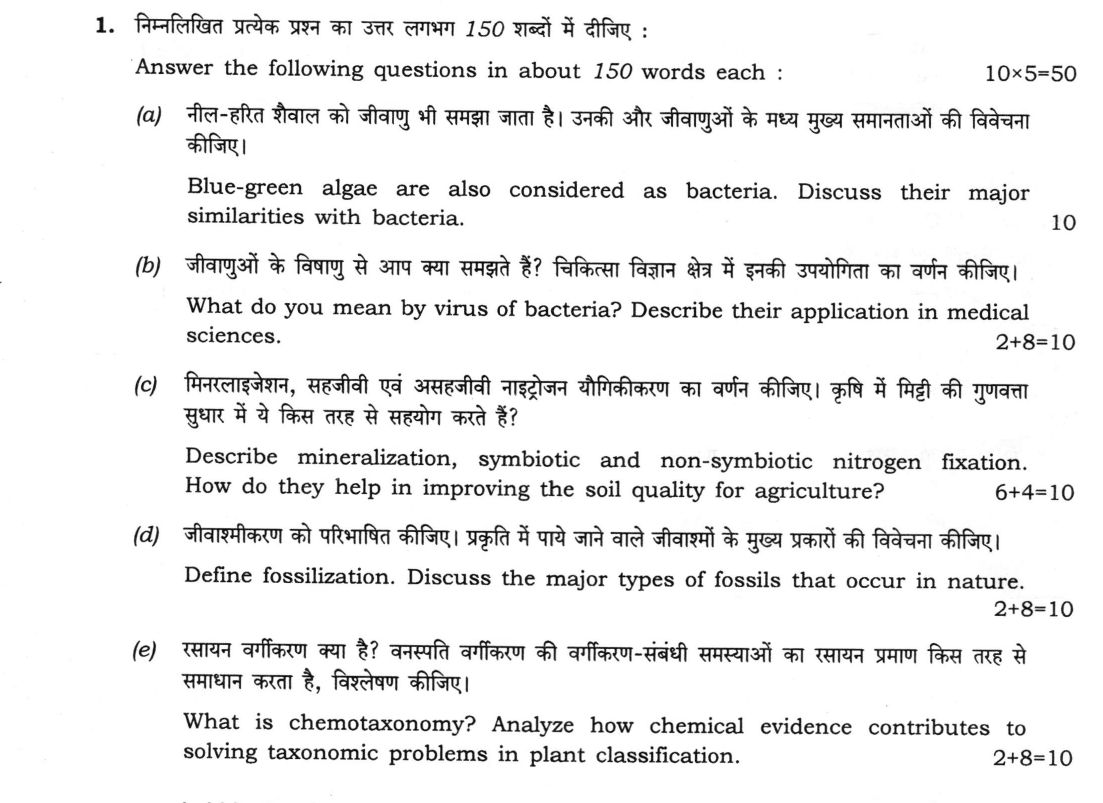
Answer the following questions in about 150 words each :
Blue-green algae are also considered as bacteria. Discuss their major similarities with bacteria. 10 marks
What do you mean by virus of bacteria? Describe their application in medical sciences. 10 marks
Describe mineralization, symbiotic and non-symbiotic nitrogen fixation. How do they help in improving the soil quality for agriculture? 10 marks
Define fossilization. Discuss the major types of fossils that occur in nature. 10 marks
What is chemotaxonomy? Analyze how chemical evidence contributes to solving taxonomic problems in plant classification. 10 marks
हिंदी में प्रश्न पढ़ें
निम्नलिखित प्रत्येक प्रश्न का उत्तर लगभग 150 शब्दों में दीजिए :
नील-हरित शैवाल को जीवाणु भी समझा जाता है। उनकी और जीवाणुओं के मध्य मुख्य समानताओं की विवेचना कीजिए। (10 अंक)
जीवाणुओं के विषाणु से आप क्या समझते हैं? चिकित्सा विज्ञान क्षेत्र में इनकी उपयोगिता का वर्णन कीजिए। (10 अंक)
मिनरलाइजेशन, सहजीवी एवं असहजीवी नाइट्रोजन यौगिकीकरण का वर्णन कीजिए। कृषि में मिट्टी की गुणवत्ता सुधार में ये किस तरह से सहयोग करते हैं? (10 अंक)
जीवाश्मीकरण को परिभाषित कीजिए। प्रकृति में पाये जाने वाले जीवाश्मों के मुख्य प्रकारों की विवेचना कीजिए। (10 अंक)
रासायन वर्गीकरण क्या है? वनस्पति वर्गीकरण की वर्गीकरण-संबंधी समस्याओं का रासायन प्रमाण किस तरह से समाधान करता है, विश्लेषण कीजिए। (10 अंक)
Model answer
Drafted with AI by UPSC Answer Check against this question's marking rubric, to the 150-word length. UPSC does not publish answers for Mains — this is one way to score well, not an official key. How we build rubrics and answers.
(a) Similarities of blue-green algae with bacteria (10 marks)
Blue-green algae (cyanobacteria) share these major features with bacteria:
- Prokaryotic organisation: no true nucleus or nuclear membrane; a nucleoid of naked, circular DNA without histones.
- No membrane-bound organelles (no mitochondria, endoplasmic reticulum, Golgi or chloroplasts); the photosynthetic thylakoids lie free in the cytoplasm.
- 70S ribosomes.
- A cell wall of peptidoglycan (murein), of the Gram-negative type with an outer membrane and lipopolysaccharide, so they are sensitive to lysozyme and penicillin.
- Reproduction by binary fission, fragmentation and spores; no true sexual reproduction, though gene transfer occurs by conjugation, transformation and transduction (cyanophages).
- Presence of plasmids, and nitrogen fixation by nitrogenase, as in Azotobacter.
- Absence of flagella (cyanobacteria glide) and a mucilage sheath around the cell.
They differ from most bacteria in having chlorophyll a and oxygenic photosynthesis, which is why they were once classed with algae.
(b) Virus of bacteria and its application in medical sciences (10 marks)
Virus of bacteria (2 marks). A bacteriophage is a virus that infects bacteria: an obligate parasite made of a nucleic acid core inside a protein coat (capsid), as in the T4 phage with head, tail and tail fibres, which multiplies by the lytic or lysogenic cycle.
Medical applications (8 marks):
- Phage therapy: phages, or their lysins, against antibiotic-resistant infections (Pseudomonas, Staphylococcus, Klebsiella); used in Georgia and Poland and in trials elsewhere.
- Phage typing to identify strains of bacteria such as Salmonella Typhi and Staphylococcus in epidemiology.
- Rapid detection of bacteria, such as the luciferase reporter phage for Mycobacterium tuberculosis.
- Phage display to obtain antibodies, peptides and vaccine candidates.
- Vectors (lambda, M13) for cloning, and transduction in genetic studies.
- Disinfection of hospital surfaces and food.
- Study of phage defences led to CRISPR-Cas gene-editing tools.
(c) Mineralization and nitrogen fixation, and their help in improving soil quality (10 marks)
Description (6 marks):
- Mineralization: heterotrophic microbes break organic nitrogen (proteins, humus) into ammonium (ammonification), which Nitrosomonas and Nitrobacter oxidise to nitrite and nitrate (nitrification). Net release occurs when the C:N ratio of the residue is below about 25:1.
- Symbiotic fixation: Rhizobium in the root nodules of legumes (with leghaemoglobin protecting nitrogenase) reduces N₂ to NH₃; also Frankia in Alnus and Casuarina and Anabaena in Azolla.
- Non-symbiotic fixation: free-living Azotobacter and Beijerinckia (aerobic), Clostridium (anaerobic) and cyanobacteria (Nostoc, Anabaena); Azospirillum is associative.
Soil quality (4 marks):
- They add plant-available nitrogen at low cost, reducing the need for chemical fertiliser and its pollution.
- Mineralization releases nitrogen, phosphorus and sulphur from residues and builds humus, improving structure and water retention.
- Legume rotations, green manures, Azolla in rice and biofertilisers raise fertility and organic matter and sustain soil biodiversity.
(d) Fossilization and the major types of fossils (10 marks)
Fossilization (2 marks) is the process by which the remains, impressions or traces of ancient organisms are buried and preserved in sedimentary rocks over long periods.
Major types (8 marks):
- Petrifaction (permineralization): the cell spaces are filled with silica or calcium carbonate, preserving internal structure, as in petrified wood and the Deccan intertrappean plants.
- Compression: the plant is flattened under sediment to a carbon film, as in leaves on shale.
- Impression: an imprint of the surface with no organic matter left.
- Mould and cast: the mould is the cavity left after decay, and the cast is the mineral infilling of it.
- Incrustation: mineral, often lime, deposits around the plant.
- Coal balls and coal: partly carbonised plant matter.
- Amber (resin) with trapped insects and plant parts, and coprolites.
- Microfossils (pollen, spores) in sediments; an Indian example is Williamsonia from the Rajmahal Hills.
(e) Chemotaxonomy and its contribution to solving taxonomic problems (10 marks)
Chemotaxonomy (chemosystematics) (2 marks) is the use of chemical characters, such as secondary metabolites, proteins and other macromolecules, to classify plants and clarify their relationships.
Contribution (8 marks):
- Betalains occur in most families of the order Caryophyllales and never together with anthocyanins, which supports placing Cactaceae there; Caryophyllaceae and Molluginaceae, which have anthocyanins instead, are exceptions that mark them as distinct lineages.
- Glucosinolates link Brassicaceae with Capparaceae and Resedaceae, in Brassicales.
- Flavonoid profiles identify hybrids and their parents, for example in Baptisia.
- Alkaloids, terpenoids and iridoids support relationships among genera, and chemotypes separate races in Mentha and Thymus.
- Seed proteins and serology settle uncertain placements.
- Chemical convergence limits their use, so they must be combined with morphological and molecular evidence.
How this answer will be evaluated
Evaluation rubric
Each sub-part is marked on its own, against the marks and word limit printed on the paper.
- (a) Discuss the major similarities of blue-green algae with bacteria, in about 150 words (10 marks). 10 marks · 150 words
Must cover
- Prokaryotic cell: no nucleus or membrane-bound organelles, naked circular DNA, 70S ribosomes
- Peptidoglycan cell wall of Gram-negative type
- Binary fission or fragmentation, gene transfer by conjugation, transformation, transduction; plasmids
- Nitrogen fixation by nitrogenase (as in Azotobacter), sensitivity to lysozyme and penicillin
Loses marks
- Calling cyanobacteria eukaryotes or stating they have a nuclear membrane.
- Listing differences instead of similarities only.
Earns more
- Thylakoids free in cytoplasm noted.
- Difference (chlorophyll a and oxygenic photosynthesis) stated.
Extra mark
- Absence of flagella with gliding movement
- (b) Two parts (2 + 8): what is a virus of bacteria; describe its application in medical sciences, in about 150 words (10 marks). 10 marks · 150 words
Must cover
- Definition: bacteriophage, obligate parasite with nucleic acid in a capsid, lytic and lysogenic cycles (2 marks)
- Phage therapy against antibiotic-resistant bacteria, and lysins
- Phage typing and rapid detection (e.g. luciferase reporter phage for tuberculosis)
- Phage display, cloning vectors, and CRISPR-Cas origin from phage defence
Loses marks
- Calling a bacteriophage a bacterium or an antibiotic.
- Applications given without any medical link.
Earns more
- Named phage such as T4 with its structure.
- Hospital and food disinfection.
Extra mark
- Phage-antibiotic synergy or current clinical use in Georgia and Poland
- (c) Two parts (6 + 4): describe mineralization, symbiotic and non-symbiotic nitrogen fixation; how they improve soil quality for agriculture, in about 150 words (10 marks). 10 marks · 150 words
Must cover
- Mineralization: ammonification then nitrification (Nitrosomonas, Nitrobacter), C:N ratio control
- Symbiotic fixation: Rhizobium in legume nodules with leghaemoglobin, also Frankia and Azolla-Anabaena
- Non-symbiotic fixation: Azotobacter, Beijerinckia, Clostridium, cyanobacteria; Azospirillum associative
- Soil benefits: cheap nitrogen, less fertiliser use, humus, structure, rotations, green manure, biofertilisers
Loses marks
- Confusing nitrification with denitrification.
- Omitting the agricultural benefits (4 marks).
Earns more
- Nitrogenase reaction N₂ → NH₃ stated.
- Link to sustainable agriculture.
Extra mark
- Field figures for nitrogen fixed by a legume crop
- (d) Two parts (2 + 8): define fossilization; discuss the major types of fossils in nature, in about 150 words (10 marks). 10 marks · 150 words
Must cover
- Definition: preservation of remains, impressions or traces of ancient organisms in sedimentary rocks (2 marks)
- Petrifaction or permineralization and compression, each with an example
- Impression, mould and cast, incrustation
- Amber, coprolites, coal balls or microfossils; an Indian example
Loses marks
- Defining fossils as only bones or shells.
- Calling an impression a petrifaction.
Earns more
- Distinguishing mould from cast correctly.
- Conditions favouring fossilization (rapid burial).
Extra mark
- Rajmahal or Deccan intertrappean localities
- (e) Two parts (2 + 8): what is chemotaxonomy; analyse how chemical evidence helps solve taxonomic problems in plant classification, in about 150 words (10 marks). 10 marks · 150 words
Must cover
- Definition: use of chemical characters (secondary metabolites, proteins) in classification (2 marks)
- Betalains versus anthocyanins in Caryophyllales, including the exceptions
- Glucosinolates in Brassicales; flavonoid profiling of hybrids
- Chemotypes, seed proteins and serology; limitation from convergence and need to combine with morphology and molecular data
Loses marks
- Claiming chemical data alone decide classification.
- Stating that betalains and anthocyanins co-occur.
Earns more
- At least two families or genera as examples.
- Balanced statement of limits.
Extra mark
- Non-protein amino acids in legumes or iridoids in Asteridae
What "Discuss" is asking you to do
Lay the issue out from more than one side — how it arose, what is claimed for it, what is held against it, and where it now stands. UPSC attaches discuss to broad topics with several live dimensions, so coverage of the dimensions earns more than the strength of your opinion.
Structure that answers it
Set the issue up → the case as it is made → the case against → the dimension both sides leave out → where the balance now lies
Where marks are lost
Listing facts with no thread between them, or arguing one side throughout and calling it a discussion.
Practice this exact question
Write your answer and it is marked point by point against the model answer above — what you covered, what you missed, what you got wrong.
Evaluate my answer →More from Botany 2026 Paper I
- Q1 Answer the following questions in about 150 words each : (a) Blue-green algae are also co…
- Q2 (a) What are the major characteristics of Anthocerotopsida? Describe the gametophytic and…
- Q3 (a) Name the organism that causes stalk rot disease in maize. Describe its symptoms, dise…
- Q4 (a) Explain the APG IV classification. State briefly how it differs from existing classif…