Paper I — Q3
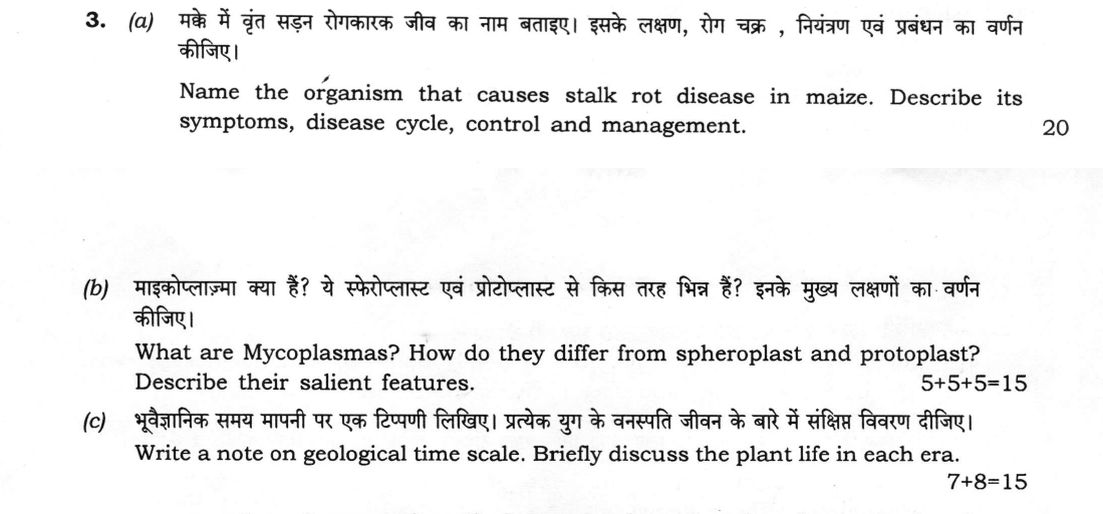
(a) Name the organism that causes stalk rot disease in maize. Describe its symptoms, disease cycle, control and management. (20…
Name the organism that causes stalk rot disease in maize. Describe its symptoms, disease cycle, control and management. 20 marks
What are Mycoplasmas? How do they differ from spheroplast and protoplast? Describe their salient features. 15 marks
Write a note on geological time scale. Briefly discuss the plant life in each era. 15 marks
हिंदी में प्रश्न पढ़ें
मक्के में वृंत सड़न रोगाकारक जीव का नाम बताइए। इसके लक्षण, रोग चक्र, नियंत्रण एवं प्रबंधन का वर्णन कीजिए। (20 अंक)
माइकोप्लाज्मा क्या हैं? ये स्फेरोप्लास्ट एवं प्रोटोप्लास्ट से किस तरह भिन्न हैं? इनके मुख्य लक्षणों का वर्णन कीजिए। (15 अंक)
भूवैज्ञानिक समय मापनी पर एक टिप्पणी लिखिए। प्रत्येक युग के वनस्पति जीवन के बारे में संक्षिप्त विवरण दीजिए। (15 अंक)
Model answer
Drafted with AI by UPSC Answer Check against this question's marking rubric, to the expected length. UPSC does not publish answers for Mains — this is one way to score well, not an official key. How we build rubrics and answers.
(a) Stalk rot of maize: pathogen, symptoms, disease cycle, control and management (20 marks)
Pathogen. Stalk rot is a disease complex. The chief cause is the fungus Fusarium verticillioides (syn. F. moniliforme; teleomorph Gibberella moniliformis), which causes post-flowering stalk rot. Other causes include Gibberella zeae (Fusarium graminearum), Macrophomina phaseolina (charcoal rot), Stenocarpella (Diplodia) maydis, Pythium aphanidermatum (Pythium stalk rot) and the bacterium Dickeya zeae (bacterial stalk rot).
Symptoms:
- They appear after flowering, from tasselling to grain filling: the plants suddenly wilt and dry, and the leaves turn dull grey-green.
- The lower internodes turn soft and brown, and the pith is discoloured pink to reddish and breaks down, leaving shredded vascular strands, so the stalk is easily pinched and lodges at the nodes.
- White to pink mycelium may be seen at the nodes; the ears are small and light with chaffy grain.
- In charcoal rot, tiny black sclerotia are seen in the pith and beneath the rind. In bacterial stalk rot, the base is water-soaked with a foul smell, and the top may fall. In Pythium stalk rot, the basal internodes twist and the plant falls.
Disease cycle. The fungus survives in crop residues and in the soil as mycelium and spores, and in the seed. Infection occurs through the roots and through wounds made by insects such as the stem borer (Chilo partellus). Stress after silking (drought followed by rain, water logging), excess nitrogen with low potassium, a dense stand and cool, wet weather all favour it. Conidia from the residues spread by wind, rain splash, insects and seed give secondary spread, and the fungus colonises the pith and stops the transport of water and food to the ear.
Control and management:
- Grow resistant or tolerant hybrids and use healthy seed.
- Rotate with non-hosts (legumes) for two to three years, and remove and destroy crop residues by deep ploughing.
- Give balanced fertiliser with adequate potassium, avoid excess nitrogen, keep the recommended plant density, and provide drainage and light irrigation at flowering to avoid water stress.
- Treat the seed with carbendazim or thiram (2 to 2.5 g/kg) or with Trichoderma viride.
- Control stem borer to prevent wounds.
- Drench the base with carbendazim for the fungal rots and with bleaching powder (about 100 ppm chlorine) for the bacterial rot; harvest promptly to limit lodging.
(b) Mycoplasmas: what they are, difference from spheroplast and protoplast, salient features (15 marks)
What they are (5 marks). Mycoplasmas are the smallest free-living prokaryotes, belonging to the class Mollicutes ("soft skin"). They have no cell wall and are bounded only by a unit membrane, which contains sterols in Mycoplasma. They are pleomorphic (0.1 to 0.3 µm), pass through bacterial filters and have a very small genome (about 0.6 to 1.4 Mb). Those that infect plants are called phytoplasmas and cannot be cultured; they cause yellows, little leaf, witches' broom and grassy shoot of sugarcane, and are spread by leafhoppers and planthoppers.
Difference from spheroplast and protoplast (5 marks). A protoplast is a cell whose wall has been completely removed, as by lysozyme in Gram-positive bacteria, and a spheroplast is a Gram-negative cell that retains parts of the wall (outer membrane). Both are artificial products, osmotically fragile, and need an isotonic or hypertonic medium; they can regenerate the wall and revert to normal cells. Mycoplasmas are naturally wall-less, permanently so, because they lack the genes for wall synthesis, and never revert.
Salient features (5 marks):
- Reproduction by binary fission, budding and fragmentation.
- Ribosomes 70S, DNA and RNA both present, and low G+C content.
- Cultivable ones (Mycoplasma) form small "fried-egg" colonies on serum-rich media.
- Insensitive to penicillin and other wall-active agents but sensitive to tetracycline.
- Cause plant yellows and animal diseases such as atypical pneumonia (Mycoplasma pneumoniae) and contagious bovine pleuropneumonia.
(c) Geological time scale and plant life in each era (15 marks)
Geological time scale (7 marks). It is the chronological scheme for the 4.6 billion years of Earth's history, set by fossils, rock strata and radiometric dating. It is divided into eons, eras, periods, epochs and ages. The Precambrian (about 4,600 to 539 million years ago) covers most of Earth's history. The Phanerozoic eon (539 million years ago to now) has three eras: the Palaeozoic (539 to 252 million years ago; Cambrian, Ordovician, Silurian, Devonian, Carboniferous, Permian), the Mesozoic (252 to 66 million years ago; Triassic, Jurassic, Cretaceous) and the Cenozoic (66 million years ago to present; Palaeogene, Neogene, Quaternary). Boundaries mark mass extinctions and major changes in life.
Plant life (8 marks):
- Precambrian: bacteria and cyanobacteria (stromatolites, about 3.5 billion years old), then algae.
- Palaeozoic: marine algae; the first land plants in the Ordovician and Silurian (Cooksonia); the Devonian brought psilophytes (Rhynia), lycopods, horsetails and the first forests and seed plants; the Carboniferous coal forests of Lepidodendron, Sigillaria, Calamites and seed ferns; in the Permian, conifers and the Glossopteris flora of Gondwana, source of Indian coal.
- Mesozoic: the age of gymnosperms, with cycads, cycadeoids (Williamsonia of the Rajmahal Hills), conifers and ginkgos; the first angiosperms appeared in the early Cretaceous and spread quickly.
- Cenozoic: the age of angiosperms, with forests, and grasslands spreading in the Miocene, so that the modern flora had formed by the Pleistocene, when it was reshaped by the ice ages.
How this answer will be evaluated
Evaluation rubric
Each sub-part is marked on its own, against the marks and word limit printed on the paper.
- (a) Name the organism causing stalk rot of maize; describe its symptoms, disease cycle, control and management (20 marks; no word limit printed). 20 marks
Must cover
- Pathogen named: Fusarium verticillioides (Gibberella moniliformis), with the disease complex (Macrophomina, Stenocarpella, Pythium, Dickeya)
- Symptoms: post-flowering wilting, soft brown lower internodes, discoloured shredded pith, lodging, chaffy ears
- Disease cycle: survival in residue, soil and seed; root and wound infection (borer); favouring stress conditions; spread by conidia
- Control: resistant hybrids, rotation, residue destruction, balanced potassium and water management, seed treatment, borer control, drenching
Loses marks
- Naming only leaf blight organisms or a single unrelated pathogen.
- Omitting disease cycle or management.
Earns more
- Symptoms of at least one other pathogen (charcoal rot or bacterial).
- Predisposing factors explained.
Extra mark
- Bleaching powder drench for bacterial stalk rot and Trichoderma seed treatment
- (b) Three parts (5 + 5 + 5; 15 marks): what are mycoplasmas; difference from spheroplast and protoplast; their salient features. No word limit printed. 15 marks
Must cover
- Definition: smallest free-living prokaryotes, class Mollicutes, no cell wall, unit membrane with sterols, pleomorphic, tiny genome
- Protoplast (wall completely removed) and spheroplast (partial wall) are artificial and can revert; mycoplasma naturally wall-less and never revert
- Features: binary fission and budding, fried-egg colonies, insensitive to penicillin but sensitive to tetracycline, pass through filters
- Diseases and vectors: phytoplasma yellows, little leaf, grassy shoot by leafhoppers; atypical pneumonia and CBPP in animals
Loses marks
- Stating that mycoplasmas have a peptidoglycan wall.
- Saying protoplasts are natural wall-less organisms.
Earns more
- Size and genome figures.
- Explanation of why penicillin does not act.
Extra mark
- Phytoplasmas cannot be cultured in cell-free media
- (c) Two parts (7 + 8; 15 marks): a note on the geological time scale; plant life in each era. No word limit printed. 15 marks
Must cover
- Time scale: basis (fossils, strata, radiometric), hierarchy of eons, eras, periods, epochs; ages of eras
- Palaeozoic, Mesozoic and Cenozoic with their periods and dates
- Palaeozoic plants: first land plants, Devonian forests and seed plants, Carboniferous coal forests, Permian Glossopteris flora
- Mesozoic age of gymnosperms and first angiosperms; Cenozoic age of angiosperms and grasslands
Loses marks
- Calling the Mesozoic the age of pteridophytes or the Palaeozoic the age of angiosperms.
- Note on the scale with no dates or divisions.
Earns more
- Precambrian life (cyanobacteria, algae) included.
- Indian examples (Glossopteris, Williamsonia).
Extra mark
- Mass extinction boundaries at the end of Permian and Cretaceous
What "Describe" is asking you to do
Give a full, ordered account of the thing named — its parts, stages or mechanism — in the sequence in which it actually exists or occurs. Most describe questions come from the science optionals, where the marks sit in correct technical detail and, where the stem says so, a labelled diagram.
Structure that answers it
One-line identification of the subject → the parts or stages in their real order, each with its defining detail → labelled diagram where the subject is structural → closing line on function or significance
Where marks are lost
Loose general prose where the examiner is ticking named parts, correct terminology and their sequence; and in the General Studies papers, turning to evaluation before the description is finished.
Practice this exact question
Write your answer and it is marked point by point against the model answer above — what you covered, what you missed, what you got wrong.
Evaluate my answer →More from Botany 2026 Paper I
- Q1 Answer the following questions in about 150 words each : (a) Blue-green algae are also co…
- Q2 (a) What are the major characteristics of Anthocerotopsida? Describe the gametophytic and…
- Q3 (a) Name the organism that causes stalk rot disease in maize. Describe its symptoms, dise…
- Q4 (a) Explain the APG IV classification. State briefly how it differs from existing classif…
- Q5 Answer the following questions in about 150 words each : (a) Describe the androecium of O…
- Q6 (a) Mention the diagnostic features of family Apiaceae and Solanaceae. Write the botanica…