Paper I — Q4
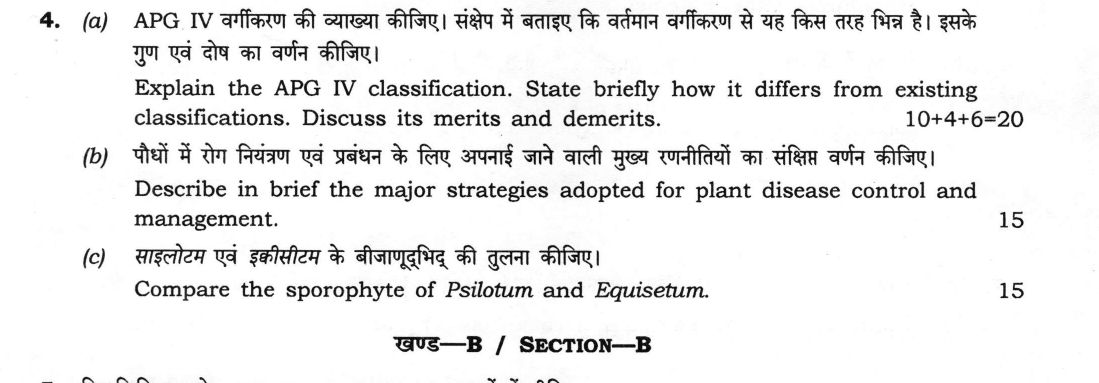
(a) Explain the APG IV classification. State briefly how it differs from existing classifications. Discuss its merits and…
Explain the APG IV classification. State briefly how it differs from existing classifications. Discuss its merits and demerits. 20 marks
Describe in brief the major strategies adopted for plant disease control and management. 15 marks
Compare the sporophyte of Psilotum and Equisetum. 15 marks
हिंदी में प्रश्न पढ़ें
APG IV वर्गीकरण की व्याख्या कीजिए। संक्षेप में बताइए कि वर्तमान वर्गीकरण से यह किस तरह भिन्न है। इसके गुण एवं दोष का वर्णन कीजिए। (20 अंक)
पौधों में रोग नियंत्रण एवं प्रबंधन के लिए अपनाई जाने वाली मुख्य रणनीतियों का संक्षिप्त वर्णन कीजिए। (15 अंक)
साइलोटम एवं इक्वीसीटम के बीजाणुभिद् की तुलना कीजिए। (15 अंक)
Model answer
Drafted with AI by UPSC Answer Check against this question's marking rubric, to the expected length. UPSC does not publish answers for Mains — this is one way to score well, not an official key. How we build rubrics and answers.
(a) APG IV classification, its difference from existing systems, and its merits and demerits (20 marks)
The APG IV classification (10 marks). The Angiosperm Phylogeny Group IV system, published in 2016, is a phylogenetic classification of flowering plants based on cladistics, in which every group must be monophyletic, that is, include an ancestor and all its descendants. It rests mainly on DNA sequence data, chiefly plastid genes (rbcL, atpB, matK), with nuclear ribosomal and mitochondrial genes and morphology in support. It is a consensus of many taxonomists and is revised as new evidence arrives. It recognises 64 orders and 416 families, and above the order it uses informal clades instead of ranks: the ANA grade (Amborellales, Nymphaeales, Austrobaileyales), magnoliids, monocots, and eudicots with core eudicots, superrosids and superasterids (rosids: fabids and malvids; asterids: lamiids and campanulids). APG IV added five orders to APG III (Boraginales, Dilleniales, Icacinales, Metteniusales, Vahliales) and re-arranged some families.
Difference from existing systems (4 marks). Earlier systems such as Bentham and Hooker, Engler and Prantl, and Cronquist were based on morphology and assumed phylogeny, and often placed groups on overall similarity, so they included paraphyletic groups. APG discards the dicot group, which is not monophyletic, and splits it into basal angiosperms, magnoliids and eudicots. It also re-defines many families, for example, Scrophulariaceae is broken up, many genera moving to Plantaginaceae, Asclepiadaceae is merged into Apocynaceae, Chenopodiaceae into Amaranthaceae, and Sterculiaceae, Tiliaceae and Bombacaceae into Malvaceae.
Merits and demerits (6 marks).
Merits:
- It rests on monophyly, so the groups reflect real evolutionary relationships.
- It uses objective, repeatable DNA evidence, is a consensus, and is open to revision.
- It resolves long-standing problems and predicts unexpected relationships, and gives a stable framework for research, herbaria and databases.
Demerits:
- Many groups have no simple morphological characters, so they are hard to identify or key in the field or classroom.
- Lumping of families (Malvaceae, Amaranthaceae) may hide useful diversity.
- It depends heavily on a few genes, mostly plastid, and changes with each revision.
- It covers only angiosperms and has no ranks above the order.
- Bentham and Hooker's system, being simple to use, is still followed in many Indian herbaria.
(b) Major strategies of plant disease control and management (15 marks)
Control rests on the principles of exclusion, eradication, protection, resistance and therapy, combined in an integrated approach.
- Exclusion: legal quarantine (India's Plant Quarantine Order, 2003), certified disease-free seed and planting material, and inspection, to keep pathogens out of an area.
- Avoidance: choose the site, sowing time, spacing and disease-free seed so that crop and pathogen do not meet at the vulnerable stage.
- Eradication: rouging of infected plants, crop rotation, destruction of crop residues, removal of weeds and alternate hosts, and soil solarisation.
- Protection: chemicals such as Bordeaux mixture, copper fungicides, sulphur, and systemic fungicides such as carbendazim as seed treatments, sprays and drenches; bactericides such as streptocycline; and cultural methods like irrigation and drainage.
- Host resistance: resistant or tolerant varieties bred conventionally or through genetic engineering, the cheapest and most durable method.
- Biological control: antagonists such as Trichoderma, Pseudomonas fluorescens and Bacillus, and Agrobacterium strain K84 against crown gall.
- Therapy: hot-water treatment of seed and setts, chemotherapy, and meristem culture to make virus-free plants.
- Integrated disease management: combining these, monitoring and forecasting, with the least reliance on pesticide.
(c) Comparison of the sporophyte of Psilotum and Equisetum (15 marks)
Both are homosporous pteridophytes, but they differ in almost every organ.
- Habit: Psilotum (whisk fern) is a small, bushy plant with forked green aerial stems; Equisetum (horsetail) is a larger plant with erect, jointed aerial stems and whorled branches.
- Underground part: Psilotum has a creeping rhizome with rhizoids and mycorrhizal fungus and no roots; Equisetum has a perennial rhizome, sometimes with tubers, bearing adventitious roots.
- Stem: in Psilotum it is dichotomously branched, ridged and green; in Equisetum it is differentiated into nodes and internodes, with ridges and furrows, a hollow centre and silica in the epidermis.
- Leaves: Psilotum has small, scale-like, vascular-less enations; Equisetum has small scale leaves in whorls at the nodes, united into a sheath.
- Stele: Psilotum has a protostele in the rhizome, changing to a siphonostele with pith in the aerial stem; Equisetum has a siphonostele broken into separate bundles, each with a carinal canal, and the cortex has vallecular canals.
- Sporangia: Psilotum has trilocular synangia at the tips of short forked branches; Equisetum has sporangia on peltate sporangiophores, in a terminal cone (strobilus), five to ten on each.
- Spores: Psilotum has spores without elaters; Equisetum has spores with four hygroscopic elaters.
How this answer will be evaluated
Evaluation rubric
Each sub-part is marked on its own, against the marks and word limit printed on the paper.
- (a) Three parts (10 + 4 + 6; 20 marks): explain the APG IV classification; state briefly how it differs from existing classifications; discuss its merits and demerits. No word limit printed. 20 marks
Must cover
- APG IV (2016): phylogenetic, cladistic, monophyletic groups, mainly DNA evidence (plastid rbcL, atpB, matK), consensus system; 64 orders and 416 families
- Informal clades above order (ANA grade, magnoliids, monocots, eudicots, superrosids, superasterids); five new orders over APG III
- Difference: earlier systems (Bentham-Hooker, Engler-Prantl, Cronquist) morphology-based with paraphyletic groups; dicots abandoned; families re-circumscribed (Malvaceae, Apocynaceae, Amaranthaceae)
- Merits (monophyly, objective evidence, stability, revision) and demerits (hard to key, lumping, gene dependence, angiosperms only, no ranks above order)
Loses marks
- Calling APG a phenetic or morphological system.
- Retaining Dicotyledons as a natural group.
Earns more
- Two family reshuffles named correctly.
- Balanced list of at least two merits and two demerits.
Extra mark
- Reference to Indian herbaria still following Bentham and Hooker
- (b) Describe in brief the major strategies adopted for plant disease control and management (15 marks; no word limit printed). 15 marks
Must cover
- Exclusion and avoidance: quarantine (Plant Quarantine Order 2003), certified seed, site and sowing time
- Eradication: rouging, rotation, residue destruction, alternate host removal, solarisation
- Protection: fungicides, bactericides, seed treatment; cultural methods
- Host resistance, biological control (Trichoderma, Pseudomonas, K84), therapy (hot water, meristem culture), integrated disease management
Loses marks
- Listing only pesticides.
- Omitting host resistance and biological control.
Earns more
- Named chemical or biological agent for each strategy.
- Distinction of principles (exclusion, eradication, protection, resistance, therapy).
Extra mark
- Forecasting and monitoring in IDM
- (c) Compare the sporophyte of Psilotum and Equisetum (15 marks; no word limit printed). 15 marks
Must cover
- Habit and underground parts: Psilotum rootless, rhizome with mycorrhiza; Equisetum rhizome with adventitious roots and tubers
- Stem and leaves: Psilotum forked ridged stem with enations; Equisetum jointed stem with ridges, furrows, silica, whorled scale leaves in sheaths
- Stele: Psilotum protostele to siphonostele; Equisetum siphonostele with carinal and vallecular canals
- Sporangia and spores: Psilotum trilocular synangia, no elaters; Equisetum sporangiophores in cone, four elaters
Loses marks
- Attributing true roots to Psilotum.
- Giving Equisetum a protostele or spores without elaters.
Earns more
- Comparison shown feature by feature.
- Both noted as homosporous.
Extra mark
- Classification (Psilotales versus Equisetales)
What "Discuss" is asking you to do
Lay the issue out from more than one side — how it arose, what is claimed for it, what is held against it, and where it now stands. UPSC attaches discuss to broad topics with several live dimensions, so coverage of the dimensions earns more than the strength of your opinion.
Structure that answers it
Set the issue up → the case as it is made → the case against → the dimension both sides leave out → where the balance now lies
Where marks are lost
Listing facts with no thread between them, or arguing one side throughout and calling it a discussion.
Practice this exact question
Write your answer and it is marked point by point against the model answer above — what you covered, what you missed, what you got wrong.
Evaluate my answer →More from Botany 2026 Paper I
- Q1 Answer the following questions in about 150 words each : (a) Blue-green algae are also co…
- Q2 (a) What are the major characteristics of Anthocerotopsida? Describe the gametophytic and…
- Q3 (a) Name the organism that causes stalk rot disease in maize. Describe its symptoms, dise…
- Q4 (a) Explain the APG IV classification. State briefly how it differs from existing classif…
- Q5 Answer the following questions in about 150 words each : (a) Describe the androecium of O…
- Q6 (a) Mention the diagnostic features of family Apiaceae and Solanaceae. Write the botanica…
- Q7 (a) Briefly explain the method of herbaria preparation. What is its role in modern taxono…