Paper I — Q5
(a) Describe the androecium of Orchidaceae and Asclepiadaceae. Highlight the differences between them. (10 marks) (b) Discuss…
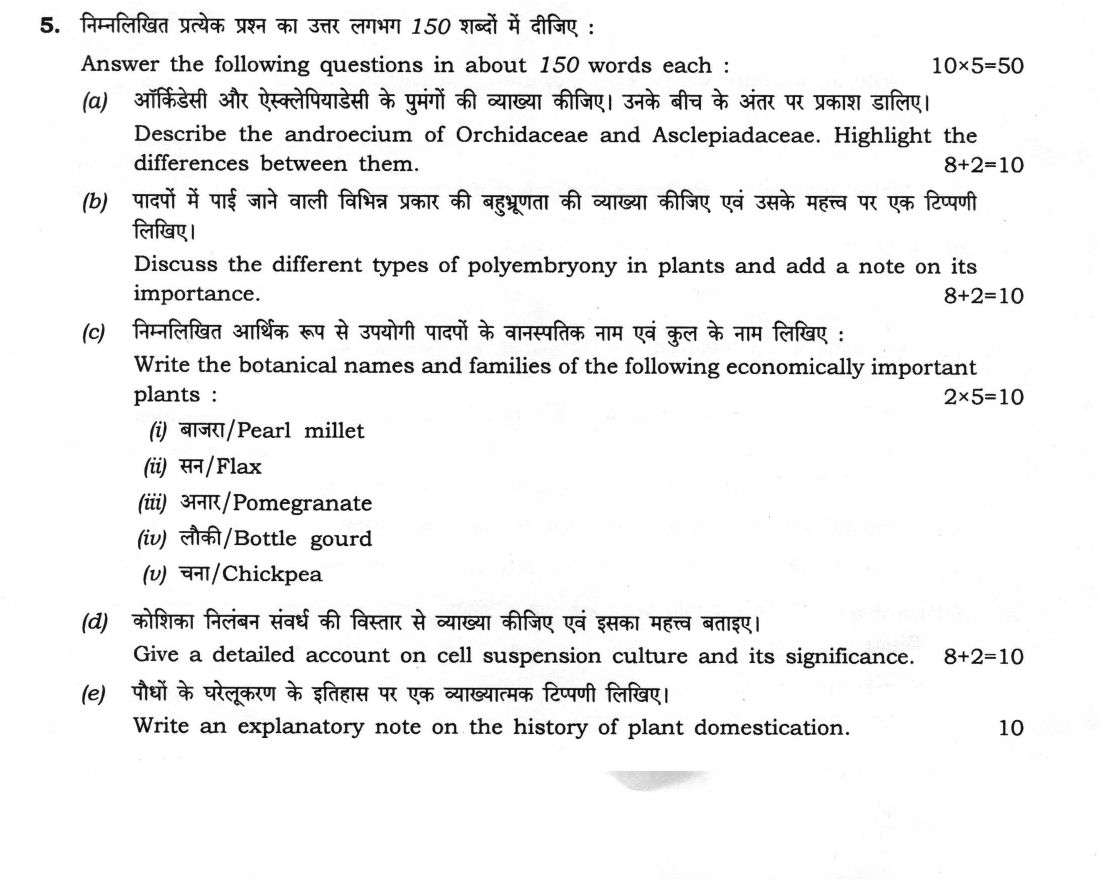
Answer the following questions in about 150 words each :
Describe the androecium of Orchidaceae and Asclepiadaceae. Highlight the differences between them. 10 marks
Discuss the different types of polyembryony in plants and add a note on its importance. 10 marks
Write the botanical names and families of the following economically important plants : Pearl millet
Flax
Pomegranate
Bottle gourd
Chickpea 10 marks
Give a detailed account on cell suspension culture and its significance. 10 marks
Write an explanatory note on the history of plant domestication. 10 marks
हिंदी में प्रश्न पढ़ें
निम्नलिखित प्रत्येक प्रश्न का उत्तर लगभग 150 शब्दों में दीजिए :
आर्किडेसी और ऐस्क्लेपियाडेसी के पुमंग की व्याख्या कीजिए। उनके बीच के अंतर पर प्रकाश डालिए। (10 अंक)
पादपों में पाई जाने वाली विभिन्न प्रकार की बहुभ्रूणता की व्याख्या कीजिए एवं उसके महत्व पर एक टिप्पणी लिखिए। (10 अंक)
निम्नलिखित आर्थिक रूप से उपयोगी पादपों के वानस्पतिक नाम एवं कुल के नाम लिखिए : बाजरा
सन
अनार
लौकी
चना (10 अंक)
कोशिका निलंबन संवर्ध की विस्तार से व्याख्या कीजिए एवं इसका महत्व बताइए। (10 अंक)
पौधों के घरेलूकरण के इतिहास पर एक व्याख्यात्मक टिप्पणी लिखिए। (10 अंक)
Model answer
Drafted with AI by UPSC Answer Check against this question's marking rubric, to the 150-word length. UPSC does not publish answers for Mains — this is one way to score well, not an official key. How we build rubrics and answers.
(a) Androecium of Orchidaceae and Asclepiadaceae, and the differences (10 marks)
Description (8 marks):
- Orchidaceae: one fertile stamen in most orchids (monandrous), two in slipper orchids, the rest being staminodes. The stamen is fused with the style and stigma into a column, the gynostemium. Pollen is bound into masses, the pollinia (powdery or sectile), each with a stalk (caudicle) ending in a sticky disc (viscidium) that sticks to an insect.
- Asclepiadaceae (now Apocynaceae, subfamily Asclepiadoideae): five stamens, with filaments united into a tube, and anthers adhering to the stigmatic head to form a gynostegium, with a corona of five hoods on the tube. Each anther lobe has a waxy pollinium, and pollinia of adjacent anthers are joined by two arms to a sticky gland (corpusculum), the translator.
Differences (2 marks):
- Stamens: one or two in orchids and five in Asclepiadaceae.
- Pollinia: powdery or sectile with a viscidium in orchids, and waxy with a translator in Asclepiadaceae.
- Orchids have a gynostemium (column) and no corona; Asclepiadaceae have a gynostegium with a corona.
(b) Types of polyembryony and its importance (10 marks)
Polyembryony is the occurrence of more than one embryo in a seed. Its types (8 marks):
- Cleavage polyembryony: the zygote or young embryo splits into several embryos, as in Pinus and other gymnosperms and in some angiosperms such as orchids.
- Adventive (nucellar or integumentary) embryony: embryos arise directly from diploid nucellus or integument cells, without fertilisation, and grow beside the zygotic embryo, as in Citrus and mango.
- Multiple embryo sacs: more than one embryo sac in an ovule, each producing an embryo, as in Casuarina and some Rosaceae.
- Other cells of the embryo sac: synergids or antipodals develop into embryos, as reported in Argemone and Ulmus.
- Simple polyembryony in gymnosperms: several archegonia in an ovule are fertilised.
Importance (2 marks):
- Nucellar seedlings are genetically identical to the mother, so they give uniform, true-to-type and often virus-free rootstocks in Citrus and mango.
- Twin seedlings are a source of haploids and polyploids in breeding, but polyembryony makes it hard to recover hybrids.
(c) Botanical names and families (10 marks)
- (i) Pearl millet (bajra): Pennisetum glaucum (accepted name now Cenchrus americanus), family Poaceae.
- (ii) Flax (sun or alsi): Linum usitatissimum, family Linaceae.
- (iii) Pomegranate (anar): Punica granatum, family Lythraceae (formerly Punicaceae).
- (iv) Bottle gourd (lauki): Lagenaria siceraria, family Cucurbitaceae.
- (v) Chickpea (chana): Cicer arietinum, family Fabaceae (Leguminosae).
(d) Cell suspension culture and its significance (10 marks)
Cell suspension culture is the growth of single cells and small cell aggregates dispersed in a liquid medium.
Procedure (8 marks):
- A friable callus is raised on solid MS medium with 2,4-D and a cytokinin.
- About 2 to 3 g of callus goes into 50 to 100 ml of liquid medium in a conical flask.
- The flasks are shaken at 100 to 120 rpm at about 25 °C in dim light, to aerate and break up clumps.
- Large clumps are removed by nylon mesh, and the suspension is subcultured every 1 to 2 weeks at about 1 in 5 to 1 in 10 dilution.
- Growth is followed by cell count, packed cell volume and dry weight (lag, exponential, linear, stationary phases), and viability by fluorescein diacetate or Evans blue; cultures may be batch or continuous.
Significance (2 marks). It is a source of secondary metabolites (shikonin, berberine), of protoplasts and somatic embryos, and a system for selecting mutant or stress-tolerant cells and for biotransformation.
(e) History of plant domestication (10 marks)
Domestication is the genetic change of wild plants under human selection so that they suit cultivation. It began about 10,000 to 12,000 years ago at the end of the last Ice Age, when people shifted from gathering to farming. Vavilov identified centres of origin, such as the Fertile Crescent (wheat, barley, peas, lentil, flax), Mesoamerica (maize from teosinte, beans, squash), the Andes (potato), China (rice, millets, soybean), and the Indian region (rice, mung, cotton, brinjal). Early farmers at sites such as Mehrgarh in the Indus region grew wheat and barley by about 7000 BCE.
Selection, first unconscious and then deliberate, produced the domestication syndrome: loss of seed shattering, larger seeds and fruits, reduced dormancy, uniform ripening, less branching and less bitterness or toxin. Hybridisation and polyploidy created new crops, such as bread wheat. Crops then spread along trade routes, and the Columbian exchange after 1492 moved potato, maize and tomato worldwide. Modern breeding after Mendel and the Green Revolution continued the process.
How this answer will be evaluated
Evaluation rubric
Each sub-part is marked on its own, against the marks and word limit printed on the paper.
- (a) Two parts (8 + 2): describe the androecium of Orchidaceae and Asclepiadaceae; highlight the differences, in about 150 words (10 marks). 10 marks · 150 words
Must cover
- Orchidaceae: one (or two) fertile stamen fused with style and stigma into gynostemium; pollen in pollinia with caudicle and viscidium; staminodes
- Asclepiadaceae: five stamens united into a staminal tube, gynostegium with the stigmatic head, corona of hoods
- Asclepiadaceae pollinia: waxy, one per anther lobe, joined in pairs by caudicles to a corpusculum (translator)
- Differences: stamen number, pollinia type and attachment, gynostemium versus gynostegium, corona
Loses marks
- Giving orchids five stamens or Asclepiadaceae one.
- Mixing up caudicle and translator.
Earns more
- Both structures labelled or named correctly.
- Explanation of pollinia removal by insects.
Extra mark
- Asclepiadaceae now placed in Apocynaceae
- (b) Two parts (8 + 2): discuss the different types of polyembryony in plants; add a note on its importance, in about 150 words (10 marks). 10 marks · 150 words
Must cover
- Definition: more than one embryo in a seed
- Cleavage polyembryony and adventive (nucellar) embryony with examples (Pinus; Citrus, mango)
- Multiple embryo sacs and embryos from synergids or antipodals; simple polyembryony in gymnosperms
- Importance: true-to-type virus-free nucellar seedlings, rootstocks, haploid twins; problem for hybrid recovery
Loses marks
- Defining polyembryony as more than one seed.
- Omitting importance (2 marks).
Earns more
- Sporophytic (apomictic) origin of adventive embryos.
- Named examples for every type given.
Extra mark
- Twin seedlings as a source of haploids
- (c) Write the botanical names and families of the following (2 × 5 = 10 marks): pearl millet, flax, pomegranate, bottle gourd, chickpea. 10 marks · 150 words
Must cover
- Pearl millet: Pennisetum glaucum (Cenchrus americanus), Poaceae; flax: Linum usitatissimum, Linaceae
- Pomegranate: Punica granatum, Lythraceae (formerly Punicaceae)
- Bottle gourd: Lagenaria siceraria, Cucurbitaceae
- Chickpea: Cicer arietinum, Fabaceae (Leguminosae)
Loses marks
- Wrong genus for pearl millet (for example Sorghum) or family for pomegranate (Myrtaceae).
- Giving only family or only binomial for a plant.
Earns more
- Correct italicised binomials with author-free form.
- Family names as per current APG.
Extra mark
- Note on accepted name change of pearl millet and pomegranate family
- (d) Two parts (8 + 2): a detailed account of cell suspension culture and its significance, in about 150 words (10 marks). 10 marks · 150 words
Must cover
- Definition: cells and small aggregates dispersed in liquid medium
- Friable callus on MS medium with 2,4-D and cytokinin, transferred to liquid medium in flasks
- Rotary shaker (100-120 rpm, 25 °C), sieving, subculture every 1-2 weeks at 1:5 to 1:10 dilution
- Growth measurement and viability, batch and continuous culture; significance: secondary metabolites, protoplasts, somatic embryos, in vitro selection
Loses marks
- Starting from a hard, non-friable callus.
- Omitting shaking or subculture.
Earns more
- Named product such as shikonin or berberine.
- Growth-phase names given.
Extra mark
- Bioreactor scale-up
- (e) Write an explanatory note on the history of plant domestication, in about 150 words (10 marks). 10 marks · 150 words
Must cover
- Definition of domestication by human selection; onset 10,000-12,000 years ago after the last Ice Age
- Centres of origin (Vavilov): Fertile Crescent, Mesoamerica, Andes, China, Indian region, with example crops; Mehrgarh evidence
- Domestication syndrome: loss of shattering, larger seeds, reduced dormancy, uniform ripening
- Spread, hybridisation and polyploidy (bread wheat), Columbian exchange, modern breeding and Green Revolution
Loses marks
- Giving dates of a few hundred years.
- Only a list of crops with no process.
Earns more
- Conscious versus unconscious selection.
- At least three crops with their regions.
Extra mark
- Archaeological evidence such as grain remains and wild ancestors (teosinte)
What "Highlight" is asking you to do
Bring the notable features of the named material forward and make their weight visible — what each feature is, and what gives it importance. Highlight expects substantive coverage of the features, not a thin selection from them.
Structure that answers it
The material and what makes a feature notable within it → feature, with the point that gives it weight → the same for each further feature → the composite picture they form
Where marks are lost
Naming features flatly as a list and never showing why any one of them signifies.
Practice this exact question
Write your answer and it is marked point by point against the model answer above — what you covered, what you missed, what you got wrong.
Evaluate my answer →More from Botany 2026 Paper I
- Q2 (a) What are the major characteristics of Anthocerotopsida? Describe the gametophytic and…
- Q3 (a) Name the organism that causes stalk rot disease in maize. Describe its symptoms, dise…
- Q4 (a) Explain the APG IV classification. State briefly how it differs from existing classif…
- Q5 Answer the following questions in about 150 words each : (a) Describe the androecium of O…
- Q6 (a) Mention the diagnostic features of family Apiaceae and Solanaceae. Write the botanica…
- Q7 (a) Briefly explain the method of herbaria preparation. What is its role in modern taxono…
- Q8 (a) What is the role played by media and growth regulators in micropropagation? How to co…