Paper I — Q8
(a) What is the role played by media and growth regulators in micropropagation? How to control exudation and contamination…
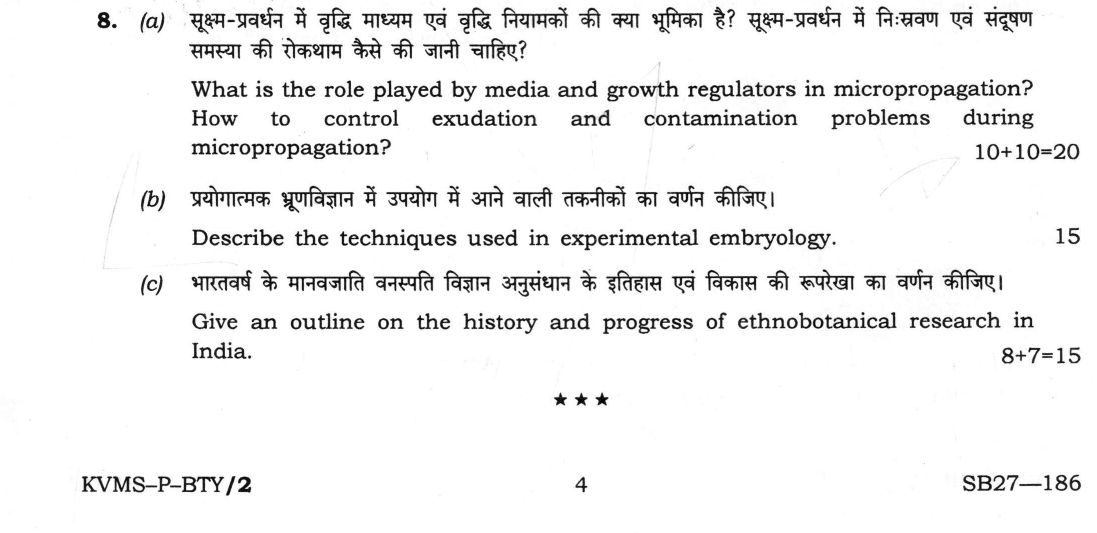
What is the role played by media and growth regulators in micropropagation? How to control exudation and contamination problems during micropropagation? 20 marks
Describe the techniques used in experimental embryology. 15 marks
Give an outline on the history and progress of ethnobotanical research in India. 15 marks
हिंदी में प्रश्न पढ़ें
सूक्ष्म-प्रवर्धन में वृद्धि माध्यम एवं वृद्धि नियामकों की क्या भूमिका है? सूक्ष्म-प्रवर्धन में निःस्रवण एवं संदूषण समस्या की रोकथाम कैसे की जानी चाहिए? (20 अंक)
प्रयोगात्मक भ्रूणविज्ञान में उपयोग में आने वाली तकनीकों का वर्णन कीजिए। (15 अंक)
भारतवर्ष के मानवजाति वनस्पति विज्ञान अनुसंधान के इतिहास एवं विकास की रूपरेखा का वर्णन कीजिए। (15 अंक)
Model answer
Drafted with AI by UPSC Answer Check against this question's marking rubric, to the expected length. UPSC does not publish answers for Mains — this is one way to score well, not an official key. How we build rubrics and answers.
(a) Role of media and growth regulators in micropropagation, and control of exudation and contamination (20 marks)
Role of media and growth regulators (10 marks).
Medium. Cultured tissue is heterotrophic and depends on the medium, most commonly Murashige and Skoog (MS) medium, which supplies:
- macronutrients (nitrogen as nitrate and ammonium, phosphorus, potassium, calcium, magnesium, sulphur) and micronutrients (iron as Fe-EDTA, manganese, zinc, boron, copper, molybdenum);
- vitamins (thiamine, pyridoxine, nicotinic acid, myo-inositol);
- a carbon and energy source, sucrose (2 to 3%), which also gives osmotic support;
- a gelling agent, agar (0.6 to 0.8%), a pH of 5.6 to 5.8, and sometimes coconut water, casein hydrolysate or activated charcoal.
Growth regulators. The type and ratio decide the response at each stage of micropropagation:
- Multiplication: a cytokinin (BAP, kinetin, TDZ) at about 1 to 3 mg/l with a little auxin breaks apical dominance and promotes axillary shoots.
- Rooting: an auxin (IBA or NAA, 0.5 to 2 mg/l), often in half-strength medium with low sugar.
- Gibberellin (GA3) elongates shoots; auxin (2,4-D) at high levels gives callus, and a high auxin to cytokinin ratio favours roots and a low one favours shoots.
Control of exudation (5 marks). Cut tissue releases phenolics, which polyphenol oxidase oxidises to toxic quinones that brown the medium and stop growth. It is controlled by:
- using young, actively growing explants from healthy plants, taken in the correct season;
- pre-soaking or adding antioxidants (ascorbic acid, citric acid, cysteine) and adsorbents such as polyvinylpyrrolidone or activated charcoal (0.1 to 0.5%);
- transferring to fresh medium at intervals of one to three days at first, incubating in the dark or in dim light initially, and using a liquid or lower-salt medium.
Control of contamination (5 marks). Bacteria, fungi and yeasts come from the explant, the medium, the instruments, the air or the worker. They are controlled by:
- sterilising the medium in an autoclave (121 °C, 15 psi, 15 to 20 minutes) and heat-labile substances by filtration (0.22 µm);
- surface-sterilising the explant (detergent wash, 70% ethanol, then mercuric chloride 0.1% or sodium hypochlorite, and rinsing in sterile water), and treating the mother plant with fungicide;
- working in a laminar-flow cabinet with sterilised tools, clean gloves and clothing, and a clean culture room;
- using antibiotics or a plant preservative mixture when needed, sealing the cultures, and discarding contaminated ones.
(b) Techniques used in experimental embryology (15 marks)
Experimental embryology studies the development of the embryo and its reproductive processes by growing the parts in vitro under controlled conditions. Its main techniques are:
- Embryo culture: mature or immature embryos are dissected out and grown on defined medium, to study nutrition and development and, in embryo rescue, to save embryos of wide crosses that would abort.
- Ovule and ovary culture: fertilised or unfertilised ovules and ovaries are cultured for seed development, and for haploid production.
- In vitro pollination and fertilisation: pollen is applied to cultured ovules or ovaries, as in test-tube fertilisation in Papaver by Kanta, Rangaswamy and Maheshwari (1962); isolated gametes may be fused, as in maize.
- Pollen culture: pollen is germinated in hanging drops or on agar, in sucrose with boric acid and calcium, to study the growth of the pollen tube and the effect of pistil factors.
- Endosperm culture: gives triploid plants and shows how endosperm supports the embryo.
- Anther, ovary and microspore culture, and protoplast fusion, for haploids and hybrids.
- Staining and microscopy: aniline blue with fluorescence to follow pollen tubes, whole-mount clearing of ovules, histochemistry, autoradiography and confocal microscopy.
The Delhi school of embryology led by Panchanan Maheshwari was a pioneer of these methods in India.
(c) History and progress of ethnobotanical research in India (15 marks)
History (8 marks). Ethnobotany is the study of the relationship between people and plants. The term was proposed by John Harshberger in 1895. In India, knowledge of plants for food, fibre and medicine is old, recorded in the Vedas, the Charaka and Sushruta Samhitas, and in Ayurveda and Sangam literature. Colonial-period works include Hortus Malabaricus (Van Rheede, 1678 to 1693), Roxburgh's Flora Indica, and Watt's Dictionary of the Economic Products of India (1889 to 1896). E. K. Janaki Ammal began ethnobotanical surveys at the Botanical Survey of India in the 1950s, and S. K. Jain built the field in the 1960s and later, so that he is often called the father of Indian ethnobotany.
Progress (7 marks):
- The All India Coordinated Research Project on Ethnobiology (from 1982) surveyed tribes across the country.
- Research at the Botanical Survey of India, the National Botanical Research Institute, CSIR, ICMR and universities, and journals such as Ethnobotany and the Indian Journal of Traditional Knowledge, has documented uses of plants by tribes, such as the Gond, Santhal, Bhil and Toda.
- Leads from folk use gave drugs, such as reserpine from Rauvolfia serpentina, and Jeevani from Trichopus zeylanicus (arogyapacha), developed with the Kani tribe, which became a widely cited early benefit-sharing arrangement.
- Protection of traditional knowledge grew through the Traditional Knowledge Digital Library (2001) and the Biological Diversity Act, 2002 and People's Biodiversity Registers; and the National Medicinal Plants Board and Ministry of AYUSH promote conservation and use.
How this answer will be evaluated
Evaluation rubric
Each sub-part is marked on its own, against the marks and word limit printed on the paper.
- (a) Two parts (10 + 10; 20 marks): the role of media and growth regulators in micropropagation; how exudation and contamination are controlled. No word limit printed. 20 marks
Must cover
- Medium (MS): macro- and micronutrients, vitamins, sucrose, agar, pH 5.6-5.8, supplements
- Growth regulators by stage: cytokinin for multiplication, auxin for rooting, GA3, auxin:cytokinin ratio
- Exudation: phenolic oxidation to quinones; control by young explants, antioxidants, PVP or charcoal, frequent transfer, dark incubation
- Contamination: sources; autoclaving (121 °C, 15 psi), filter sterilisation, explant surface sterilisation, laminar flow, antibiotics
Loses marks
- Describing exudation as leakage of nutrients from the medium.
- Omitting either exudation or contamination control.
Earns more
- Named hormones with concentrations.
- Sterilant concentrations and contact times.
Extra mark
- Stages of micropropagation (establishment, multiplication, rooting, hardening)
- (b) Describe the techniques used in experimental embryology (15 marks; no word limit printed). 15 marks
Must cover
- Embryo culture (mature, immature) and embryo rescue of wide crosses
- Ovule and ovary culture; in vitro pollination and fertilisation (Kanta, Rangaswamy and Maheshwari 1962, Papaver)
- Pollen culture and pollen tube growth studies; endosperm culture
- Staining and microscopy (aniline blue fluorescence, clearing, autoradiography), anther and protoplast techniques; Indian contribution (Maheshwari school)
Loses marks
- Listing only micropropagation techniques.
- No mention of in vitro pollination or embryo rescue.
Earns more
- Medium components for pollen germination.
- Applications of each technique.
Extra mark
- Isolated-gamete fertilisation in maize
- (c) Two parts (8 + 7; 15 marks): the history and the progress of ethnobotanical research in India. No word limit printed. 15 marks
Must cover
- Definition; Harshberger 1895; ancient records (Vedas, Charaka and Sushruta Samhitas, Ayurveda)
- Colonial works (Hortus Malabaricus, Roxburgh, Watt); pioneers E. K. Janaki Ammal and S. K. Jain
- Progress: AICRPE from 1982, BSI, NBRI, CSIR, journals, tribal surveys
- Drug leads (reserpine, Jeevani with Kani tribe), TKDL 2001, Biological Diversity Act 2002, National Medicinal Plants Board
Loses marks
- Giving Harshberger's date as the 20th century.
- History with no post-independence progress.
Earns more
- Named tribes and regions studied.
- Benefit-sharing and biopiracy concerns.
Extra mark
- People's Biodiversity Registers and AYUSH role
What "Explain" is asking you to do
Make the working of something clear — what sets it off, what follows from what, and what it produces. Explain is the Commission's mechanism word: it dominates the technical papers and the “explain why” stems, where the marks sit in the causal chain and not in the label.
Structure that answers it
State what it is → the initiating condition → the chain of cause, step by step → an instance where it plays out → what the chain produces
Where marks are lost
Describing what something looks like instead of why it works that way. Naming the stages without linking them reads as description too.
Practice this exact question
Write your answer and it is marked point by point against the model answer above — what you covered, what you missed, what you got wrong.
Evaluate my answer →More from Botany 2026 Paper I
- Q5 Answer the following questions in about 150 words each : (a) Describe the androecium of O…
- Q6 (a) Mention the diagnostic features of family Apiaceae and Solanaceae. Write the botanica…
- Q7 (a) Briefly explain the method of herbaria preparation. What is its role in modern taxono…
- Q8 (a) What is the role played by media and growth regulators in micropropagation? How to co…