Paper I — Q6
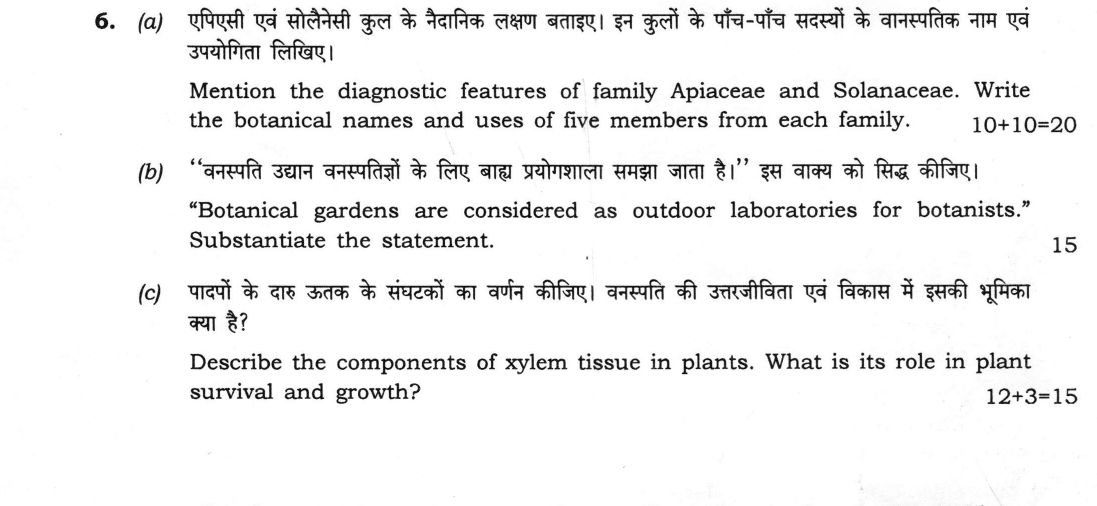
(a) Mention the diagnostic features of family Apiaceae and Solanaceae. Write the botanical names and uses of five members from…
Mention the diagnostic features of family Apiaceae and Solanaceae. Write the botanical names and uses of five members from each family. 20 marks
“Botanical gardens are considered as outdoor laboratories for botanists.” Substantiate the statement. 15 marks
Describe the components of xylem tissue in plants. What is its role in plant survival and growth? 15 marks
हिंदी में प्रश्न पढ़ें
एपिएसी एवं सोलैनेसी कुल के नैदानिक लक्षण बताइए। इन कुलों के पाँच-पाँच सदस्यों के वानस्पतिक नाम एवं उपयोगिता लिखिए। (20 अंक)
“वनस्पति उद्यान वनस्पतिज्ञों के लिए बाह्य प्रयोगशाला समझा जाता है।” इस वाक्य को सिद्ध कीजिए। (15 अंक)
पादपों के दारू ऊतक के संघटकों का वर्णन कीजिए। वनस्पति की उत्तरजीविता एवं विकास में इसकी भूमिका क्या है? (15 अंक)
Model answer
Drafted with AI by UPSC Answer Check against this question's marking rubric, to the expected length. UPSC does not publish answers for Mains — this is one way to score well, not an official key. How we build rubrics and answers.
(a) Diagnostic features of Apiaceae and Solanaceae, with names and uses of five members of each (20 marks)
Diagnostic features (10 marks).
Apiaceae (Umbelliferae):
- Aromatic herbs with hollow (fistular), furrowed stems and oil ducts (schizogenous) containing essential oils.
- Leaves alternate, pinnately compound or much dissected, with a sheathing base.
- Inflorescence a compound umbel, with an involucre and involucels.
- Flowers small, bisexual, epigynous and pentamerous, with minute sepals and five free petals, five stamens and a nectar-secreting stylopodium.
- Ovary inferior, of two fused carpels, bilocular, with one pendulous ovule in each; fruit a cremocarp that splits into two one-seeded mericarps hanging from a carpophore; formula ⊕ ⚥ K(5) or 0 C5 A5 G̅(2).
Solanaceae:
- Herbs, shrubs or small trees; leaves simple, alternate and exstipulate; vascular bundles bicollateral, with internal phloem.
- Inflorescence cymose, often extra-axillary or leaf-opposed.
- Flowers actinomorphic, bisexual and hypogynous; calyx of five united persistent sepals, corolla of five united petals (rotate or campanulate), five epipetalous stamens alternating with the petals, anthers often opening by pores.
- Ovary superior, bicarpellary, bilocular with an obliquely placed septum and swollen axile placentae; fruit a berry or capsule; formula ⊕ ⚥ K(5) C(5) A5 G(2). Alkaloids are characteristic.
Botanical names and uses (10 marks).
Apiaceae:
- Coriandrum sativum (coriander): leaves and fruits as spice and garnish.
- Cuminum cyminum (cumin): seeds as spice, carminative.
- Foeniculum vulgare (fennel): fruits as spice and mouth-freshener; carminative.
- Daucus carota (carrot): edible root, rich in carotene.
- Trachyspermum ammi (ajwain): fruits as spice, and thymol for digestive and antiseptic use.
Solanaceae:
- Solanum tuberosum (potato): edible starchy tuber.
- Solanum lycopersicum (tomato): fruit as vegetable, rich in lycopene and vitamin C.
- Solanum melongena (brinjal): fruit as vegetable.
- Capsicum annuum (chilli): fruit as spice, source of capsaicin.
- Withania somnifera (ashwagandha): root used as a tonic in Ayurveda; also Nicotiana tabacum (tobacco) for nicotine and Atropa belladonna for atropine.
(b) Botanical gardens as outdoor laboratories for botanists (15 marks)
A botanical garden is a living collection of plants, labelled and arranged for study, and it serves as a laboratory in the open in these ways:
- Taxonomy: living plants named and documented are reference material beside the herbarium, letting botanists study variation, flowering and fruiting through the year, and compare related taxa side by side. Seeds are exchanged through Index Seminum.
- Conservation: ex situ conservation of endangered and endemic species, with seed banks, propagation and reintroduction, as at Kew and in India at the National Botanical Research Institute, Lucknow.
- Introduction and acclimatisation: economic plants such as cinchona, tea and rubber were first tried in gardens; the Indian Botanic Garden at Howrah, founded in 1787, played a part in this.
- Experimental research: plant physiology, anatomy, cytology, genetics, breeding and ecology, including phenology and the effects of climate change; DNA barcoding needs authenticated material.
- Economic and medicinal botany: gardens grow herbs, spices, timber and drug plants for study and for bioprospecting.
- Education and public awareness: teaching, field practicals, identification and training for students, and plant-science education for the public.
- Horticulture: development and display of ornamentals, and hybrid and cultivar trials.
Hence a botanical garden gives botanists what a field station or a laboratory gives, a supply of authenticated, living material under known conditions, to study and to protect plants.
(c) Components of xylem and its role in survival and growth of plants (15 marks)
Xylem is the complex tissue that conducts water and minerals, and it has four kinds of elements (12 marks):
- Tracheids: long, tapering, dead cells with lignified walls and bordered pits, with no perforation. They conduct water through the pits and give strength. They are the main water-conducting cells of pteridophytes and gymnosperms.
- Vessels (tracheae): tubes of dead vessel elements placed end to end, with perforated end walls and wide lumens, so they carry water rapidly. They are typical of angiosperms, with annular, spiral, scalariform, reticulate or pitted thickening.
- Xylem fibres: elongated, thick-walled sclerenchyma cells (libriform fibres and fibre-tracheids), which give mechanical strength.
- Xylem parenchyma: living cells, in axial strands and in rays, that store starch and fats, transport water and food radially, and form tyloses that block old vessels.
Protoxylem, first formed with annular and spiral thickening, and metaxylem, with pitted thickening, form the primary xylem, and secondary xylem is the wood, in which sapwood conducts and heartwood only supports.
Role (3 marks). Xylem carries water and minerals from roots to leaves, by transpiration pull and cohesion, so that photosynthesis and growth continue; it gives mechanical support, allowing tall growth on land; and it stores food. Secondary xylem increases stem girth and gives timber.
How this answer will be evaluated
Evaluation rubric
Each sub-part is marked on its own, against the marks and word limit printed on the paper.
- (a) Two parts (10 + 10; 20 marks): the diagnostic features of Apiaceae and Solanaceae; the botanical names and uses of five members from each family. No word limit printed. 20 marks
Must cover
- Apiaceae: aromatic hollow-stemmed herbs, compound umbel, epigynous flowers, inferior bicarpellary ovary, cremocarp
- Solanaceae: bicollateral bundles, actinomorphic hypogynous flowers, five epipetalous stamens, superior bicarpellary ovary with oblique septum, berry or capsule
- Five correct botanical names with uses from Apiaceae (coriander, cumin, fennel, carrot, ajwain)
- Five correct botanical names with uses from Solanaceae (potato, tomato, brinjal, chilli, ashwagandha)
Loses marks
- Naming plants of other families (for example onion or mustard).
- Common names without binomials.
Earns more
- Floral formulae for both families.
- Plant part used specified for each member.
Extra mark
- Alkaloids (nicotine, atropine) of Solanaceae and essential oils of Apiaceae
- (b) Substantiate the statement: 'Botanical gardens are considered as outdoor laboratories for botanists' (15 marks; no word limit printed). 15 marks
Must cover
- Definition: labelled living collection used for study; taxonomy and reference to herbarium
- Ex situ conservation, seed banks and reintroduction, with examples (Kew, NBRI, Indian Botanic Garden, Howrah)
- Introduction and acclimatisation of economic plants (cinchona, tea, rubber); experimental research in physiology, genetics, ecology and phenology
- Education and training, medicinal and horticultural work; conclusion tying to laboratory functions
Loses marks
- Describing only recreation and landscaping.
- Generic answer with no example of a garden.
Earns more
- Examples from India and abroad.
- Each function linked back to the laboratory analogy.
Extra mark
- DNA barcoding and climate-change studies
- (c) Two parts (12 + 3; 15 marks): describe the components of xylem tissue; its role in plant survival and growth. No word limit printed. 15 marks
Must cover
- Tracheids: dead, tapering, bordered pits, no perforation, main conducting cells in pteridophytes and gymnosperms
- Vessels: dead elements with perforated end walls, wide, in angiosperms; types of wall thickening
- Xylem fibres (support) and xylem parenchyma (storage, radial transport, tyloses)
- Role: water and mineral conduction (transpiration pull), mechanical support, storage; secondary xylem gives girth and timber
Loses marks
- Describing phloem elements.
- Calling vessels living or tracheids perforated.
Earns more
- Protoxylem versus metaxylem and sapwood versus heartwood.
- Statement of cohesion-tension mechanism.
Extra mark
- Embolism and drought adaptation
What "Mention" is asking you to do
Put specific factual content on record — the names, features, targets or instances the stem asks for. Mention is usually the subordinate half of a larger question, so it must be done fully but quickly, leaving room for the part that carries the main directive.
Structure that answers it
The items named directly, without preamble → one qualifying detail against each → straight on to the part of the stem the marks actually sit in
Where marks are lost
Gesturing at the category instead of naming the particulars, or expanding it until the analytical half of the question is squeezed.
Practice this exact question
Write your answer and it is marked point by point against the model answer above — what you covered, what you missed, what you got wrong.
Evaluate my answer →More from Botany 2026 Paper I
- Q3 (a) Name the organism that causes stalk rot disease in maize. Describe its symptoms, dise…
- Q4 (a) Explain the APG IV classification. State briefly how it differs from existing classif…
- Q5 Answer the following questions in about 150 words each : (a) Describe the androecium of O…
- Q6 (a) Mention the diagnostic features of family Apiaceae and Solanaceae. Write the botanica…
- Q7 (a) Briefly explain the method of herbaria preparation. What is its role in modern taxono…
- Q8 (a) What is the role played by media and growth regulators in micropropagation? How to co…