Paper I — Q7
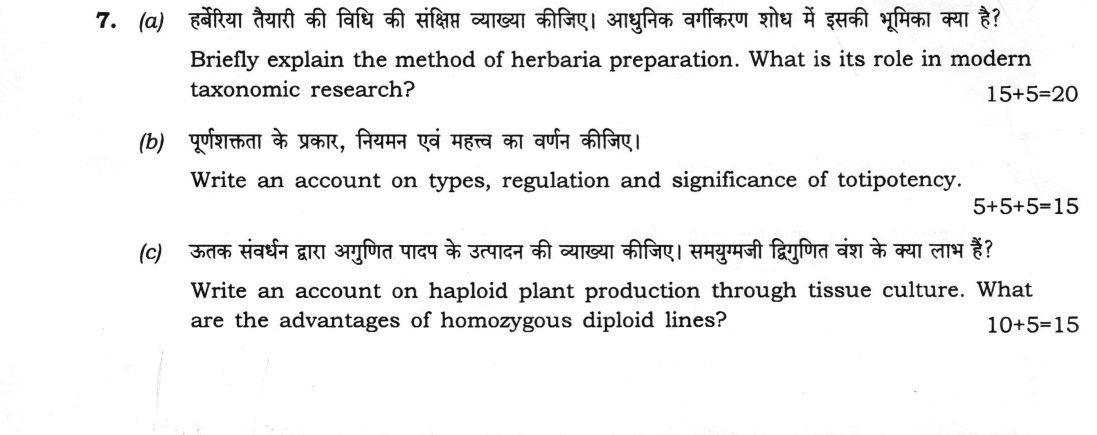
(a) Briefly explain the method of herbaria preparation. What is its role in modern taxonomic research? (20 marks) (b) Write an…
Briefly explain the method of herbaria preparation. What is its role in modern taxonomic research? 20 marks
Write an account on types, regulation and significance of totipotency. 15 marks
Write an account on haploid plant production through tissue culture. What are the advantages of homozygous diploid lines? 15 marks
हिंदी में प्रश्न पढ़ें
हर्बेरिया तैयारी की विधि की संक्षिप्त व्याख्या कीजिए। आधुनिक वर्गीकरण शोध में इसकी भूमिका क्या है? (20 अंक)
पूर्णशक्तता के प्रकार, नियमन एवं महत्त्व का वर्णन कीजिए। (15 अंक)
ऊतक संवर्धन द्वारा आगुणित पादप के उत्पादन की व्याख्या कीजिए। समयुग्मजी द्विगुणित वंश के क्या लाभ हैं? (15 अंक)
Model answer
Drafted with AI by UPSC Answer Check against this question's marking rubric, to the expected length. UPSC does not publish answers for Mains — this is one way to score well, not an official key. How we build rubrics and answers.
(a) Method of herbarium preparation, and its role in modern taxonomic research (20 marks)
Method (15 marks). A herbarium is a collection of dried, pressed, mounted and labelled plant specimens.
- Collection: take a representative specimen with roots (for herbs), stem, leaves, flowers and, if possible, fruits, about 30 by 42 cm, using a digger, secateurs and a vasculum or polythene bag. Record in a field book the collection number, date, locality, habitat, altitude, plant habit, colour of parts, local name and uses, and take a GPS position.
- Pressing: arrange the specimen flat between sheets of blotting paper or newspaper, with the leaves shown from both sides, and place it in a plant press between corrugated boards and tighten it.
- Drying: change the driers daily in the first few days; dry in the sun, a ventilated warm place or a dryer for one to two weeks, until brittle. Fleshy parts may be sliced, and large fruits dried separately.
- Poisoning and pest control: earlier the specimens were treated with a solution of mercuric chloride in alcohol; nowadays safer methods such as freezing at -20 °C for a few days or fumigation are preferred, along with naphthalene or paradichlorobenzene in cabinets.
- Mounting: fix the dry specimen on a standard herbarium sheet (about 42 by 28 cm) with glue, gummed strips or stitching, with loose material in a packet.
- Labelling: paste a label (about 11 by 7 cm) at the bottom right corner, with family, botanical name, locality, habitat, date, collector and number.
- Storage: file the sheets in genus covers and family folders in insect-proof cabinets, arranged by a system such as Bentham and Hooker, and keep them dry with regular checks and fumigation.
Role in modern taxonomic research (5 marks):
- It is a permanent reference for identification and comparison of specimens.
- It holds type specimens that fix the application of names under the botanical code.
- It documents distribution, biodiversity and flowering time, the basis of floras, monographs and revisions.
- Old specimens yield DNA for molecular phylogeny and give data on climate change and extinct or rare taxa.
- Digitisation into virtual herbaria (for example, GBIF) makes specimens available worldwide.
(b) Types, regulation and significance of totipotency (15 marks)
Types (5 marks). Totipotency is the ability of a cell to give rise to a whole organism. In plants, most living cells retain it, but its expression differs:
- Zygote and embryonic cells are naturally totipotent.
- Differentiated somatic cells express it after dedifferentiation, forming callus and then either shoots and roots (organogenesis) or embryos (somatic embryogenesis).
- The pathway may be direct, from the explant, or indirect, through callus.
Regulation (5 marks):
- Hormones: the auxin to cytokinin ratio; a high ratio favours roots and embryogenic callus, and a low ratio favours shoots (Skoog and Miller).
- Genes: transcription factors such as WUSCHEL, BABY BOOM, LEC1, LEC2 and the SERK receptor kinases start dedifferentiation and embryogenesis.
- Epigenetic changes: chromatin remodelling, histone modification and DNA methylation.
- Stress and medium: 2,4-D, heat or osmotic stress, sugar, nitrogen source, pH and light, and the genotype and age of the explant.
Significance (5 marks):
- Micropropagation, somatic embryogenesis and synthetic seeds for clonal multiplication.
- Regeneration of transgenic plants after genetic transformation and of hybrids from protoplast fusion.
- Virus-free plants by meristem culture, and germplasm conservation by cryopreservation.
- Haploid production, in vitro selection and secondary metabolites; and the experimental proof that a plant cell has the whole genetic programme.
(c) Haploid plant production through tissue culture, and advantages of homozygous diploid lines (15 marks)
Haploid production (10 marks):
- Androgenesis: anthers or isolated microspores are cultured at the late uninucleate stage, often after cold pretreatment (about 4 °C for several days), on MS or N6 medium with sucrose (6 to 9%) and 2,4-D or other hormones. The pollen turns from its normal path and forms embryos directly or through callus, which develop into haploid plantlets. Guha and Maheshwari first obtained haploids in Datura in 1964, and the method works in tobacco, rice, wheat, barley and Brassica. Problems include low frequency and albino plants.
- Gynogenesis: unpollinated ovaries or ovules are cultured, and the haploid embryo sac forms an embryo (barley, sugar beet, onion).
- Elimination of the chromosomes of the pollen parent after wide crosses, such as the Hordeum bulbosum method in barley, followed by embryo rescue in vitro.
- Chromosome doubling with colchicine (about 0.1 to 0.2%), or spontaneously, gives a doubled haploid.
Advantages of homozygous diploid lines (5 marks):
- Complete homozygosity in a single generation, instead of six to eight generations of selfing, saving time and cost.
- Recessive traits and mutations are expressed and selected effectively.
- Stable lines fix desirable gene combinations and can be used as inbred parents of hybrids.
- Ideal populations for mapping genes and QTLs, and for transformation with homozygous transgenes.
How this answer will be evaluated
Evaluation rubric
Each sub-part is marked on its own, against the marks and word limit printed on the paper.
- (a) Two parts (15 + 5; 20 marks): briefly explain the method of herbarium preparation; its role in modern taxonomic research. No word limit printed. 20 marks
Must cover
- Collection with field notes (number, date, locality, habitat, colour, uses) and representative complete specimen
- Pressing between blotting paper and corrugated boards, changing driers, drying, poisoning or freezing against pests
- Mounting on 42 x 28 cm sheet, label at bottom right, filing in cabinets by a system and fumigation
- Role: reference and identification, type specimens, distribution data and floras, DNA and climate data, digital herbaria
Loses marks
- Mounting specimens before they are dry.
- Omitting poisoning or pest control and labelling.
Earns more
- Standard sheet and label sizes.
- Steps shown in sequence.
Extra mark
- Named herbaria (CAL, DD, Kew) or digital platform (GBIF)
- (b) Three parts (5 + 5 + 5; 15 marks): types, regulation and significance of totipotency. No word limit printed. 15 marks
Must cover
- Definition of totipotency; zygote and embryonic cells; somatic cells after dedifferentiation; direct and indirect routes (organogenesis, somatic embryogenesis)
- Regulation by auxin:cytokinin ratio (Skoog and Miller) and genes such as WUS, BBM, LEC1, LEC2, SERK
- Epigenetic, stress and medium factors; explant and genotype
- Significance: micropropagation, synthetic seeds, transgenic regeneration, virus-free plants, cryopreservation, haploids, in vitro selection
Loses marks
- Stating that only stem cells are totipotent in plants.
- Giving the auxin:cytokinin effect the wrong way round.
Earns more
- Callus stage explained (dedifferentiation and redifferentiation).
- Examples of hormone balance and outcome.
Extra mark
- Difference between totipotent, pluripotent and multipotent cells
- (c) Two parts (10 + 5; 15 marks): haploid plant production through tissue culture; advantages of homozygous diploid lines. No word limit printed. 15 marks
Must cover
- Androgenesis: anther or microspore culture at late uninucleate stage, cold pretreatment, medium, embryo or callus route, first in Datura (Guha and Maheshwari 1964)
- Gynogenesis (ovary or ovule culture) and chromosome elimination in wide crosses (Hordeum bulbosum)
- Chromosome doubling by colchicine to give doubled haploids; problems of albinism and low frequency
- Advantages: complete homozygosity in one generation, expression of recessives, fixed lines for hybrids, mapping and transformation
Loses marks
- Describing somatic embryogenesis from leaf as haploid production.
- Claiming haploid plants are fertile without doubling.
Earns more
- Crops named (tobacco, rice, wheat, barley, Brassica).
- Comparison with 6-8 generations of selfing.
Extra mark
- Use of doubled haploids in QTL mapping
What "Explain" is asking you to do
Make the working of something clear — what sets it off, what follows from what, and what it produces. Explain is the Commission's mechanism word: it dominates the technical papers and the “explain why” stems, where the marks sit in the causal chain and not in the label.
Structure that answers it
State what it is → the initiating condition → the chain of cause, step by step → an instance where it plays out → what the chain produces
Where marks are lost
Describing what something looks like instead of why it works that way. Naming the stages without linking them reads as description too.
Practice this exact question
Write your answer and it is marked point by point against the model answer above — what you covered, what you missed, what you got wrong.
Evaluate my answer →More from Botany 2026 Paper I
- Q4 (a) Explain the APG IV classification. State briefly how it differs from existing classif…
- Q5 Answer the following questions in about 150 words each : (a) Describe the androecium of O…
- Q6 (a) Mention the diagnostic features of family Apiaceae and Solanaceae. Write the botanica…
- Q7 (a) Briefly explain the method of herbaria preparation. What is its role in modern taxono…
- Q8 (a) What is the role played by media and growth regulators in micropropagation? How to co…