Paper I — Q2
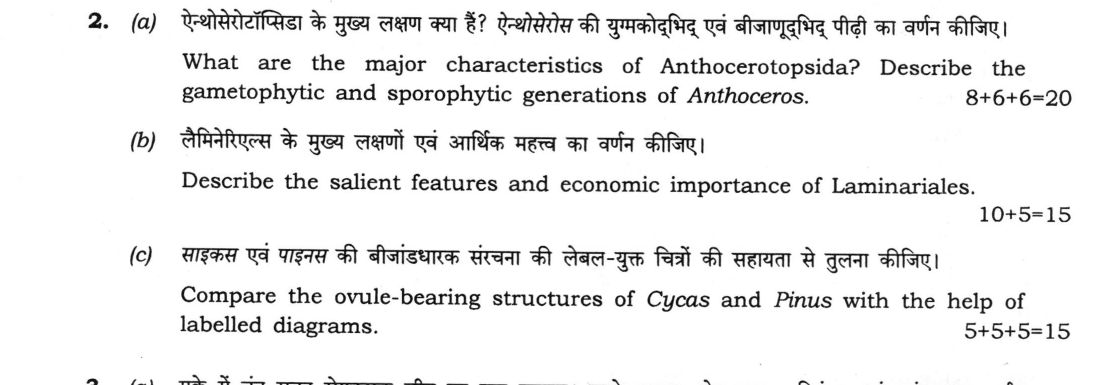
(a) What are the major characteristics of Anthocerotopsida? Describe the gametophytic and sporophytic generations of Anthoceros…
What are the major characteristics of Anthocerotopsida? Describe the gametophytic and sporophytic generations of Anthoceros. 20 marks
Describe the salient features and economic importance of Laminariales. 15 marks
Compare the ovule-bearing structures of Cycas and Pinus with the help of labelled diagrams. 15 marks
हिंदी में प्रश्न पढ़ें
ऐंथोसेरोटॉप्सिडा के मुख्य लक्षण क्या हैं? ऐंथोसेरोस की युग्मकोद्भिद् एवं बीजाणुद्भिद् पीढ़ी का वर्णन कीजिए। (20 अंक)
लैमिनेरिएल्स के मुख्य लक्षणों एवं आर्थिक महत्त्व का वर्णन कीजिए। (15 अंक)
साइकस एवं पाइनस की बीजांडधारक संरचना की लेबल-युक्त चित्रों की सहायता से तुलना कीजिए। (15 अंक)
Model answer
Drafted with AI by UPSC Answer Check against this question's marking rubric, to the expected length. UPSC does not publish answers for Mains — this is one way to score well, not an official key. How we build rubrics and answers.
(a) Anthocerotopsida, and the gametophyte and sporophyte of Anthoceros (20 marks)
Major characteristics of Anthocerotopsida (hornworts) (8 marks):
- The gametophyte is a flat, dorsiventral, lobed thallus of parenchyma, with no differentiation into tissues, and no scales.
- Each cell has usually one large chloroplast with a pyrenoid, unlike other bryophytes.
- Rhizoids are smooth-walled and unicellular; the ventral surface has slime pores leading to mucilage cavities that house the cyanobacterium Nostoc.
- Antheridia and archegonia are embedded (endogenous) in the thallus.
- The sporophyte is a long, green, horn-like capsule that keeps growing from a basal meristem, with a foot but no seta.
- The capsule has a columella (in Anthoceros), stomata in the epidermis, and spores mixed with sterile pseudoelaters, and splits from the apex downward by two valves.
- The sporophyte is photosynthetic but depends on the gametophyte for water and minerals.
Gametophyte of Anthoceros (6 marks). The thallus is dark green, rosette-like and 1 to 2 cm across, lobed and fixed by rhizoids. The cells are parenchymatous, each with a chloroplast and pyrenoid. Slime pores on the ventral surface open into cavities with Nostoc colonies. Species are monoecious or dioecious. Antheridia develop in groups in chambers roofed by two layers of cells on the dorsal surface, and each produces biflagellate sperms. The archegonia are sunken in the thallus with only the neck projecting. Vegetative propagation is by fragmentation, tubers and gemmae, and fertilisation needs water.
Sporophyte of Anthoceros (6 marks). After fertilisation the zygote forms an embryo that develops into a foot embedded in the thallus and a slender, erect capsule 2 to 5 cm long or more, without a seta. A basal meristem adds tissue continuously, so spores ripen from the tip downward. In section the wall has an epidermis with stomata and a layer of chlorophyll-rich cells; inside are the central sterile columella and the sporogenous tissue, which forms spore tetrads and pseudoelaters. The mature capsule splits into two valves and the spores are shed and germinate into new gametophytes.
(b) Laminariales: salient features and economic importance (15 marks)
Salient features (10 marks):
- They are large brown algae (Phaeophyceae), the kelps, of cold marine waters, such as Laminaria (Saccharina), Macrocystis, Nereocystis, Ecklonia and Undaria; Macrocystis can exceed 40 m.
- The pigments are chlorophylls a and c and fucoxanthin; the food reserves are laminarin and mannitol; the wall contains cellulose and alginic acid.
- The sporophyte is large and differentiated into a root-like holdfast (hapteron), a stalk (stipe) and a flat blade (lamina), with some kelps also having gas bladders.
- Growth is from an intercalary meristem at the junction of stipe and blade; the stipe has an outer meristoderm, a cortex and a medulla with trumpet hyphae that transport food.
- Alternation of generations is heteromorphic: the large sporophyte bears sori of unilocular sporangia, which produce zoospores by meiosis, and these grow into microscopic, filamentous male and female gametophytes.
- Reproduction is oogamous, and the zygote grows directly into a new sporophyte.
Economic importance (5 marks):
- Alginates from the kelps are used as thickeners and stabilisers in ice cream, paints, textiles, paper, dental impressions, wound dressings and drug capsules.
- Kombu (Saccharina) and wakame (Undaria) are eaten as food; kelp is a source of iodine, mannitol and animal feed and is used as manure.
- Kelp forests support fisheries and coastal ecosystems.
- Stipes were used as laminaria tents to dilate the cervix.
(c) Comparison of the ovule-bearing structures of Cycas and Pinus with labelled diagrams (15 marks)
Cycas (5 marks). The ovules are borne on megasporophylls, which are leaf-like, brown, hairy structures arranged in a loose rosette at the stem apex, with no cone. Each has a stalk, a fertile middle region carrying 2 to 6 large ovules on its margins, and a sterile pinnate tip. The ovules are orthotropous and have one three-layered integument.
Pinus (5 marks). The female cone is compact, with an axis bearing spirally arranged compound scales. Each scale consists of a small sterile bract scale and, above it, a larger woody ovuliferous scale, a modified dwarf shoot, carrying two anatropous ovules on the upper surface at its base with the micropyles turned toward the cone axis. Each ovule has a single integument.

Comparison (5 marks):
- Organisation: a loose rosette of leaf-like megasporophylls in Cycas, against a compact cone of bract and ovuliferous scales in Pinus.
- Number of ovules: 2 to 6 or more per sporophyll, against 2 per scale.
- Position: marginal in Cycas, adaxial and basal in Pinus.
- Ovule orientation: orthotropous in Cycas, anatropous in Pinus.
- Seed: large, fleshy and orange-red in Cycas, winged in Pinus.
- Development: Cycas seeds mature in about a year, and Pinus cones take two to three years from pollination.
How this answer will be evaluated
Evaluation rubric
Each sub-part is marked on its own, against the marks and word limit printed on the paper.
- (a) Three parts (8 + 6 + 6; 20 marks): major characteristics of Anthocerotopsida; the gametophytic generation of Anthoceros; the sporophytic generation of Anthoceros. No word limit printed. 20 marks
Must cover
- Class characters: dorsiventral thallus, one chloroplast with pyrenoid per cell, smooth rhizoids, Nostoc cavities, endogenous sex organs
- Sporophyte: horn-like capsule with basal meristem, foot, no seta, columella, stomata, pseudoelaters, dehiscence in two valves from the apex
- Gametophyte of Anthoceros: rosette thallus, slime pores, antheridia in chambers, sunken archegonia, vegetative propagation
- Sporophyte of Anthoceros: development from zygote, capsule anatomy (epidermis, assimilatory layer, columella, sporogenous tissue), spore release
Loses marks
- Describing a seta in the sporophyte.
- Calling the thallus erect or leafy.
- Confusing the gametophyte and sporophyte descriptions.
Earns more
- Marks allotted 8, 6 and 6 to the three parts.
- Sporophyte partly dependent on gametophyte for water and minerals.
Extra mark
- Distinguishing hornworts from liverworts (stomata, pyrenoid, meristem)
- (b) Two parts (10 + 5; 15 marks): salient features and economic importance of Laminariales. No word limit printed. 15 marks
Must cover
- Large brown algae (kelps) with pigments chlorophyll a and c and fucoxanthin, laminarin and mannitol reserve, alginic acid in wall
- Sporophyte with holdfast, stipe, blade; intercalary meristem; stipe anatomy with trumpet hyphae
- Heteromorphic alternation: unilocular sporangia in sori, zoospores by meiosis, microscopic filamentous gametophytes, oogamy
- Economic use: alginates, food (kombu, wakame), iodine, mannitol, fodder and manure, kelp forests
Loses marks
- Stating that gametophyte is the dominant generation.
- Confusing laminarin with starch.
Earns more
- Named examples (Laminaria, Macrocystis, Undaria).
- Specific uses of alginate.
Extra mark
- Laminaria tents in obstetrics
- (c) Three parts (5 + 5 + 5; 15 marks): compare the ovule-bearing structures of Cycas and Pinus with labelled diagrams. No word limit printed. 15 marks
Must cover
- Cycas megasporophyll: loose rosette, leaf-like, stalk, fertile region with 2-6 marginal ovules, sterile pinnate tip; orthotropous ovule
- Pinus: compact female cone, bract scale and ovuliferous scale, two anatropous ovules on the upper surface with micropyles toward the axis
- Labelled diagrams of both structures
- Comparison on organisation, ovule number, position, orientation, seed and time to maturity
Loses marks
- Giving Pinus ovules as marginal or orthotropous.
- No labelled diagram, or unlabelled sketches.
Earns more
- Ovuliferous scale as a modified dwarf shoot.
- Single three-layered integument of Cycas.
Extra mark
- Cycas has no female cone, Pinus has compound cone
What "Describe" is asking you to do
Give a full, ordered account of the thing named — its parts, stages or mechanism — in the sequence in which it actually exists or occurs. Most describe questions come from the science optionals, where the marks sit in correct technical detail and, where the stem says so, a labelled diagram.
Structure that answers it
One-line identification of the subject → the parts or stages in their real order, each with its defining detail → labelled diagram where the subject is structural → closing line on function or significance
Where marks are lost
Loose general prose where the examiner is ticking named parts, correct terminology and their sequence; and in the General Studies papers, turning to evaluation before the description is finished.
Practice this exact question
Write your answer and it is marked point by point against the model answer above — what you covered, what you missed, what you got wrong.
Evaluate my answer →More from Botany 2026 Paper I
- Q1 Answer the following questions in about 150 words each : (a) Blue-green algae are also co…
- Q2 (a) What are the major characteristics of Anthocerotopsida? Describe the gametophytic and…
- Q3 (a) Name the organism that causes stalk rot disease in maize. Describe its symptoms, dise…
- Q4 (a) Explain the APG IV classification. State briefly how it differs from existing classif…
- Q5 Answer the following questions in about 150 words each : (a) Describe the androecium of O…