Paper II — Q1
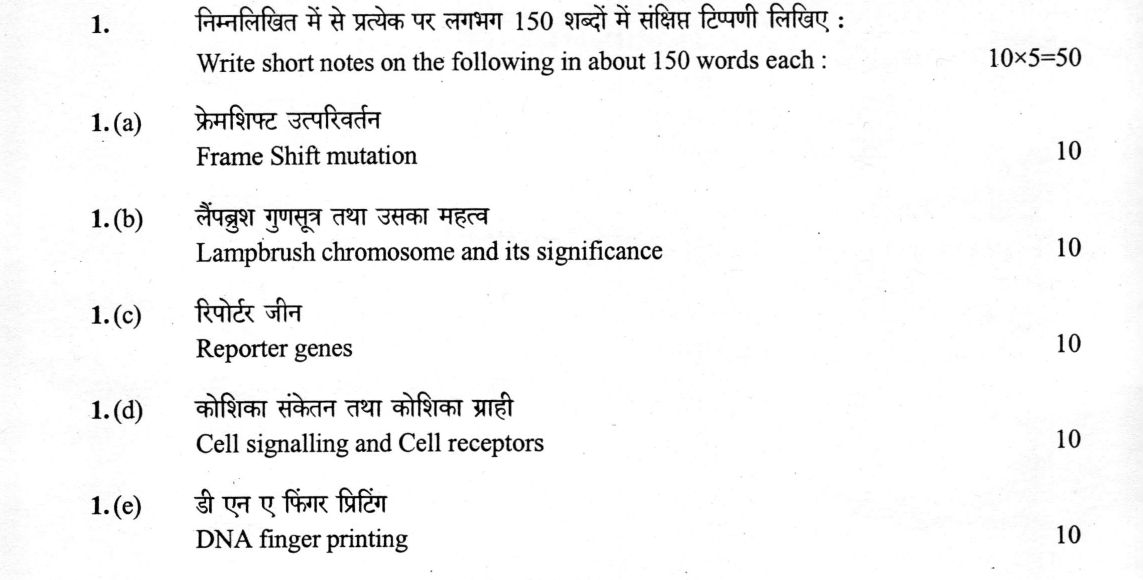
(a) Frame Shift mutation (10 marks) (b) Lampbrush chromosome and its significance (10 marks) (c) Reporter genes (10 marks) (d)…
Write short notes on the following in about 150 words each :
Frame Shift mutation 10 marks
Lampbrush chromosome and its significance 10 marks
Reporter genes 10 marks
Cell signalling and Cell receptors 10 marks
DNA finger printing 10 marks
हिंदी में प्रश्न पढ़ें
निम्नलिखित में से प्रत्येक पर लगभग 150 शब्दों में संक्षिप्त टिप्पणी लिखिए :
फ्रेमशिफ्ट उत्परिवर्तन (10 अंक)
लैम्पब्रुश गुणसूत्र तथा उसका महत्व (10 अंक)
रिपोर्टर जीन (10 अंक)
कोशिका संकेतन तथा कोशिका ग्राही (10 अंक)
डी एन ए फिंगर प्रिंटिंग (10 अंक)
Model answer
Drafted with AI by UPSC Answer Check against this question's marking rubric, to the 150-word length. UPSC does not publish answers for Mains — this is one way to score well, not an official key. How we build rubrics and answers.
(a) Frameshift mutation (10 marks)
A frameshift mutation is the insertion or deletion of nucleotides, in a number not divisible by three, in a coding sequence. Since the code is read in non-overlapping triplets, the reading frame shifts and every codon downstream is altered. For example, AUG AAA GCU CCU becomes AUG AAG CUC CU when the fourth base is deleted.
Consequences: all later amino acids change and a premature stop codon is usually met, giving a truncated, non-functional protein, so the effect is generally severe; the mRNA is often destroyed by nonsense-mediated decay.
Causes: intercalating agents such as acridine dyes (proflavine, acridine orange), and polymerase slippage in repeats. Examples: the 32-bp deletion in CCR5 (CCR5-delta32) and the 4-bp insertion in HEXA that causes Tay-Sachs disease.
Crick, Brenner and co-workers used T4 rII mutants in 1961 to show that adding or removing one or two bases inactivates the gene but three restore the frame, proving that the code is a triplet.
(b) Lampbrush chromosome and its significance (10 marks)
Lampbrush chromosomes are giant chromosomes seen in the diplotene stage of meiotic prophase I in the oocytes of amphibians (Triturus, Xenopus) and also of reptiles, birds, fish and insects. They were first described by Flemming (1882) and named by Rückert (1892), and are 0.5 to 1 mm long.
Structure:
- Bivalents are held together by chiasmata.
- Each chromosome has a central axis of condensed chromomeres carrying DNA.
- Pairs of lateral loops, one for each sister chromatid, project from the chromomeres like the bristles of a lamp brush, thin at one end and thicker at the other.
- The loops carry an RNA-protein matrix of nascent transcripts and are active in transcription.
Significance:
- They are sites of intense transcription during oogenesis, storing RNA for early embryonic development.
- They are a model for gene expression, transcription units and RNA processing.
- They help in gene mapping by in situ hybridisation and in the study of chromosome structure and chiasmata.
(c) Reporter genes (10 marks)
A reporter gene is a gene whose product is easily detected, and it is fused to a promoter or another gene to monitor gene expression, promoter activity and the success of transformation.
Properties of a good reporter: it is absent from the host or has very low background activity; its product is quickly, sensitively and quantitatively assayed; and it is non-toxic, stable and small.
Examples:
- lacZ (beta-galactosidase), which turns X-gal blue.
- uidA (GUS, beta-glucuronidase), which turns X-Gluc blue, widely used in plants; the assay destroys the tissue.
- Green fluorescent protein (GFP) from the jellyfish Aequorea victoria, which fluoresces under blue or UV light with no substrate, allows live imaging and localises proteins fused to it.
- Luciferase (firefly), which emits light with luciferin and ATP, very sensitive and real-time.
Uses: studying tissue-specific promoters, protein localisation and screening of transformants. A reporter differs from a selectable marker such as nptII (kanamycin resistance), which lets only transformed cells survive.
(d) Cell signalling and cell receptors (10 marks)
Cell signalling is the communication between cells and within them, in which a signal (ligand) is received by a receptor, transduced and produces a response.
Types: endocrine (hormones carried through the body), paracrine (nearby cells), autocrine (the same cell) and juxtacrine, contact-dependent (membrane-bound ligands, plasmodesmata, gap junctions). Signals include hormones, growth factors, neurotransmitters, light, auxin, ethylene and pathogen elicitors.
Transduction uses second messengers (cAMP, Ca²⁺, inositol trisphosphate, diacylglycerol) and phosphorylation cascades (MAP kinases), ending in altered gene expression, and is then switched off.
Receptors:
- Cell-surface receptors for signals that cannot cross the membrane: G-protein-coupled (seven-transmembrane) receptors, enzyme-linked receptors such as receptor tyrosine kinases, receptor-like kinases in plants (BRI1, FLS2, CLV1) and ligand-gated ion channels.
- Intracellular receptors for lipid-soluble signals: steroid hormone receptors; in plants, phytochrome for red and far-red light and the receptors of auxin (TIR1), gibberellin (GID1) and abscisic acid (PYR/PYL).
(e) DNA fingerprinting (10 marks)
DNA fingerprinting, developed by Alec Jeffreys in 1984, identifies individuals from their DNA. It rests on hypervariable repeats, minisatellites or VNTRs (repeats of 10 to 100 bp) and microsatellites or STRs (repeats of 2 to 6 bp), whose repeat number differs among people, so the pattern is unique except in identical twins.
Method:
- Isolate DNA from blood, hair, semen or tissue.
- Cut with a restriction enzyme (HaeIII, HinfI) and separate the fragments by agarose gel electrophoresis.
- Transfer to a membrane (Southern blotting) and hybridise with a labelled VNTR probe.
- Detect by autoradiography to give a barcode-like pattern.
Modern practice amplifies STR loci by PCR with fluorescent primers and reads them by capillary electrophoresis, needing only a tiny sample.
Applications: forensic cases, paternity disputes, identification of disaster victims, wildlife forensics, and, in plants, varietal identification and diversity studies. In India it was pioneered at CCMB, Hyderabad, by Lalji Singh.
How this answer will be evaluated
Evaluation rubric
Each sub-part is marked on its own, against the marks and word limit printed on the paper.
- (a) Write a short note on frameshift mutation, in about 150 words (10 marks). 10 marks · 150 words
Must cover
- Definition: insertion or deletion of nucleotides not in multiples of three, shifting the reading frame
- Effect: altered codons downstream, premature stop, truncated non-functional protein; worked example
- Causes: acridine dyes (intercalation), polymerase slippage; named examples (CCR5-delta32, Tay-Sachs HEXA)
- Crick et al. 1961 T4 rII experiment proving the triplet code
Loses marks
- Describing a base substitution as a frameshift.
- Insertion of three bases called frameshift.
Earns more
- Contrast with point (substitution) mutation.
- Mention of nonsense-mediated decay.
Extra mark
- Intragenic suppression by a compensating indel
- (b) Write a short note on lampbrush chromosome and its significance, in about 150 words (10 marks). 10 marks · 150 words
Must cover
- Occurrence: diplotene of meiotic prophase I in oocytes (amphibians, also birds, reptiles, insects); Flemming 1882, Rückert 1892
- Structure: bivalents with chiasmata, axis of chromomeres, paired lateral loops per chromatid with RNA-protein matrix
- Loops transcriptionally active; thin and thick ends
- Significance: stockpile of RNA for early embryo, model for transcription and RNA processing, gene mapping
Loses marks
- Placing lampbrush chromosomes in mitosis or in salivary glands.
- Describing loops as inactive.
Earns more
- Size 0.5-1 mm and visibility under light microscope.
- Comparison with polytene chromosome.
Extra mark
- Y-chromosome loops of Drosophila spermatocytes
- (c) Write a short note on reporter genes, in about 150 words (10 marks). 10 marks · 150 words
Must cover
- Definition: gene with easily assayed product used to monitor expression, promoter activity, transformation
- Properties: absent in host, sensitive quantitative assay, non-toxic, stable
- Examples with detection: lacZ, GUS, GFP, luciferase, CAT
- Uses (promoter analysis, protein localisation, screening) and difference from selectable markers
Loses marks
- Equating reporter genes with antibiotic resistance markers.
- Naming genes that are not reporters.
Earns more
- GUS destructive versus GFP non-destructive.
- Substrate named for each enzyme reporter.
Extra mark
- GFP Nobel Prize 2008 (Shimomura, Chalfie, Tsien)
- (d) Write a short note on cell signalling and cell receptors, in about 150 words (10 marks). 10 marks · 150 words
Must cover
- Signalling steps: ligand, receptor, transduction, response, termination
- Types: endocrine, paracrine, autocrine, juxtacrine
- Transduction: second messengers (cAMP, Ca²⁺, IP3, DAG), phosphorylation cascades (MAPK)
- Receptors: cell-surface (GPCR, enzyme-linked, ion channel, plant RLKs) and intracellular (steroid, phytochrome, TIR1, GID1, PYR/PYL)
Loses marks
- Confusing receptor with ligand.
- Treating signalling as only a hormonal process.
Earns more
- Plant and animal examples both given.
- Explanation of why lipid-soluble ligands use intracellular receptors.
Extra mark
- Signal amplification and cross-talk
- (e) Write a short note on DNA fingerprinting, in about 150 words (10 marks). 10 marks · 150 words
Must cover
- Basis: hypervariable VNTR and STR repeats, individual-specific (Jeffreys 1984)
- Steps: DNA isolation, restriction digestion, electrophoresis, Southern blotting, probe hybridisation, autoradiography
- Modern STR-PCR with capillary electrophoresis
- Applications: forensics, paternity, disaster victims, wildlife, plant varieties; Indian pioneer Lalji Singh at CCMB
Loses marks
- Saying fingerprints of skin are used.
- Claiming the pattern is identical between siblings.
Earns more
- Exception of identical twins.
- Stated size of repeat units.
Extra mark
- Match probability or CODIS loci
What "Write short notes" is asking you to do
Five or six self-contained answers, marked separately, typically 10 marks and about 150 words each. Each note must carry its own definition, its two or three defining features and a line on why it matters; a common introduction or conclusion across the notes earns nothing.
Structure that answers it
Per note: one-line definition or identification → two or three features, mechanisms or named examples → one line of significance or Indian application
Where marks are lost
Writing the first two notes at essay length and rationing the rest. Each note is marked on its own, so marks surrendered on a compressed or unattempted note cannot be won back by the long ones.
Practice this exact question
Write your answer and it is marked point by point against the model answer above — what you covered, what you missed, what you got wrong.
Evaluate my answer →More from Botany 2026 Paper II
- Q1 Write short notes on the following in about 150 words each : (a) Frame Shift mutation (10…
- Q2 (a) Give a detailed account on sex linked inheritance ? (20 marks) (b) Explain the struct…
- Q3 (a) (i) Write in detail the chemical composition of microtubules. (10 marks) (ii) Elabora…
- Q4 (a) Discuss on the tools and techniques involved in PCR and FISH. (20 marks) (b) Explain…