Paper II — Q3
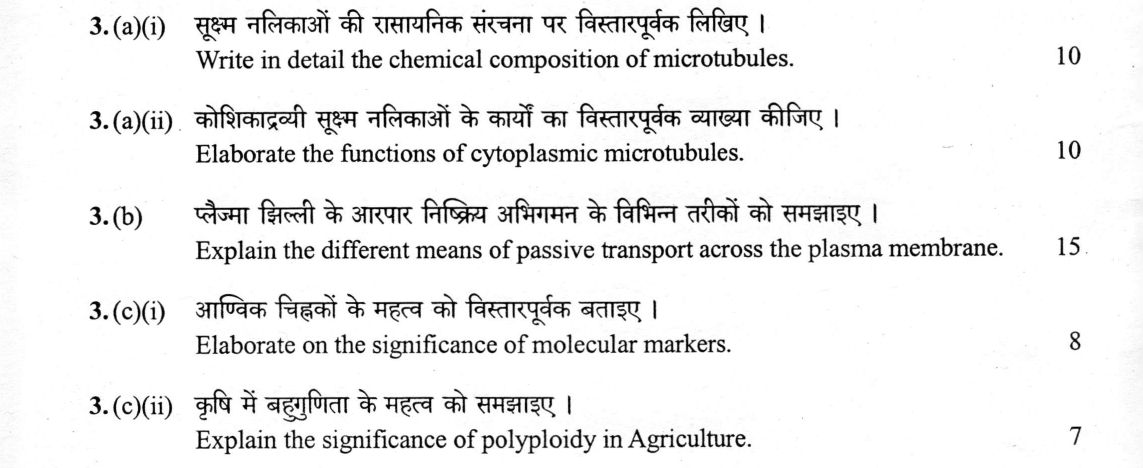
(a) (i) Write in detail the chemical composition of microtubules. (10 marks) (ii) Elaborate the functions of cytoplasmic…
Write in detail the chemical composition of microtubules. 10 marks
Elaborate the functions of cytoplasmic microtubules. 10 marks
Explain the different means of passive transport across the plasma membrane. 15 marks
Elaborate on the significance of molecular markers. 8 marks
Explain the significance of polyploidy in Agriculture. 7 marks
हिंदी में प्रश्न पढ़ें
सूक्ष्म नलिकाओं की रासायनिक संरचना पर विस्तारपूर्वक लिखिए । (10 अंक)
कोशिकाद्रव्यी सूक्ष्म नलिकाओं के कार्यों का विस्तारपूर्वक व्याख्या कीजिए । (10 अंक)
प्लैज्मा झिल्ली के आरपार निष्क्रिय अभिगमन के विभिन्न तरीकों को समझाइए । (15 अंक)
आण्विक चिह्नकों के महत्व को विस्तारपूर्वक बताइए । (8 अंक)
कृषि में बहुगुणिता के महत्व को समझाइए । (7 अंक)
Model answer
Drafted with AI by UPSC Answer Check against this question's marking rubric, to the expected length. UPSC does not publish answers for Mains — this is one way to score well, not an official key. How we build rubrics and answers.
(a)(i) Chemical composition of microtubules (10 marks)
Microtubules are hollow cylindrical tubes about 25 nm in outer diameter, with a lumen of about 15 nm, and are made mainly (over 95%) of the protein tubulin, with associated proteins and only traces of other components.
Tubulin. The building unit is a heterodimer of alpha-tubulin and beta-tubulin, each of about 55 kDa (dimer about 110 kDa), joined non-covalently. Each subunit binds one molecule of GTP. GTP bound to alpha-tubulin is permanently held, but the GTP of beta-tubulin is exchangeable and is hydrolysed to GDP after the dimer is added to the tube; the GTP cap stabilises the end. Gamma-tubulin, in a ring complex (gamma-TuRC) at the microtubule-organising centre, nucleates assembly at the minus end.
Assembly. The dimers join head to tail into protofilaments, and 13 protofilaments arranged side by side form the wall. The tube is polar, with a fast-growing plus end (beta-tubulin exposed) and a slow-growing minus end (alpha-tubulin exposed), and shows dynamic instability, alternating growth and shrinkage. Assembly needs GTP and Mg²⁺; low temperature, high Ca²⁺ and high pressure cause disassembly.
Associated proteins. Microtubule-associated proteins (MAP2, tau, MAP4, and MAP65 in plants) stabilise and bundle the tubes, katanin severs them, and the motor proteins kinesin (towards the plus end) and dynein (towards the minus end) move along them.
Drugs. Colchicine, vinblastine and nocodazole bind tubulin and block assembly; taxol stabilises the tubes and blocks their disassembly.
(a)(ii) Functions of cytoplasmic microtubules (10 marks)
- Cytoskeleton: give shape and support, and resist compression, and organise the cytoplasm.
- Intracellular transport: kinesin and dynein carry vesicles, mitochondria, Golgi and ER elements and mRNA along the tracks, as in axonal transport, and position organelles.
- Cell division: the mitotic and meiotic spindle (kinetochore, polar and astral microtubules) moves chromosomes; in plants, the preprophase band marks the plane of division and the phragmoplast guides the cell plate.
- Cell wall formation in plants: cortical microtubules lie beneath the plasma membrane and guide cellulose synthase complexes, and so the orientation of cellulose microfibrils, which decides the direction of cell elongation and patterns of secondary wall thickening (as in xylem).
- Motility: form the axoneme (9 + 2) of cilia and flagella, and the centrioles and basal bodies.
- Cell polarity and morphogenesis, growth of pollen tubes and root hairs, and organisation of the ER and Golgi apparatus.
- They are targets of drugs: colchicine arrests mitosis and induces polyploidy, and taxol and vinca alkaloids are anticancer drugs.
(b) Passive transport across the plasma membrane (15 marks)
Passive transport moves substances down their concentration or electrochemical gradient, without expenditure of metabolic energy. Its means are:
- Simple diffusion: small non-polar or lipid-soluble molecules (O₂, CO₂, N₂, steroids, ethanol, and some small uncharged polar molecules like water and urea slowly) dissolve in the lipid bilayer and pass through it. The rate follows Fick's law and increases with the gradient, with lipid solubility (partition coefficient) and with small size, and it is not saturable and needs no protein.
- Osmosis: net diffusion of water across the selectively permeable membrane from lower to higher solute concentration (higher to lower water potential). Water crosses through the bilayer and, faster, through aquaporins (PIPs and TIPs in plants).
- Facilitated diffusion through channel proteins: ions and polar molecules cross still down the gradient, through water-filled selective pores that are often gated (voltage-gated, ligand-gated); K⁺, Na⁺, Ca²⁺ and Cl⁻ channels carry 10⁶ to 10⁸ ions per second, and the K⁺ channels of guard cells are an example in plants.
- Facilitated diffusion through carrier (uniporter) proteins: the solute binds the carrier, which changes conformation and releases it on the other side, as with the GLUT glucose transporter; carriers are specific, saturable, show Vmax and Km, and are subject to competitive inhibition.
Compared with active transport, passive transport is not against a gradient, needs no ATP, and stops at equilibrium (for ions, at the electrochemical equilibrium).
(c)(i) Significance of molecular markers (8 marks)
Molecular markers are DNA sequences (RFLP, RAPD, AFLP, SSR or microsatellites, ISSR, SNP) or proteins (isozymes) that are detectable and mark a position in the genome. Unlike morphological markers they are abundant, neutral, not affected by the environment and detectable at any stage of growth. Their significance:
- Assessment of genetic diversity, and characterisation and conservation of germplasm.
- Identification of varieties, DNA fingerprinting and protection of breeders' rights, and testing of the purity of hybrid seed.
- Construction of genetic linkage maps, and mapping of genes and QTLs.
- Marker-assisted selection and backcrossing, and pyramiding of genes, as in Improved Samba Mahsuri rice with three bacterial blight resistance genes (xa5, xa13, Xa21) and Swarna-Sub1 with flooding tolerance.
- Study of phylogeny and taxonomy, and detection of transgenes.
(c)(ii) Significance of polyploidy in agriculture (7 marks)
Polyploidy is the presence of more than two sets of chromosomes, either autopolyploidy (from one species) or allopolyploidy (from hybrids between species). Its uses:
- Larger organs (gigantism), as in tetraploid varieties of rye, berseem and ornamentals.
- Seedless fruits, as in triploid banana and triploid watermelon (from a 4n by 2n cross).
- New crops, such as bread wheat (AABBDD, hexaploid), cotton (allotetraploid), Brassica napus (from B. rapa and B. oleracea), tobacco, and the man-made cereal triticale (wheat by rye).
- Restoration of fertility in sterile interspecific hybrids by doubling of chromosomes, and fixation of hybrid vigour, since duplicated genomes keep heterozygosity.
- Higher stress tolerance and adaptability, and higher sugar content in triploid sugar beet.
- Induction by colchicine (0.1 to 0.5%), oryzalin or temperature shock.
How this answer will be evaluated
Evaluation rubric
Each sub-part is marked on its own, against the marks and word limit printed on the paper.
- (a)(i) (a)(i) Write in detail the chemical composition of microtubules (10 marks; no word limit printed). 10 marks
Must cover
- Tubulin as the main protein: alpha-beta heterodimer of about 55 kDa each, GTP bound to each, exchangeable GTP on beta
- 13 protofilaments forming a hollow tube of about 25 nm; polarity with plus and minus ends; gamma-tubulin ring complex nucleation
- Associated proteins: MAPs (tau, MAP2, MAP65), motor proteins kinesin and dynein, katanin
- Conditions and drugs: GTP and Mg²⁺ for assembly, colchicine and vinblastine inhibit, taxol stabilises; dynamic instability
Loses marks
- Describing actin or a nine-fold triplet structure as the composition.
- Omitting associated proteins.
Earns more
- Both alpha and beta tubulin GTP-binding behaviour distinguished.
- Dimensions and molecular weights stated.
Extra mark
- Post-translational modifications of tubulin (acetylation, detyrosination)
- (a)(ii) (a)(ii) Elaborate the functions of cytoplasmic microtubules (10 marks; no word limit printed). 10 marks
Must cover
- Cytoskeletal shape and support; organelle positioning
- Intracellular transport by kinesin and dynein
- Spindle formation in mitosis and meiosis; in plants preprophase band and phragmoplast
- Guidance of cellulose microfibril deposition by cortical microtubules; cilia, flagella and centrioles; drug targets
Loses marks
- Confusing microtubules with microfilaments or intermediate filaments.
- Listing only spindle function.
Earns more
- Plant-specific functions given.
- Direction of motor movement stated.
Extra mark
- Cell polarity and pollen tube growth
- (b) (b) Explain the different means of passive transport across the plasma membrane (15 marks; no word limit printed). 15 marks
Must cover
- Passive transport defined: down electrochemical gradient, no metabolic energy
- Simple diffusion of lipid-soluble molecules with factors affecting the rate (Fick's law, partition coefficient, size)
- Osmosis with aquaporins
- Facilitated diffusion: channel proteins (gated, selective, high rate) and carrier proteins (saturable, specific, Vmax and Km); comparison with active transport
Loses marks
- Including ATP-driven pumps as passive transport.
- Stating that facilitated diffusion is against the gradient.
Earns more
- Examples for each means (O₂ and CO₂; GLUT; K⁺ channels in guard cells).
- Difference between channel and carrier.
Extra mark
- Aquaporin isoforms PIP and TIP in plants
- (c)(i) (c)(i) Elaborate on the significance of molecular markers (8 marks; no word limit printed). 8 marks
Must cover
- Definition and advantages over morphological markers (abundant, neutral, environment-independent)
- Diversity assessment, germplasm characterisation, variety identification and fingerprinting
- Linkage maps and QTL mapping
- Marker-assisted selection, gene pyramiding with examples (Improved Samba Mahsuri, Swarna-Sub1), hybrid purity, phylogeny
Loses marks
- Describing only the techniques without significance.
- Claiming markers are affected by environment.
Earns more
- Named marker types (RFLP, RAPD, AFLP, SSR, SNP).
- Named improved variety.
Extra mark
- Detection of transgenes and intellectual property protection
- (c)(ii) (c)(ii) Explain the significance of polyploidy in agriculture (7 marks; no word limit printed). 7 marks
Must cover
- Definition; autopolyploidy and allopolyploidy
- Gigas effect and seedlessness (triploid banana, watermelon)
- New crops: bread wheat, cotton, Brassica napus, triticale; fertility restoration of interspecific hybrids and fixation of hybrid vigour
- Induction by colchicine, oryzalin and temperature shock
Loses marks
- Calling triploids fertile.
- Confusing polyploidy with aneuploidy.
Earns more
- Genome formula of bread wheat.
- Correct account of triploid watermelon cross.
Extra mark
- Higher stress tolerance and sugar beet
What "Describe" is asking you to do
Give a full, ordered account of the thing named — its parts, stages or mechanism — in the sequence in which it actually exists or occurs. Most describe questions come from the science optionals, where the marks sit in correct technical detail and, where the stem says so, a labelled diagram.
Structure that answers it
One-line identification of the subject → the parts or stages in their real order, each with its defining detail → labelled diagram where the subject is structural → closing line on function or significance
Where marks are lost
Loose general prose where the examiner is ticking named parts, correct terminology and their sequence; and in the General Studies papers, turning to evaluation before the description is finished.
Practice this exact question
Write your answer and it is marked point by point against the model answer above — what you covered, what you missed, what you got wrong.
Evaluate my answer →More from Botany 2026 Paper II
- Q1 Write short notes on the following in about 150 words each : (a) Frame Shift mutation (10…
- Q2 (a) Give a detailed account on sex linked inheritance ? (20 marks) (b) Explain the struct…
- Q3 (a) (i) Write in detail the chemical composition of microtubules. (10 marks) (ii) Elabora…
- Q4 (a) Discuss on the tools and techniques involved in PCR and FISH. (20 marks) (b) Explain…
- Q5 Write short notes on the following in about 150 words each : (a) Munch hypothesis (10 mar…
- Q6 (a) (i) Explain the significance of Nod factors and the process of root nodule formation.…