Paper II — Q5
(a) Munch hypothesis (10 marks) (b) Correlation and Regression (10 marks) (c) Heat Shock Proteins (HSP's) (10 marks) (d)…
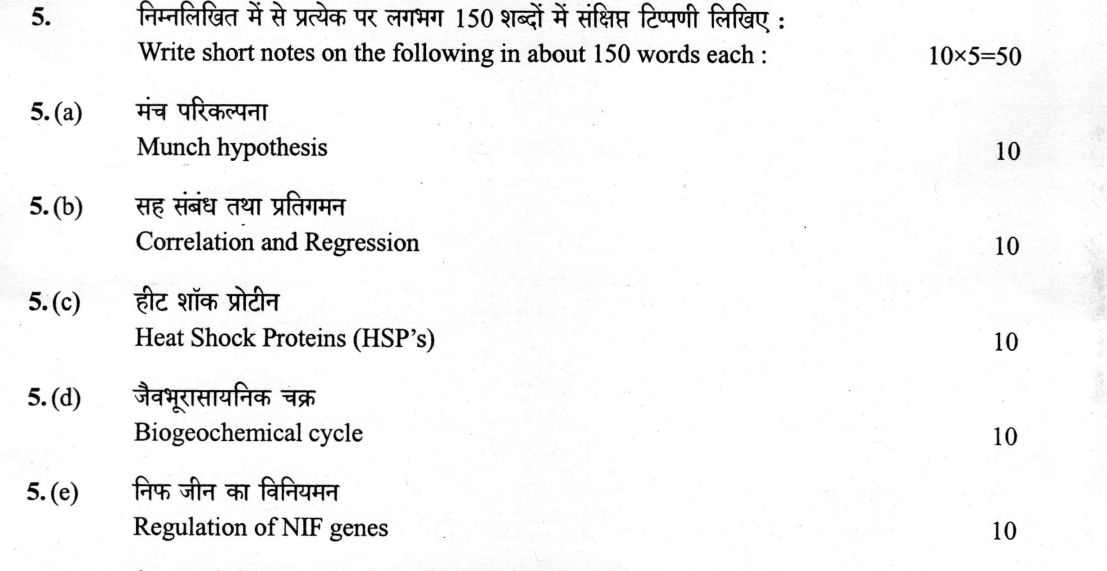
Write short notes on the following in about 150 words each :
Munch hypothesis 10 marks
Correlation and Regression 10 marks
Heat Shock Proteins (HSP's) 10 marks
Biogeochemical cycle 10 marks
Regulation of NIF genes 10 marks
हिंदी में प्रश्न पढ़ें
निम्नलिखित में से प्रत्येक पर लगभग 150 शब्दों में संक्षिप्त टिप्पणी लिखिए :
मंच परिकल्पना (10 अंक)
सह संबंध तथा प्रतिगमन (10 अंक)
हीट शॉक प्रोटीन (10 अंक)
जैवभूरासायनिक चक्र (10 अंक)
निफ जीन का विनियमन (10 अंक)
Model answer
Drafted with AI by UPSC Answer Check against this question's marking rubric, to the 150-word length. UPSC does not publish answers for Mains — this is one way to score well, not an official key. How we build rubrics and answers.
(a) Munch hypothesis (10 marks)
The Munch (pressure-flow or mass-flow) hypothesis, proposed by Ernst Münch in 1930, explains translocation in phloem as bulk flow driven by a turgor pressure gradient between source and sink.
Mechanism:
- At the source (mature leaf), sucrose is actively loaded into the sieve tubes through companion cells by an H⁺-sucrose symporter, lowering their water potential.
- Water enters from the xylem by osmosis and turgor becomes high.
- At the sink (root, fruit, storage organ), sucrose is unloaded and used or stored, water leaves for the xylem and turgor falls.
- The pressure difference pushes the sap in bulk through the sieve tubes, at about 30 to 100 cm per hour.
Evidence: sap exudes under positive pressure from aphid stylets, girdling causes accumulation above the ring, and ¹⁴C-sucrose moves from source to sink.
Objections: sieve plates offer resistance and some tubes show two-way flow; yet the hypothesis is widely accepted, with energy needed only for loading and unloading.
(b) Correlation and regression (10 marks)
Correlation measures the degree and direction of a linear relationship between two variables, such as plant height and yield. It is given by the Pearson coefficient, r = Σ(x - x̄)(y - ȳ) / √[Σ(x - x̄)² × Σ(y - ȳ)²], which lies between -1 and +1: +1 is a perfect positive relation, -1 a perfect negative one, and 0 no linear relation. It is unit-free, and r² gives the proportion of variation explained. Significance is tested by a t-test. Correlation does not prove cause and effect.
Regression describes the dependence of one variable (y) on another (x) so that y can be predicted from x, by the line y = a + bx, fitted by least squares. The slope b, the regression coefficient, is Σ(x - x̄)(y - ȳ) / Σ(x - x̄)², equal to r × (sy/sx), and a is the intercept. There are two regression lines, y on x and x on y, which coincide when r = ±1. Regression is used to predict, for example yield from rainfall.
(c) Heat shock proteins (10 marks)
Heat shock proteins (HSPs) are highly conserved proteins, found in bacteria, plants and animals, that are induced when cells are exposed to high temperature. Ritossa discovered them in 1962 as chromosome puffs in Drosophila salivary glands after heat shock, and Tissières identified the proteins in 1974.
Induction: by heat (in plants usually 5 to 10 °C above the optimum) and also by cold, drought, heavy metals and oxidative stress. Heat shock transcription factors (HSF) bind heat shock elements in the promoters and switch on the genes.
Classes, named by size: HSP100, HSP90, HSP70, HSP60 (chaperonins) and small HSPs (15 to 30 kDa), which are abundant in plants.
Functions: they are molecular chaperones that prevent misfolding and aggregation of proteins, refold denatured proteins, help new proteins to fold and cross membranes, and direct damaged proteins for degradation. This gives thermotolerance. HSPs are important in breeding for heat tolerance and are drug targets (HSP90 inhibitors in cancer).
(d) Biogeochemical cycle (10 marks)
A biogeochemical cycle is the cyclic movement of an element or compound, such as carbon, nitrogen, phosphorus, sulphur or water, between living organisms (bio) and the physical environment (geo: atmosphere, hydrosphere and lithosphere). Each has a large, slow reservoir pool and a smaller exchange pool between organisms and their surroundings.
Types:
- Gaseous cycles, with the reservoir in the atmosphere or hydrosphere: carbon, nitrogen, oxygen and hydrogen. They are fast and largely self-regulating.
- Sedimentary cycles, with the reservoir in the earth's crust: phosphorus, calcium, iron, potassium and, partly, sulphur. They are slow, and material is lost in deep sediments.
Examples. In the carbon cycle, plants fix CO₂ by photosynthesis, and respiration, decomposition, combustion and ocean exchange return it. In the phosphorus cycle, weathering releases phosphate that plants absorb, consumers pass on, and decomposers return; there is no gaseous phase, and much is lost to sediments.
The cycles keep nutrients available and ecosystems stable, and are disturbed by fossil fuel burning, fertiliser run-off (eutrophication) and deforestation.
(e) Regulation of nif genes (10 marks)
The nif genes encode nitrogenase and its associated proteins. In Klebsiella pneumoniae, the best studied, about 20 nif genes lie in a 24 kb cluster of seven or eight operons: nifHDKTY (H for the Fe protein, D and K for the MoFe protein), nifENX and nifB (FeMo cofactor), nifUSVWZM, nifF, nifJ, and nifLA (regulators).
Regulation is mainly at transcription:
- The nif promoters need the alternative sigma factor sigma-54 (RpoN) and the activator NifA, which binds upstream and uses ATP to open the promoter.
- nifLA itself is activated by the Ntr system (NtrC) only when fixed nitrogen (ammonium, glutamine) is scarce.
- NifL is an anti-activator: it inhibits NifA when oxygen is present or fixed nitrogen is high, switching nif genes off.
- High temperature (above about 30 °C) and lack of molybdenum or iron also reduce expression.
In some bacteria, nitrogenase is also switched off directly by ADP-ribosylation of the Fe protein. In Rhizobium, nifA is activated under low oxygen by the FixL-FixJ system.
How this answer will be evaluated
Evaluation rubric
Each sub-part is marked on its own, against the marks and word limit printed on the paper.
- (a) Write a short note on the Munch hypothesis, in about 150 words (10 marks). 10 marks · 150 words
Must cover
- Statement: mass flow of phloem sap driven by turgor pressure gradient from source to sink (Münch 1930)
- Loading of sucrose at source lowers water potential, water enters by osmosis, high turgor; unloading at sink lowers turgor
- Bulk flow through sieve tubes at 30-100 cm per hour; energy needed only for loading and unloading
- Evidence (aphid stylets, girdling, 14C) and objections (sieve plate resistance, two-way flow)
Loses marks
- Calling phloem transport diffusion or an active pumping of sap.
- Stating that the flow is driven by transpiration pull.
Earns more
- Explanation using two-osmometer model.
- Role of companion cells and H⁺-sucrose symporter.
Extra mark
- Symplastic and apoplastic loading
- (b) Write a short note on correlation and regression, in about 150 words (10 marks). 10 marks · 150 words
Must cover
- Correlation: strength and direction of linear relationship; Pearson r formula; range -1 to +1; r² ; no causation
- Regression: dependence of y on x; y = a + bx; least squares; regression coefficient b = r·sy/sx
- Two regression lines and their coincidence at r = ±1
- Uses (prediction, calibration) and difference between the two
Loses marks
- Stating that correlation proves causation.
- Interchanging the roles of dependent and independent variables.
Earns more
- Example from plant data such as height and yield.
- Test of significance by t-test.
Extra mark
- Coefficient of determination interpretation
- (c) Write a short note on heat shock proteins, in about 150 words (10 marks). 10 marks · 150 words
Must cover
- Discovery: Ritossa 1962 (Drosophila puffs), Tissières 1974; conserved across organisms
- Induction by heat and other stresses through HSF binding heat shock elements
- Classes by size: HSP100, 90, 70, 60, small HSPs
- Functions as molecular chaperones (prevent aggregation, refold, translocation, degradation), thermotolerance
Loses marks
- Describing HSPs as enzymes of heat metabolism.
- Naming a wrong discoverer or date.
Earns more
- Temperature range for plant induction (5-10 °C above optimum).
- Importance in breeding or drug targets.
Extra mark
- Constitutive HSC70 members
- (d) Write a short note on the biogeochemical cycle, in about 150 words (10 marks). 10 marks · 150 words
Must cover
- Definition: cyclic movement of elements between organisms and the physical environment; reservoir and exchange pools
- Gaseous cycles (C, N, O, H): atmospheric reservoir, fast, self-regulating
- Sedimentary cycles (P, Ca, Fe, K): crustal reservoir, slow, loss to sediments
- Carbon and phosphorus cycles as examples; importance and human disturbance
Loses marks
- Placing phosphorus in the gaseous cycle.
- Defining the cycle without the geo component.
Earns more
- Explicit contrast of gaseous and sedimentary cycles.
- Human impact (global warming, eutrophication).
Extra mark
- Sulphur as partly gaseous and partly sedimentary
- (e) Write a short note on the regulation of nif genes, in about 150 words (10 marks). 10 marks · 150 words
Must cover
- nif cluster in Klebsiella pneumoniae: about 20 genes, 7-8 operons, roles of nifHDK, nifENB, nifLA
- Sigma-54 dependent promoters activated by NifA
- nifLA activated by NtrC under nitrogen limitation; NifL inhibits NifA in presence of oxygen or fixed nitrogen
- Other controls: temperature, molybdenum, iron, ADP-ribosylation of Fe protein; FixL-FixJ in Rhizobium
Loses marks
- Calling NifA a repressor.
- Describing nif gene expression as constitutive.
Earns more
- Role of the Ntr system stated correctly.
- Both NifL and NifA functions distinguished.
Extra mark
- Mention of the nitrogenase oxygen sensitivity
What "Write short notes" is asking you to do
Five or six self-contained answers, marked separately, typically 10 marks and about 150 words each. Each note must carry its own definition, its two or three defining features and a line on why it matters; a common introduction or conclusion across the notes earns nothing.
Structure that answers it
Per note: one-line definition or identification → two or three features, mechanisms or named examples → one line of significance or Indian application
Where marks are lost
Writing the first two notes at essay length and rationing the rest. Each note is marked on its own, so marks surrendered on a compressed or unattempted note cannot be won back by the long ones.
Practice this exact question
Write your answer and it is marked point by point against the model answer above — what you covered, what you missed, what you got wrong.
Evaluate my answer →More from Botany 2026 Paper II
- Q2 (a) Give a detailed account on sex linked inheritance ? (20 marks) (b) Explain the struct…
- Q3 (a) (i) Write in detail the chemical composition of microtubules. (10 marks) (ii) Elabora…
- Q4 (a) Discuss on the tools and techniques involved in PCR and FISH. (20 marks) (b) Explain…
- Q5 Write short notes on the following in about 150 words each : (a) Munch hypothesis (10 mar…
- Q6 (a) (i) Explain the significance of Nod factors and the process of root nodule formation.…
- Q7 Explain the following : (a) (i) Explain the factors affecting enzyme activity. (10 marks)…
- Q8 (a) (i) What is the basic concept of phytogeography ? (5 marks) (ii) Give a detailed acco…