Paper II — Q8
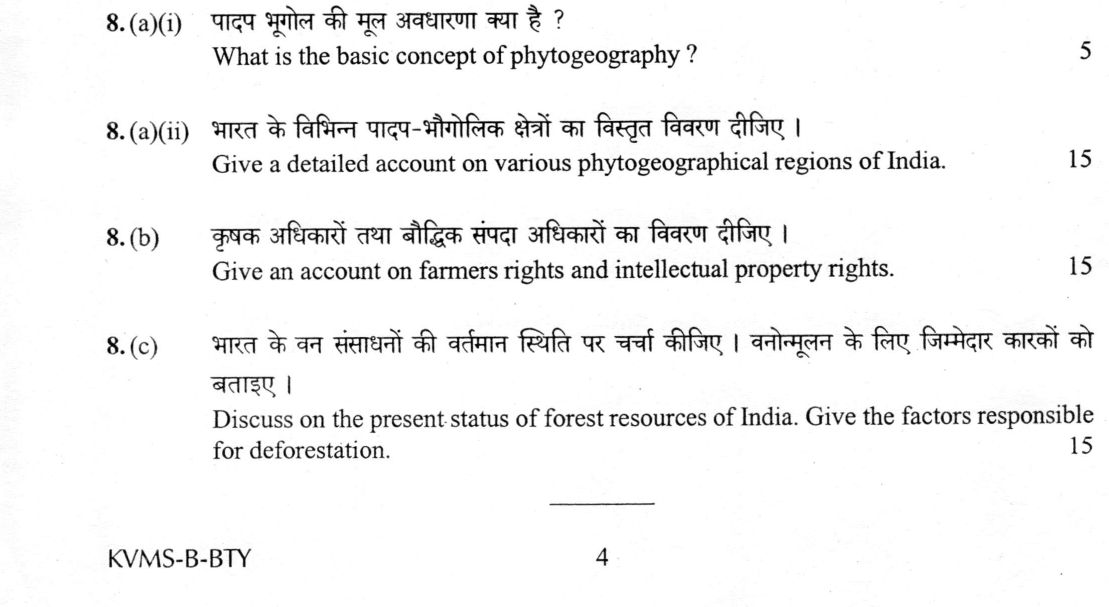
(a) (i) What is the basic concept of phytogeography ? (5 marks) (ii) Give a detailed account on various phytogeographical…
What is the basic concept of phytogeography ? 5 marks
Give a detailed account on various phytogeographical regions of India. 15 marks
Give an account on farmers rights and intellectual property rights. 15 marks
Discuss on the present status of forest resources of India. Give the factors responsible for deforestation. 15 marks
हिंदी में प्रश्न पढ़ें
पादप भूगोल की मूल अवधारणा क्या है ? (5 अंक)
भारत के विभिन्न पादप-भौगोलिक क्षेत्रों का विस्तृत विवरण दीजिए । (15 अंक)
कृषक अधिकारों तथा बौद्धिक संपदा अधिकारों का विवरण दीजिए । (15 अंक)
भारत के वन संसाधनों की वर्तमान स्थिति पर चर्चा कीजिए । वनोन्मूलन के लिए जिम्मेदार कारकों को बताइए । (15 अंक)
Model answer
Drafted with AI by UPSC Answer Check against this question's marking rubric, to the expected length. UPSC does not publish answers for Mains — this is one way to score well, not an official key. How we build rubrics and answers.
(a)(i) Basic concept of phytogeography (5 marks)
Phytogeography is the study of the geographical distribution of plants and of the causes behind it. Its basic concept is that the distribution of species, genera and vegetation types is not random: it is controlled by climate, soil, topography and biotic factors, and by history, including continental drift, migration, barriers and speciation. It has two branches: descriptive (floristic) and ecological, and it explains endemism, disjunct ranges and floristic realms.
(a)(ii) Phytogeographical regions of India (15 marks)
India's varied relief and climate give it several floristic regions. Chatterjee (1940, 1962) recognised eight.
- Western Himalaya (Kashmir to Kumaon): temperate and alpine vegetation of Cedrus deodara, Pinus wallichiana, Abies, Picea, with oaks and rhododendrons at higher levels; Mediterranean and Central Asian elements.
- Eastern Himalaya (Sikkim, Darjeeling, Arunachal): the richest region, with wet subtropical forests, oaks, magnolias, rhododendrons and orchids; Sino-Himalayan and Malayan elements, many endemics.
- Indus plain (Punjab, Rajasthan, Kutch): arid and semi-arid, with Prosopis cineraria, Acacia, Capparis and Calligonum; Saharo-Sindian elements.
- Gangetic plain: alluvial plains with moist and dry deciduous vegetation and cultivation, few endemics; Shorea robusta and grasslands in the terai.
- Assam: a very high-rainfall tropical evergreen and semi-evergreen region with bamboo, canes and orchids, related to Burma and Malaya.
- Malabar (Western Ghats and west coast): tropical wet evergreen forests (Dipterocarpus, Calophyllum, Mesua), high in endemism (Malayan and Ceylonese affinities), with mangroves on the coast.
- Deccan: the semi-arid peninsular plateau, mainly dry deciduous and thorn forests (teak, Acacia, Anogeissus), with an old and more endemic flora.
- Andaman and Nicobar: tropical evergreen and mangrove forests with strong Malayan and Burmese affinity.
A later and widely used scheme (Rodgers and Panwar, 1988) has ten biogeographic zones: Trans-Himalaya, Himalaya, Desert, Semi-arid, Western Ghats, Deccan Peninsula, Gangetic Plain, North-East India, Islands and Coasts. India has four biodiversity hotspots: the Himalaya, Indo-Burma, the Western Ghats and Sri Lanka, and Sundaland (the Nicobar Islands), which hold most of its endemics.
(b) Farmers' rights and intellectual property rights (15 marks)
Intellectual property rights (IPRs) are legal rights over creations of the mind. Those relevant to plants include patents, plant breeders' rights, geographical indications, trademarks, trade secrets and, for biological material, access and benefit-sharing arrangements. The TRIPS Agreement (WTO, 1995), Article 27.3(b), requires members to protect plant varieties by patents, an effective sui generis system, or both. India chose the sui generis route, and does not allow patents on plants and seeds.
Farmers' rights recognise the contribution of farmers who have conserved, improved and made available plant genetic resources. They are protected internationally by the FAO International Treaty on Plant Genetic Resources for Food and Agriculture (2001, in force 2004), which covers the right to save, use, exchange and sell farm-saved seed, to share benefits and to take part in decisions.
In India these are covered by the following laws.
- Protection of Plant Varieties and Farmers' Rights Act, 2001 (PPV&FR Act): registers new, extant and farmers' varieties, and gives breeders exclusive rights for 15 years (18 for trees and vines). A farmer may save, use, sow, exchange, share or sell farm-produced seed, but not sell branded seed of a registered variety. Farmers have the right to a reward and recognition for conservation and to compensation if a variety fails to perform as claimed, and benefit-sharing applies to a variety using a farmer's landrace. The Authority is in New Delhi, with a Gene Fund, and Plant Genome Saviour awards.
- Biological Diversity Act, 2002: the National Biodiversity Authority regulates access to biological resources and knowledge, and requires benefit-sharing with local communities.
- Patents Act, 1970 (amended): excludes plants, animals and essentially biological processes for their production from patentability (section 3(j)), and an invention that is in effect traditional knowledge (3(p)).
- Geographical Indications of Goods Act, 1999: protects names such as Darjeeling tea and Basmati.
Public interest cases include the neem, turmeric and basmati patent disputes, where revocation was won using the Traditional Knowledge Digital Library (TKDL). In sum, the legislation tries to balance breeders' incentives with the farmers' role as custodians and breeders.
(c) Forest resources of India and the causes of deforestation (15 marks)
Present status. According to the India State of Forest Report 2023, forest cover is 715,343 km², or 21.76% of the geographical area, and tree cover is 112,014 km² (3.41%), so total forest and tree cover is 25.17%, against the national policy goal of 33%. By density, very dense forest is about 3.0%, moderately dense about 9.3% and open forest about 9.4%, with scrub in addition. Madhya Pradesh has the largest forest area and Mizoram the highest share of its area (over 84%). Mangroves cover roughly 4,992 km². Forest cover has increased modestly in the last decades, but the natural forests of the north-east and the Western Ghats have been declining, and much of the gain is plantation and open forest, so quality lags behind extent. Forest types (Champion and Seth) range from tropical wet evergreen to alpine scrub, with tropical dry deciduous forest the most extensive.
Factors responsible for deforestation:
- Agricultural expansion and shifting cultivation (jhum), mainly in the north-east.
- Population growth and demand for fuelwood, fodder, timber and grazing.
- Development projects: mining, dams, roads, railways, power lines and urbanisation, with forest land diverted.
- Forest fires, and encroachment on forest land.
- Overgrazing and illegal felling, and commercial exploitation (timber, pulp, plantations replacing natural forest).
- Pests, diseases and invasive species; climate change and extreme events.
Consequences include loss of biodiversity, soil erosion, floods, disturbed water cycles and carbon emissions. Remedies include the Forest (Conservation) Act, 1980 (amended 2023), the Forest Rights Act, 2006, compensatory afforestation, joint forest management, agroforestry and the Green India Mission.
How this answer will be evaluated
Evaluation rubric
Each sub-part is marked on its own, against the marks and word limit printed on the paper.
- (a)(i) (a)(i) State the basic concept of phytogeography (5 marks; about 75 words). 5 marks
Must cover
- Definition: geographical distribution of plants and its causes
- Distribution non-random: climate, soil, topography, biotic factors
- Historical factors: continental drift, migration, barriers, speciation
- Branches (descriptive, ecological); endemism, disjunction
Loses marks
- Confusing it with zoogeography only.
- Far exceeding the limit.
Earns more
- Concise statement within the limit.
Extra mark
- Floristic realms
- (a)(ii) (a)(ii) Give a detailed account of the phytogeographical regions of India (15 marks). 15 marks
Must cover
- Chatterjee's eight regions named: Western Himalaya, Eastern Himalaya, Indus plain, Gangetic plain, Assam, Malabar, Deccan, Andaman and Nicobar
- Characteristic vegetation and climate of each, with example species
- Floristic affinities and endemism (Eastern Himalaya, Malabar)
- Rodgers-Panwar ten biogeographic zones and biodiversity hotspots
Loses marks
- Listing regions without any vegetation description.
- Naming three hotspots or omitting Sundaland/Nicobar when hotspots are stated.
Earns more
- Map-like ordering of regions.
- Correct examples of endemics.
Extra mark
- Four hotspots correctly named
- (b) (b) Give an account of farmers' rights and intellectual property rights (15 marks). 15 marks
Must cover
- IPR types relevant to plants; TRIPS Art. 27.3(b) and India's sui generis choice
- Farmers' rights: FAO Treaty (2001) and rights to save, use, exchange, sell farm-saved seed
- PPV&FR Act 2001: registration categories, breeders' term (15/18 years), farmers' rights, benefit-sharing, Authority
- Biological Diversity Act 2002, Patents Act s.3(j), GI Act 1999; cases (neem, turmeric, basmati, TKDL)
Loses marks
- Saying India grants patents on plants.
- Stating that farmers may sell branded seed of registered varieties.
Earns more
- Balance between breeders and farmers explained.
- Compensation and reward provisions.
Extra mark
- Plant Genome Saviour Award, Gene Fund
- (c) (c) Discuss the present status of India's forest resources and the factors responsible for deforestation (15 marks). 15 marks
Must cover
- Present status with figures: forest cover 21.76%, tree cover 3.41%, total 25.17% (ISFR 2023); 33% policy goal
- Density classes, leading states, mangroves; quality versus extent
- Causes: agriculture and jhum, fuelwood and grazing, development projects, fires, encroachment, illegal felling
- Consequences and remedies (FCA 1980, FRA 2006, JFM, CAMPA/compensatory afforestation)
Loses marks
- Quoting obsolete or incorrect percentages.
- Listing causes without any status data.
Earns more
- Champion and Seth forest types.
- Distinction between natural forest and plantation gains.
Extra mark
- Green India Mission
What "Explain" is asking you to do
Make the working of something clear — what sets it off, what follows from what, and what it produces. Explain is the Commission's mechanism word: it dominates the technical papers and the “explain why” stems, where the marks sit in the causal chain and not in the label.
Structure that answers it
State what it is → the initiating condition → the chain of cause, step by step → an instance where it plays out → what the chain produces
Where marks are lost
Describing what something looks like instead of why it works that way. Naming the stages without linking them reads as description too.
Practice this exact question
Write your answer and it is marked point by point against the model answer above — what you covered, what you missed, what you got wrong.
Evaluate my answer →More from Botany 2026 Paper II
- Q5 Write short notes on the following in about 150 words each : (a) Munch hypothesis (10 mar…
- Q6 (a) (i) Explain the significance of Nod factors and the process of root nodule formation.…
- Q7 Explain the following : (a) (i) Explain the factors affecting enzyme activity. (10 marks)…
- Q8 (a) (i) What is the basic concept of phytogeography ? (5 marks) (ii) Give a detailed acco…