Paper II — Q7
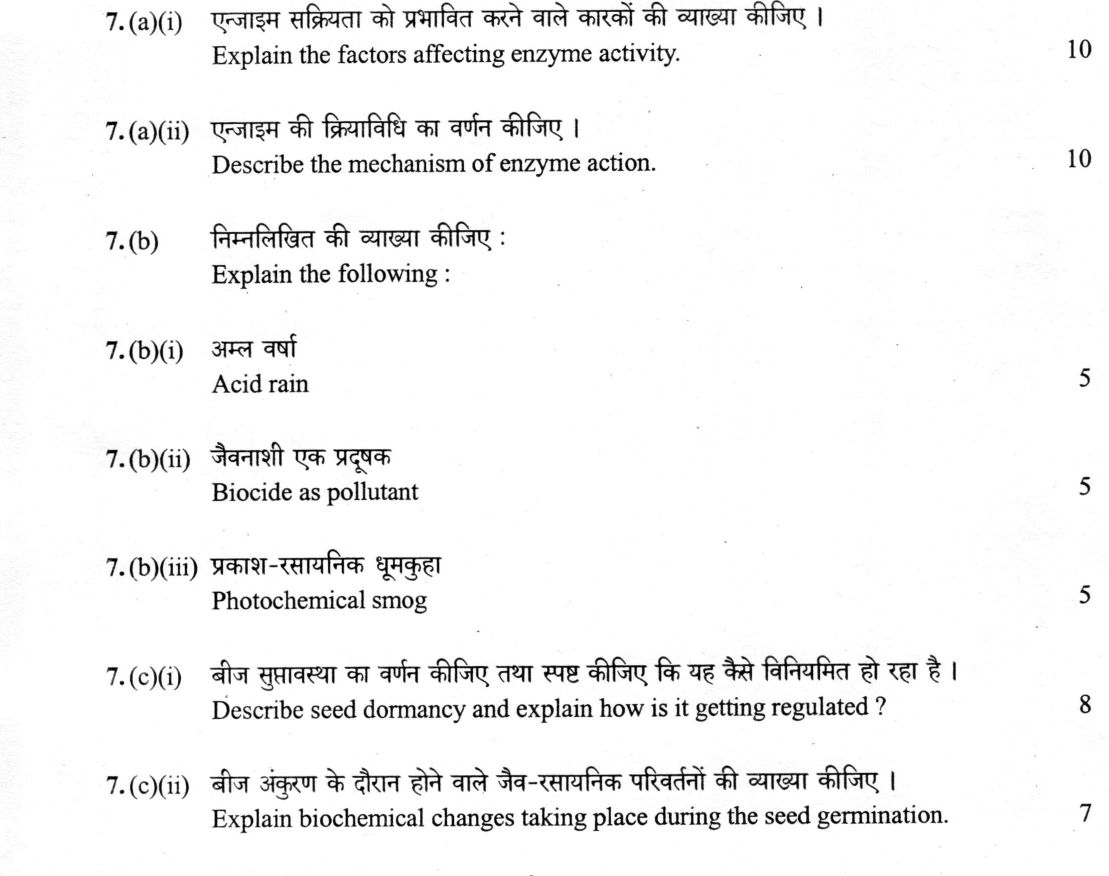
(a) (i) Explain the factors affecting enzyme activity. (10 marks) (ii) Describe the mechanism of enzyme action. (10 marks) (b)…
Explain the following :
Explain the factors affecting enzyme activity. 10 marks
Describe the mechanism of enzyme action. 10 marks
Acid rain 5 marks
Biocide as pollutant 5 marks
Photochemical smog 5 marks
Describe seed dormancy and explain how is it getting regulated ? 8 marks
Explain biochemical changes taking place during the seed germination. 7 marks
हिंदी में प्रश्न पढ़ें
निम्नलिखित की व्याख्या कीजिए :
एन्जाइम सक्रियता को प्रभावित करने वाले कारकों की व्याख्या कीजिए । (10 अंक)
एन्जाइम की क्रियाविधि का वर्णन कीजिए । (10 अंक)
अम्ल वर्षा (5 अंक)
जैवनाशी एक प्रदूषक (5 अंक)
प्रकाश-रसायनिक धूमकुहा (5 अंक)
बीज सुपावस्था का वर्णन कीजिए तथा स्पष्ट कीजिए कि यह कैसे विनियमित हो रहा है । (8 अंक)
बीज अंकुरण के दौरान होने वाले जैव-रसायनिक परिवर्तनों की व्याख्या कीजिए । (7 अंक)
Model answer
Drafted with AI by UPSC Answer Check against this question's marking rubric, to the expected length. UPSC does not publish answers for Mains — this is one way to score well, not an official key. How we build rubrics and answers.
(a)(i) Factors affecting enzyme activity (10 marks)
- Substrate concentration: at low concentration the rate rises with substrate, and at high concentration it levels off at Vmax, when all enzyme molecules are saturated, giving a hyperbolic curve (Michaelis-Menten). Km, the substrate concentration at half Vmax, measures the affinity of the enzyme.
- Enzyme concentration: with excess substrate, rate is directly proportional to enzyme concentration.
- Temperature: rate roughly doubles for a 10 °C rise (Q₁₀ about 2) up to an optimum (about 35 to 40 °C for many enzymes), and above it the enzyme is denatured and activity falls sharply. Low temperature slows but does not destroy enzymes.
- pH: each enzyme has an optimum pH (pepsin about 2, salivary amylase about 6.8, trypsin about 8), giving a bell-shaped curve, since pH alters the ionisation of the active site and the shape of the protein.
- Inhibitors: competitive inhibitors resemble the substrate and raise Km without changing Vmax, non-competitive inhibitors lower Vmax, and irreversible inhibitors (heavy metal ions, poisons) bind permanently.
- Activators and cofactors: metal ions (Mg²⁺, Zn²⁺, Mn²⁺) and coenzymes are needed for activity of many enzymes.
- Products and regulators: accumulation of the product, allosteric effectors and feedback inhibition change the rate, and radiation, high salt and water content also affect it.
(a)(ii) Mechanism of enzyme action (10 marks)
Enzymes are biological catalysts that speed up reactions by lowering the activation energy, without changing the equilibrium or being consumed. The enzyme's active site, a cleft made of a few amino acid residues, binds the substrate to form an enzyme-substrate complex (ES), which goes to the enzyme-product complex and then releases the product: E + S ⇌ ES → EP → E + P.
Models of binding:
- Lock-and-key (Fischer, 1894): the substrate fits rigidly into an active site of complementary shape.
- Induced fit (Koshland, 1958): the active site is flexible and changes shape after the substrate binds, giving a closer fit.
How catalysis is achieved:
- Proximity and orientation: the substrates are brought close together in the correct orientation.
- Strain and stabilisation of the transition state: the enzyme binds the transition state more tightly than the substrate, distorting bonds.
- Acid-base catalysis: amino acid side chains donate or accept protons.
- Covalent catalysis: a temporary covalent intermediate forms with a residue.
- Metal ion catalysis: a metal or cofactor stabilises charges or takes part in electron transfer.
For example, in chymotrypsin a serine-histidine-aspartate triad forms an acyl-enzyme intermediate to hydrolyse peptide bonds.
(b)(i) Acid rain (5 marks)
Acid rain is rain, snow or dry deposition with a pH below 5.6, the pH of normal rain in equilibrium with atmospheric CO₂. It arises from sulphur dioxide and nitrogen oxides, released by coal-burning power plants, smelters and vehicles, which are oxidised in the atmosphere to sulphuric and nitric acids. Effects: acidification of lakes and death of fish, leaching of calcium and magnesium from soil and release of toxic aluminium, damage to forests and crops, and corrosion of buildings and marble monuments. Control: flue gas desulphurisation, low-sulphur fuel, catalytic converters and liming of lakes.
(b)(ii) Biocide as a pollutant (5 marks)
Biocides, such as insecticides, herbicides and fungicides, are chemicals that kill living organisms. They become pollutants because they are spread beyond the target through drift, run-off and leaching into soil, water and air. Persistent ones (DDT, BHC, aldrin) are not biodegradable, are fat-soluble, and accumulate in tissues and are magnified along food chains (DDT thinned the eggshells of birds of prey). They kill non-target organisms such as bees and natural enemies, produce resistant pests, contaminate groundwater and food, and harm health (cancer, endocrine disruption; endosulfan). Control is by integrated pest management, biopesticides and bans on persistent chemicals (Stockholm Convention, 2001).
(b)(iii) Photochemical smog (5 marks)
Photochemical smog is a brownish haze that forms in warm, sunny, still air over cities with heavy traffic, as in Los Angeles. The primary pollutants are nitrogen oxides and volatile organic compounds (hydrocarbons) from vehicle exhaust. Sunlight splits NO₂ into NO and atomic oxygen, which combines with O₂ to make ozone; hydrocarbons react with NO and O₃ to form peroxyacetyl nitrate (PAN), aldehydes and other oxidants. Effects: eye irritation, respiratory illness, damage to leaves of crops and trees (bleaching and necrosis), and cracking of rubber. It differs from the sulphurous smog of London, which is a reducing type. Control is by catalytic converters and emission standards.
(c)(i) Seed dormancy and its regulation (8 marks)
Seed dormancy is the failure of a viable seed to germinate even under favourable moisture, temperature and oxygen. It ensures germination at a suitable season and spreads it over time.
Causes:
- Hard, impermeable seed coats (legumes, Cassia), or coats that resist the embryo's growth or exclude oxygen.
- An immature (rudimentary) embryo, as in orchids and Fraxinus.
- Physiological dormancy from germination inhibitors, such as abscisic acid, phenolics and coumarin, which may be in the coat or fruit pulp, and a need for after-ripening.
- Light requirement (photoblastic seeds such as lettuce, through phytochrome) or a temperature requirement.
Regulation. The balance between ABA, which maintains dormancy, and gibberellins, which promote germination, is central; transcription factors ABI3 and ABI5 and the gene DOG1 act in it. Light acts through phytochrome, and low temperature (stratification), nitrate, ethylene and smoke compounds lower ABA or raise GA sensitivity. Dormancy is broken by scarification (mechanical or with sulphuric acid), stratification at 0 to 5 °C, leaching of inhibitors, light, and treatment with GA₃, KNO₃ or thiourea.
(c)(ii) Biochemical changes during seed germination (7 marks)
- Imbibition of water rehydrates the seed, followed by a lag phase and then radicle emergence, and respiration rises sharply, with repair of mitochondria and more ATP.
- Reserves are mobilised by hydrolytic enzymes. Gibberellin, released by the embryo, induces alpha-amylase in the aleurone layer (as in barley), and starch is converted to maltose and glucose. Proteases break proteins into amino acids, lipases break fats into fatty acids and glycerol, and in oily seeds the glyoxylate cycle (isocitrate lyase, malate synthase) converts fat to sugar. Phytase releases phosphate, calcium and magnesium.
- These soluble products move to the embryo, where new proteins, RNA and DNA are made, partly from stored mRNA, and cell division and expansion begin.
- The level of ABA falls, and gibberellins and cytokinins rise.
- Dry weight of the seed falls at first, because of respiration, and rises when the seedling begins photosynthesis.
How this answer will be evaluated
Evaluation rubric
Each sub-part is marked on its own, against the marks and word limit printed on the paper.
- (a)(i) (a)(i) Explain the factors affecting enzyme activity (10 marks; no word limit printed). 10 marks
Must cover
- Substrate concentration (hyperbolic curve, Vmax, Km) and enzyme concentration
- Temperature (Q₁₀, optimum, denaturation) and pH (optimum, bell-shaped curve, examples)
- Inhibitors: competitive, non-competitive, irreversible with effect on Km and Vmax
- Activators and cofactors; product accumulation, allosteric and feedback control
Loses marks
- Stating that low temperature denatures enzymes.
- Reversing the effects of competitive and non-competitive inhibitors.
Earns more
- Named optimum values (pepsin pH 2, amylase 6.8).
- Explanation why each factor acts.
Extra mark
- Radiation, salt concentration and water
- (a)(ii) (a)(ii) Describe the mechanism of enzyme action (10 marks; no word limit printed). 10 marks
Must cover
- Lowering of activation energy; ES complex formation and E + S ⇌ ES → EP → E + P
- Lock-and-key (Fischer) and induced-fit (Koshland) models
- Catalytic strategies: proximity and orientation, transition-state stabilisation, acid-base, covalent, metal ion catalysis
- Example such as chymotrypsin triad; enzyme unchanged and equilibrium not altered
Loses marks
- Saying enzymes add energy to the reaction.
- Enzyme consumed in the reaction.
Earns more
- Active site described.
- Energy profile explained in words.
Extra mark
- Michaelis-Menten equation
- (b)(i) (b)(i) Explain acid rain (5 marks; no word limit printed). 5 marks
Must cover
- Definition: rain with pH below 5.6; causes SO₂ and NOx
- Sources: coal power plants, smelters, vehicles; formation of H₂SO₄ and HNO₃
- Effects on lakes, soil, forests, crops, monuments
- Control measures
Loses marks
- Attributing acid rain to CO₂ alone.
- Giving pH below 7 as the definition.
Earns more
- Reason for reference pH 5.6.
- Named example of monument damage.
Extra mark
- Wet and dry deposition
- (b)(ii) (b)(ii) Explain biocide as a pollutant (5 marks; no word limit printed). 5 marks
Must cover
- Biocides defined (insecticides, herbicides, fungicides); spread by drift, run-off, leaching
- Persistence and biomagnification (DDT, BHC, aldrin)
- Effects on non-target organisms, resistance, water and health
- Alternatives: IPM, biopesticides, bans (Stockholm Convention)
Loses marks
- Describing biocides as harmless to non-target species.
- Confusing biomagnification with bioaccumulation in one organism only.
Earns more
- Mechanism of biomagnification.
- Named case (eggshell thinning, endosulfan).
Extra mark
- Stockholm Convention 2001
- (b)(iii) (b)(iii) Explain photochemical smog (5 marks; no word limit printed). 5 marks
Must cover
- Conditions: sunlight, warm still air, heavy traffic
- Precursors: NOx and volatile organic compounds
- Reactions producing ozone, PAN and aldehydes
- Effects and control; contrast with London smog
Loses marks
- Attributing it to SO₂ and smoke.
- Stating that it forms at night.
Earns more
- Reaction steps written out.
- Effects on plants.
Extra mark
- Los Angeles example
- (c)(i) (c)(i) Describe seed dormancy and explain how it is regulated (8 marks; no word limit printed). 8 marks
Must cover
- Definition and significance of seed dormancy
- Causes: hard seed coat, immature embryo, inhibitors, light and temperature requirement
- Regulation: ABA and GA balance, phytochrome, ABI3/ABI5, DOG1, ethylene, nitrate
- Methods of breaking: scarification, stratification, leaching, GA₃, KNO₃, light
Loses marks
- Defining dormancy as non-viability.
- Stating that ABA promotes germination.
Earns more
- Examples for each cause.
- After-ripening mentioned.
Extra mark
- Smoke-derived karrikins
- (c)(ii) (c)(ii) Explain the biochemical changes taking place during seed germination (7 marks; no word limit printed). 7 marks
Must cover
- Imbibition, lag and radicle emergence; increased respiration and ATP
- Enzymatic mobilisation: alpha-amylase induced by GA in aleurone, proteases, lipases, glyoxylate cycle, phytase
- Transport of soluble products and synthesis of proteins, RNA and DNA from stored mRNA
- Hormone changes (ABA falls, GA and cytokinin rise); dry weight changes
Loses marks
- Stating that photosynthesis supplies energy at the start of germination.
- Omitting hormone control.
Earns more
- Named enzymes with substrates.
- Barley aleurone example.
Extra mark
- DNA repair and mitochondrial repair
What "Explain" is asking you to do
Make the working of something clear — what sets it off, what follows from what, and what it produces. Explain is the Commission's mechanism word: it dominates the technical papers and the “explain why” stems, where the marks sit in the causal chain and not in the label.
Structure that answers it
State what it is → the initiating condition → the chain of cause, step by step → an instance where it plays out → what the chain produces
Where marks are lost
Describing what something looks like instead of why it works that way. Naming the stages without linking them reads as description too.
Practice this exact question
Write your answer and it is marked point by point against the model answer above — what you covered, what you missed, what you got wrong.
Evaluate my answer →More from Botany 2026 Paper II
- Q4 (a) Discuss on the tools and techniques involved in PCR and FISH. (20 marks) (b) Explain…
- Q5 Write short notes on the following in about 150 words each : (a) Munch hypothesis (10 mar…
- Q6 (a) (i) Explain the significance of Nod factors and the process of root nodule formation.…
- Q7 Explain the following : (a) (i) Explain the factors affecting enzyme activity. (10 marks)…
- Q8 (a) (i) What is the basic concept of phytogeography ? (5 marks) (ii) Give a detailed acco…