Paper II — Q4
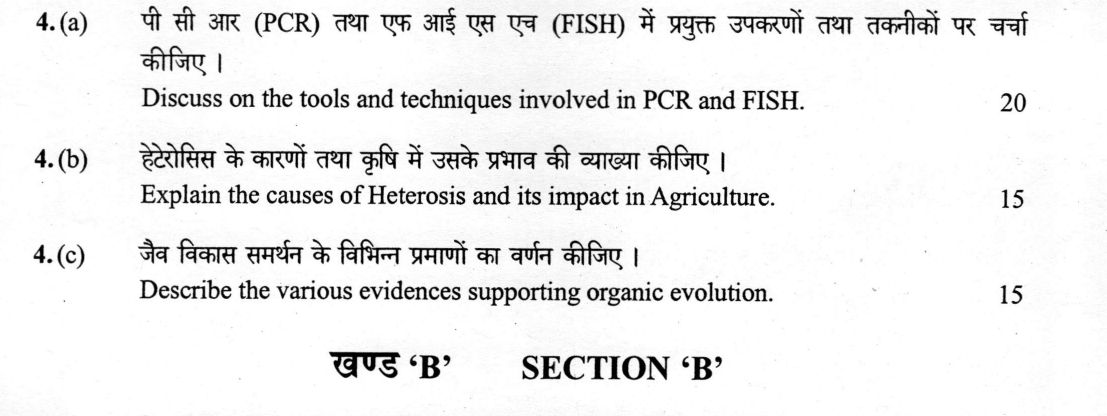
(a) Discuss on the tools and techniques involved in PCR and FISH. (20 marks) (b) Explain the causes of Heterosis and its impact…
Discuss on the tools and techniques involved in PCR and FISH. 20 marks
Explain the causes of Heterosis and its impact in Agriculture. 15 marks
Describe the various evidences supporting organic evolution. 15 marks
हिंदी में प्रश्न पढ़ें
पी सी आर (PCR) तथा एफ आई एस एच (FISH) में प्रयुक्त उपकरणों तथा तकनीकों पर चर्चा कीजिए । (20 अंक)
हेटेरोसिस के कारणों तथा कृषि में उसके प्रभाव की व्याख्या कीजिए । (15 अंक)
जैव विकास समर्थन के विभिन्न प्रमाणों का वर्णन कीजिए । (15 अंक)
Model answer
Drafted with AI by UPSC Answer Check against this question's marking rubric, to the expected length. UPSC does not publish answers for Mains — this is one way to score well, not an official key. How we build rubrics and answers.
(a) Tools and techniques involved in PCR and FISH (20 marks)
Polymerase chain reaction (PCR), devised by Kary Mullis in 1983, amplifies a chosen DNA segment exponentially in vitro.
Tools (reagents and equipment):
- Template DNA, which may be a tiny amount.
- Two primers (forward and reverse), 18 to 25 nucleotides long, flanking the target.
- A thermostable DNA polymerase, Taq polymerase from Thermus aquaticus (or proofreading enzymes such as Pfu), four dNTPs, Mg²⁺ (about 1.5 mM) and a buffer.
- A thermal cycler, to change temperatures rapidly, and a gel unit for analysis.
Technique. Each cycle has three steps: denaturation at 94 to 95 °C, which separates the strands; annealing at 50 to 65 °C (about 5 °C below the primer Tm), when primers bind; and extension at 72 °C, when Taq synthesises the new strands (about 1 minute for each kb). After 25 to 35 cycles the target is amplified about 2ⁿ times, and the product is checked by agarose gel electrophoresis with ethidium bromide or SYBR stain. Variants are reverse transcription PCR, real-time (quantitative) PCR, multiplex PCR, nested PCR and hot-start PCR. It is used in diagnosis, cloning, DNA fingerprinting, mutation detection and GMO testing.
Fluorescence in situ hybridisation (FISH) locates a specific DNA sequence on a chromosome or in a nucleus by hybridising a fluorescent probe to it.
Tools:
- Labelled DNA probes: repeat sequences (centromeric), locus-specific probes, or whole-chromosome paints, labelled directly with fluorochromes (FITC, rhodamine, Cy3), or indirectly with biotin or digoxigenin detected with fluorescent streptavidin or antibody.
- Chromosome spreads (metaphase), interphase nuclei or tissue sections fixed on slides.
- A hybridisation oven or chamber, formamide and SSC solutions, DAPI counterstain, and a fluorescence microscope with filters and a CCD camera for imaging.
Technique: fix and prepare the slides; denature the chromosomal DNA (about 70 to 72 °C in formamide) and the probe; hybridise overnight at about 37 °C; wash at controlled stringency; detect, counterstain and image. In plants, genomic in situ hybridisation (GISH) uses total DNA of one species to identify alien chromosomes, as in wheat-rye lines. FISH is used for gene and rDNA mapping, detection of translocations (BCR-ABL), aneuploidy and deletions, and study of karyotype evolution.
(b) Causes of heterosis and its impact in agriculture (15 marks)
Heterosis (hybrid vigour), a term of Shull (1914), is the superiority of the F1 hybrid over its parents in vigour, yield or other traits. Its causes are explained by these hypotheses:
- Dominance hypothesis (Davenport, Bruce, and Keeble and Pellew): the parents carry harmful recessive alleles at different loci, and in the hybrid dominant favourable alleles of one parent mask the recessive ones of the other; for example AAbbCC by aaBBcc gives AaBbCc, with dominant alleles at all loci. It cannot explain why no inbred line is as vigorous as the hybrid, but linkage of dominant alleles explains part of this.
- Overdominance hypothesis (Shull and East): the heterozygote at a locus (Aa) is superior to either homozygote (AA, aa), because of the interaction of two alleles, as in the two different enzyme forms that give a broader function.
- Epistasis (interaction of non-allelic genes), and more recently gene expression, epigenetic and complementation of alleles, contribute.
Impact in agriculture. Heterosis is exploited by hybrid varieties, which give 15 to 50% more yield, with uniformity, earliness, better quality and stress tolerance:
- Maize hybrids (Jones' double cross, 1918), which began commercial hybrid seed.
- In India, maize hybrids (Ganga 1, Deccan), sorghum CSH-1 (1964), pearl millet HB-1 (1965), cotton hybrid H-4 (1970), rice hybrids (from 1994), and hybrids of castor, sunflower, vegetables and Bt cotton.
- Hybrid seed production uses male sterility, cytoplasmic male sterility (three-line A, B, R) or genic and environment-sensitive male sterility (two-line).
Limitations: heterosis is lost in F2 (inbreeding depression), so farmers buy fresh seed each season, seed production is costly, and genetic uniformity can increase vulnerability to disease. Apomixis, which would fix heterosis, is a goal.
(c) Evidences supporting organic evolution (15 marks)
- Comparative anatomy: homologous organs (pentadactyl limbs of vertebrates, mouthparts of insects) show divergent evolution from a common ancestor, and analogous organs (wings of birds and insects) show convergence. Vestigial organs (appendix, coccyx, pelvic girdle of python) and atavism show ancestry.
- Embryology: early embryos of vertebrates are alike (von Baer), with gill slits and tails, and Haeckel's recapitulation, in a modified form, points to common descent.
- Palaeontology: fossils in strata show change through time, with transitional forms such as Archaeopteryx (reptile and bird), Tiktaalik (fish and tetrapod), the horse series from Eohippus to Equus, and whale ancestors (Pakicetus), and among plants seed ferns and Rhynia. Living fossils (Ginkgo, Cycas, Limulus, Latimeria) link past and present. Radiometric dating fixes the ages.
- Biogeography: endemic species of islands, such as Darwin's finches, marsupials of Australia, and disjunct distribution of Glossopteris and Nothofagus across Gondwana.
- Physiology and biochemistry: a universal genetic code, ATP and cytochrome c in all living things, serum precipitin tests, and haemoglobin sequences that show degrees of relationship.
- Molecular evidence: DNA and protein sequence similarity (human and chimpanzee DNA about 98.8% alike), molecular clocks, pseudogenes and endogenous retroviruses, rRNA phylogeny.
- Evidence of natural and artificial selection: industrial melanism in the peppered moth (Kettlewell), resistance to antibiotics and pesticides, and domestication (wild cabbage into cabbage, kale, cauliflower and broccoli).
- Speciation observed: polyploid species such as Spartina anglica and Tragopogon, and connecting links such as Peripatus.
How this answer will be evaluated
Evaluation rubric
Each sub-part is marked on its own, against the marks and word limit printed on the paper.
- (a) Discuss the tools and techniques involved in PCR and FISH (20 marks; no word limit printed). 20 marks
Must cover
- PCR tools: template, primers, Taq polymerase, dNTPs, Mg²⁺, buffer, thermal cycler
- PCR technique: denaturation 94-95 °C, annealing 50-65 °C, extension 72 °C, 25-35 cycles (2ⁿ), gel detection; variants (RT-PCR, qPCR, nested, multiplex) and uses
- FISH tools: labelled probes (direct fluorochrome or biotin/digoxigenin), chromosome or nuclei preparations, hybridisation reagents, DAPI, fluorescence microscope
- FISH technique: denaturation, hybridisation, stringent washes, detection and imaging; GISH, gene mapping, translocations, aneuploidy
Loses marks
- Confusing FISH with Southern blotting.
- Giving PCR temperatures in the wrong order.
Earns more
- Kary Mullis and Thermus aquaticus mentioned.
- Both techniques treated in balance.
Extra mark
- Real-time PCR chemistry (SYBR, TaqMan) or multicolour FISH
- (b) Explain the causes of heterosis and its impact in agriculture (15 marks; no word limit printed). 15 marks
Must cover
- Definition of heterosis (Shull 1914)
- Dominance hypothesis with example genotypes and its objection
- Overdominance hypothesis (Shull, East) and epistasis; recent explanations
- Agricultural impact: hybrids in maize, sorghum, pearl millet, cotton, rice, vegetables; yield gain, male sterility systems; limitations (F2 breakdown, seed cost)
Loses marks
- Equating heterosis with inbreeding depression.
- Claiming heterosis persists in F2.
Earns more
- Yield increase figures and Indian hybrid names with years.
- Cytoplasmic male sterility system named.
Extra mark
- Apomixis to fix heterosis
- (c) Describe the various evidences supporting organic evolution (15 marks; no word limit printed). 15 marks
Must cover
- Comparative anatomy: homologous, analogous, vestigial organs, atavism
- Embryology: von Baer, recapitulation in modified form
- Palaeontology: transitional forms (Archaeopteryx, Tiktaalik, horse, whale), living fossils, dating
- Biogeography, biochemistry and molecular evidence, selection (peppered moth, resistance), observed speciation
Loses marks
- Citing Lamarck's giraffe neck as evidence.
- Presenting Haeckel's law unqualified.
Earns more
- Plant evidences (seed ferns, Rhynia, polyploid speciation).
- Correct example for each category.
Extra mark
- Molecular clock and pseudogenes
What "Discuss" is asking you to do
Lay the issue out from more than one side — how it arose, what is claimed for it, what is held against it, and where it now stands. UPSC attaches discuss to broad topics with several live dimensions, so coverage of the dimensions earns more than the strength of your opinion.
Structure that answers it
Set the issue up → the case as it is made → the case against → the dimension both sides leave out → where the balance now lies
Where marks are lost
Listing facts with no thread between them, or arguing one side throughout and calling it a discussion.
Practice this exact question
Write your answer and it is marked point by point against the model answer above — what you covered, what you missed, what you got wrong.
Evaluate my answer →More from Botany 2026 Paper II
- Q1 Write short notes on the following in about 150 words each : (a) Frame Shift mutation (10…
- Q2 (a) Give a detailed account on sex linked inheritance ? (20 marks) (b) Explain the struct…
- Q3 (a) (i) Write in detail the chemical composition of microtubules. (10 marks) (ii) Elabora…
- Q4 (a) Discuss on the tools and techniques involved in PCR and FISH. (20 marks) (b) Explain…
- Q5 Write short notes on the following in about 150 words each : (a) Munch hypothesis (10 mar…
- Q6 (a) (i) Explain the significance of Nod factors and the process of root nodule formation.…
- Q7 Explain the following : (a) (i) Explain the factors affecting enzyme activity. (10 marks)…