Paper II — Q2
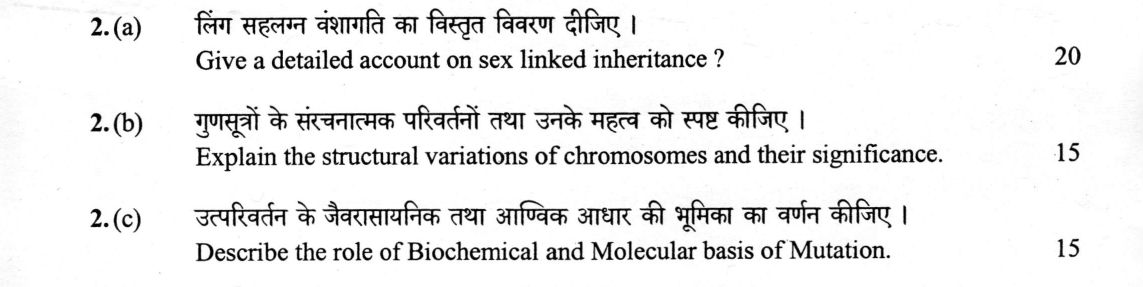
(a) Give a detailed account on sex linked inheritance ? (20 marks) (b) Explain the structural variations of chromosomes and…
Give a detailed account on sex linked inheritance ? 20 marks
Explain the structural variations of chromosomes and their significance. 15 marks
Describe the role of Biochemical and Molecular basis of Mutation. 15 marks
हिंदी में प्रश्न पढ़ें
लिंग सहलग्न वंशागति का विस्तृत विवरण दीजिए । (20 अंक)
गुणसूत्रों के संरचनात्मक परिवर्तनों तथा उनके महत्व को स्पष्ट कीजिए । (15 अंक)
उत्परिवर्तन के जैवरासायनिक तथा आण्विक आधार की भूमिका का वर्णन कीजिए । (15 अंक)
Model answer
Drafted with AI by UPSC Answer Check against this question's marking rubric, to the expected length. UPSC does not publish answers for Mains — this is one way to score well, not an official key. How we build rubrics and answers.
(a) Sex-linked inheritance (20 marks)
Sex-linked inheritance is the inheritance of genes located on the sex chromosomes. Because the X and Y chromosomes differ in gene content, the inheritance of such genes differs in the two sexes.
Types:
- X-linked (the commonest): genes on the X chromosome with no counterpart on the Y, so males are hemizygous and express even a recessive allele. Examples in humans are red-green colour blindness, haemophilia A, and Duchenne muscular dystrophy (recessive), and hypophosphataemic rickets (dominant).
- Y-linked (holandric): genes on the Y chromosome pass only from father to son, as SRY, the male-determining gene.
- Genes in the pseudoautosomal regions, which are homologous on X and Y, behave like autosomal genes.
- In birds, moths and some reptiles females are ZW and males ZZ, and Z-linked genes, such as the barred plumage gene in Plymouth Rock fowl, show a reversed pattern.
Morgan's experiment (1910). In Drosophila, a white-eyed male crossed with a red-eyed female gave red-eyed F1, and the F2 had red and white eyes in a 3 : 1 ratio, with all the white-eyed flies male. In the reciprocal cross, a white-eyed female crossed with a red-eyed male gave red-eyed daughters and white-eyed sons in F1, and a 1 : 1 : 1 : 1 ratio in F2. This shows criss-cross inheritance and that the eye-colour gene lies on the X chromosome. Bridges' study of non-disjunction later gave strong support to the chromosome theory.
Characteristics of X-linked recessive inheritance:
- Males are affected more often than females.
- An affected father passes the gene to all his daughters, who become carriers, and to none of his sons.
- A carrier mother passes it to half of her sons, who are affected, and half of her daughters, who are carriers.
- Traits skip a generation, moving from a grandfather through a carrier daughter to a grandson.
Examples. A colour-blind man and a normal woman produce normal sons and carrier daughters. A carrier woman and a normal man produce, in equal proportion, a normal daughter, a carrier daughter, a normal son and a colour-blind son. Haemophilia A (factor VIII deficiency) appeared in the descendants of Queen Victoria.
Females have two X chromosomes but one is inactivated (Barr body, the Lyon hypothesis), so gene dosage is equal in the two sexes and heterozygous females are mosaics. Sex-linked genes should not be confused with sex-limited genes, expressed only in one sex, or sex-influenced genes, whose expression depends on the sex, such as baldness.
(b) Structural variations of chromosomes and their significance (15 marks)
Structural variations are changes in the structure of a chromosome, from breakage and faulty rejoining, that alter the number or order of genes. There are four types:
- Deletion (deficiency): loss of a segment, terminal or interstitial. In a heterozygote, the normal chromosome forms a loop at pachytene. Homozygous deletions are usually lethal. Examples are cri-du-chat syndrome (deletion of 5p) and Notch in Drosophila. Deletions help to map genes and cause pseudodominance.
- Duplication: a segment is repeated, tandem or displaced. The Bar eye of Drosophila is due to a duplication of band 16A. Duplications supply extra genes that may evolve new functions, as in the globin gene families.
- Inversion: a segment is reversed, paracentric (excluding the centromere) or pericentric (including it). In heterozygotes an inversion loop forms; crossing over in it gives dicentric bridges and acentric fragments in the paracentric type, so recombination is suppressed. Inversions maintain gene combinations and are important in the evolution of Drosophila species.
- Translocation: a segment is shifted to a non-homologous chromosome, simple or reciprocal; a Robertsonian translocation joins two acrocentrics. In a reciprocal translocation heterozygote the meiotic configuration is a ring or a chain of four, and gametes are often unbalanced, so there is semi-sterility. The Philadelphia chromosome, t(9;22), produces the BCR-ABL gene in chronic myeloid leukaemia, and familial Down syndrome can arise from a 14;21 translocation.
Significance:
- They are a source of variation for evolution and speciation, and change the karyotype.
- They cause genetic disease and cancer.
- They are tools for gene mapping, and balancer chromosomes with inversions maintain lethal genes.
- In breeding, translocations transfer alien genes, as in wheat-rye 1BL.1RS lines and leaf rust resistance from Aegilops and Agropyron.
(c) Role of the biochemical and molecular basis of mutation (15 marks)
Biochemical basis. Garrod and later Beadle and Tatum (Neurospora, 1941) showed that a mutation changes a gene, and hence an enzyme, causing a block in a metabolic pathway: inborn errors such as alkaptonuria, phenylketonuria (phenylalanine hydroxylase) and albinism (tyrosinase). Ingram showed in 1957 that sickle-cell disease is a single amino acid change in beta globin (glutamic acid to valine, from a single base change, GAG to GUG). Biochemical mutants (auxotrophs) have been used to work out pathways, and the Ames test uses Salmonella his⁻ reversion to detect mutagens.
Molecular basis:
- Base substitutions are transitions (purine to purine or pyrimidine to pyrimidine) or transversions, and deletions and insertions cause frameshifts.
- Spontaneous mutation comes from rare tautomeric shifts causing mismatches, depurination, deamination of cytosine to uracil and of 5-methylcytosine to thymine (CpG hotspots), replication slippage, oxidative damage (8-oxoguanine), and insertion of transposons.
- Induced mutation is caused by base analogues (5-bromouracil, 2-aminopurine, giving transitions), nitrous acid (deamination), hydroxylamine, alkylating agents such as EMS (O⁶-ethylguanine pairing with thymine), intercalating agents such as acridines (frameshifts), UV light (thymine dimers) and ionising radiation (breaks).
- DNA repair (photoreactivation, excision repair, mismatch repair, recombination repair) corrects most damage, and failure of repair (xeroderma pigmentosum) leaves mutations.
Role of this knowledge:
- Understanding genetic diseases and cancer (RAS point mutation, TP53).
- Induced mutation breeding of crops, such as Sharbati Sonora wheat and many other varieties.
- Screening of mutagens and carcinogens, and design of site-directed mutagenesis and genome editing.
- Explaining the source of variation in evolution.
How this answer will be evaluated
Evaluation rubric
Each sub-part is marked on its own, against the marks and word limit printed on the paper.
- (a) Give a detailed account of sex-linked inheritance (20 marks; no word limit printed). 20 marks
Must cover
- Definition and types: X-linked recessive and dominant, Y-linked (holandric), pseudoautosomal, Z-linked in ZW systems, with human and other examples
- Morgan's Drosophila white-eye cross with ratios (3:1 with white all male; reciprocal cross criss-cross, 1:1:1:1); Bridges' non-disjunction
- Characteristics of X-linked recessive inheritance: hemizygous males, carrier females, criss-cross, skipping a generation
- Human examples with crosses (colour blindness, haemophilia A, DMD); dosage compensation and Lyon hypothesis; distinguish sex-limited and sex-influenced
Loses marks
- Stating that an affected father passes X-linked recessive to sons.
- Confusing sex-linked with sex-limited traits.
Earns more
- Correct genotypic and phenotypic ratios for at least two crosses.
- Royal haemophilia pedigree.
Extra mark
- Sex linkage in plants (Silene) or birds (barred plumage)
- (b) Explain the structural variations of chromosomes and their significance (15 marks; no word limit printed). 15 marks
Must cover
- Deletion, duplication, inversion, translocation defined with subtypes
- Meiotic consequences: deletion loop, inversion loop with bridge and fragment, translocation ring or chain and semi-sterility
- Examples: cri-du-chat, Bar eye, Philadelphia chromosome, Robertsonian and familial Down syndrome
- Significance: evolution and speciation, disease and cancer, gene mapping, balancer chromosomes, alien gene transfer in breeding
Loses marks
- Confusing structural changes with numerical changes (aneuploidy, polyploidy).
- Giving translocation as exchange between homologues.
Earns more
- Distinction of paracentric and pericentric inversion.
- Recombination suppression explained.
Extra mark
- Position effect
- (c) Describe the role of the biochemical and molecular basis of mutation (15 marks; no word limit printed). 15 marks
Must cover
- Biochemical basis: gene-enzyme link, inborn errors (alkaptonuria, PKU, albinism), sickle-cell amino acid change, auxotroph and Ames test
- Molecular basis: transitions, transversions, indels; spontaneous causes (tautomerism, depurination, deamination, slippage, transposons)
- Induced: base analogues, nitrous acid, EMS, acridines, UV, radiation; DNA repair systems
- Role: genetic disease and cancer, mutation breeding, mutagen screening, site-directed mutagenesis and evolution
Loses marks
- Calling all mutations harmful.
- Listing mutagens without explaining how they change DNA.
Earns more
- Named mutagens with mechanism.
- Named crop varieties from mutation breeding.
Extra mark
- CpG hotspots and 8-oxoguanine
What "Discuss" is asking you to do
Lay the issue out from more than one side — how it arose, what is claimed for it, what is held against it, and where it now stands. UPSC attaches discuss to broad topics with several live dimensions, so coverage of the dimensions earns more than the strength of your opinion.
Structure that answers it
Set the issue up → the case as it is made → the case against → the dimension both sides leave out → where the balance now lies
Where marks are lost
Listing facts with no thread between them, or arguing one side throughout and calling it a discussion.
Practice this exact question
Write your answer and it is marked point by point against the model answer above — what you covered, what you missed, what you got wrong.
Evaluate my answer →More from Botany 2026 Paper II
- Q1 Write short notes on the following in about 150 words each : (a) Frame Shift mutation (10…
- Q2 (a) Give a detailed account on sex linked inheritance ? (20 marks) (b) Explain the struct…
- Q3 (a) (i) Write in detail the chemical composition of microtubules. (10 marks) (ii) Elabora…
- Q4 (a) Discuss on the tools and techniques involved in PCR and FISH. (20 marks) (b) Explain…
- Q5 Write short notes on the following in about 150 words each : (a) Munch hypothesis (10 mar…