Paper II — Q6
(a) (i) Explain the significance of Nod factors and the process of root nodule formation. (10 marks) (ii) Describe the process…
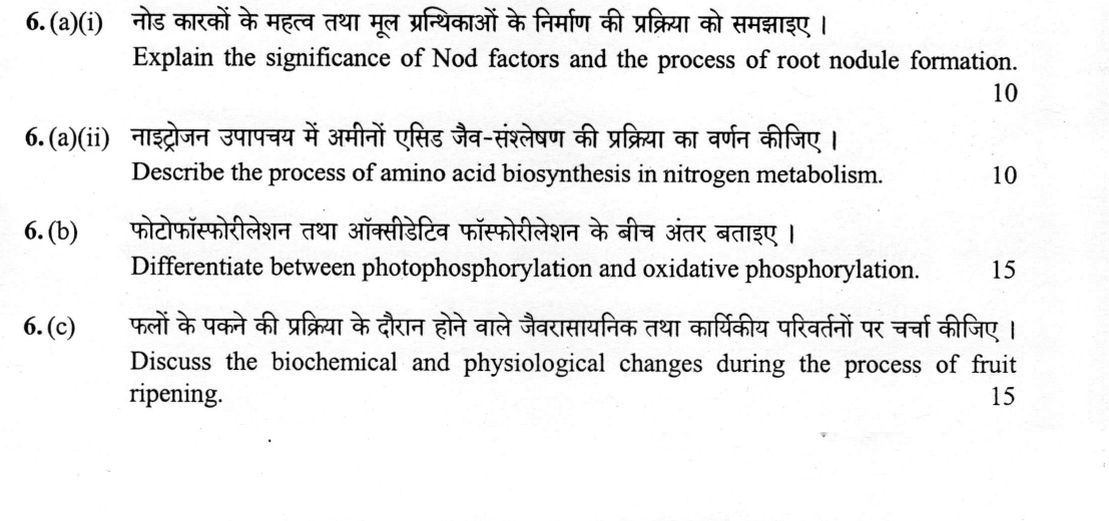
Explain the significance of Nod factors and the process of root nodule formation. 10 marks
Describe the process of amino acid biosynthesis in nitrogen metabolism. 10 marks
Differentiate between photophosphorylation and oxidative phosphorylation. 15 marks
Discuss the biochemical and physiological changes during the process of fruit ripening. 15 marks
हिंदी में प्रश्न पढ़ें
नोड कारकों के महत्व तथा मूल ग्रंथिकाओं के निर्माण की प्रक्रिया को समझाइए । (10 अंक)
नाइट्रोजन उपापचय में अमीनों एसिड जैव-संश्लेषण की प्रक्रिया का वर्णन कीजिए । (10 अंक)
फोटोफॉस्फोरीलेशन तथा ऑक्सीडेटिव फॉस्फोरीलेशन के बीच अंतर बताइए । (15 अंक)
फलों के पकने की प्रक्रिया के दौरान होने वाले जैवरासायनिक तथा कार्यिकीय परिवर्तनों पर चर्चा कीजिए । (15 अंक)
Model answer
Drafted with AI by UPSC Answer Check against this question's marking rubric, to the expected length. UPSC does not publish answers for Mains — this is one way to score well, not an official key. How we build rubrics and answers.
(a)(i) Significance of Nod factors and the process of root nodule formation (10 marks)
Nod factors are the signal molecules produced by rhizobia that trigger nodulation in legumes. Chemically they are lipo-chitooligosaccharides: a backbone of three to five beta-1,4-linked N-acetylglucosamine units with a fatty acyl chain on the non-reducing end, and species-specific decorations (sulphate, acetyl, methyl or fucosyl groups). They are made by the products of the nod genes: nodA, nodB and nodC are common (nodC is a chitin synthase), while host-specific genes add the decorations, and nodD, activated by flavonoids exuded by the legume root (luteolin, daidzein, genistein), switches the nod genes on.
Significance:
- They determine host specificity, as the plant recognises only the correct decorations through LysM receptor kinases (NFR1 and NFR5 in Lotus).
- They induce root hair curling and deformation, calcium spiking, expression of early nodulin genes, cortical cell division and infection thread formation, and so are sufficient to start nodule development.
Process of nodule formation:
- Flavonoids from the root attract rhizobia and activate nodD.
- Bacteria attach to root hairs, and the Nod factors curl the hair (shepherd's crook).
- An infection thread forms by invagination and carries the dividing bacteria to the cortex.
- Cortical cells divide to form the nodule primordium, from the inner cortex in soybean (determinate nodule) or outer cortex in pea (indeterminate).
- Bacteria are released into the cells by endocytosis, enclosed by a symbiosome membrane, and become nitrogen-fixing bacteroids.
- Leghaemoglobin (pink colour) keeps oxygen low, nitrogenase reduces N₂ to ammonia, and the plant supplies malate while receiving fixed nitrogen.
(a)(ii) Amino acid biosynthesis in nitrogen metabolism (10 marks)
Amino acids are made from assimilated nitrogen and carbon skeletons from glycolysis, the TCA cycle and the pentose phosphate pathway.
Nitrogen assimilation. Nitrate is reduced to nitrite by nitrate reductase (cytosol, NADH) and to ammonium by nitrite reductase (plastids, reduced ferredoxin). Ammonium, from nitrate, nitrogen fixation or photorespiration, is assimilated mainly by the GS-GOGAT cycle:
- Glutamine synthetase: glutamate + NH₄⁺ + ATP → glutamine.
- Glutamate synthase (GOGAT): glutamine + 2-oxoglutarate + reduced ferredoxin or NADH → two glutamate.
- Glutamate dehydrogenase can also aminate 2-oxoglutarate to glutamate when ammonium is high.
Formation of other amino acids:
- Transamination: aminotransferases with pyridoxal phosphate move the amino group from glutamate to an oxo acid; aspartate aminotransferase makes aspartate from oxaloacetate, and alanine aminotransferase makes alanine from pyruvate.
- Amidation: asparagine synthetase forms asparagine from aspartate and glutamine.
- Families derived from a common precursor: glutamate (Gln, Pro, Arg), aspartate (Asn, Lys, Met, Thr, Ile), pyruvate (Ala, Val, Leu), 3-phosphoglycerate (Ser, Gly, Cys), and the shikimate pathway (Phe, Tyr, Trp), with histidine from ribose phosphate.
Glutamine and glutamate are the main donors of nitrogen for all other nitrogenous compounds.
(b) Photophosphorylation versus oxidative phosphorylation (15 marks)
Both make ATP by chemiosmosis (Mitchell), with an electron transport chain that builds a proton gradient and an ATP synthase driven by that gradient. They differ as follows:
- Site: photophosphorylation is in the thylakoid membranes of chloroplasts, and oxidative phosphorylation in the inner mitochondrial membrane.
- Energy source: light absorbed by photosystems in the first, and the energy released by oxidation of NADH and FADH₂ in the second.
- Electron donor: water in photophosphorylation (releasing O₂), and NADH and FADH₂ in oxidative phosphorylation.
- Final electron acceptor: NADP⁺ in non-cyclic photophosphorylation, and oxygen (forming water) in oxidative phosphorylation.
- Carriers: photosystem II, plastoquinone, cytochrome b6f, plastocyanin, photosystem I and ferredoxin, against complexes I to IV, ubiquinone and cytochrome c.
- Direction of electron flow: uphill, against the redox gradient, driven by light, in the Z-scheme, and downhill, exergonic, from NADH to O₂.
- Proton gradient: protons are pumped into the thylakoid lumen, and ATP is made on the stroma side by the CF₀-CF₁ ATP synthase; in mitochondria they are pumped into the intermembrane space and ATP is made in the matrix by F₀-F₁.
- Types: photophosphorylation may be cyclic (only ATP, involving photosystem I) or non-cyclic (ATP, NADPH and O₂); oxidative phosphorylation has one type.
- Occurrence: only in light, in photosynthetic cells; oxidative phosphorylation occurs in the light and in the dark, in all aerobic cells.
- Use: the ATP of photophosphorylation goes into the Calvin cycle, and that of oxidative phosphorylation into cellular work.
(c) Biochemical and physiological changes during fruit ripening (15 marks)
Fruit ripening is the change of a mature fruit into an edible one, in which the fruit softens, changes colour, becomes sweet and aromatic. Climacteric fruits (apple, banana, tomato, mango) show a burst of respiration and an autocatalytic rise of ethylene, while non-climacteric fruits (citrus, grape, strawberry) do not.
Physiological changes:
- A respiratory climacteric in climacteric fruits, and a surge of ethylene made by ACC synthase and ACC oxidase, acting through its receptor (ETR1) and the signalling pathway CTR1, EIN2 and EIN3.
- Increased membrane permeability, loss of compartmentation and a rise in ripening-specific gene expression under transcription factors such as RIN and NOR in tomato.
Biochemical changes:
- Softening: cell wall-degrading enzymes (polygalacturonase, pectin methylesterase, cellulase, expansin) break down protopectin into soluble pectin, and the middle lamella loosens.
- Colour: chlorophyll breaks down, and carotenoids (lycopene in tomato) and anthocyanins are synthesised as chloroplasts become chromoplasts.
- Sweetness: starch is hydrolysed to sugars (amylase and phosphorylase), and organic acids fall as they are used in respiration.
- Flavour: volatile esters, alcohols, aldehydes and terpenes form (isoamyl acetate in banana).
- Astringency falls, as tannins polymerise, and toxic alkaloids (solanine) decline.
- Protein synthesis and hormone changes occur, with ABA and ethylene rising.
Control: ethylene (or ethephon) is used to ripen fruits, while 1-MCP, low temperature, low O₂ with high CO₂, and calcium slow ripening in storage.
How this answer will be evaluated
Evaluation rubric
Each sub-part is marked on its own, against the marks and word limit printed on the paper.
- (a)(i) (a)(i) Explain the significance of Nod factors and the process of root nodule formation (10 marks; no word limit printed). 10 marks
Must cover
- Nod factors: lipo-chitooligosaccharides made by nod genes (nodABC, nodD activated by flavonoids); host-specific decorations
- Significance: host specificity, LysM receptors, root hair curling, cortical division, infection thread, early nodulins
- Steps: flavonoid signal, attachment and curling, infection thread, cortical division and nodule primordium, bacteroid formation
- Symbiotic function: leghaemoglobin, nitrogenase, exchange of malate and fixed nitrogen; determinate and indeterminate nodules
Loses marks
- Describing Nod factors as proteins or hormones of the plant.
- Placing bacteria inside the root hair cell wall without an infection thread.
Earns more
- Named flavonoids or receptors (NFR1, NFR5).
- Symbiosome membrane described.
Extra mark
- Autoregulation of nodulation
- (a)(ii) (a)(ii) Describe the process of amino acid biosynthesis in nitrogen metabolism (10 marks; no word limit printed). 10 marks
Must cover
- Nitrate reduction: nitrate reductase then nitrite reductase to ammonium
- Ammonium assimilation by GS-GOGAT cycle (reactions with cofactors); GDH minor route
- Transamination with PLP, amidation (asparagine synthetase)
- Amino acid families (glutamate, aspartate, pyruvate, serine, aromatic, histidine)
Loses marks
- Giving GDH as the main assimilation route.
- Omitting nitrate reduction.
Earns more
- Locations of enzymes (cytosol, plastid).
- Carbon skeleton sources.
Extra mark
- Glutamine and glutamate as principal nitrogen donors
- (b) (b) Differentiate between photophosphorylation and oxidative phosphorylation (15 marks; no word limit printed). 15 marks
Must cover
- Site: thylakoid versus inner mitochondrial membrane
- Energy source and electron donor and acceptor: light and water and NADP⁺ versus NADH, FADH₂ and oxygen
- Carriers and direction of electron flow (uphill Z-scheme versus downhill), cyclic and non-cyclic types
- Proton gradient and ATP synthase orientation (CF₀-CF₁ versus F₀-F₁), occurrence and use of ATP
Loses marks
- Attributing photophosphorylation to mitochondria.
- Stating that oxidative phosphorylation occurs only in the dark.
Earns more
- Common chemiosmotic principle stated.
- At least eight points of difference.
Extra mark
- Photophosphorylation in bacteria
- (c) (c) Discuss the biochemical and physiological changes during fruit ripening (15 marks; no word limit printed). 15 marks
Must cover
- Climacteric and non-climacteric fruits; respiratory rise and ethylene autocatalysis (ACC synthase, ACC oxidase, ETR1, CTR1, EIN)
- Softening by pectin-degrading enzymes and cell wall loosening
- Colour change (chlorophyll loss, carotenoids, anthocyanins), sugar accumulation from starch, acid decrease
- Aroma volatiles, loss of astringency, membrane and gene-expression changes; control (1-MCP, controlled atmosphere, calcium)
Loses marks
- Stating that ethylene is produced only in non-climacteric fruits.
- Listing changes without biochemical explanation.
Earns more
- Named examples of each fruit type.
- Named transcription factors (RIN, NOR).
Extra mark
- Commercial ripening with ethephon
What "Explain" is asking you to do
Make the working of something clear — what sets it off, what follows from what, and what it produces. Explain is the Commission's mechanism word: it dominates the technical papers and the “explain why” stems, where the marks sit in the causal chain and not in the label.
Structure that answers it
State what it is → the initiating condition → the chain of cause, step by step → an instance where it plays out → what the chain produces
Where marks are lost
Describing what something looks like instead of why it works that way. Naming the stages without linking them reads as description too.
Practice this exact question
Write your answer and it is marked point by point against the model answer above — what you covered, what you missed, what you got wrong.
Evaluate my answer →More from Botany 2026 Paper II
- Q3 (a) (i) Write in detail the chemical composition of microtubules. (10 marks) (ii) Elabora…
- Q4 (a) Discuss on the tools and techniques involved in PCR and FISH. (20 marks) (b) Explain…
- Q5 Write short notes on the following in about 150 words each : (a) Munch hypothesis (10 mar…
- Q6 (a) (i) Explain the significance of Nod factors and the process of root nodule formation.…
- Q7 Explain the following : (a) (i) Explain the factors affecting enzyme activity. (10 marks)…
- Q8 (a) (i) What is the basic concept of phytogeography ? (5 marks) (ii) Give a detailed acco…