Paper I — Q1
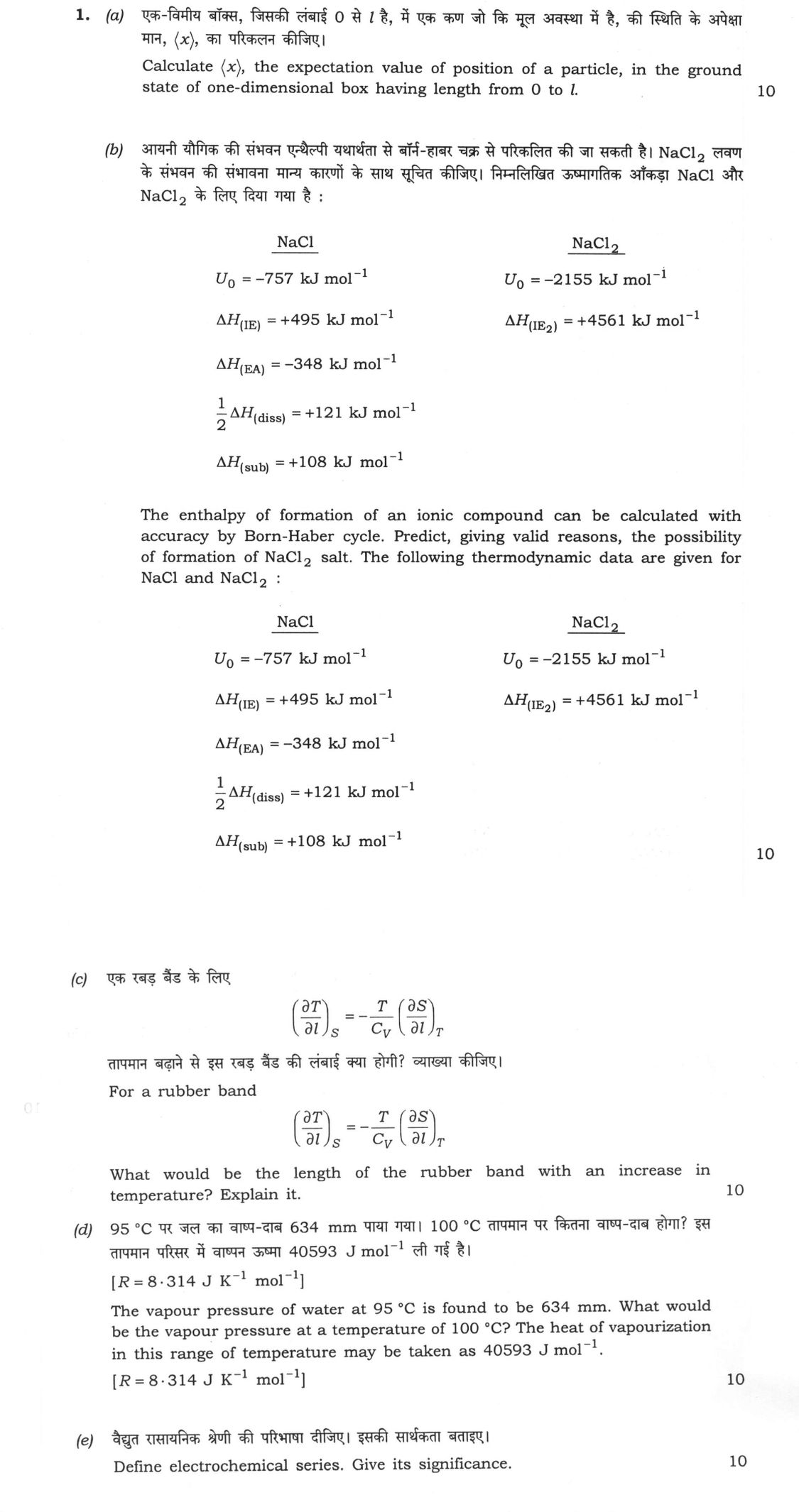
(a) Calculate ⟨x⟩, the expectation value of position of a particle, in the ground state of one-dimensional box having length from…
Calculate ⟨x⟩, the expectation value of position of a particle, in the ground state of one-dimensional box having length from 0 to l. 10 marks
The enthalpy of formation of an ionic compound can be calculated with accuracy by Born-Haber cycle. Predict, giving valid reasons, the possibility of formation of NaCl₂ salt. The following thermodynamic data are given for NaCl and NaCl₂ :
NaCl U₀ = −757 kJ mol⁻¹ ΔH₍IE₎ = +495 kJ mol⁻¹ ΔH₍EA₎ = −348 kJ mol⁻¹ ½ ΔH₍diss₎ = +121 kJ mol⁻¹ ΔH₍sub₎ = +108 kJ mol⁻¹
NaCl₂ U₀ = −2155 kJ mol⁻¹ ΔH₍IE₂₎ = +4561 kJ mol⁻¹ 10 marks
For a rubber band
((∂ T)/(∂ l))_S = -T/(C_V)((∂ S)/(∂ l))_T
What would be the length of the rubber band with an increase in temperature? Explain it. 10 marks
The vapour pressure of water at 95 °C is found to be 634 mm. What would be the vapour pressure at a temperature of 100 °C? The heat of vapourization in this range of temperature may be taken as 40593 J mol⁻¹.
[R = 8·314 J K⁻¹ mol⁻¹] 10 marks
Define electrochemical series. Give its significance. 10 marks
हिंदी में प्रश्न पढ़ें
एक-विमीय बॉक्स, जिसकी लंबाई 0 से l है, में एक कण जो कि मूल अवस्था में है, की स्थिति के अपेक्षा मान, ⟨x⟩, का परिकलन कीजिए। (10 अंक)
आयनी यौगिक की संभव एन्थैल्पी यथार्थता से बॉर्न-हाबर चक्र से परिकलित की जा सकती है। NaCl₂ लवण के संभव की संभावना मान्य कारणों के साथ सूचित कीजिए। निम्नलिखित ऊष्मागतिक आँकड़ा NaCl और NaCl₂ के लिए दिया गया है :
NaCl U₀ = −757 kJ mol⁻¹ ΔH₍IE₎ = +495 kJ mol⁻¹ ΔH₍EA₎ = −348 kJ mol⁻¹ ½ ΔH₍diss₎ = +121 kJ mol⁻¹ ΔH₍sub₎ = +108 kJ mol⁻¹
NaCl₂ U₀ = −2155 kJ mol⁻¹ ΔH₍IE₂₎ = +4561 kJ mol⁻¹ (10 अंक)
एक रबड़ बैंड के लिए
((∂ T)/(∂ l))_S = -T/(C_V)((∂ S)/(∂ l))_T
तापमान बढ़ाने से इस रबड़ बैंड की लंबाई क्या होगी? व्याख्या कीजिए। (10 अंक)
95 °C पर जल का वाष्प-दाब 634 mm पाया गया। 100 °C तापमान पर कितना वाष्प-दाब होगा? इस तापमान परिसर में वाष्पन ऊष्मा 40593 J mol⁻¹ ली गई है।
[R = 8·314 J K⁻¹ mol⁻¹] (10 अंक)
वैद्युत रासायनिक श्रेणी की परिभाषा दीजिए। इसकी सार्थकता बताइए। (10 अंक)
Model answer
Written by UPSC Answer Check against this question's marking rubric, to the expected length. UPSC does not publish answers for Mains — this is one way to score well, not an official key.
(a) For a particle in a one-dimensional box of length l from 0 to l, the ground-state wavefunction is ψ₁(x) = √(2/l) sin(πx/l), 0 ≤ x ≤ l. The expectation value of position is defined by ⟨x⟩ = ∫₀ˡ x |ψ₁(x)|² dx. Substitute ψ₁: ⟨x⟩ = (2/l) ∫₀ˡ x sin²(πx/l) dx. Use sin²θ = (1 − cos 2θ)/2: ⟨x⟩ = (1/l) ∫₀ˡ x dx − (1/l) ∫₀ˡ x cos(2πx/l) dx. Now (1/l) ∫₀ˡ x dx = (1/l)(l²/2) = l/2. For the second integral, integrate by parts: ∫ x cos(ax) dx = (x/a) sin(ax) + (1/a²) cos(ax), with a = 2π/l. At x = l, sin(2π) = 0; at x = 0, x sin(ax) = 0. Thus ∫₀ˡ x cos(2πx/l) dx = (1/a²)[cos(2π) − cos 0] = 0. Therefore ⟨x⟩ = l/2. This agrees with the symmetry of the ground-state probability density about the centre of the box.
(b) Use the Born-Haber cycle, which applies Hess’s law to the formation of an ionic solid from its elements through sublimation, ionisation, dissociation, electron gain, and lattice formation.
For NaCl(s): Na(s) + ½Cl₂(g) → NaCl(s) Steps:
- Na(s) → Na(g): ΔHₛᵤᵦ = +108 kJ mol⁻¹
- Na(g) → Na⁺(g) + e⁻: IE₁ = +495 kJ mol⁻¹
- ½Cl₂(g) → Cl(g): ½ΔH_diss = +121 kJ mol⁻¹
- Cl(g) + e⁻ → Cl⁻(g): EA = −348 kJ mol⁻¹
- Na⁺(g) + Cl⁻(g) → NaCl(s): U₀ = −757 kJ mol⁻¹
Hence ΔH_f(NaCl) = 108 + 495 + 121 − 348 − 757 = −381 kJ mol⁻¹. The negative value shows that NaCl formation is thermodynamically favourable and NaCl is stable.
For NaCl₂(s), the formation reaction is Na(s) + Cl₂(g) → NaCl₂(s). Since sodium must become Na²⁺, both first and second ionisation enthalpies are needed. Taking the given IE₂ as the second ionisation step Na⁺ → Na²⁺ + e⁻:
- Na(s) → Na(g): +108 kJ mol⁻¹
- Na(g) → Na⁺(g) + e⁻: +495 kJ mol⁻¹
- Na⁺(g) → Na²⁺(g) + e⁻: +4561 kJ mol⁻¹
- Cl₂(g) → 2Cl(g): 2 × 121 = +242 kJ mol⁻¹
- 2Cl(g) + 2e⁻ → 2Cl⁻(g): 2 × (−348) = −696 kJ mol⁻¹
- Na²⁺(g) + 2Cl⁻(g) → NaCl₂(s): U₀ = −2155 kJ mol⁻¹
Thus ΔH_f(NaCl₂) = 108 + 495 + 4561 + 242 − 696 − 2155 = +2555 kJ mol⁻¹. This is highly endothermic. Although the lattice enthalpy of NaCl₂ is much more negative than that of NaCl, it cannot compensate for the enormous second ionisation enthalpy of sodium. Also, the formation entropy change for a solid from a solid and a gas is generally unfavourable. Hence NaCl₂ is not expected to form under normal conditions; NaCl is the stable salt.
(c) For a rubber band, the given thermodynamic relation is (∂T/∂l)ₛ = −(T/Cᵥ)(∂S/∂l)ₜ. When a rubber band is stretched, the long polymer chains become more aligned and ordered. Therefore entropy decreases with increasing length: (∂S/∂l)ₜ < 0. Since T and Cᵥ are positive, the right-hand side becomes positive: (∂T/∂l)ₛ > 0. Thus, under adiabatic conditions, stretching a rubber band raises its temperature, and sudden contraction cools it.
To answer the length change when temperature is increased, keep tension/load constant. For an elastic system, the relevant Maxwell relation from dG = −S dT − l df is (∂l/∂T)_f = (∂S/∂f)ₜ. Increasing tension f stretches the band and decreases entropy, so (∂S/∂f)ₜ < 0. Therefore (∂l/∂T)_f < 0. Hence, at constant tension, an increase in temperature causes the rubber band to contract; a decrease in temperature makes it lengthen. Physically, heating increases the entropy, and the entropically favoured state is the more coiled, disordered, shorter state. This is why a stretched rubber band contracts when warmed and expands when cooled.
(d) Use the integrated Clausius-Clapeyron equation, assuming ΔHᵥₐₚ is constant over the range and water vapour behaves ideally: ln(P₂/P₁) = (ΔHᵥₐₚ/R)(1/T₁ − 1/T₂). Given: P₁ = 634 mm at T₁ = 95 °C = 368.15 K, T₂ = 100 °C = 373.15 K, ΔHᵥₐₚ = 40593 J mol⁻¹, R = 8.314 J K⁻¹ mol⁻¹.
Compute ΔHᵥₐₚ/R = 40593/8.314 = 4882.49 K. Also 1/T₁ − 1/T₂ = 1/368.15 − 1/373.15 = (373.15 − 368.15)/(368.15 × 373.15) = 5/137375.17 = 3.6397 × 10⁻⁵ K⁻¹.
Therefore ln(P₂/P₁) = 4882.49 × 3.6397 × 10⁻⁵ = 0.1777. Thus P₂/P₁ = e⁰·¹⁷⁷⁷ = 1.1945. P₂ = 634 × 1.1945 = 757.3 mm.
The vapour pressure of water at 100 °C is approximately 757.3 mm Hg. The value is close to the standard 760 mm Hg; the small difference arises because the heat of vapourization is assumed constant over the interval.
(e) Definition: The electrochemical series is the arrangement of elements, electrodes, or half-reactions in order of their standard electrode potentials, usually standard reduction potentials E°, measured relative to the standard hydrogen electrode, whose potential is taken as 0.00 V at 298 K, 1 M activity, and 1 bar pressure. A half-reaction with a more positive E° has a greater tendency to undergo reduction; a more negative E° indicates a greater tendency to undergo oxidation.
Significance:
- It predicts the relative strength of oxidising and reducing agents. More positive E° means a stronger oxidising agent; more negative E° means a stronger reducing agent.
- It predicts the feasibility of a redox reaction. For a cell, E°cell = E°cathode − E°anode. If E°cell is positive, the reaction is spontaneous and ΔG° = −nFE°cell is negative.
- It helps calculate the equilibrium constant using log K = nE°cell/0.0591 at 298 K.
- It explains displacement reactions: a metal with more negative E° can displace a metal with more positive E° from its salt solution.
- It is used to choose electrodes in galvanic cells, batteries, electrolysis, electroplating, and electrochemical refining.
- It indicates corrosion tendency. Metals with highly negative E° are easily oxidised and can be used as sacrificial electrodes to protect iron.
- It explains reactions with acids: metals above hydrogen in the series displace H₂ from dilute acids, while those below hydrogen generally do not.
What "Solve" is asking you to do
Choose the method, then carry it through to a final answer. Identifying what kind of problem this is and why that method applies is the first thing marked; a correct figure arrived at invisibly earns almost nothing.
Structure that answers it
Given data and what is required → method chosen, with the reason it applies → set-up (equation, circuit, free body, trial balance) → working, step by step → answer with units and any condition of validity
Where marks are lost
Doing the middle steps mentally and writing only the result. In mathematics papers, a further loss comes from giving a decimal where the exact value in surds or fractions was wanted, or from skipping the justification a part explicitly asks for.
How this answer will be evaluated
Approach
(a) calculate: given > formula > substitution > result with units > interpretation | (b) justify: claim > 3-4 reasons > evidence > conclusion | (c) explain: definition/context > points in order > small example > short close | (d) calculate: given > formula > substitution > result with units > interpretation | (e) define: precise definition > the distinguishing feature > one example Full marks: Full derivations, correct signs, clear physical reasoning, and accurate calculations.
Key points expected
- State ground state wavefunction ψ₁ = √(2/l)sin(πx/l)
- Set up integral ⟨x⟩ = ∫₀ˡ x|ψ₁|² dx
- Show integration by parts or substitution steps
- Final result ⟨x⟩ = l/2
- Calculate ΔH_f for NaCl (should be negative)
- Calculate ΔH_f for NaCl₂ (should be positive)
- Compare stability based on enthalpy signs
- Conclude NaCl₂ is not stable
Evaluation rubric
Each sub-part is marked on its own, against the marks and word limit printed on the paper.
- (a) Derive the expectation value of position for a particle in a 1D box. 10 marks
calculate— given → formula → substitution → result with units → interpretation
Must cover
- State ground state wavefunction ψ₁ = √(2/l)sin(πx/l)
- Set up integral ⟨x⟩ = ∫₀ˡ x|ψ₁|² dx
- Show integration by parts or substitution steps
- Final result ⟨x⟩ = l/2
Loses marks
- Using wrong wavefunction (e.g., cos)
- Missing integration steps
Earns more
- Mention symmetry argument for l/2
- Correct limits of integration
Extra mark
- Comparison with classical probability distribution
- (b) Predict formation of NaCl₂ using Born-Haber cycle data. 10 marks
justify— claim → 3-4 reasons → evidence → conclusion
Must cover
- Calculate ΔH_f for NaCl (should be negative)
- Calculate ΔH_f for NaCl₂ (should be positive)
- Compare stability based on enthalpy signs
- Conclude NaCl₂ is not stable
Loses marks
- Arithmetic errors in summation
- Ignoring the sign of enthalpy
Earns more
- Explicit Born-Haber cycle equation
- Mention high 2nd IE of Na
Extra mark
- Reference to actual lattice energy trends
- (c) Explain length change of rubber band with temperature increase. 10 marks
explain— definition/context → points in order → small example → short close
Must cover
- Identify (∂S/∂l)_T as negative (entropy decreases on stretch)
- Deduce (∂T/∂l)_S is positive
- State rubber contracts on heating (negative expansion)
- Link to entropic elasticity of polymer chains
Loses marks
- Claiming rubber expands like metals
- Confusing isothermal and adiabatic conditions
Earns more
- Mention adiabatic heating on stretching
- Reference to molecular coiling
Extra mark
- Gough-Joule effect reference
- (d) Calculate vapour pressure of water at 100 °C. 10 marks
calculate— given → formula → substitution → result with units → interpretation
Must cover
- Use Clausius-Clapeyron equation
- Convert temperatures to Kelvin (368K, 373K)
- Substitute ΔH_vap = 40593 J/mol
- Calculate P₂ ≈ 760 mm
Loses marks
- Using Celsius in gas constant term
- Sign error in log equation
Earns more
- Correct use of log(P₂/P₁) form
- Unit consistency check
Extra mark
- Mentioning standard boiling point
- (e) Define electrochemical series and its significance. 10 marks
define— precise definition → the distinguishing feature → one example
Must cover
- Define as list of elements by standard reduction potential
- Mention reference to Standard Hydrogen Electrode (SHE)
- Explain use in predicting cell EMF
- Explain use in predicting displacement reactions
Loses marks
- Confusing oxidation and reduction potential order
- Vague definition without standard conditions
Earns more
- Mentioning galvanic vs electrolytic cells
- Example of a specific reaction
Extra mark
- Reference to corrosion protection
Practice this exact question
Write your answer and it is marked point by point against the model answer above — what you covered, what you missed, what you got wrong.
Evaluate my answer →More from Chemistry 2021 Paper I
- Q1 (a) Calculate ⟨x⟩, the expectation value of position of a particle, in the ground state o…
- Q2 (a) Hydrogen atoms are observed to have radiative transitions from n = 101 to n = 100 to…
- Q3 (a) A drop of water, 0·4 cm in radius, is split up into 125 tiny drops. Find the increase…
- Q4 (a) Calculate the e.m.f. of the following electrochemical cell at 25 °C : Pt/H₂₍₁ ₐₜₘ₎|H⁺…