Paper I — Q3
(a) A drop of water, 0·4 cm in radius, is split up into 125 tiny drops. Find the increase in surface energy. [γwater (surface…
A drop of water, 0·4 cm in radius, is split up into 125 tiny drops. Find the increase in surface energy. [γwater (surface tension of water) = 72 dynes/cm ] 10 marks
What are ion-selective electrodes? How is glass electrode used in the determination of pH of a given solution? 20 marks
Draw and explain the graph of enthalpy of vapourization from the triple point (Tp) to the critical point (Tc). 10 marks
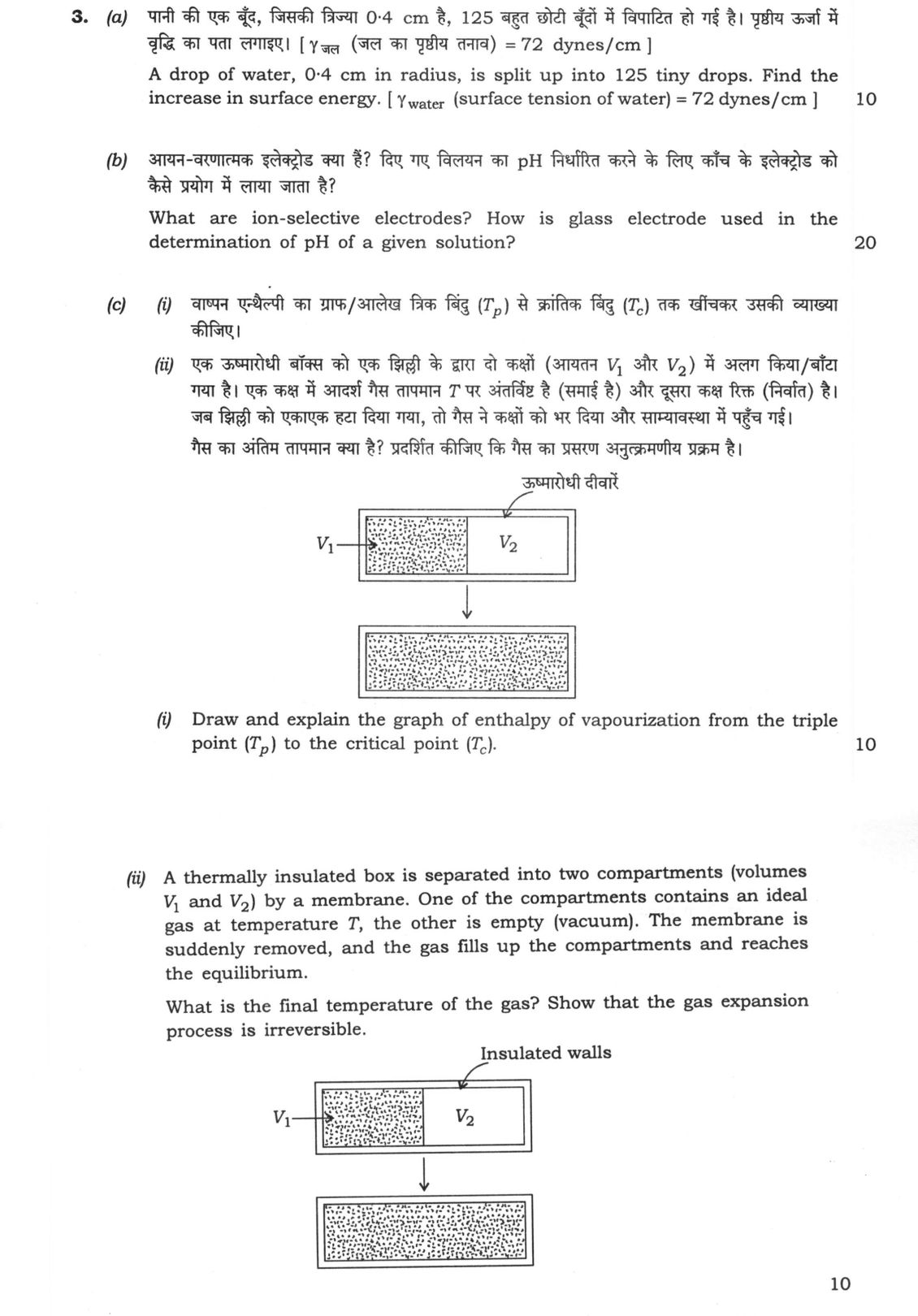
A thermally insulated box is separated into two compartments (volumes V₁ and V₂) by a membrane. One of the compartments contains an ideal gas at temperature T, the other is empty (vacuum). The membrane is suddenly removed, and the gas fills up the compartments and reaches the equilibrium. What is the final temperature of the gas? Show that the gas expansion process is irreversible. 10 marks
हिंदी में प्रश्न पढ़ें
पानी की एक बूंद, जिसकी त्रिज्या 0·4 cm है, 125 बहुत छोटी बूंदों में विपाटित हो गई है। पृष्ठीय ऊर्जा में वृद्धि का पता लगाइए। [γजल (जल का पृष्ठीय तनाव) = 72 dynes/cm ] (10 अंक)
आयन-वरणात्मक इलेक्ट्रोड क्या हैं? दिए गए विलयन का pH निर्धारित करने के लिए कांच के इलेक्ट्रोड को कैसे प्रयोग में लाया जाता है? (20 अंक)
वाष्प एन्थैल्पी का ग्राफ/आलेख त्रिक बिंदु (Tp) से क्रांतिक बिंदु (Tc) तक खींचकर उसकी व्याख्या कीजिए। (10 अंक)
एक उष्मारोधी बॉक्स को एक झिल्ली के द्वारा दो कक्षों (आयतन V1 और V2) में अलग किया/बांटा गया है। एक कक्ष में आदर्श गैस तापमान T पर अंतर्विष्ट है (समाई है) और दूसरा कक्ष रिक्त (निर्वात) है। जब झिल्ली को एकाएक हटा दिया गया, तो गैस ने कक्षों को भर दिया और साम्यावस्था में पहुंच गई। गैस का अंतिम तापमान क्या है? प्रदर्शित कीजिए कि गैस का प्रसरण अनुक्रमणीय प्रक्रम है। (10 अंक)
Model answer
Written by UPSC Answer Check against this question's marking rubric, to the expected length. UPSC does not publish answers for Mains — this is one way to score well, not an official key.
Surface phenomena, electrode potentials and phase thermodynamics all express how molecular interactions create macroscopic energy and potential differences.
Part (a) Let the large drop radius be R = 0.4 cm and the number of small drops n = 125. Volume is conserved: (4/3)πR³ = 125(4/3)πr³, so r = R/5 = 0.08 cm. Initial area A_i = 4πR². Final area A_f = 125 × 4πr² = 125 × 4π(R/5)² = 5 × 4πR². Hence ΔA = A_f − A_i = 16πR². Surface energy increase ΔE = γΔA = 72 dyn cm⁻¹ × 16π(0.4 cm)² = 184.32π erg = 5.79 × 10² erg. Since 1 erg = 10⁻⁷ J, ΔE ≈ 5.8 × 10⁻⁵ J, about 58 μJ. This is the work needed to create new liquid-vapour surface; smaller drops have more area per unit volume, so surface energy rises.
Part (b) Ion-selective electrodes are membrane electrodes whose potential responds selectively to the activity of one ion. The glass electrode is the standard H⁺ electrode. It has a thin ion-exchange glass membrane, an internal buffer of fixed H⁺ activity, and an Ag/AgCl internal reference wire. On contact with the test solution, a hydrated gel layer forms; H⁺ exchanges at the outer surface while the inner surface remains fixed, producing a membrane potential that depends on external H⁺ activity. For a reversible response, E = E° + (RT/F) ln a_H⁺ = E° − (2.303RT/F) pH; at 25°C, E = E° − 0.0591 pH. In a pH cell it is paired with a reference electrode, such as calomel, and calibrated with standard buffers, commonly pH 4, 7 and 10; temperature compensation is applied because the Nernst slope changes with T. The measured emf is therefore converted to pH, linking electrochemical potential to the chemical potential of H⁺.
Part (c)(i) A graph of ΔH_vap against temperature has T on the x-axis and ΔH_vap on the y-axis. The x-axis should show 0, then T_p, then T_c; the curve starts at T_p, not at zero temperature, with a finite, near-maximum positive value. Along the liquid-vapour coexistence line, as T rises, intermolecular attractions become less important relative to thermal motion, so the energy required to vaporise one mole falls. The curve declines smoothly and reaches zero at T_c, where liquid and vapour densities become identical and no latent heat is needed. Its shape is gently concave downward. Trouton’s rule is relevant as context: at the normal boiling point many liquids have roughly constant entropy of vaporisation, ΔS_vap = ΔH_vap/T_b, but it does not assume constant latent heat; here ΔH_vap itself falls to zero at T_c.
Part (c)(ii) The gas expands into a vacuum in an insulated box, so q = 0. The opposing external pressure is zero, so w = 0 and ΔU = q + w = 0. For an ideal gas, internal energy depends only on temperature; therefore T_final = T_initial. The final pressure is lower, but the temperature is unchanged. The process is irreversible because the entropy of the gas increases: ΔS = nR ln(V_final/V_initial) = nR ln[(V₁ + V₂)/V₁] > 0. Since the box is isolated, this is the total entropy production, so the process cannot be reversed without changing the surroundings. This is free expansion, not throttling; real gases may show a small temperature change in free expansion, while Joule-Thomson cooling belongs to a separate constant-enthalpy throttling process.
Conclusion: The surface-energy calculation, the Nernstian glass-electrode response, and the thermodynamic limits of vaporisation and free expansion together show how molecular-scale interactions determine measurable energy, potential and phase behaviour.
What "Explain" is asking you to do
Make the working of something clear — what sets it off, what follows from what, and what it produces. Explain is the Commission's mechanism word: it dominates the technical papers and the “explain why” stems, where the marks sit in the causal chain and not in the label.
Structure that answers it
State what it is → the initiating condition → the chain of cause, step by step → an instance where it plays out → what the chain produces
Where marks are lost
Describing what something looks like instead of why it works that way. Naming the stages without linking them reads as description too.
How this answer will be evaluated
Approach
Framework: Concept > Structure or mechanism > Reasoning > Result. (a) calculate: given > formula > substitution > result with units > interpretation | (b) explain: definition/context > points in order > small example > short close | (c(i)) describe: define > structure or process in order > labelled diagram > significance | (c(ii)) justify: claim > 3-4 reasons > evidence > conclusion Full marks: Accurate calculations, clear mechanisms, and rigorous thermodynamic proofs.
Key points expected
- Conservation of volume: 4/3πR³ = 125(4/3πr³)
- Calculation of new radius r = R/5
- Formula for change in surface energy ΔE = γΔA
- Final numerical result in ergs or J
- Definition of ion-selective electrodes (ISE)
- Description of glass electrode structure (membrane)
- Nernst equation application for pH
- Explanation of potential difference generation
Evaluation rubric
Each sub-part is marked on its own, against the marks and word limit printed on the paper.
- (a) Numerical calculation of the increase in surface energy. 10 marks
calculate— given → formula → substitution → result with units → interpretation
Must cover
- Conservation of volume: 4/3πR³ = 125(4/3πr³)
- Calculation of new radius r = R/5
- Formula for change in surface energy ΔE = γΔA
- Final numerical result in ergs or J
Loses marks
- Incorrect radius ratio (e.g., R/125)
- Missing units in final answer
Earns more
- Correct unit conversion (dynes/cm to N/m)
- Explicit calculation of initial and final areas
Extra mark
- Mention of work done against surface tension
- (b) Definition of ion-selective electrodes and the mechanism of pH determination. 20 marks
explain— definition/context → points in order → small example → short close
Must cover
- Definition of ion-selective electrodes (ISE)
- Description of glass electrode structure (membrane)
- Nernst equation application for pH
- Explanation of potential difference generation
Loses marks
- Confusing glass electrode with calomel electrode
- Omitting the role of the reference electrode
Earns more
- Mention of reference electrode (e.g., Ag/AgCl)
- Diagram of the electrode setup
Extra mark
- Mention of liquid junction potential
- (c(i)) Graph of enthalpy of vaporization vs temperature with explanation. 10 marks
describe— define → structure or process in order → labelled diagram → significance
Must cover
- Graph showing ΔHvap decreasing with T
- Identification of Triple Point (Tp)
- Identification of Critical Point (Tc)
- Explanation of why ΔHvap is zero at Tc
Loses marks
- Graph showing constant ΔHvap
- Failing to label Tp and Tc
Earns more
- Mention of Clausius-Clapeyron relation
- Labeling of the liquid and vapor phases
Extra mark
- Mention of the Watson equation
- (c(ii)) Determination of final temperature and proof of irreversibility. 10 marks
justify— claim → 3-4 reasons → evidence → conclusion
Must cover
- Application of First Law of Thermodynamics (ΔU = 0)
- Statement that final temperature is T
- Calculation of entropy change (ΔS > 0)
- Conclusion that process is irreversible
Loses marks
- Assuming temperature change
- Failing to calculate entropy change
Earns more
- Explicit formula for ΔS = nR ln(V2/V1)
- Mention of free expansion
Extra mark
- Mention of adiabatic condition
Practice this exact question
Write your answer and it is marked point by point against the model answer above — what you covered, what you missed, what you got wrong.
Evaluate my answer →More from Chemistry 2021 Paper I
- Q1 (a) Calculate ⟨x⟩, the expectation value of position of a particle, in the ground state o…
- Q2 (a) Hydrogen atoms are observed to have radiative transitions from n = 101 to n = 100 to…
- Q3 (a) A drop of water, 0·4 cm in radius, is split up into 125 tiny drops. Find the increase…
- Q4 (a) Calculate the e.m.f. of the following electrochemical cell at 25 °C : Pt/H₂₍₁ ₐₜₘ₎|H⁺…
- Q5 (a) Derive an equation for rate constant of a zero-order reaction. Show that half-life pe…
- Q6 (a) How does the bonding in cyclic phosphazene differ from that of benzene and borazine?…