Paper I — Q5
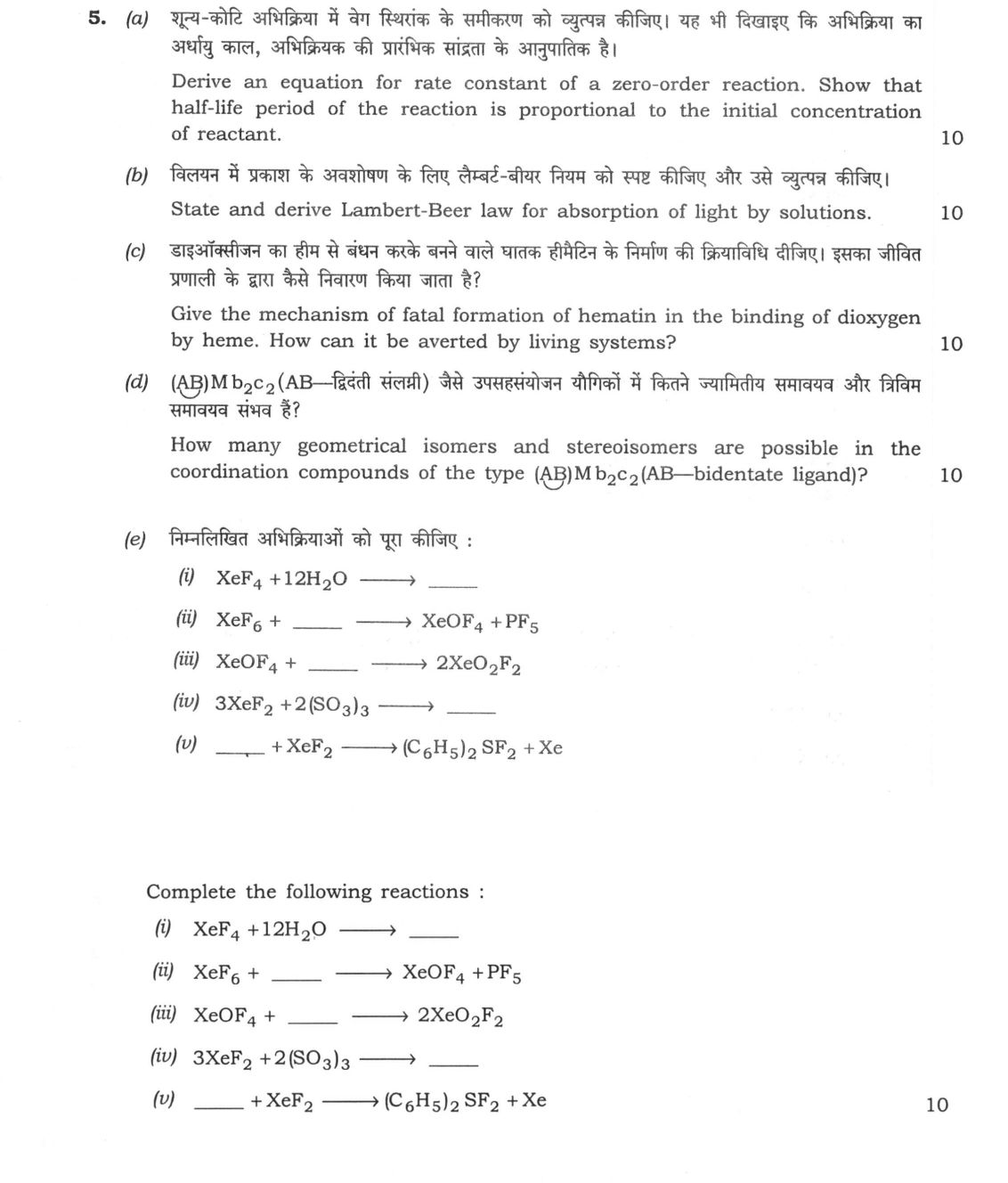
(a) Derive an equation for rate constant of a zero-order reaction. Show that half-life period of the reaction is proportional to…
Derive an equation for rate constant of a zero-order reaction. Show that half-life period of the reaction is proportional to the initial concentration of reactant. 10 marks
State and derive Lambert-Beer law for absorption of light by solutions. 10 marks
Give the mechanism of fatal formation of hematin in the binding of dioxygen by heme. How can it be averted by living systems? 10 marks
How many geometrical isomers and stereoisomers are possible in the coordination compounds of the type (AB)Mb₂c₂(AB—bidentate ligand)? 10 marks
Complete the following reactions: XeF₄ + 12H₂O —→ ____
XeF₆ + ____ —→ XeOF₄ + PF₅
XeOF₄ + ____ —→ 2XeO₂F₂
3XeF₂ + 2(SO₃)₃ —→ ____
____ + XeF₂ —→ (C₆H₅)₂ SF₂ + Xe 10 marks
हिंदी में प्रश्न पढ़ें
शून्य-कोटि अभिक्रिया में वेग स्थिरांक के समीकरण को व्युत्पन्न कीजिए। यह भी दिखाइए कि अभिक्रिया का अर्धायु काल, अभिक्रियक की प्रारंभिक सांद्रता के आनुपातिक है। (10 अंक)
विलयन में प्रकाश के अवशोषण के लिए लैम्बर्ट-बीयर नियम को स्पष्ट कीजिए और उसे व्युत्पन्न कीजिए। (10 अंक)
डाइऑक्सीजन का हीम से बंधन करके बनने वाले घातक हीमेटिन के निर्माण की क्रियाविधि दीजिए। इसका जीवित प्रणाली के द्वारा कैसे निवारण किया जाता है? (10 अंक)
(AB)Mb₂c₂(AB—द्विदंती संलग्नी) जैसे उपसहसंयोजन यौगिकों में कितने ज्यामितीय समावयव और विविध समावयव संभव हैं? (10 अंक)
निम्नलिखित अभिक्रियाओं को पूरा कीजिए : XeF₄ + 12H₂O —→ ____
XeF₆ + ____ —→ XeOF₄ + PF₅
XeOF₄ + ____ —→ 2XeO₂F₂
3XeF₂ + 2(SO₃)₃ —→ ____
____ + XeF₂ —→ (C₆H₅)₂ SF₂ + Xe (10 अंक)
Model answer
Written by UPSC Answer Check against this question's marking rubric, to the expected length. UPSC does not publish answers for Mains — this is one way to score well, not an official key.
(a) For a zero-order reaction A → products, the rate law is Rate = -d[A]/dt = k[A]⁰ = k. Separating variables, d[A] = -k dt. Integrate from [A]₀ at t = 0 to [A] at time t: ∫ from [A]₀ to [A] d[A] = -k ∫ from 0 to t dt. So, [A] - [A]₀ = -k t or [A] = [A]₀ - k t. Hence the rate constant is k = ([A]₀ - [A])/t. Its unit is mol dm⁻³ s⁻¹.
At half-life t₁/₂, [A] = [A]₀/2. Substituting, [A]₀/2 = [A]₀ - k t₁/₂. Therefore, k t₁/₂ = [A]₀/2 and t₁/₂ = [A]₀/(2k). Thus t₁/₂ ∝ [A]₀, i.e. half-life is directly proportional to initial concentration. This holds as long as the zero-order rate law remains valid and [A] does not reach zero.
(b) Lambert’s law states that the intensity of monochromatic light absorbed by a homogeneous medium is proportional to the path length. Beer’s law states that absorption is proportional to the concentration of the absorbing species. Combining them gives the Lambert-Beer law: A = log₁₀(I₀/I) = ε c l, where I₀ is incident intensity, I is transmitted intensity, c is concentration, l is path length, and ε is molar absorptivity.
Derivation: Consider a thin slab of thickness dx at depth x. Let I be the intensity at x. The fractional decrease in intensity is -dI/I = α c dx, where α is a proportionality constant. Integrate from x = 0 to x = l, with I = I₀ at x = 0 and I = I at x = l: -∫ from I₀ to I dI/I = α c ∫ from 0 to l dx. So, ln(I₀/I) = α c l. Converting to base 10, log₁₀(I₀/I) = (α/2.303) c l = ε c l. Thus, A = ε c l. Transmittance T = I/I₀ = 10⁻ᴬ. For a mixture, A_total = Σ εᵢ cᵢ l. Conditions: monochromatic radiation, dilute solution, no scattering or fluorescence, and non-interacting absorbing species. Units: c in mol dm⁻³, l in cm, ε in dm³ mol⁻¹ cm⁻¹.
(c) Deoxyheme contains Fe(II). Dioxygen binds to Fe(II) to give oxyheme, but the Fe–O₂ unit has resonance forms Fe(II)–O₂ ⇌ Fe(III)–O₂•⁻. In free heme or when two heme units approach, the bound dioxygen can bridge two iron centres: Fe(II)–O₂ + Fe(II) → Fe(III)–O₂²⁻–Fe(III) forming a μ-peroxo dimer. Protonation and cleavage of the O–O bond then produce Fe(III)–OH, i.e. hematin/methemoglobin, along with H₂O₂ or superoxide radicals. Fe(III) heme cannot bind O₂ reversibly, so oxygen transport is destroyed; hematin may also precipitate and damage membranes.
Living systems avert this in several ways. The globin pocket around heme is hydrophobic and sterically hinders heme–heme contact, preventing μ-peroxo dimer formation. Distal histidine (His E7) hydrogen-bonds to bound O₂, stabilising the Fe(II)–O₂ form and blocking protonation. If Fe(III) is formed, methemoglobin reductase (NADH-cytochrome b5 reductase) reduces it back to Fe(II). Superoxide dismutase, catalase and glutathione remove O₂•⁻ and H₂O₂. Thus reversible dioxygen binding is preserved.
(d) Assume an octahedral complex [M(AB)b₂c₂], where AB is an unsymmetrical bidentate ligand, and b and c are different monodentate ligands. Fix the oriented AB chelate on one edge, with A at one vertex and B at the adjacent vertex. The four remaining vertices are inequivalent under rotations that preserve this oriented edge. Arrange two b and two c among these four positions: Number = 4!/(2!2!) = 6. Thus there are 6 stereoisomers under proper rotations.
A mirror plane containing the AB edge and the metal fixes A, B, and the two vertices trans to A and B, while interchanging the other two remaining vertices. This leaves unchanged the two arrangements in which:
- b occupies the two trans-to-A/B vertices and c occupies the interchanged pair;
- b occupies the interchanged pair and c occupies the two trans-to-A/B vertices.
These are two achiral geometrical isomers. The other four arrangements form two enantiomeric pairs. Hence: Geometrical isomers = 4; stereoisomers = 6 (2 achiral + 2 enantiomeric pairs).
(e) (i) 6XeF₄ + 12H₂O → 2XeO₃ + 4Xe + 3O₂ + 24HF. (ii) XeF₆ + POF₃ → XeOF₄ + PF₅. (iii) XeOF₄ + XeO₃ → 2XeO₂F₂. (iv) 3XeF₂ + 2(SO₃)₃ → 3Xe(SO₃F)₂. (v) (C₆H₅)₂S + XeF₂ → (C₆H₅)₂SF₂ + Xe.
What "Derive" is asking you to do
Reach the stated expression from a starting relation, justifying every step. The destination is printed in the question, so only the route earns marks, and the assumptions you work under are part of that route.
Structure that answers it
Assumptions and notation defined → starting relation or governing equation → each step with its justification → the required expression → limiting case or boundary check
Where marks are lost
Writing the standard result first and fitting three lines to it, which an examiner reads at a glance. Marks also go on assumptions left unstated — lossless medium, small amplitude, errors independent with zero mean — and on symbols used before they are defined, even when the question says usual notations.
How this answer will be evaluated
Approach
(a) derive: given > assumptions > stepwise derivation > result > check | (b) derive: given > assumptions > stepwise derivation > result > check | (c) explain: definition/context > points in order > small example > short close | (d) calculate: given > formula > substitution > result with units > interpretation | (e) enumerate: list the items in order > one line each > no commentary Full marks: All derivations complete with correct algebra; mechanisms show electron flow; isomer counts are accurate with structures; all reactions balanced with correct products.
Key points expected
- Rate law: -d[A]/dt = k
- Integrated form: [A]₀ - [A] = kt
- Half-life derivation: t₁/₂ = [A]₀/2k
- Explicit statement of proportionality to [A]₀
- Statement of law: I = I₀e⁻ᵏˣ or A = εcl
- Derivation from Beer's law (intensity vs path length)
- Derivation from Lambert's law (intensity vs concentration)
- Definition of terms (I, I₀, ε, c, l)
Evaluation rubric
Each sub-part is marked on its own, against the marks and word limit printed on the paper.
- (a) Derive rate constant equation and show half-life is proportional to initial concentration. 10 marks
derive— given → assumptions → stepwise derivation → result → check
Must cover
- Rate law: -d[A]/dt = k
- Integrated form: [A]₀ - [A] = kt
- Half-life derivation: t₁/₂ = [A]₀/2k
- Explicit statement of proportionality to [A]₀
Loses marks
- Using first-order integrated rate law
- Failing to show the algebraic step for t₁/₂
Earns more
- Graph of [A] vs t showing linear decrease
- Units of k for zero-order reaction (mol L⁻¹ s⁻¹)
Extra mark
- Comparison with first-order half-life (constant)
- (b) State and derive the Lambert-Beer law for light absorption by solutions. 10 marks
derive— given → assumptions → stepwise derivation → result → check
Must cover
- Statement of law: I = I₀e⁻ᵏˣ or A = εcl
- Derivation from Beer's law (intensity vs path length)
- Derivation from Lambert's law (intensity vs concentration)
- Definition of terms (I, I₀, ε, c, l)
Loses marks
- Stating law without derivation
- Confusing absorbance (A) with transmittance (T)
Earns more
- Mention of limitations (high concentration, scattering)
- Connection to molar absorptivity
Extra mark
- Mention of Beer's original 1729 work
- (c) Explain the mechanism of hematin formation from heme-dioxygen binding and biological prevention. 10 marks
explain— definition/context → points in order → small example → short close
Must cover
- Mechanism of heme oxidation to hematin (Fe²⁺ to Fe³⁺)
- Role of superoxide or reactive oxygen species (ROS)
- Biological averters: superoxide dismutase (SOD), catalase
- Role of antioxidant systems (glutathione)
Loses marks
- Confusing hematin with methemoglobin
- Failing to mention specific enzymes for prevention
Earns more
- Mention of methemoglobin reductase
- Structural change in heme pocket
Extra mark
- Specific enzyme names with EC numbers
- (d) Determine the number of geometrical and stereoisomers for (AB)Mb₂c₂ coordination compounds. 10 marks
calculate— given → formula → substitution → result with units → interpretation
Must cover
- Identification of octahedral geometry
- Count of geometrical isomers (cis/trans or fac/mer)
- Count of stereoisomers (optical isomers)
- Total number of isomers
Loses marks
- Incorrect count of isomers
- Failing to distinguish geometrical from optical isomers
Earns more
- Drawing of specific isomer structures
- Explanation of symmetry elements
Extra mark
- Mention of specific examples (e.g., [Co(en)₂Cl₂]⁺)
- (e) Complete the five given reactions involving Xenon compounds. 10 marks
enumerate— list the items in order → one line each → no commentary
Must cover
- Correct products for all 5 reactions
- Balanced chemical equations
- Correct stoichiometry
- Identification of missing reactants
Loses marks
- Unbalanced equations
- Incorrect products for XeF₄ hydrolysis
Earns more
- Mention of reaction conditions (if applicable)
- Correct oxidation states of Xe
Extra mark
- Mention of reaction type (hydrolysis, redox, etc.)
Practice this exact question
Write your answer and it is marked point by point against the model answer above — what you covered, what you missed, what you got wrong.
Evaluate my answer →More from Chemistry 2021 Paper I
- Q2 (a) Hydrogen atoms are observed to have radiative transitions from n = 101 to n = 100 to…
- Q3 (a) A drop of water, 0·4 cm in radius, is split up into 125 tiny drops. Find the increase…
- Q4 (a) Calculate the e.m.f. of the following electrochemical cell at 25 °C : Pt/H₂₍₁ ₐₜₘ₎|H⁺…
- Q5 (a) Derive an equation for rate constant of a zero-order reaction. Show that half-life pe…
- Q6 (a) How does the bonding in cyclic phosphazene differ from that of benzene and borazine?…
- Q7 (a) Draw the structures of various iron-sulphur proteins and their corresponding redox st…
- Q8 (a) Justify that the interhalogen compound BrF₃ acts as an aprotic solvent and undergoes…