Paper I — Q2
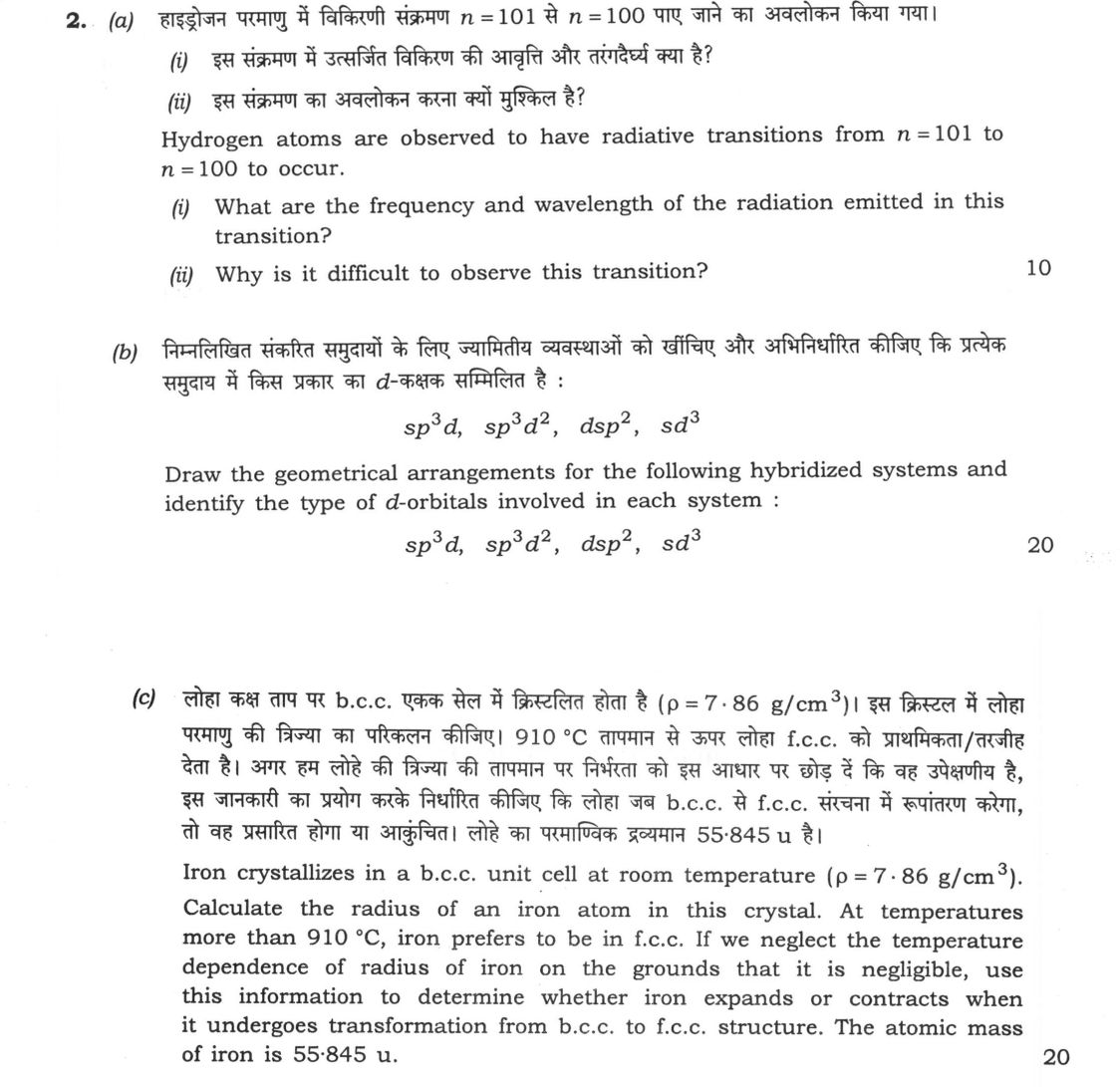
(a) Hydrogen atoms are observed to have radiative transitions from n = 101 to n = 100 to occur. (i) What are the frequency and…
Hydrogen atoms are observed to have radiative transitions from n = 101 to n = 100 to occur.
What are the frequency and wavelength of the radiation emitted in this transition?
Why is it difficult to observe this transition? 10 marks
Draw the geometrical arrangements for the following hybridized systems and identify the type of d-orbitals involved in each system :
sp³d, sp³d², dsp², sd³ 20 marks
Iron crystallizes in a b.c.c. unit cell at room temperature (ρ = 7·86 g/cm³). Calculate the radius of an iron atom in this crystal. At temperatures more than 910 °C, iron prefers to be in f.c.c. If we neglect the temperature dependence of radius of iron on the grounds that it is negligible, use this information to determine whether iron expands or contracts when it undergoes transformation from b.c.c. to f.c.c. structure. The atomic mass of iron is 55·845 u. 20 marks
हिंदी में प्रश्न पढ़ें
हाइड्रोजन परमाणु में विकिरणी संक्रमण n = 101 से n = 100 पाए जाने का अवलोकन किया गया।
इस संक्रमण में उत्सर्जित विकिरण की आवृत्ति और तरंगदैर्घ्य क्या है?
इस संक्रमण का अवलोकन करना क्यों मुश्किल है? (10 अंक)
निम्नलिखित संकरित समुदायों के लिए ज्यामितीय व्यवस्थाओं को खींचिए और अभिनिर्धारित कीजिए कि प्रत्येक समुदाय में किस प्रकार का d-क्षक सम्मिलित है :
sp³d, sp³d², dsp², sd³ (20 अंक)
लोहा कक्ष ताप पर b.c.c. एकक सेल में क्रिस्टलित होता है (ρ = 7·86 g/cm³)| इस क्रिस्टल में लोहा परमाणु की त्रिज्या का परिकलन कीजिए। 910 °C तापमान से ऊपर लोहा f.c.c. को प्राथमिकता/तर्जीह देता है। अगर हम लोहे की त्रिज्या की तापमान पर निर्भरता को इस आधार पर छोड़ दें कि वह उपेक्षणीय है, इस जानकारी का प्रयोग करके निर्धारित कीजिए कि लोहा जब b.c.c. से f.c.c. संरचना में रूपांतरण करेगा, तो वह प्रसारित होगा या आकुंचित। लोहे का परमाणविक द्रव्यमान 55·845 u है। (20 अंक)
Model answer
Written by UPSC Answer Check against this question's marking rubric, to the expected length. UPSC does not publish answers for Mains — this is one way to score well, not an official key.
(a)(i) Using the Rydberg formula for hydrogen, 1/λ = R_H(1/n_f² − 1/n_i²) = R_H(1/100² − 1/101²). Now, 1/100² − 1/101² = (101² − 100²)/(100²·101²) = 201/(10000×10201) = 201/102010000 = 1.970395×10⁻⁶. With R_H = 1.09677583×10⁷ m⁻¹, 1/λ = (1.09677583×10⁷)(1.970395×10⁻⁶) = 21.6108 m⁻¹. Therefore, λ = 1/(21.6108 m⁻¹) = 4.6273×10⁻² m = 4.6273 cm. Frequency ν = c/λ = (2.99792458×10⁸ m/s)(21.6108 m⁻¹) = 6.4788×10⁹ Hz.
(a)(ii) This transition is difficult to observe because the energy gap is extremely small: ΔE = hν ≈ 4.29×10⁻²⁴ J ≈ 2.68×10⁻⁵ eV. It lies in the microwave/radio-frequency region. At high n, neighbouring levels are very close, so collisional, Stark, and Doppler effects easily mix or broaden the levels. The spontaneous transition probability is also very low, and exciting hydrogen atoms to n = 101 is experimentally difficult.
(b)
- sp³d: Geometry is trigonal bipyramidal. Two axial bonds lie along ±z; three equatorial bonds lie in the xy-plane at 120° to one another. Axial-equatorial angle = 90°, equatorial-equatorial angle = 120°, axial-axial angle = 180°. The d-orbital involved is d(z²).
- sp³d²: Geometry is octahedral. Six bonds point along ±x, ±y, ±z; adjacent bonds are at 90° and opposite bonds at 180°. The d-orbitals involved are d(x²−y²) and d(z²).
- dsp²: Geometry is square planar. Four bonds lie in one plane, say xy, along ±x and ±y; adjacent bonds are at 90°, opposite bonds at 180°. The d-orbital involved is d(x²−y²).
- sd³: Geometry is tetrahedral. The four bonds point toward alternate corners of a cube, e.g. along (1,1,1), (1,−1,−1), (−1,1,−1), (−1,−1,1); bond angle = 109°28′. The d-orbitals involved are d(xy), d(yz), and d(zx).
(c) For b.c.c., Z = 2. Using ρ = ZM/(N_A a³), a³ = (2×55.845 g/mol)/(6.022×10²³ mol⁻¹×7.86 g/cm³) = 111.690/(4.733292×10²⁴) cm³ = 2.35967×10⁻²³ cm³. Thus, a = (2.35967×10⁻²³)^(1/3) cm = 2.86825×10⁻⁸ cm = 2.86825 Å. In b.c.c., atoms touch along the body diagonal: 4r = √3 a, so r = √3 a/4 = 1.73205×2.86825/4 Å = 1.2420 Å.
For f.c.c. with the same radius, atoms touch along the face diagonal: 4r = √2 a_f, so a_f = 4r/√2 = 2√2 r = 2.82843×1.2420 Å = 3.5129 Å.
Volume per atom: b.c.c.: V_bcc = a³/2 = 23.5967/2 = 11.7983 ų. f.c.c.: V_fcc = a_f³/4 = 43.350/4 = 10.8375 ų.
Thus, V_fcc/V_bcc = 10.8375/11.7983 = 0.91856. So the f.c.c. structure has a smaller volume per atom by about 8.14%. Therefore, when iron transforms from b.c.c. to f.c.c., it contracts.
What "Calculate" is asking you to do
Apply the standard formula or schedule to data the question has already supplied — a table of readings, cost records, a balance sheet — and produce the number. The method is rarely in doubt; the marks sit in the named intermediate quantities, each of which has to appear as a labelled line.
Structure that answers it
Data as given → formula or standard treatment, named → substitution → each intermediate, labelled → result with units
Where marks are lost
Omitting an intermediate the marking scheme pays for separately, or rounding at an intermediate line so the final figure drifts. In commerce and accountancy, any figure in a statement that no numbered working note supports is treated as unearned.
How this answer will be evaluated
Approach
(a(i)) calculate: given > formula > substitution > result with units > interpretation | (a(ii)) explain: definition/context > points in order > small example > short close | (b) describe: define > structure or process in order > labelled diagram > significance | (c) calculate: given > formula > substitution > result with units > interpretation Full marks: Precise numerical values with units; clear diagrams; logical deduction for expansion.
Key points expected
- Use Rydberg formula for frequency/wavelength
- Substitute n1=100 and n2=101
- Calculate frequency in Hz
- Calculate wavelength in meters
- Link high n to small energy difference
- Link small energy to low frequency
- Mention thermal noise or detection limits
- Identify sp3d as Trigonal Bipyramidal
Evaluation rubric
Each sub-part is marked on its own, against the marks and word limit printed on the paper.
- (a(i)) Numerical values for frequency and wavelength of the n=101 to n=100 transition.
calculate— given → formula → substitution → result with units → interpretation
Must cover
- Use Rydberg formula for frequency/wavelength
- Substitute n1=100 and n2=101
- Calculate frequency in Hz
- Calculate wavelength in meters
Loses marks
- Using n=1 instead of n=100
- Confusing frequency and wavelength units
Earns more
- Identify spectral region (Radio/Microwave)
- Show unit conversions
Extra mark
- Mention specific frequency value (~6.6 GHz)
- (a(ii)) Reasoning for the experimental difficulty in observing this specific transition.
explain— definition/context → points in order → small example → short close
Must cover
- Link high n to small energy difference
- Link small energy to low frequency
- Mention thermal noise or detection limits
Loses marks
- Vague answer like 'it is hard to see'
- Ignoring the energy gap aspect
Earns more
- Reference to radio astronomy techniques
- Mention line width or resolution
Extra mark
- Reference to specific experimental setups
- (b) Geometrical shapes and specific d-orbital types for four hybridization schemes. 20 marks
describe— define → structure or process in order → labelled diagram → significance
Must cover
- Identify sp3d as Trigonal Bipyramidal
- Identify sp3d2 as Octahedral
- Identify dsp2 as Square Planar
- Identify sd3 as Tetrahedral
Loses marks
- Confusing sp3d and sp3d2 shapes
- Failing to identify the specific d-orbital
Earns more
- Draw clear 3D diagrams for each
- Specify dxy/dz2 vs dx2-y2/dxz2/dyz2 usage
Extra mark
- Mention VSEPR theory context
- (c) Radius of Fe atom in bcc and determination of expansion/contraction in fcc. 20 marks
calculate— given → formula → substitution → result with units → interpretation
Must cover
- Calculate bcc radius using density formula
- Use Z=2 for bcc and Z=4 for fcc
- Compare unit cell volumes or densities
- Conclude expansion or contraction
Loses marks
- Using Z=1 for bcc
- Ignoring the constant radius assumption
Earns more
- Show step-by-step algebra for radius
- Use atomic mass 55.845 u correctly
Extra mark
- Calculate percentage change in volume
Practice this exact question
Write your answer and it is marked point by point against the model answer above — what you covered, what you missed, what you got wrong.
Evaluate my answer →More from Chemistry 2021 Paper I
- Q1 (a) Calculate ⟨x⟩, the expectation value of position of a particle, in the ground state o…
- Q2 (a) Hydrogen atoms are observed to have radiative transitions from n = 101 to n = 100 to…
- Q3 (a) A drop of water, 0·4 cm in radius, is split up into 125 tiny drops. Find the increase…
- Q4 (a) Calculate the e.m.f. of the following electrochemical cell at 25 °C : Pt/H₂₍₁ ₐₜₘ₎|H⁺…
- Q5 (a) Derive an equation for rate constant of a zero-order reaction. Show that half-life pe…