Paper I — Q6
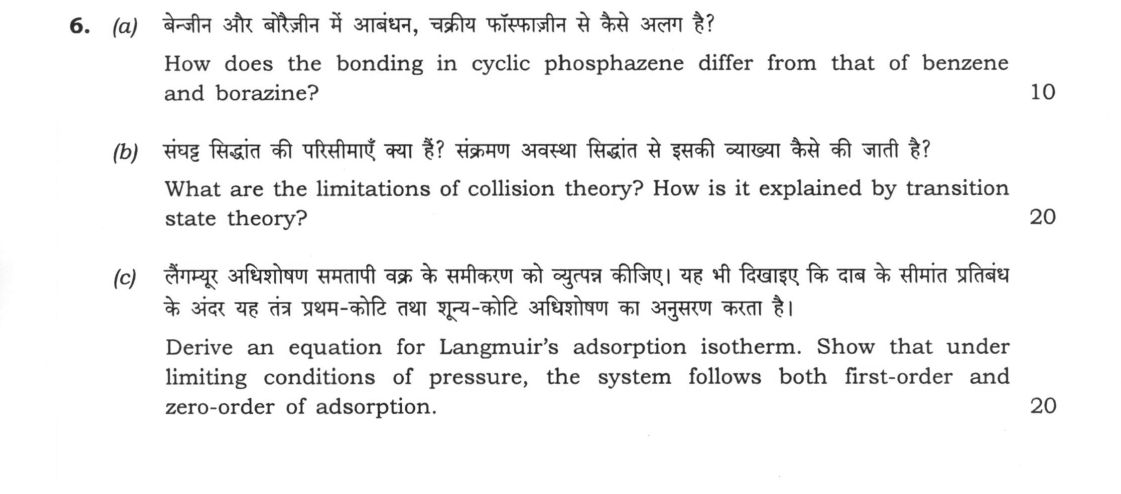
(a) How does the bonding in cyclic phosphazene differ from that of benzene and borazine? (10 marks) (b) What are the limitations…
How does the bonding in cyclic phosphazene differ from that of benzene and borazine? 10 marks
What are the limitations of collision theory? How is it explained by transition state theory? 20 marks
Derive an equation for Langmuir's adsorption isotherm. Show that under limiting conditions of pressure, the system follows both first-order and zero-order of adsorption. 20 marks
हिंदी में प्रश्न पढ़ें
बेंजीन और बोराजीन में आबंधन, चक्रीय फॉस्फाजीन से कैसे अलग है? (10 अंक)
संघट्ट सिद्धांत की परिसीमाएं क्या हैं? संक्रमण अवस्था सिद्धांत से इसकी व्याख्या कैसे की जाती है? (20 अंक)
लैंगम्यूर अधिशोषण समतापी वक्र के समीकरण को व्युत्पन्न कीजिए। यह भी दिखाइए कि दाब के सीमांत प्रतिबंध के अंदर यह तंत्र प्रथम-कोटि तथा शून्य-कोटि अधिशोषण का अनुसरण करता है। (20 अंक)
Model answer
Written by UPSC Answer Check against this question's marking rubric, to the expected length. UPSC does not publish answers for Mains — this is one way to score well, not an official key.
(a) In benzene, each C is sp² hybridised; the unhybridised 2p orbitals overlap sideways to give a delocalised π cloud. Its six π electrons satisfy Hückel's 4n+2 rule with n = 1, so benzene is a classical aromatic with equal C–C bond lengths and high resonance stabilisation. Borazine, B₃N₃H₆, is isoelectronic with benzene: B and N are approximately sp², and the ring has six π electrons. However, B–N bonds are polar, so π electron density is uneven, largely on N; borazine is aromatic but weaker and not a true benzene analogue. Cyclic phosphazenes, e.g. N₃P₃Cl₆, have a P–N σ ring. Each N has a lone pair, which can donate into phosphorus orbitals. In the older view this is dπ–pπ bonding using P 3d orbitals; in the modern view it is negative hyperconjugation into P–N σ* or P-substituent orbitals. Thus the π delocalisation is not a simple carbon-like pπ–pπ system, even though six π electrons may be counted. It is substituent-dependent, electron density remains high on N, and the ring is best called inorganic aromatic rather than benzene-like or borazine-like.
(b) Collision theory treats reacting molecules as hard spheres. It assumes reaction occurs when two molecules collide with energy greater than or equal to activation energy Ea. Its basic rate constant is k = Z e^(−Ea/RT), so Rate = Z e^(−Ea/RT)[A][B], where Z is the collision frequency. Its limitations are:
- It ignores molecular geometry, orientation and the steric factor P. Observed rate = P Z e^(−Ea/RT), but P is not predicted.
- It considers only translational collision energy and ignores internal vibrational, rotational and electronic energy.
- It assumes every collision with E ≥ Ea reacts, whereas reaction must pass through a saddle point on a potential energy surface.
- It cannot explain unimolecular reactions, solvent effects, quantum tunnelling, or pressure-dependent reactions without extra assumptions.
- It gives no structural information about entropy of activation or mechanism.
Transition state theory (TST) explains these failures. It postulates a quasi-equilibrium between reactants and an activated complex at the highest point of the reaction coordinate: A + B ⇌ AB‡. The equilibrium constant is K‡ = [AB‡]/([A][B]). The activated complex decomposes to products with universal frequency ν = k_B T/h, where k_B is Boltzmann constant and h is Planck constant. Therefore, Rate = ν[AB‡] = (k_B T/h)K‡[A][B]. For Rate = k[A][B], this gives k = (k_B T/h)K‡. Using ΔG‡ = −RT ln K‡, so K‡ = e^(−ΔG‡/RT) (for a bimolecular reaction, a standard-state concentration factor is absorbed into K‡; the exponential form is unchanged), the Eyring equation is k = (k_B T/h)e^(−ΔG‡/RT) = (k_B T/h)e^(ΔS‡/R)e^(−ΔH‡/RT). Thus TST explains collision-theory limitations: the energy barrier is replaced by ΔG‡ or ΔH‡; orientation, structure and steric restrictions appear in ΔS‡ and partition functions; the steric factor P is approximately e^(ΔS‡/R); internal states and the potential energy surface are included.
(c) Langmuir's adsorption isotherm is derived under these assumptions: adsorption is monolayer; surface sites are identical; adsorbed molecules do not interact laterally; adsorption and desorption are dynamic; equilibrium exists.
Let θ be the fraction of surface sites covered, so vacant fraction = 1 − θ. The rate of adsorption is proportional to pressure P and vacant sites: R(ads) = k₁P(1 − θ). The rate of desorption is proportional to covered sites: R(des) = k₂θ. At equilibrium, R(ads) = R(des): k₁P(1 − θ) = k₂θ. Expanding: k₁P − k₁Pθ = k₂θ. Collecting θ terms: k₁P = θ(k₂ + k₁P). Hence θ = k₁P/(k₂ + k₁P). Divide numerator and denominator by k₂: θ = (k₁/k₂)P / [1 + (k₁/k₂)P]. Let b = k₁/k₂, with units Pa⁻¹. Then θ = bP/(1 + bP). If x/m is mass adsorbed per unit mass of adsorbent and is proportional to θ, then x/m = a bP/(1 + bP). Here θ is dimensionless, P is in Pa, b is in Pa⁻¹, k₁ in Pa⁻¹ s⁻¹ and k₂ in s⁻¹.
Limiting cases:
- Low pressure, bP ≪ 1: θ = bP/(1 + bP) ≈ bP. Also R(ads) ≈ k₁P. Therefore adsorption is first-order in pressure.
- High pressure, bP ≫ 1: θ = bP/(1 + bP) ≈ 1. Here 1 − θ ≈ 1/(bP), so R(ads) = k₁P(1 − θ) ≈ k₂, independent of P. Therefore adsorption is zero-order in pressure.
Thus Langmuir adsorption follows first-order kinetics at low pressure and zero-order kinetics at high pressure.
What "Derive" is asking you to do
Reach the stated expression from a starting relation, justifying every step. The destination is printed in the question, so only the route earns marks, and the assumptions you work under are part of that route.
Structure that answers it
Assumptions and notation defined → starting relation or governing equation → each step with its justification → the required expression → limiting case or boundary check
Where marks are lost
Writing the standard result first and fitting three lines to it, which an examiner reads at a glance. Marks also go on assumptions left unstated — lossless medium, small amplitude, errors independent with zero mean — and on symbols used before they are defined, even when the question says usual notations.
How this answer will be evaluated
Approach
Framework: Concept > Structure or mechanism > Reasoning > Result. (a) compare: paired headings or table > key differences > significance > conclusion | (b) explain: definition/context > points in order > small example > short close | (c) derive: given > assumptions > stepwise derivation > result > check Full marks: Complete derivations, clear diagrams, precise terminology, all limits shown.
Key points expected
- Identify P-N alternating ring structure in phosphazene
- Describe pπ-dπ back-bonding in phosphazene
- Contrast with pπ-pπ delocalization in benzene
- Contrast with pπ-pπ delocalization in borazine
- State limitation: assumes all collisions are effective
- State limitation: ignores molecular orientation
- Define transition state (activated complex)
- Explain energy profile with activation energy
Evaluation rubric
Each sub-part is marked on its own, against the marks and word limit printed on the paper.
- (a) Contrast bonding in cyclic phosphazene with benzene and borazine. 10 marks
compare— paired headings or table → key differences → significance → conclusion
Must cover
- Identify P-N alternating ring structure in phosphazene
- Describe pπ-dπ back-bonding in phosphazene
- Contrast with pπ-pπ delocalization in benzene
- Contrast with pπ-pπ delocalization in borazine
Loses marks
- Treating phosphazene bonding as purely ionic
- Confusing borazine with benzene bonding
- Failing to distinguish d-orbital participation
Earns more
- Mention bond length equalization in phosphazene
- Reference aromaticity of all three species
- Draw structural diagrams of the three rings
Extra mark
- Mention specific bond lengths (e.g., P-N ~1.58 Å)
- (b) List limitations of collision theory and explain via transition state theory. 20 marks
explain— definition/context → points in order → small example → short close
Must cover
- State limitation: assumes all collisions are effective
- State limitation: ignores molecular orientation
- Define transition state (activated complex)
- Explain energy profile with activation energy
Loses marks
- Failing to define transition state
- Confusing activation energy with bond energy
- Omitting the energy diagram
Earns more
- Mention steric factor (P) in collision theory
- Draw energy profile diagram for TST
- Reference Arrhenius equation modification
Extra mark
- Mention Eyring equation
- (c) Derive Langmuir isotherm and show limiting orders of adsorption. 20 marks
derive— given → assumptions → stepwise derivation → result → check
Must cover
- State assumptions: monolayer, identical sites, no interaction
- Set up rate equation: adsorption = desorption
- Derive θ = KP / (1 + KP)
- Show θ ≈ KP (first order) at low P
Loses marks
- Skipping the equilibrium derivation step
- Failing to show the low-pressure limit
- Failing to show the high-pressure limit
Earns more
- Show θ ≈ 1 (zero order) at high P
- Define θ as fractional coverage
- Define K as adsorption equilibrium constant
Extra mark
- Mention applicability to heterogeneous catalysis
Practice this exact question
Write your answer and it is marked point by point against the model answer above — what you covered, what you missed, what you got wrong.
Evaluate my answer →More from Chemistry 2021 Paper I
- Q3 (a) A drop of water, 0·4 cm in radius, is split up into 125 tiny drops. Find the increase…
- Q4 (a) Calculate the e.m.f. of the following electrochemical cell at 25 °C : Pt/H₂₍₁ ₐₜₘ₎|H⁺…
- Q5 (a) Derive an equation for rate constant of a zero-order reaction. Show that half-life pe…
- Q6 (a) How does the bonding in cyclic phosphazene differ from that of benzene and borazine?…
- Q7 (a) Draw the structures of various iron-sulphur proteins and their corresponding redox st…
- Q8 (a) Justify that the interhalogen compound BrF₃ acts as an aprotic solvent and undergoes…