Paper I — Q4
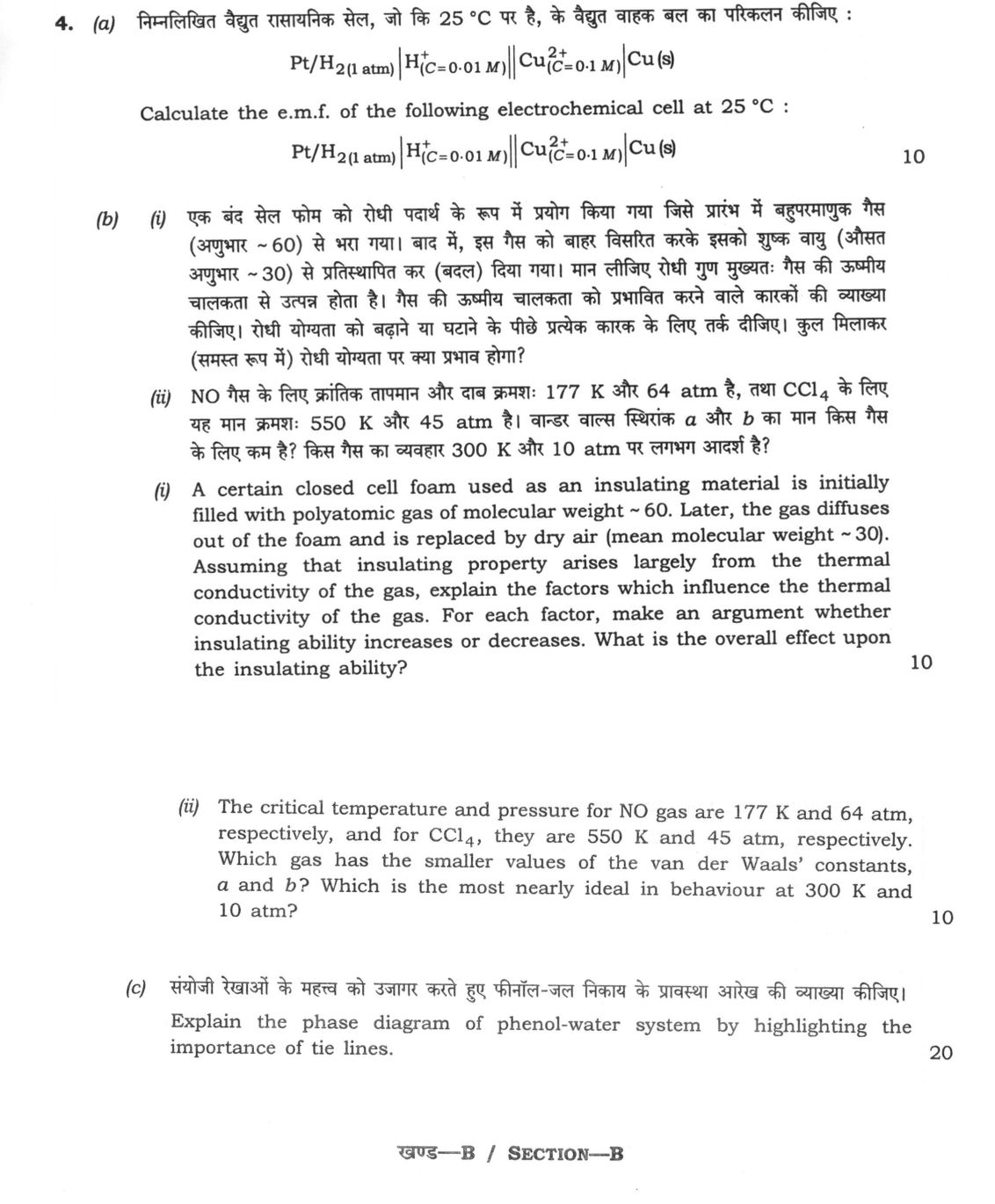
(a) Calculate the e.m.f. of the following electrochemical cell at 25 °C : Pt/H₂₍₁ ₐₜₘ₎|H⁺₍C=0.01 M₎‖Cu²⁺₍C=0.1 M₎|Cu(s) (10…
Calculate the e.m.f. of the following electrochemical cell at 25 °C : Pt/H₂₍₁ ₐₜₘ₎|H⁺₍C=0.01 M₎‖Cu²⁺₍C=0.1 M₎|Cu(s) 10 marks
A certain closed cell foam used as an insulating material is initially filled with polyatomic gas of molecular weight ~ 60. Later, the gas diffuses out of the foam and is replaced by dry air (mean molecular weight ~ 30). Assuming that insulating property arises largely from the thermal conductivity of the gas, explain the factors which influence the thermal conductivity of the gas. For each factor, make an argument whether insulating ability increases or decreases. What is the overall effect upon the insulating ability? 10 marks
The critical temperature and pressure for NO gas are 177 K and 64 atm, respectively, and for CCl₄, they are 550 K and 45 atm, respectively. Which gas has the smaller values of the van der Waals' constants, a and b? Which is the most nearly ideal in behaviour at 300 K and 10 atm? 10 marks
Explain the phase diagram of phenol-water system by highlighting the importance of tie lines. 20 marks
हिंदी में प्रश्न पढ़ें
निम्नलिखित वैद्युत रासायनिक सेल, जो कि 25 °C पर है, के वैद्युत वाहक बल का परिकलन कीजिए : Pt/H₂₍₁ ₐₜₘ₎|H⁺₍C=0.01 M₎‖Cu²⁺₍C=0.1 M₎|Cu(s) (10 अंक)
एक बंद सेल फोम को रोधी पदार्थ के रूप में प्रयोग किया गया जिसे प्रारंभ में बहुपरमाणुक गैस (अणुभार ~ 60) से भरा गया। बाद में, इस गैस को बाहर विसरित करके इसको शुष्क वायु (औसत अणुभार ~ 30) से प्रतिस्थापित कर (बदल) दिया गया। मान लीजिए रोधी गुण मुख्यतः गैस की ऊष्मीय चालकता से उत्पन्न होता है। गैस की ऊष्मीय चालकता को प्रभावित करने वाले कारकों की व्याख्या कीजिए। रोधी योग्यता को बढ़ाने या घटाने के पीछे प्रत्येक कारक के लिए तर्क दीजिए। कुल मिलाकर (समष्ट रूप में) रोधी योग्यता पर क्या प्रभाव होगा? (10 अंक)
NO गैस के लिए क्रांतिक तापमान और दाब क्रमशः: 177 K और 64 atm है, तथा CCl₄ के लिए यह मान क्रमशः: 550 K और 45 atm है। वाण्डर वाल्स स्थिरांक a और b का मान किस गैस के लिए कम है? किस गैस का व्यवहार 300 K और 10 atm पर लगभग आदर्श है? (10 अंक)
संयोजी रेखाओं के महत्व को उजागर करते हुए फीनॉल-जल निकाय के प्रावस्था आरेख की व्याख्या कीजिए। (20 अंक)
Model answer
Written by UPSC Answer Check against this question's marking rubric, to the expected length. UPSC does not publish answers for Mains — this is one way to score well, not an official key.
The three parts all turn on departure from ideal behaviour, but each requires a different physical mechanism.
Electrochemical cell. The anode reaction is H₂ → 2H⁺ + 2e⁻ and the cathode reaction is Cu²⁺ + 2e⁻ → Cu, so the cell reaction is H₂ + Cu²⁺ → 2H⁺ + Cu with n = 2. E°cell = E°Cu²⁺/Cu − E°H⁺/H₂ = 0.34 − 0 = 0.34 V. At 25 °C, E = E° − (0.0591/2) log Q, where Q = [H⁺]² / ([Cu²⁺] P_H₂) = (0.01)² / (0.1 × 1) = 10⁻³. Hence E = 0.34 − (0.0591/2)(−3) = 0.34 + 0.0887 = 0.4287 V. The non-standard concentrations make the cell more spontaneous than the standard cell.
Gas thermal conductivity. For a dilute gas at fixed T and P, kinetic theory gives κ ∝ C_v,m v_mean λ, where C_v,m is molar heat capacity, v_mean ∝ 1/√M, and λ is mean free path. If collision diameters are similar, λ is mainly pressure-dependent, so the molecular-weight part is κ ∝ C_v,m/√M; if C_v,m is comparable, this reduces to κ ∝ 1/√M. First, replacing a gas of M ≈ 60 by dry air of M ≈ 30 increases v_mean by √2, raising κ and reducing insulation. Second, the original polyatomic gas has more rotational and vibrational degrees of freedom, hence a larger C_v,m than diatomic air; this factor alone would raise κ, but air’s lower C_v,m is a partial offset. Third, the heavier polyatomic gas usually has a larger collision cross-section, so its λ is shorter and κ is lower; air’s smaller molecules give a longer λ and higher κ. Overall, the lower molecular weight and longer mean free path of air dominate, so the foam becomes more thermally conductive and its insulating ability decreases.
Van der Waals comparison. For a real gas, a = 27R²Tc²/(64Pc) and b = RTc/(8Pc). NO has Tc = 177 K and Pc = 64 atm; CCl₄ has Tc = 550 K and Pc = 45 atm. Since a ∝ Tc²/Pc and b ∝ Tc/Pc, NO has the smaller values of both a and b. At 300 K and 10 atm, NO has Tr = 300/177 ≈ 1.70 and Pr = 10/64 ≈ 0.16, whereas CCl₄ has Tr ≈ 0.55 and Pr ≈ 0.22. NO is well above its critical temperature and at low reduced pressure, so attractions and molecular volume matter less. Therefore NO is the most nearly ideal gas at 300 K and 10 atm.
Phenol-water phase diagram. Phenol and water are partially miscible below an upper consolute temperature, about 66 °C at about 34 wt% phenol. In a temperature-composition diagram, the two-liquid region is a lens bounded by two solubility curves: the left curve gives the phenol-poor aqueous phase and the right curve the phenol-rich phase. Above 66 °C the curves meet and the mixture is one homogeneous liquid. Below it, a composition inside the lens separates into two conjugate liquids. Tie lines are horizontal lines at constant temperature joining the equilibrium compositions of these two phases. They are important because they determine the actual phase compositions for any overall composition in the two-phase region, and the lever rule uses their segment lengths to calculate the relative amounts of the aqueous and phenol-rich phases. This is essential for designing phenol extraction, recovery and waste-water treatment, where one must know how much phenol remains in each phase and how many contacts are required.
Thus the cell shows concentration-driven non-ideality, the gases show van der Waals corrections, and the liquid mixture shows partial miscibility. Recognising these mechanisms is directly useful in Indian chemical engineering and materials applications, from hot-climate building insulation to phenol recovery in petrochemical and coal-tar units.
What "Explain" is asking you to do
Make the working of something clear — what sets it off, what follows from what, and what it produces. Explain is the Commission's mechanism word: it dominates the technical papers and the “explain why” stems, where the marks sit in the causal chain and not in the label.
Structure that answers it
State what it is → the initiating condition → the chain of cause, step by step → an instance where it plays out → what the chain produces
Where marks are lost
Describing what something looks like instead of why it works that way. Naming the stages without linking them reads as description too.
How this answer will be evaluated
Approach
(a) calculate: given > formula > substitution > result with units > interpretation | (b(i)) explain: definition/context > points in order > small example > short close | (b(ii)) compare: paired headings or table > key differences > significance > conclusion | (c) explain: definition/context > points in order > small example > short close Full marks: Accurate calculations, clear reasoning, and comprehensive explanations with correct terminology.
Key points expected
- Identify anode (H2) and cathode (Cu2+) half-cells
- State standard reduction potentials (E°) for both electrodes
- Apply Nernst equation with given concentrations (0.01 M, 0.1 M)
- Calculate final e.m.f. value with correct sign
- Identify molecular weight as a key factor in thermal conductivity
- Explain relationship between molecular weight and gas velocity
- Compare thermal conductivity of polyatomic gas vs dry air
- Conclude on the change in insulating ability
Evaluation rubric
Each sub-part is marked on its own, against the marks and word limit printed on the paper.
- (a) Numerical value of e.m.f. for the specified cell at 25°C. 10 marks
calculate— given → formula → substitution → result with units → interpretation
Must cover
- Identify anode (H2) and cathode (Cu2+) half-cells
- State standard reduction potentials (E°) for both electrodes
- Apply Nernst equation with given concentrations (0.01 M, 0.1 M)
- Calculate final e.m.f. value with correct sign
Loses marks
- Using wrong standard potentials
- Incorrect application of Nernst equation (e.g., wrong n value)
- Omitting concentration terms
Earns more
- Explicit calculation of standard cell potential (E°cell)
- Correct substitution of log term in Nernst equation
Extra mark
- Mention of standard hydrogen electrode (SHE) as reference
- (b(i)) Analysis of how gas replacement affects thermal conductivity and insulation. 10 marks
explain— definition/context → points in order → small example → short close
Must cover
- Identify molecular weight as a key factor in thermal conductivity
- Explain relationship between molecular weight and gas velocity
- Compare thermal conductivity of polyatomic gas vs dry air
- Conclude on the change in insulating ability
Loses marks
- Confusing thermal conductivity with thermal diffusivity
- Failing to link molecular weight to insulation
Earns more
- Mention of specific heat capacity (Cp) differences
- Reference to kinetic theory of gases
Extra mark
- Quantitative comparison of thermal conductivities
- (b(ii)) Comparison of van der Waals constants and ideality for NO and CCl4. 10 marks
compare— paired headings or table → key differences → significance → conclusion
Must cover
- Relate critical temperature/pressure to van der Waals constants a and b
- Identify which gas has smaller a and b values
- Determine which gas is more ideal at 300 K and 10 atm
- Justify ideality based on distance from critical point
Loses marks
- Incorrect relationship between critical constants and a, b
- Failing to justify the ideality choice
Earns more
- Explicit calculation or estimation of a and b from critical data
- Mention of reduced temperature and pressure
Extra mark
- Reference to compressibility factor (Z)
- (c) Detailed explanation of phenol-water phase diagram and tie lines. 20 marks
explain— definition/context → points in order → small example → short close
Must cover
- Describe the structure of the phenol-water phase diagram
- Identify the upper and lower critical solution temperatures
- Explain the significance of the two-phase region
- Define and explain the function of tie lines
Loses marks
- Confusing upper and lower critical solution temperatures
- Failing to explain the role of tie lines
- Incorrect description of the phase regions
Earns more
- Labelled diagram of the phase diagram
- Explanation of how tie lines determine phase compositions
- Mention of the consolute point
Extra mark
- Discussion of the effect of temperature on solubility
- Reference to specific applications of phenol-water systems
Practice this exact question
Write your answer and it is marked point by point against the model answer above — what you covered, what you missed, what you got wrong.
Evaluate my answer →More from Chemistry 2021 Paper I
- Q1 (a) Calculate ⟨x⟩, the expectation value of position of a particle, in the ground state o…
- Q2 (a) Hydrogen atoms are observed to have radiative transitions from n = 101 to n = 100 to…
- Q3 (a) A drop of water, 0·4 cm in radius, is split up into 125 tiny drops. Find the increase…
- Q4 (a) Calculate the e.m.f. of the following electrochemical cell at 25 °C : Pt/H₂₍₁ ₐₜₘ₎|H⁺…
- Q5 (a) Derive an equation for rate constant of a zero-order reaction. Show that half-life pe…
- Q6 (a) How does the bonding in cyclic phosphazene differ from that of benzene and borazine?…
- Q7 (a) Draw the structures of various iron-sulphur proteins and their corresponding redox st…