Paper I — Q7
(a) Draw the structures of various iron-sulphur proteins and their corresponding redox states. (10 marks) (b) How would you…
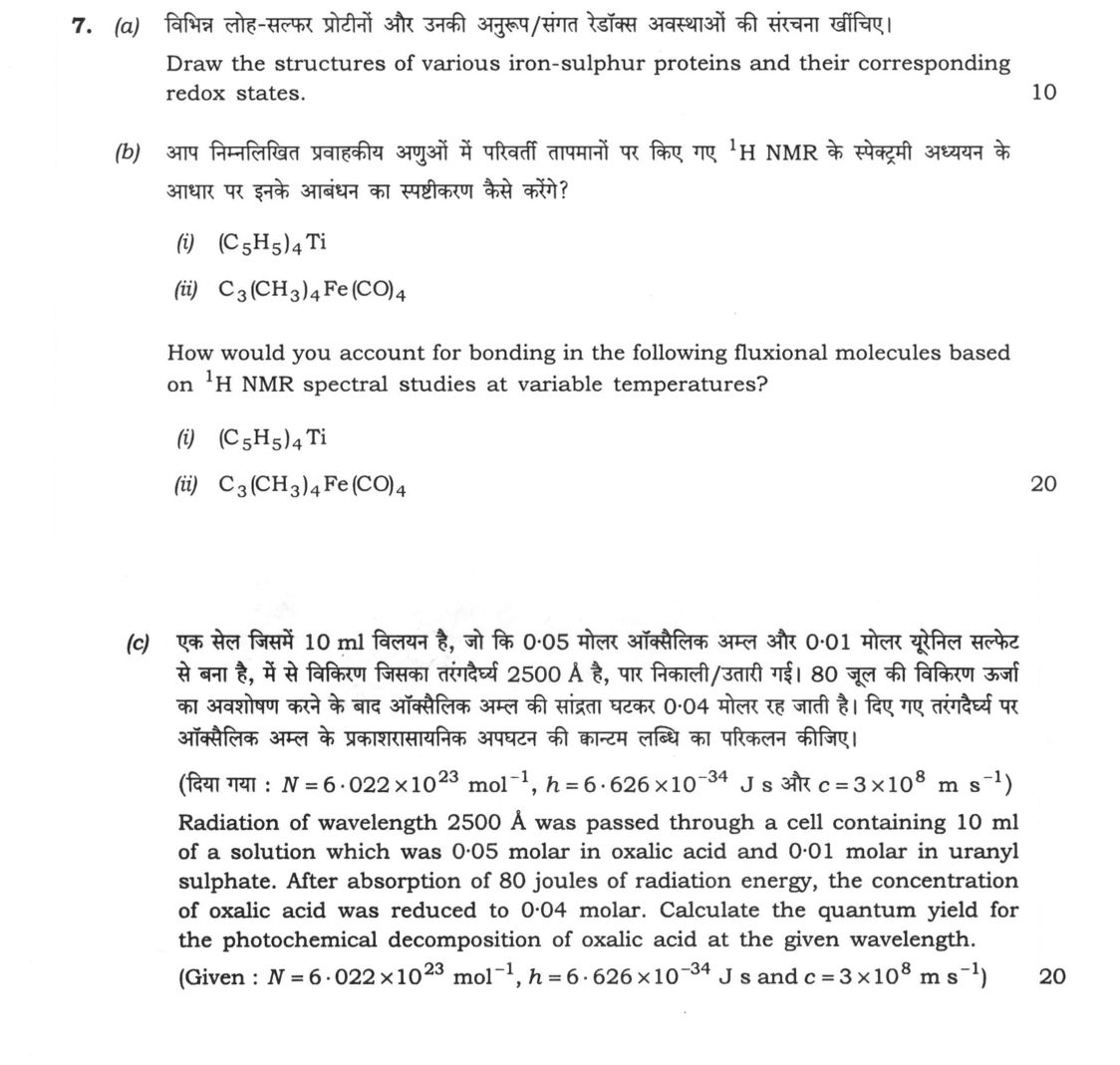
Draw the structures of various iron-sulphur proteins and their corresponding redox states. 10 marks
How would you account for bonding in the following fluxional molecules based on ¹H NMR spectral studies at variable temperatures? (C₅H₅)₄ Ti
C₃(CH₃)₄Fe(CO)₄ 20 marks
Radiation of wavelength 2500 Å was passed through a cell containing 10 ml of a solution which was 0·05 molar in oxalic acid and 0·01 molar in uranyl sulphate. After absorption of 80 joules of radiation energy, the concentration of oxalic acid was reduced to 0·04 molar. Calculate the quantum yield for the photochemical decomposition of oxalic acid at the given wavelength. (Given : N = 6·022×10²³ mol⁻¹, h = 6·626×10⁻³⁴ J s and c = 3×10⁸ m s⁻¹) 20 marks
हिंदी में प्रश्न पढ़ें
विभिन्न लोह-सल्फर प्रोटीनों और उनकी अनुरूप/संगत रेडॉक्स अवस्थाओं की संरचना खींचिए। (10 अंक)
आप निम्नलिखित प्रवाहकीय अणुओं में परिवर्ती तापमानों पर किए गए ¹H NMR के स्पेक्ट्रमी अध्ययन के आधार पर इनके आबंधन का स्पष्टीकरण कैसे करेंगे? (C₅H₅)₄ Ti
C₃(CH₃)₄Fe(CO)₄ (20 अंक)
एक सेल जिसमें 10 ml विलयन है, जो कि 0·05 मोलर ऑक्सैलिक अम्ल और 0·01 मोलर यूरेनिल सल्फेट से बना है, में से विकिरण जिसका तरंगदैर्घ्य 2500 Å है, पार निकाली/उतारी गई। 80 जूल की विकिरण ऊर्जा का अवशोषण करने के बाद ऑक्सैलिक अम्ल की सांद्रता घटकर 0·04 मोलर रह जाती है। दिए गए तरंगदैर्घ्य पर ऑक्सैलिक अम्ल के प्रकाशरासायनिक अपघटन की क्वांटम लब्धि का परिकलन कीजिए। (दिया गया : N = 6·022×10²³ mol⁻¹, h = 6·626×10⁻³⁴ J s और c = 3×10⁸ m s⁻¹) (20 अंक)
Model answer
Written by UPSC Answer Check against this question's marking rubric, to the expected length. UPSC does not publish answers for Mains — this is one way to score well, not an official key.
The three parts are explained by connecting cluster structure, dynamic NMR exchange, and photon stoichiometry.
Iron-sulphur proteins. The structures are drawn as discrete Fe–S cores. The [2Fe–2S] cluster is a rhombus of two Fe and two S²⁻ bridging atoms, each Fe also bound to cysteine thiolates; its couple is [2Fe–2S]²⁺/⁺, formally Fe³⁺/Fe³⁺ in the oxidized state and Fe³⁺/Fe²⁺ when reduced. The [4Fe–4S] cluster is a cubane of four Fe and four S²⁻; the [4Fe–4S]²⁺/⁺ couple is Fe³⁺₂Fe²⁺₂/Fe³⁺₁Fe²⁺₃. HiPIPs contain this cubane but with a higher potential. The [3Fe–4S] cluster is a distorted cubane missing one Fe; the [3Fe–4S]⁴⁺/³⁺ couple is Fe³⁺₃/Fe³⁺₂Fe²⁺. The redox electron is delocalized over Fe–S–Fe bridges, which is why mixed-valence descriptions are used. Ferredoxins and HiPIPs therefore represent different redox families because cluster geometry and mixed-valence state control potential.
Fluxional organometallics. Variable-temperature ¹H NMR accounts for bonding by showing how exchange rates change: at low T, inequivalent protons or methyl groups give separate resonances; at high T, coalescence to one averaged resonance proves rapid site exchange. The coalescence temperature is diagnostic: below it exchange is slow; above it the NMR sees a time-averaged environment.
(i) (C₅H₅)₄Ti is best formulated as (η⁵-C₅H₅)₂(η¹-C₅H₅)₂Ti. Ti(IV) is d⁰ and the complex is a 16-electron species: two η⁵ Cp⁻ rings donate 6 e each, and two η¹ Cp⁻ rings donate 2 e each. The 16-electron d⁰ framework is fluxional because η¹ rings rotate and change hapticity while η⁵ rings can become η¹; this ring-whizzing/hapticity interchange makes all four Cp rings equivalent. Hence room-temperature ¹H NMR gives a single Cp signal, and low-temperature spectra separate the ring environments.
(ii) C₃(CH₃)₄Fe(CO)₄ is the η²-tetramethylallene complex of Fe(CO)₄, not a trimethylenemethane complex. Fe(0) is d⁸; four CO ligands and one η² C=C bond of the allene give an 18-electron complex. In the static η²-allene complex the allene ligand is unsymmetrical: methyl groups on the coordinated terminal carbon and those on the other terminal carbon are not all equivalent. Fluxionality arises from rotation/interchange of the allene ligand, including re-coordination through the other C=C or rotation about the Fe–C bond, which interchanges the methyl sites. Low-temperature ¹H NMR shows separate methyl resonances; on heating they coalesce to one signal as allene-site exchange becomes rapid, so all methyl groups become equivalent in the fast-exchange limit. Carbonyl Berry pseudorotation is not the accepted mechanism.
Photochemical quantum yield. Uranyl sulphate is the photosensitizer in the classic uranyl-oxalate actinometer: UO₂²⁺ absorbs 2500 Å light, is excited, and transfers energy/electron to oxalate, producing CO, CO₂ and water; the measured loss of oxalic acid therefore reports photons absorbed by the sensitizer. The calculation assumes all 80 J are absorbed by the uranyl chromophore and that one photon corresponds to one quantum event. The solution volume is 10 ml = 0.010 L. Initial oxalic acid = 0.05 × 0.010 = 5.0 × 10⁻⁴ mol. Final concentration = 0.04 M, so final moles = 0.04 × 0.010 = 4.0 × 10⁻⁴ mol. Decomposed oxalic acid = 1.0 × 10⁻⁴ mol. The wavelength is 2500 Å = 2.5 × 10⁻⁷ m. Energy per photon = hc/λ = (6.626 × 10⁻³⁴ × 3 × 10⁸)/(2.5 × 10⁻⁷) = 7.95 × 10⁻¹⁹ J. Moles of photons absorbed = 80/(7.95 × 10⁻¹⁹ × 6.022 × 10²³) = 1.67 × 10⁻⁴ mol. Quantum yield Φ = moles of oxalic acid decomposed per mole of photons absorbed = 1.0 × 10⁻⁴/1.67 × 10⁻⁴ = 0.60. The sub-unity value indicates that not every absorbed uranyl excited state leads to oxalic acid decomposition; some energy is dissipated or follows other pathways.
What "Explain" is asking you to do
Make the working of something clear — what sets it off, what follows from what, and what it produces. Explain is the Commission's mechanism word: it dominates the technical papers and the “explain why” stems, where the marks sit in the causal chain and not in the label.
Structure that answers it
State what it is → the initiating condition → the chain of cause, step by step → an instance where it plays out → what the chain produces
Where marks are lost
Describing what something looks like instead of why it works that way. Naming the stages without linking them reads as description too.
How this answer will be evaluated
Approach
Framework: Concept > Structure or mechanism > Reasoning > Result. (a) describe: define > structure or process in order > labelled diagram > significance | (b) account for: state the phenomenon > the causes in order of weight > conclusion | (c) calculate: given > formula > substitution > result with units > interpretation Full marks: Complete structures with redox states; detailed NMR analysis; full calculation with correct quantum yield
Key points expected
- Draw [2Fe-2S] and [4Fe-4S] cluster structures
- Show oxidation states of Fe and S in clusters
- Indicate electron transfer in redox states
- Describe fluxional behavior in (C5H5)4Ti
- Explain bonding in C3(CH3)4Fe(CO)4
- Relate NMR signals to molecular motion
- Discuss temperature effects on NMR spectra
- Calculate moles of photons absorbed
Evaluation rubric
Each sub-part is marked on its own, against the marks and word limit printed on the paper.
- (a) Draw structures of iron-sulphur proteins and their redox states. 10 marks
describe— define → structure or process in order → labelled diagram → significance
Must cover
- Draw [2Fe-2S] and [4Fe-4S] cluster structures
- Show oxidation states of Fe and S in clusters
- Indicate electron transfer in redox states
Loses marks
- Missing oxidation states of iron
- Incorrect cluster geometry
Earns more
- Label cysteine residues coordinating clusters
- Show electron flow in redox cycle
Extra mark
- Mention specific proteins like ferredoxin
- (b) Explain bonding in fluxional molecules using variable temperature 1H NMR. 20 marks
account for— state the phenomenon → the causes in order of weight → conclusion
Must cover
- Describe fluxional behavior in (C5H5)4Ti
- Explain bonding in C3(CH3)4Fe(CO)4
- Relate NMR signals to molecular motion
- Discuss temperature effects on NMR spectra
Loses marks
- No connection between NMR and fluxionality
- Incorrect bonding description
Earns more
- Show specific NMR peak changes with temperature
- Explain dynamic processes in fluxional molecules
Extra mark
- Mention specific NMR techniques used
- (c) Calculate quantum yield for photochemical decomposition of oxalic acid. 20 marks
calculate— given → formula → substitution → result with units → interpretation
Must cover
- Calculate moles of photons absorbed
- Determine moles of oxalic acid decomposed
- Apply quantum yield formula
- Show all calculation steps
Loses marks
- Incorrect photon energy calculation
- Missing intermediate steps
Earns more
- Correct unit conversions
- Proper use of given constants
Extra mark
- Mention significance of quantum yield value
Practice this exact question
Write your answer and it is marked point by point against the model answer above — what you covered, what you missed, what you got wrong.
Evaluate my answer →More from Chemistry 2021 Paper I
- Q4 (a) Calculate the e.m.f. of the following electrochemical cell at 25 °C : Pt/H₂₍₁ ₐₜₘ₎|H⁺…
- Q5 (a) Derive an equation for rate constant of a zero-order reaction. Show that half-life pe…
- Q6 (a) How does the bonding in cyclic phosphazene differ from that of benzene and borazine?…
- Q7 (a) Draw the structures of various iron-sulphur proteins and their corresponding redox st…
- Q8 (a) Justify that the interhalogen compound BrF₃ acts as an aprotic solvent and undergoes…