Paper I — Q8
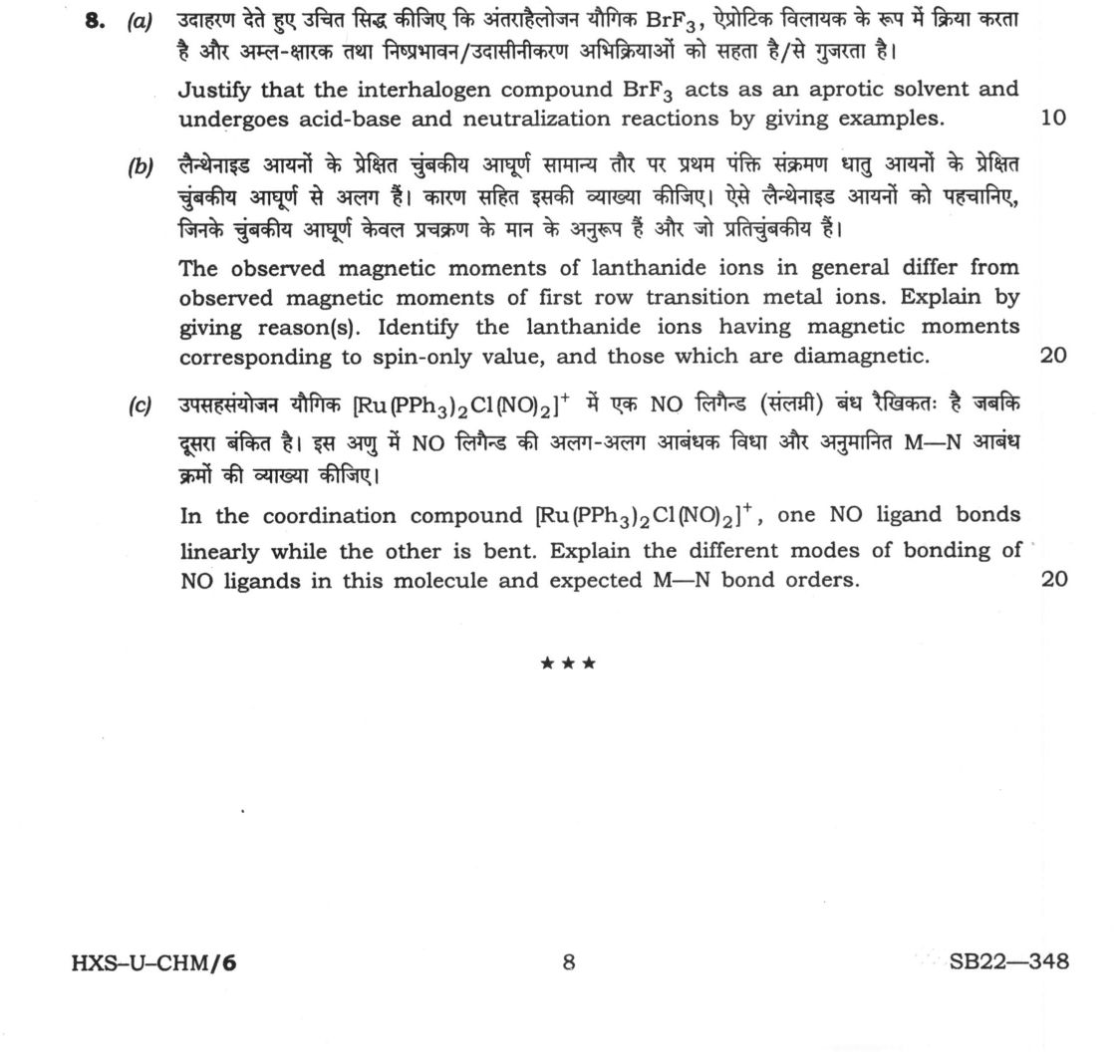
(a) Justify that the interhalogen compound BrF₃ acts as an aprotic solvent and undergoes acid-base and neutralization reactions…
Justify that the interhalogen compound BrF₃ acts as an aprotic solvent and undergoes acid-base and neutralization reactions by giving examples. 10 marks
The observed magnetic moments of lanthanide ions in general differ from observed magnetic moments of first row transition metal ions. Explain by giving reason(s). Identify the lanthanide ions having magnetic moments corresponding to spin-only value, and those which are diamagnetic. 20 marks
In the coordination compound [Ru(PPh₃)₂Cl(NO)₂]⁺, one NO ligand bonds linearly while the other is bent. Explain the different modes of bonding of NO ligands in this molecule and expected M—N bond orders. 20 marks
हिंदी में प्रश्न पढ़ें
उदाहरण देते हुए उचित सिद्ध कीजिए कि अंतरहैलोजन यौगिक BrF₃, ऐप्रोटिक विलायक के रूप में क्रिया करता है और अम्ल-क्षारक तथा निष्प्रभावन/उदासीनिकरण अभिक्रियाओं को सहता है/से गुजरता है। (10 अंक)
लैन्थेनाइड आयनों के प्रेक्षित चुंबकीय आघूर्ण सामान्य तौर पर प्रथम पंक्ति संक्रमण धातु आयनों के प्रेक्षित चुंबकीय आघूर्ण से अलग हैं। कारण सहित इसकी व्याख्या कीजिए। ऐसे लैन्थेनाइड आयनों को पहचानिए, जिनके चुंबकीय आघूर्ण केवल प्रचक्रण के मान के अनुरूप हैं और जो प्रतिचुंबकीय हैं। (20 अंक)
उपसहसंयोजन यौगिक [Ru(PPh₃)₂Cl(NO)₂]⁺ में एक NO लिगैंड (संलगी) बंध रैखिकतः है जबकि दूसरा बंकित है। इस अणु में NO लिगैंड की अलग-अलग आबंधक विधा और अनुमानित M—N आबंध क्रमों की व्याख्या कीजिए। (20 अंक)
Model answer
Written by UPSC Answer Check against this question's marking rubric, to the expected length. UPSC does not publish answers for Mains — this is one way to score well, not an official key.
The three parts concern solvent autoionization, 4f magnetism, and nitrosyl bonding.
(a) BrF₃ as an aprotic ionizing solvent. BrF₃ is aprotic because it contains no ionisable H atom, but it is an ionizing solvent by fluoride transfer: 2BrF₃ ⇌ BrF₂⁺ + BrF₄⁻. In this system BrF₂⁺ is the acidic cation and BrF₄⁻ the basic anion. A Lewis acid that removes F⁻ from BrF₃ generates BrF₂⁺, e.g. SbF₅ + BrF₃ → BrF₂⁺ SbF₆⁻. A fluoride donor acts as a base, e.g. KF + BrF₃ → K⁺ BrF₄⁻ (KBrF₄). Neutralization is the reverse of autoionization: BrF₂⁺ + BrF₄⁻ → 2BrF₃. Thus BrF₃ behaves like a non-protonic, self-ionizing medium in which acid–base chemistry is fluoride-ion transfer rather than proton transfer.
(b) Lanthanide magnetic moments. In first-row transition-metal ions the 3d orbitals are exposed to the ligand field, so orbital angular momentum is largely quenched and μeff is often close to the spin-only value μso = [n(n+2)]^1/2 BM, where n is the number of unpaired d electrons. In lanthanides the 4f orbitals are shielded by 5s and 5p electrons; crystal-field splitting is small compared with spin–orbit coupling, so the ground state is a J level and the orbital contribution is not quenched. The moment is therefore μeff = gJ[J(J+1)]^1/2 BM, with Landé gJ = 3/2 + [S(S+1)+L(L+1)−J(J+1)]/[2J(J+1)]. This is why lanthanide moments often differ from spin-only values. For a half-filled 4f shell L = 0, J = S and gJ = 2, so the formula reduces to spin-only. Hence Gd³⁺ (4f⁷, S = 7/2, L = 0, J = 7/2) has μeff = 2[7/2(9/2)]^1/2 = [63]^1/2 = 7.94 BM, the spin-only value. La³⁺ (4f⁰) and Lu³⁺ (4f¹⁴) have no unpaired f electrons, μ = 0 BM, and are diamagnetic; they also formally give the spin-only value.
(c) Linear and bent nitrosyl bonding. In [Ru(PPh₃)₂Cl(NO)₂]⁺ the two nitrosyls are inequivalent. Assign the linear M–N–O unit as NO⁺ and the bent unit as NO⁻. With Cl⁻, NO⁺ and NO⁻, the metal is Ru(II), d⁶. Ionic electron count: Ru(II) 6e, two PPh₃ 4e, Cl⁻ 2e, linear NO⁺ 2e, bent NO⁻ 2e, total 16e; the same neutral count is Ru(0) 8e + 2 PPh₃ 4e + Cl 1e + linear NO 3e + bent NO 1e − 1e charge = 16e. The complex is therefore coordinatively unsaturated, and the 18-electron rule is not the explanation. Formally it is {Ru(NO⁺)(NO⁻)}⁺ or, in Enemark–Feltham notation, {Ru(NO)₂}⁷: d⁶ plus one electron in the NO π* manifold associated with the bent nitrosyl. The seven electrons in the combined dπ/NOπ* set leave one nitrosyl NO⁺ like and the other NO⁻ like. Linear NO⁺ is isoelectronic with CO: it is a strong σ donor and π acceptor, keeps the M–N–O angle near 180°, and gives a short, strong M–N bond of bond order about 2 (often described as 2–3 because of partial triple-bond character). Bent NO⁻ has one electron in the NO π* manifold; the M–N–O angle is about 120°, the M–N bond is longer and weaker, and its bond order is about 1 (range 1–2). Thus the same metal centre can accommodate one linear, NO⁺-like nitrosyl and one bent, NO⁻-like nitrosyl, with correspondingly different M–N bond orders.
Overall, the observed behaviour follows from the dominant electronic interaction: fluoride autoionization in BrF₃, spin–orbit coupling in lanthanides, and π* occupancy in nitrosyls.
What "Explain" is asking you to do
Make the working of something clear — what sets it off, what follows from what, and what it produces. Explain is the Commission's mechanism word: it dominates the technical papers and the “explain why” stems, where the marks sit in the causal chain and not in the label.
Structure that answers it
State what it is → the initiating condition → the chain of cause, step by step → an instance where it plays out → what the chain produces
Where marks are lost
Describing what something looks like instead of why it works that way. Naming the stages without linking them reads as description too.
How this answer will be evaluated
Approach
Framework: Concept > Structure or mechanism > Reasoning > Result. (a) justify: claim > 3-4 reasons > evidence > conclusion | (b) explain: definition/context > points in order > small example > short close | (c) explain: definition/context > points in order > small example > short close Full marks: Complete mechanisms, correct examples, precise bond orders, clear reasoning throughout
Key points expected
- Define BrF3 as aprotic (no protons to donate)
- Explain autoionization of BrF3 (2BrF3 ⇌ BrF2+ + BrF4-)
- Give example of acid-base reaction in BrF3
- Give example of neutralization reaction in BrF3
- Explain spin-orbit coupling in lanthanides (4f orbitals)
- Contrast with transition metals (3d, weaker spin-orbit)
- Identify lanthanide ions with spin-only magnetic moments
- Identify diamagnetic lanthanide ions (e.g., La3+, Lu3+)
Evaluation rubric
Each sub-part is marked on its own, against the marks and word limit printed on the paper.
- (a) Explain BrF3 as aprotic solvent and its acid-base/neutralization behavior with examples. 10 marks
justify— claim → 3-4 reasons → evidence → conclusion
Must cover
- Define BrF3 as aprotic (no protons to donate)
- Explain autoionization of BrF3 (2BrF3 ⇌ BrF2+ + BrF4-)
- Give example of acid-base reaction in BrF3
- Give example of neutralization reaction in BrF3
Loses marks
- Confusing aprotic with non-polar solvent
- Failing to show autoionization equation
- Giving examples from aqueous system instead of BrF3
Earns more
- Mention Lewis acid-base character of BrF3
- Show electron pair donation/acceptance mechanism
- Compare with water autoionization
- Mention specific compounds reacting in BrF3
Extra mark
- Draw Lewis structures showing electron pairs
- Mention industrial applications of BrF3 as solvent
- (b) Explain why lanthanide magnetic moments differ from transition metals; identify spin-only and diamagnetic ions. 20 marks
explain— definition/context → points in order → small example → short close
Must cover
- Explain spin-orbit coupling in lanthanides (4f orbitals)
- Contrast with transition metals (3d, weaker spin-orbit)
- Identify lanthanide ions with spin-only magnetic moments
- Identify diamagnetic lanthanide ions (e.g., La3+, Lu3+)
Loses marks
- Using only spin-only formula for lanthanides
- Failing to identify specific diamagnetic ions
- Confusing 4f with 3d orbital behavior
Earns more
- Mention Russell-Saunders coupling scheme
- Show formula μ = g√J(J+1) for lanthanides
- Explain why 4f orbitals are shielded
- List specific ions with their magnetic moments
Extra mark
- Provide table of lanthanide ions with μ values
- Mention temperature dependence of magnetic moments
- (c) Explain linear vs bent NO bonding in [Ru(PPh3)2Cl(NO)2]+ and expected M-N bond orders. 20 marks
explain— definition/context → points in order → small example → short close
Must cover
- Explain linear NO as NO+ (nitrosonium) with 2-electron donation
- Explain bent NO as NO- (nitrosyl) with 1-electron donation
- State M-N bond order for linear NO (typically 1.5-2)
- State M-N bond order for bent NO (typically 1-1.5)
Loses marks
- Treating both NO ligands identically
- Failing to specify bond orders for each type
- Confusing NO+ and NO- electron donation
Earns more
- Show electron counting for Ru oxidation state
- Explain back-bonding from Ru to NO π* orbitals
- Mention Enemark-Rohlfson notation for NO
- Draw structures showing linear vs bent geometry
Extra mark
- Provide IR stretching frequency data for both NO types
- Mention specific bond lengths from crystallographic data
Practice this exact question
Write your answer and it is marked point by point against the model answer above — what you covered, what you missed, what you got wrong.
Evaluate my answer →More from Chemistry 2021 Paper I
- Q5 (a) Derive an equation for rate constant of a zero-order reaction. Show that half-life pe…
- Q6 (a) How does the bonding in cyclic phosphazene differ from that of benzene and borazine?…
- Q7 (a) Draw the structures of various iron-sulphur proteins and their corresponding redox st…
- Q8 (a) Justify that the interhalogen compound BrF₃ acts as an aprotic solvent and undergoes…