Paper I — Q1
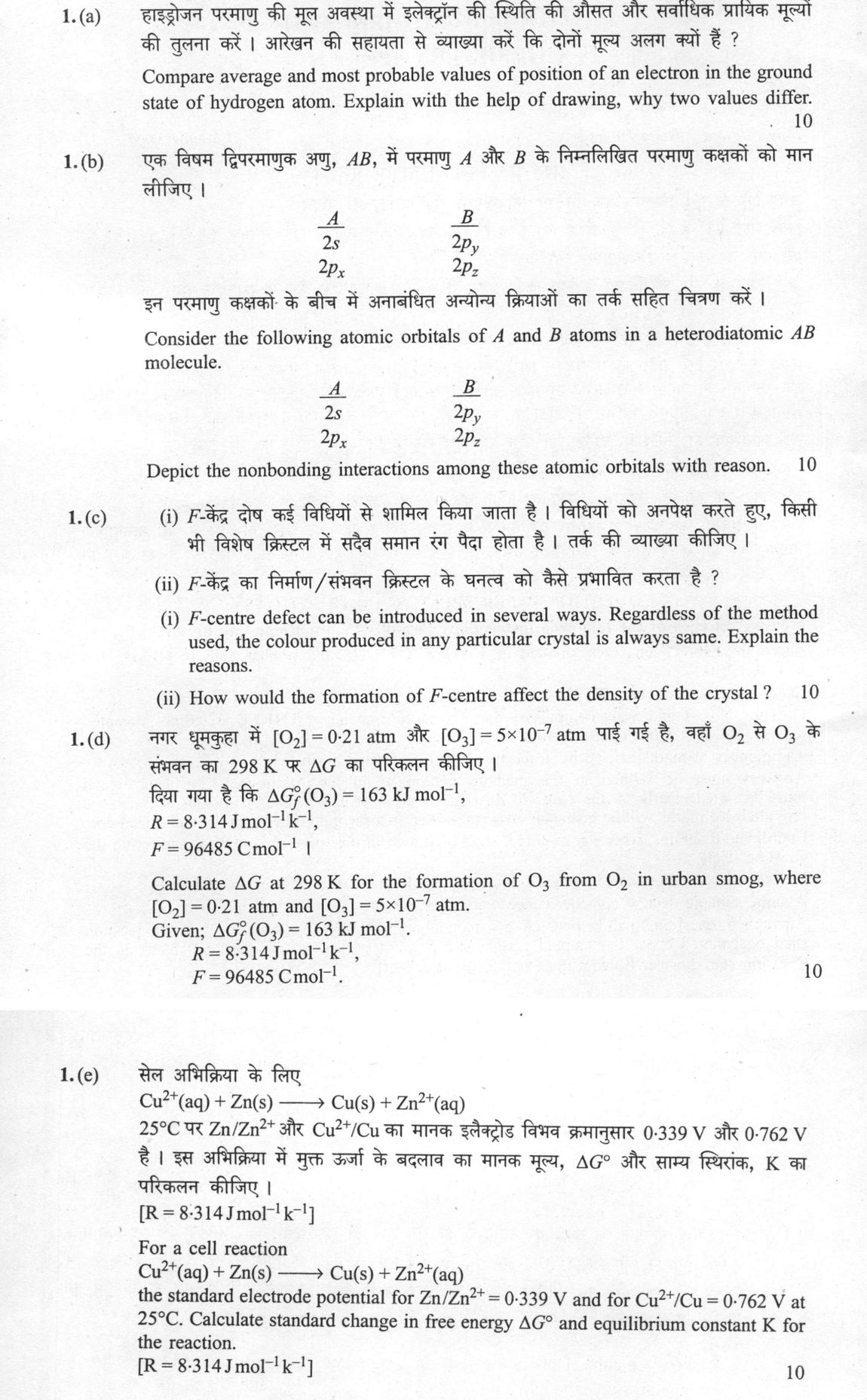
1.(a) Compare average and most probable values of position of an electron in the ground state of hydrogen atom. Explain with the…
1.(a) Compare average and most probable values of position of an electron in the ground state of hydrogen atom. Explain with the help of drawing, why two values differ. 10 marks
1.(b) Consider the following atomic orbitals of A and B atoms in a heterodiatomic AB molecule.
A 2s 2px
B 2py 2pz
Depict the nonbonding interactions among these atomic orbitals with reason. 10 marks
1.(c) (i) F-centre defect can be introduced in several ways. Regardless of the method used, the colour produced in any particular crystal is always same. Explain the reasons.
How would the formation of F-centre affect the density of the crystal ? 10 marks
1.(d) Calculate ΔG at 298 K for the formation of O3 from O2 in urban smog, where [O2] = 0·21 atm and [O3] = 5×10⁻⁷ atm. Given; ΔG°f(O3) = 163 kJ mol⁻¹. R = 8·314 J mol⁻¹K⁻¹, F = 96485 C mol⁻¹. 10 marks
1.(e) For a cell reaction Cu²⁺(aq) + Zn(s) → Cu(s) + Zn²⁺(aq) the standard electrode potential for Zn/Zn²⁺ = 0·339 V and for Cu²⁺/Cu = 0·762 V at 25°C. Calculate standard change in free energy ΔG° and equilibrium constant K for the reaction. [R = 8·314 J mol⁻¹ k⁻¹] 10 marks
हिंदी में प्रश्न पढ़ें
1.(a) हाइड्रोजन परमाणु की मूल अवस्था में इलेक्ट्रॉन की स्थिति की औसत और सर्वाधिक प्रायिक मूल्यों की तुलना करें । आरेख की सहायता से व्याख्या करें कि दोनों मूल्य अलग क्यों हैं ? (10 अंक)
1.(b) एक विषम द्विपरमाणुक अणु, AB, में परमाणु A और B के निम्नलिखित परमाणु कक्षकों को मान लीजिए ।
A 2s 2px
B 2py 2pz
इन परमाणु कक्षकों के बीच में अनाबंधित अन्योन्य क्रियाओं का तर्क सहित चित्रण करें । (10 अंक)
1.(c) (i) F-केंद्र दोष कई विधियों से शामिल किया जाता है । विधियों को अनपेक्ष करते हुए, किसी भी विशेष क्रिस्टल में सदैव समान रंग पैदा होता है । तर्क की व्याख्या कीजिए ।
F-केंद्र का निर्माण/संभवन क्रिस्टल के घनत्व को कैसे प्रभावित करता है ? (10 अंक)
1.(d) नगर धूमुकुहा में [O2] = 0·21 atm और [O3] = 5×10⁻⁷ atm पाई गई है, वहाँ O2 से O3 के संभवन का 298 K पर ΔG का परिकलन कीजिए ।
दिया गया है कि ΔG°f(O3) = 163 kJ mol⁻¹, R = 8·314 J mol⁻¹K⁻¹, F = 96485 C mol⁻¹ । (10 अंक)
1.(e) सेल अभिक्रिया के लिए Cu²⁺(aq) + Zn(s) → Cu(s) + Zn²⁺(aq) 25°C पर Zn/Zn²⁺ और Cu²⁺/Cu का मानक इलेक्ट्रोड विभव क्रमानुसार 0·339 V और 0·762 V है । इस अभिक्रिया में मुक्त ऊर्जा के बदलाव का मानक मूल्य, ΔG° और साम्य स्थिरांक, K का परिकलन कीजिए । [R = 8·314 J mol⁻¹ k⁻¹] (10 अंक)
The figure this question refers to, in words
The question paper is a scan and the diagram did not survive as text. This is the figure as read from the original page — every component, value and label — so the question can be worked from the text below.
(b) A B 2s 2py 2px 2pz
Model answer
Written by UPSC Answer Check against this question's marking rubric, to the expected length. UPSC does not publish answers for Mains — this is one way to score well, not an official key.
(a) For H 1s, the radial probability distribution P(r)=4πr²|ψ|² starts at zero at the nucleus, peaks at r_mp=a0, and then decays. The average distance is the mean of this distribution, <r>=∫rP(r)dr=3a0/2. A drawing shows a peak at a0 and a long tail; the area is unity and its centroid is at 1.5a0. Thus r_mp is the peak, while <r> is the weighted mean; the tail makes the average larger.
(b) Taking the internuclear axis as z, only A(2s) with B(2p_z) has the required σ symmetry; no parallel p pair is present for π bonding, so that pair is not nonbonding. A sketch would show the nonbonding pairs as A(2s) with B(2p_y), A(2p_x) with B(2p_y), and A(2p_x) with B(2p_z). In each case the positive and negative lobes give equal and opposite overlap, or the orbitals are orthogonal in x, y, or z, so the net overlap integral is zero. Hence no bonding/antibonding splitting occurs and these AOs remain essentially nonbonding.
(c) (i) An F-centre is an anion vacancy occupied by a trapped electron. Its colour comes from absorption of visible light as the electron is promoted to an excited state. The transition energy is fixed by the size and symmetry of the vacancy, the lattice parameter, and the dielectric environment, not by the method of formation. The Mollwo-Ivey relation, λ_max=A+B/r0, shows that the same crystal gives the same absorption wavelength and therefore the same complementary colour. (ii) Forming an F-centre removes an anion from a lattice site while the trapped electron contributes negligible mass. The unit-cell volume changes only slightly, so the crystal loses mass without a proportional loss of volume; its density therefore decreases.
(d) For (3/2)O2(g)→O3(g), ΔG°=ΔG°f(O3)=163 kJ mol⁻¹. Q=P_O3/(P_O2)^(3/2)=5×10⁻⁷/(0.21)^(3/2)=5.2×10⁻⁶. At 298 K, RT lnQ=8.314×298×ln(5.2×10⁻⁶)=−30.1 kJ mol⁻¹. Hence ΔG=163−30.1=132.9 kJ mol⁻¹.
(e) For Cu²⁺+Zn→Cu+Zn²⁺, n=2. Using standard reduction potentials, E°(Cu²⁺/Cu)=+0.339 V and E°(Zn²⁺/Zn)=−0.762 V, so E°cell=0.339−(−0.762)=1.101 V. ΔG°=−nFE°=−2×96485×1.101=−212.5 kJ mol⁻¹. From ΔG°=−RT lnK, lnK=nFE°/RT=85.8, so K≈1.7×10³⁷. The large K and negative ΔG° show the reaction is strongly product-favoured.
What "Compare" is asking you to do
Set the items against each other on named dimensions. In UPSC practice compare already carries both halves — likeness and difference — and where the stem names the dimensions, as in region, nature and climatic impact, those are the headings the examiner expects to see.
Structure that answers it
Dimensions named → both items on dimension 1 → dimension 2 → dimension 3 → where they converge and where they part
Where marks are lost
Two self-contained descriptive blocks with the comparison left for the reader to make. Marks here sit on the dimensions, so an answer that names none of them gives the examiner nothing to award.
How this answer will be evaluated
Approach
(a) compare: paired headings or table > key differences > significance > conclusion | (b) describe: define > structure or process in order > labelled diagram > significance | (c(i)) explain: definition/context > points in order > small example > short close | (c(ii)) explain: definition/context > points in order > small example > short close | (d) calculate: given > formula > substitution > result with units > interpretation | (e) calculate: given > formula > substitution > result with units > interpretation Full marks: Precise definitions, correct derivations, and error-free numerical working with units.
Key points expected
- Most probable radius is a0 (Bohr radius).
- Average radius is 1.5 a0.
- Explanation of radial probability distribution P(r).
- Drawing of P(r) vs r curve.
- Identification of A(2s) as nonbonding.
- Identification of B(2py) as nonbonding.
- Reason: Symmetry mismatch (s vs p).
- Reason: Orthogonality (px vs py).
Evaluation rubric
Each sub-part is marked on its own, against the marks and word limit printed on the paper.
- (a) Comparison of average vs most probable electron position in H-atom ground state. 10 marks
compare— paired headings or table → key differences → significance → conclusion
Must cover
- Most probable radius is a0 (Bohr radius).
- Average radius is 1.5 a0.
- Explanation of radial probability distribution P(r).
- Drawing of P(r) vs r curve.
Loses marks
- Confusing probability density with radial probability.
- Stating values without the required drawing.
- Omitting the reason for the difference (asymmetry of P(r)).
Earns more
- Explicit calculation of <r> = 3/2 a0.
- Explicit calculation of r_max = a0.
- Distinction between probability density and radial probability.
Extra mark
- Reference to specific quantum numbers (n=1, l=0).
- Graph showing the peak at a0 and the tail extending to 1.5a0.
- (b) Identification and depiction of nonbonding interactions in heterodiatomic AB. 10 marks
describe— define → structure or process in order → labelled diagram → significance
Must cover
- Identification of A(2s) as nonbonding.
- Identification of B(2py) as nonbonding.
- Reason: Symmetry mismatch (s vs p).
- Reason: Orthogonality (px vs py).
Loses marks
- Claiming 2s and 2py can form a bond.
- Confusing nonbonding with antibonding.
- Failure to provide the 'reason' as requested.
Earns more
- Drawing of orbital orientations.
- Explicit statement that overlap integral is zero.
- Identification of bonding/antibonding pairs (px-pz) for context.
Extra mark
- Energy level diagram showing nonbonding orbitals at atomic energy levels.
- (c(i)) Reason why F-centre colour is consistent regardless of introduction method.
explain— definition/context → points in order → small example → short close
Must cover
- Colour arises from electron trapped in anion vacancy.
- Absorption of visible light promotes electron to higher level.
- Energy gap depends on crystal lattice, not defect creation method.
Loses marks
- Attributing colour to the cation.
- Claiming colour depends on the method of introduction.
Earns more
- Reference to band theory (valence to conduction band).
- Specific example (e.g., NaCl turning yellow).
Extra mark
- Equation for the energy of the absorbed photon.
- (c(ii)) Effect of F-centre formation on crystal density.
explain— definition/context → points in order → small example → short close
Must cover
- Anion vacancy reduces total mass of the unit cell.
- Volume of the crystal remains effectively constant.
- Conclusion: Density decreases.
Loses marks
- Claiming density increases.
- Confusing F-centre with interstitial defects.
Earns more
- Comparison with Schottky defect density change.
- Quantitative logic (mass/volume).
Extra mark
- Reference to specific ionic radii.
- (d) Calculation of ΔG for O3 formation from O2 at 298 K. 10 marks
calculate— given → formula → substitution → result with units → interpretation
Must cover
- Balanced equation: 3/2 O2 -> O3.
- Calculation of ΔG°rxn = 163 kJ/mol.
- Calculation of reaction quotient Q.
- Application of ΔG = ΔG° + RT ln Q.
Loses marks
- Using unbalanced equation (O2 -> O3).
- Using F instead of R in the equation.
- Arithmetic errors in log calculation.
Earns more
- Correct substitution of partial pressures into Q.
- Final answer in kJ/mol with correct sign.
Extra mark
- Explicit calculation of the RT ln Q term.
- (e) Calculation of ΔG° and K for the Cu-Zn cell reaction. 10 marks
calculate— given → formula → substitution → result with units → interpretation
Must cover
- Determination of E°cell (0.762 - 0.339 V).
- Calculation of ΔG° = -nFE°cell.
- Calculation of K using ΔG° = -RT ln K.
- Correct value for n (n=2).
Loses marks
- Using wrong sign for E°cell.
- Using n=1 instead of n=2.
- Unit mismatch (kJ vs J) in calculations.
Earns more
- Correct identification of anode and cathode.
- Final K value in scientific notation.
Extra mark
- Explicit conversion of ΔG° to Joules before using in K calculation.
Practice this exact question
Write your answer and it is marked point by point against the model answer above — what you covered, what you missed, what you got wrong.
Evaluate my answer →More from Chemistry 2022 Paper I
- Q1 1.(a) Compare average and most probable values of position of an electron in the ground s…
- Q2 2.(a) An automobile tyre contains air at 320×10³ Pa at 20°C. The stem valve is removed an…
- Q3 (a) Identify the least stable ion of the following ions and justify your answer. OCN⁻ ONC…
- Q4 (a) By using the following given data, find that under what conditions is H₂ in the state…