Paper I — Q2
2.(a) An automobile tyre contains air at 320×10³ Pa at 20°C. The stem valve is removed and the air is allowed to expand…
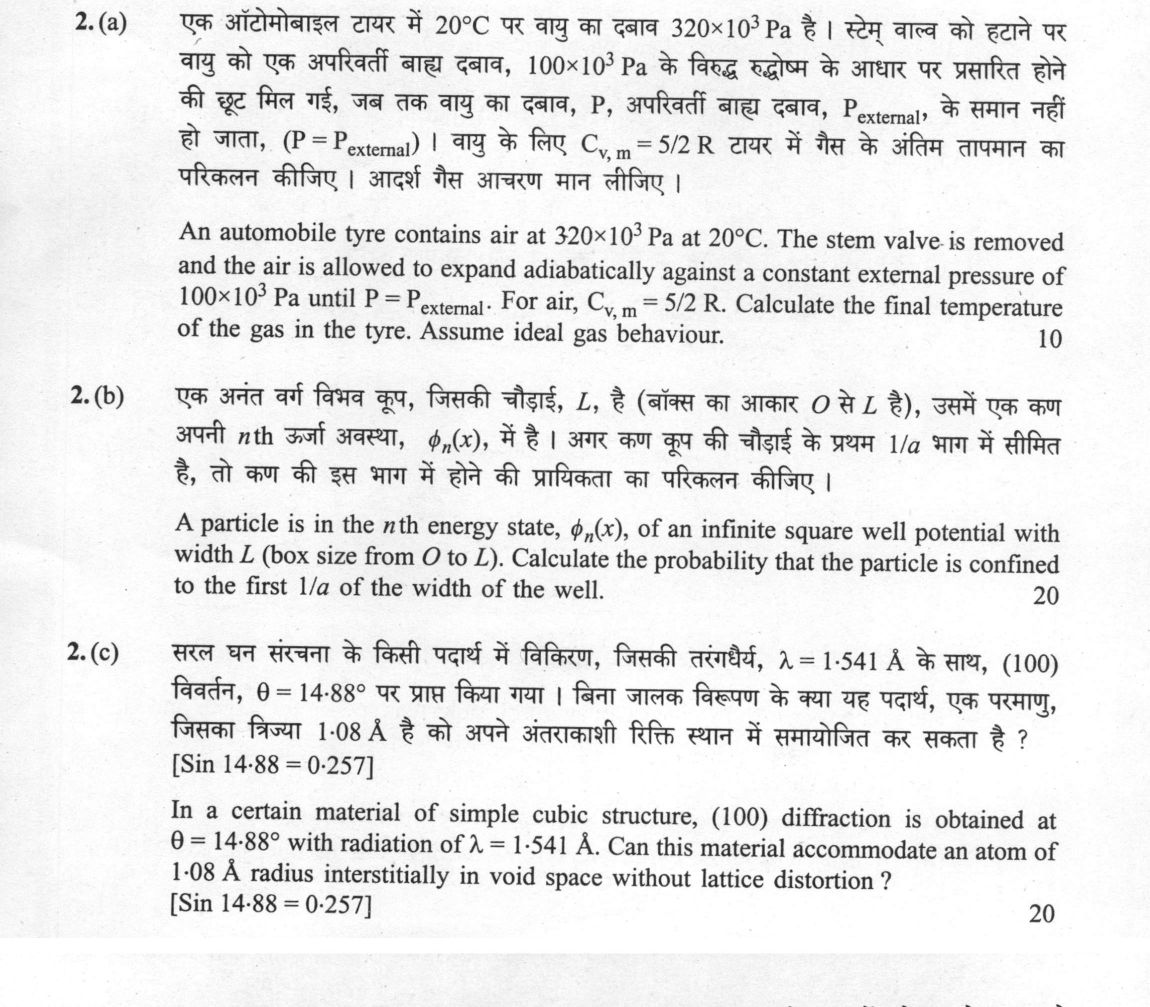
2.(a) An automobile tyre contains air at 320×10³ Pa at 20°C. The stem valve is removed and the air is allowed to expand adiabatically against a constant external pressure of 100×10³ Pa until P = P_external. For air, C_v, m = 5/2 R. Calculate the final temperature of the gas in the tyre. Assume ideal gas behaviour. 10 marks
2.(b) A particle is in the nth energy state, φ_n(x), of an infinite square well potential with width L (box size from O to L). Calculate the probability that the particle is confined to the first 1/a of the width of the well. 20 marks
2.(c) In a certain material of simple cubic structure, (100) diffraction is obtained at θ = 14·88° with radiation of λ = 1·541 Å. Can this material accommodate an atom of 1·08 Å radius interstitially in void space without lattice distortion ? [Sin 14·88 = 0·257] 20 marks
हिंदी में प्रश्न पढ़ें
2.(a) एक ऑटोमोबाइल टायर में 20°C पर वायु का दबाव 320×10³ Pa है । स्टेम वाल्व को हटाने पर वायु को एक अपरिवर्ती बाह्य दबाव, 100×10³ Pa के विरुद्ध रुद्धोष्म के आधार पर प्रसारित होने की छूट मिल गई, जब तक वायु का दबाव, P, अपरिवर्ती बाह्य दबाव, P_external, के समान नहीं हो जाता, (P = P_external) । वायु के लिए C_v, m = 5/2 R टायर में गैस के अंतिम तापमान का परिकलन कीजिए । आदर्श गैस आचरण मान लीजिए । (10 अंक)
2.(b) एक अंत वर्ग विभव कूप, जिसकी चौड़ाई, L, है (बॉक्स का आकार O से L है), उसमें एक कण अपनी nth ऊर्जा अवस्था, φ_n(x), में है । अगर कण कूप की चौड़ाई के प्रथम 1/a भाग में सीमित है, तो कण की इस भाग में होने की प्रायिकता का परिकलन कीजिए । (20 अंक)
2.(c) सरल घन संरचना के किसी पदार्थ में विकिरण, जिसकी तरंगदैर्घ्य, λ = 1·541 Å के साथ, (100) विवर्तन, θ = 14·88° पर प्राप्त किया गया । बिना जालक विक्षेपण के क्या यह पदार्थ, एक परमाणु, जिसका त्रिज्या 1·08 Å है को अपने अंतराकाशी रिक्त स्थान में समायोजित कर सकता है ? [Sin 14·88 = 0·257] (20 अंक)
Model answer
Written by UPSC Answer Check against this question's marking rubric, to the expected length. UPSC does not publish answers for Mains — this is one way to score well, not an official key.
(a) For an irreversible adiabatic expansion, q = 0, so by the first law, ΔU = w. For an ideal gas with constant Cᵥ,ₘ:
ΔU = nCᵥ,ₘ(T₂ − T₁) = n(5/2)R(T₂ − T₁)
Work done against constant external pressure is:
w = −Pₑₓₜ(V₂ − V₁)
Therefore,
n(5/2)R(T₂ − T₁) = −Pₑₓₜ(V₂ − V₁)
Using PV = nRT for initial and final states, V₁ = nRT₁/P₁ and V₂ = nRT₂/P₂. Dividing by nR:
(5/2)(T₂ − T₁) = −Pₑₓₜ(T₂/P₂ − T₁/P₁)
Since the final pressure equals the external pressure, P₂ = Pₑₓₜ = 100×10³ Pa:
(5/2)(T₂ − T₁) = −T₂ + (Pₑₓₜ/P₁)T₁
So,
(7/2)T₂ = (5/2 + Pₑₓₜ/P₁)T₁
Here P₁ = 320×10³ Pa, so Pₑₓₜ/P₁ = 100/320 = 5/16. Thus:
T₂ = T₁ × (5/2 + 5/16)/(7/2) = T₁ × (45/16) × (2/7) = (45/56)T₁
T₁ = 20°C = 293.15 K, hence:
T₂ = (45/56) × 293.15 K = 235.57 K = −37.58°C
Final temperature: 235.57 K, i.e. −37.58°C.
(b) For an infinite square well from 0 to L, the normalized nth state is:
φₙ(x) = √(2/L) sin(nπx/L), 0 ≤ x ≤ L
The probability of finding the particle in the first 1/a of the well, i.e. from x = 0 to x = L/a, is:
Pₙ = ∫ from 0 to L/a of |φₙ(x)|² dx
= (2/L) ∫ from 0 to L/a of sin²(nπx/L) dx
Use sin²u = (1 − cos 2u)/2. Let u = nπx/L. Then dx = L/(nπ) du, and when x = L/a, u = nπ/a. Therefore:
Pₙ = (2/L)(L/(nπ)) ∫ from 0 to nπ/a of sin²u du
= (2/(nπ)) [u/2 − sin(2u)/4] from 0 to nπ/a
= (1/(nπ)) [u − (1/2) sin 2u] from 0 to nπ/a
= (1/(nπ)) [nπ/a − (1/2) sin(2nπ/a)]
Hence:
Pₙ = 1/a − sin(2nπ/a)/(2nπ)
This result is valid for a ≥ 1 so that the interval lies inside the well.
Final probability: Pₙ = 1/a − sin(2nπ/a)/(2nπ).
(c) By Bragg’s law, nλ = 2d sinθ. Taking first-order diffraction, n = 1:
d₁₀₀ = λ/(2 sinθ)
Given λ = 1.541 Å and sin 14.88° = 0.257:
d₁₀₀ = 1.541/(2 × 0.257) Å = 1.541/0.514 Å = 2.998 Å
For a simple cubic lattice, d₁₀₀ = a, so the lattice constant is:
a ≈ 2.998 Å
In a simple cubic structure, the atoms touch along the cube edge, so if the host atom radius is rₕ:
a = 2rₕ ⇒ rₕ = a/2 = 1.499 Å
The interstitial void is at the body centre of the cube. The distance from the body centre to a corner atom is (√3/2)a. Therefore, the largest interstitial atom radius r_void is:
r_void = (√3/2)a − rₕ = (√3/2)a − a/2 = a(√3 − 1)/2
Substituting a = 2.998 Å:
r_void = 2.998 × (1.732 − 1)/2 Å = 2.998 × 0.732/2 Å ≈ 1.097 Å
The guest atom radius is 1.08 Å. Since 1.097 Å > 1.08 Å, the void is slightly larger than the guest atom.
Yes, the material can accommodate an atom of radius 1.08 Å interstitially in the void space without lattice distortion.
What "Calculate" is asking you to do
Apply the standard formula or schedule to data the question has already supplied — a table of readings, cost records, a balance sheet — and produce the number. The method is rarely in doubt; the marks sit in the named intermediate quantities, each of which has to appear as a labelled line.
Structure that answers it
Data as given → formula or standard treatment, named → substitution → each intermediate, labelled → result with units
Where marks are lost
Omitting an intermediate the marking scheme pays for separately, or rounding at an intermediate line so the final figure drifts. In commerce and accountancy, any figure in a statement that no numbered working note supports is treated as unearned.
How this answer will be evaluated
Approach
(a) calculate: given > formula > substitution > result with units > interpretation | (b) calculate: given > formula > substitution > result with units > interpretation | (c) calculate: given > formula > substitution > result with units > interpretation Full marks: All parts show complete working with correct formulas and final answers.
Key points expected
- First law of thermodynamics for irreversible process
- Work done calculated as P_ext(V_f - V_i)
- Ideal gas law used to relate V and T
- Final temperature calculated in Kelvin
- Wave function for nth state of infinite well
- Probability integral set up from 0 to L/a
- Integration of sin^2 term performed correctly
- Final probability expression in terms of n and a
Evaluation rubric
Each sub-part is marked on its own, against the marks and word limit printed on the paper.
- (a) Final temperature of air in tyre after adiabatic expansion. 10 marks
calculate— given → formula → substitution → result with units → interpretation
Must cover
- First law of thermodynamics for irreversible process
- Work done calculated as P_ext(V_f - V_i)
- Ideal gas law used to relate V and T
- Final temperature calculated in Kelvin
Loses marks
- Using reversible adiabatic equation PV^gamma = constant
- Ignoring the constant external pressure
Earns more
- Correct identification of adiabatic condition (q=0)
- Use of C_v,m = 5/2 R for diatomic gas
Extra mark
- Conversion of final answer to Celsius
- (b) Probability of particle in first 1/a of infinite square well width. 20 marks
calculate— given → formula → substitution → result with units → interpretation
Must cover
- Wave function for nth state of infinite well
- Probability integral set up from 0 to L/a
- Integration of sin^2 term performed correctly
- Final probability expression in terms of n and a
Loses marks
- Using probability density instead of integrated probability
- Incorrect limits of integration
Earns more
- Correct normalization of the wave function
- Use of trigonometric identity for integration
Extra mark
- Discussion of probability for specific n values
- (c) Determine if 1.08 Å atom fits in simple cubic void. 20 marks
calculate— given → formula → substitution → result with units → interpretation
Must cover
- Bragg's law used to find lattice parameter a
- Correct d-spacing for (100) plane in simple cubic
- Radius of void in simple cubic calculated
- Comparison of void radius with 1.08 Å
Loses marks
- Using wrong d-spacing formula for (100) plane
- Incorrect void radius formula for simple cubic
Earns more
- Correct application of sin theta value
- Clear statement of simple cubic geometry
Extra mark
- Diagram of simple cubic unit cell showing void
Practice this exact question
Write your answer and it is marked point by point against the model answer above — what you covered, what you missed, what you got wrong.
Evaluate my answer →More from Chemistry 2022 Paper I
- Q1 1.(a) Compare average and most probable values of position of an electron in the ground s…
- Q2 2.(a) An automobile tyre contains air at 320×10³ Pa at 20°C. The stem valve is removed an…
- Q3 (a) Identify the least stable ion of the following ions and justify your answer. OCN⁻ ONC…
- Q4 (a) By using the following given data, find that under what conditions is H₂ in the state…
- Q5 (a) The rate Law for the reaction N₂O₂(g) → 2NO(g) is of first order in the concentration…