Paper I — Q4
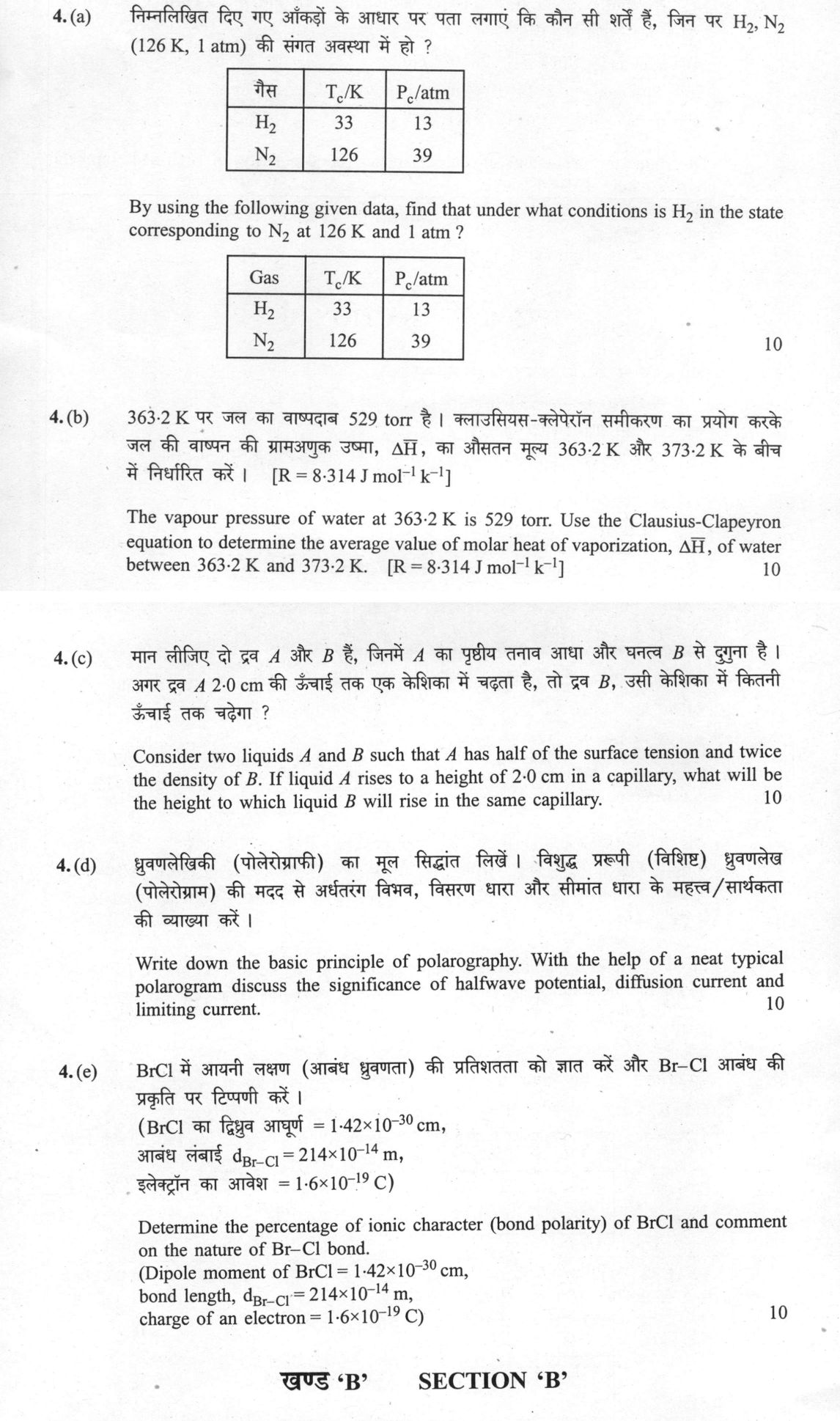
(a) By using the following given data, find that under what conditions is H₂ in the state corresponding to N₂ at 126 K and 1 atm…
By using the following given data, find that under what conditions is H₂ in the state corresponding to N₂ at 126 K and 1 atm ?
| Gas | Tc/K | Pc/atm |
|---|---|---|
| H₂ | 33 | 13 |
| N₂ | 126 | 39 |
10 marks
The vapour pressure of water at 363·2 K is 529 torr. Use the Clausius-Clapeyron equation to determine the average value of molar heat of vaporization, ΔH̄, of water between 363·2 K and 373·2 K. [R = 8·314 J mol⁻¹ k⁻¹] 10 marks
Consider two liquids A and B such that A has half of the surface tension and twice the density of B. If liquid A rises to a height of 2·0 cm in a capillary, what will be the height to which liquid B will rise in the same capillary. 10 marks
Write down the basic principle of polarography. With the help of a neat typical polarogram discuss the significance of halfwave potential, diffusion current and limiting current. 10 marks
Determine the percentage of ionic character (bond polarity) of BrCl and comment on the nature of Br–Cl bond. (Dipole moment of BrCl = 1·42×10⁻³⁰ cm, bond length, d_Br–Cl = 214×10⁻¹⁴ m, charge of an electron = 1·6×10⁻¹⁹ C) 10 marks
हिंदी में प्रश्न पढ़ें
निम्नलिखित दिए गए आंकड़ों के आधार पर पता लगाएं कि कौन सी शर्तें हैं, जिन पर H₂, N₂ (126 K, 1 atm) की संगत अवस्था में हो ?
| गैस | Tc/K | Pc/atm |
|---|---|---|
| H₂ | 33 | 13 |
| N₂ | 126 | 39 |
(10 अंक)
363·2 K पर जल का वाष्पदाब 529 torr है । क्लॉजियस-क्लेपेरॉन समीकरण का प्रयोग करके जल की वाष्पन की मोलरऊष्मा, ΔH̄, का औसत मूल्य 363·2 K और 373·2 K के बीच में निर्धारित करें । [R = 8·314 J mol⁻¹ k⁻¹] (10 अंक)
मान लीजिए दो द्रव A और B हैं, जिनमें A का पृष्ठीय तनाव आधा और घनत्व B से दुगुना है। यदि द्रव A 2·0 cm की ऊँचाई तक एक केशिका में चढ़ता है, तो द्रव B, उसी केशिका में कितनी ऊँचाई तक चढ़ेगा ? (10 अंक)
ध्रुवणलेखिकी (पोलेरोग्राफी) का मूल सिद्धांत लिखें। विशुद्ध प्ररूपी (विशिष्ट) ध्रुवणलेख (पोलेरोग्राम) की मदद से अर्धतरंग विभव, विसरण धारा और सीमांत धारा के महत्व/सार्थकता की व्याख्या करें। (10 अंक)
BrCl में आयनी लक्षण (आबंध ध्रुवता) की प्रतिशतता को ज्ञात करें और Br–Cl आबंध की प्रकृति पर टिप्पणी करें। (BrCl का द्विध्रुव आघूर्ण = 1·42×10⁻³⁰ cm, आबंध लंबाई d_Br–Cl = 214×10⁻¹⁴ m, इलेक्ट्रॉन का आवेश = 1·6×10⁻¹⁹ C) (10 अंक)
Model answer
Written by UPSC Answer Check against this question's marking rubric, to the expected length. UPSC does not publish answers for Mains — this is one way to score well, not an official key.
(a) The law of corresponding states states that real gases obey the same reduced equation of state; hence they are in corresponding states when their reduced temperatures Tᵣ = T/T_c and reduced pressures Pᵣ = P/P_c are equal.
For N₂ at 126 K and 1 atm: T_c(N₂) = 126 K, so Tᵣ(N₂) = 126/126 = 1. P_c(N₂) = 39 atm, so Pᵣ(N₂) = 1/39 = 0.02564.
For H₂ to be in the corresponding state, it must have the same reduced variables: Tᵣ(H₂) = 1 and Pᵣ(H₂) = 1/39.
For H₂, T_c = 33 K and P_c = 13 atm. Thus, T(H₂) = Tᵣ × T_c = 1 × 33 K = 33 K. P(H₂) = Pᵣ × P_c = (1/39) × 13 atm = 13/39 atm = 1/3 atm = 0.333 atm.
Therefore, H₂ is in the state corresponding to N₂ at 126 K and 1 atm when T = 33 K and P = 0.333 atm (1/3 atm).
This result is based on the classical two-parameter law of corresponding states. Because H₂ is a light quantum gas at low temperature, small deviations from this law are expected. A third parameter such as the acentric factor would be needed for better accuracy.
(b) Use the integrated Clausius–Clapeyron equation for liquid–vapour equilibrium: ln(P₂/P₁) = −(ΔH̄/R)(1/T₂ − 1/T₁) = (ΔH̄/R)(1/T₁ − 1/T₂).
Assumptions: vapour behaves ideally, molar volume of liquid is negligible compared with vapour, and ΔH̄ is constant over the interval. The equation is valid when these conditions are met. The result is an average value because ΔH̄ varies slightly with temperature.
Given: T₁ = 363.2 K, P₁ = 529 torr. At the normal boiling point, T₂ = 373.2 K and P₂ = 760 torr.
Then ln(P₂/P₁) = ln(760/529) = ln(1.43667) = 0.36233.
Also, 1/T₁ − 1/T₂ = (T₂ − T₁)/(T₁T₂) = 10.0/(363.2 × 373.2) = 10.0/135546.24 = 7.3776 × 10⁻⁵ K⁻¹.
Therefore, ΔH̄ = R × ln(P₂/P₁)/(1/T₁ − 1/T₂) = 8.314 × 0.36233/(7.3776 × 10⁻⁵) J mol⁻¹ = 3.0124/(7.3776 × 10⁻⁵) J mol⁻¹ = 40830 J mol⁻¹ = 40.83 kJ mol⁻¹.
Average molar heat of vaporization of water between 363.2 K and 373.2 K = 4.08 × 10⁴ J mol⁻¹ = 40.8 kJ mol⁻¹.
(c) The capillary rise is given by h = 2γ cosθ/(ρgr), where γ is surface tension, θ is contact angle, ρ is density, g is acceleration due to gravity, and r is capillary radius.
For the same capillary and the same contact angle θ, r, g and θ are constant. Hence h ∝ γ/ρ.
Let the surface tension and density of liquid B be γ_B and ρ_B. For liquid A: γ_A = (1/2)γ_B and ρ_A = 2ρ_B.
Thus, h_A ∝ γ_A/ρ_A = (γ_B/2)/(2ρ_B) = γ_B/(4ρ_B). For liquid B, h_B ∝ γ_B/ρ_B.
Therefore, h_A/h_B = (γ_B/(4ρ_B))/(γ_B/ρ_B) = 1/4, so h_B = 4h_A. Given h_A = 2.0 cm, h_B = 4 × 2.0 cm = 8.0 cm.
Liquid B will rise to a height of 8.0 cm in the same capillary.
This assumes the contact angle is the same for both liquids in the capillary. If the contact angles differ, the result would change accordingly.
(d) Polarography is a voltammetric technique in which current is measured as a function of applied potential using a dropping mercury electrode (DME) as the working electrode. The DME gives a fresh mercury surface at each drop, which prevents accumulation of products and gives reproducible diffusion-controlled currents. A supporting electrolyte is added to suppress migration of the electroactive species and reduce solution resistance. The analyte reaches the electrode mainly by diffusion. When the applied potential becomes sufficiently cathodic or anodic, the analyte is reduced or oxidized. The current rises and then reaches a nearly constant plateau because the rate of diffusion of the analyte to the electrode surface becomes the limiting factor.
A typical polarogram is a plot of current (μA) on the y-axis against applied potential (V) on the x-axis. It shows:
- a small residual current before the wave,
- a rising portion when the electroactive species begins to undergo electron transfer,
- a limiting-current plateau, and
- a midpoint potential called the half-wave potential.
The limiting current is the total current at the plateau. After subtracting the residual current, the remaining current is the diffusion current, i_d. Under supporting-electrolyte conditions, the limiting current is essentially the sum of residual current and diffusion current.
Significance of the terms: (i) Half-wave potential, E½: It is the potential at which the current is exactly half of the diffusion current. For a reversible diffusion-controlled wave, E½ is independent of concentration and is characteristic of the reducible or oxidizable species in a given medium. Therefore, it is used for qualitative identification and for studying complex formation, pH effects, and reversibility. (ii) Diffusion current, i_d: It is the plateau current corrected for residual current. It is directly proportional to the concentration of the electroactive species, as expressed by the Ilkovic equation: i_d = 708 n C D^(1/2) m^(2/3) t^(1/6), where C is concentration, n is number of electrons, D is diffusion coefficient, m is mass flow rate of mercury, and t is drop time. Hence i_d is used for quantitative analysis. (iii) Limiting current: It is the maximum steady current attained at the plateau. It indicates that the electrode reaction is controlled by mass transport, usually diffusion. Its height above the residual current gives the diffusion current used for analytical measurement.
Thus, E½ gives qualitative identity, while i_d gives quantitative concentration; the limiting current plateau represents diffusion control.
(e) The percentage ionic character of a diatomic bond is calculated by comparing the observed dipole moment with the dipole moment expected for complete transfer of one electron: % ionic character = (μ_observed/μ_ionic) × 100, where μ_ionic = e × d.
The question writes the dipole moment as 1.42×10⁻³⁰ cm; this is read as 1.42×10⁻³⁰ C m, the SI unit, because otherwise the data are dimensionally inconsistent. Also the bond length 214×10⁻¹⁴ m is a typographical error; the physical bond length is 214×10⁻¹² m = 2.14×10⁻¹⁰ m.
Given: μ_observed = 1.42 × 10⁻³⁰ C m, e = 1.6 × 10⁻¹⁹ C, d = 2.14 × 10⁻¹⁰ m.
Then μ_ionic = e × d = (1.6 × 10⁻¹⁹ C)(2.14 × 10⁻¹⁰ m) = 3.424 × 10⁻²⁹ C m.
Therefore, % ionic character = (1.42 × 10⁻³⁰)/(3.424 × 10⁻²⁹) × 100 = (1.42/34.24) × 100 = 4.15%.
Percentage ionic character of BrCl ≈ 4.15%.
The partial charge is therefore about 0.0415e on each atom. Since Cl is more electronegative than Br, the bond is polarised as Br^δ+–Cl^δ−. The very low ionic character shows that the Br–Cl bond is predominantly covalent, with only slight polarity, consistent with the small electronegativity difference between Br and Cl.
What "Solve" is asking you to do
Choose the method, then carry it through to a final answer. Identifying what kind of problem this is and why that method applies is the first thing marked; a correct figure arrived at invisibly earns almost nothing.
Structure that answers it
Given data and what is required → method chosen, with the reason it applies → set-up (equation, circuit, free body, trial balance) → working, step by step → answer with units and any condition of validity
Where marks are lost
Doing the middle steps mentally and writing only the result. In mathematics papers, a further loss comes from giving a decimal where the exact value in surds or fractions was wanted, or from skipping the justification a part explicitly asks for.
How this answer will be evaluated
Approach
(a) calculate: given > formula > substitution > result with units > interpretation | (b) calculate: given > formula > substitution > result with units > interpretation | (c) calculate: given > formula > substitution > result with units > interpretation | (d) describe: define > structure or process in order > labelled diagram > significance | (e) calculate: given > formula > substitution > result with units > interpretation Full marks: Accurate calculations with full steps; clear diagrams; precise definitions.
Key points expected
- State Law of Corresponding States
- Calculate reduced temperature (Tr) for N₂
- Calculate reduced pressure (Pr) for N₂
- Calculate T and P for H₂ using critical constants
- State Clausius-Clapeyron equation (ln form)
- Identify T1, P1, T2, P2 (1 atm at 373.2 K)
- Substitute values into equation
- Solve for ΔH with correct units (J/mol)
Evaluation rubric
Each sub-part is marked on its own, against the marks and word limit printed on the paper.
- (a) Determine T and P for H₂ corresponding to N₂ at 126 K and 1 atm. 10 marks
calculate— given → formula → substitution → result with units → interpretation
Must cover
- State Law of Corresponding States
- Calculate reduced temperature (Tr) for N₂
- Calculate reduced pressure (Pr) for N₂
- Calculate T and P for H₂ using critical constants
Loses marks
- Confusing reduced and absolute values
- Arithmetic errors in division
Earns more
- Correct substitution of Tc and Pc values
- Final answer with units (K, atm)
Extra mark
- Mention of acentric factor (if applicable)
- (b) Calculate average molar heat of vaporization of water. 10 marks
calculate— given → formula → substitution → result with units → interpretation
Must cover
- State Clausius-Clapeyron equation (ln form)
- Identify T1, P1, T2, P2 (1 atm at 373.2 K)
- Substitute values into equation
- Solve for ΔH with correct units (J/mol)
Loses marks
- Using log base 10 without adjusting R
- Incorrect temperature difference sign
Earns more
- Conversion of pressure units (torr to atm)
- Correct use of R constant
Extra mark
- Comparison with standard literature value
- (c) Determine capillary rise height for liquid B. 10 marks
calculate— given → formula → substitution → result with units → interpretation
Must cover
- State capillary rise formula (h = 2S / ρgr)
- Establish proportionality h ∝ S/ρ
- Substitute given ratios (S_A = 0.5S_B, ρ_A = 2ρ_B)
- Calculate final height for B
Loses marks
- Inverting the density ratio
- Ignoring the constant radius r
Earns more
- Clear algebraic steps showing ratio derivation
Extra mark
- Mention of contact angle assumption (θ=0)
- (d) Explain polarography principle and interpret a polarogram. 10 marks
describe— define → structure or process in order → labelled diagram → significance
Must cover
- Define polarography (DC voltammetry)
- Describe DME (Dropping Mercury Electrode) setup
- Label half-wave potential (E1/2) on diagram
- Define diffusion and limiting current
Loses marks
- Confusing polarography with polarimetry
- Missing the current-potential plot
Earns more
- Mention of Ilkovic equation
- Explanation of sigmoidal curve shape
Extra mark
- Mention of residual current
- (e) Calculate ionic character of BrCl and comment on bond nature. 10 marks
calculate— given → formula → substitution → result with units → interpretation
Must cover
- Convert dipole moment to SI units (C·m)
- Calculate theoretical dipole for 100% ionic bond
- Calculate % ionic character (μ_exp / μ_ionic × 100)
- Comment on bond nature (polar covalent)
Loses marks
- Unit mismatch in dipole moment calculation
- Failing to comment on bond nature
Earns more
- Correct unit conversion (10^-10 cm to 10^-12 m)
- Comparison of Br and Cl electronegativity
Extra mark
- Mention of Fajans' rules
Practice this exact question
Write your answer and it is marked point by point against the model answer above — what you covered, what you missed, what you got wrong.
Evaluate my answer →More from Chemistry 2022 Paper I
- Q1 1.(a) Compare average and most probable values of position of an electron in the ground s…
- Q2 2.(a) An automobile tyre contains air at 320×10³ Pa at 20°C. The stem valve is removed an…
- Q3 (a) Identify the least stable ion of the following ions and justify your answer. OCN⁻ ONC…
- Q4 (a) By using the following given data, find that under what conditions is H₂ in the state…
- Q5 (a) The rate Law for the reaction N₂O₂(g) → 2NO(g) is of first order in the concentration…
- Q6 (a) (i) Calculate the number of metal-metal bond in Cp₂Fe₂(CO)₄. (ii) Determine the struc…
- Q7 (a) Cite one example of an optically active tetracoordinated complex compound where the m…