Paper I — Q8
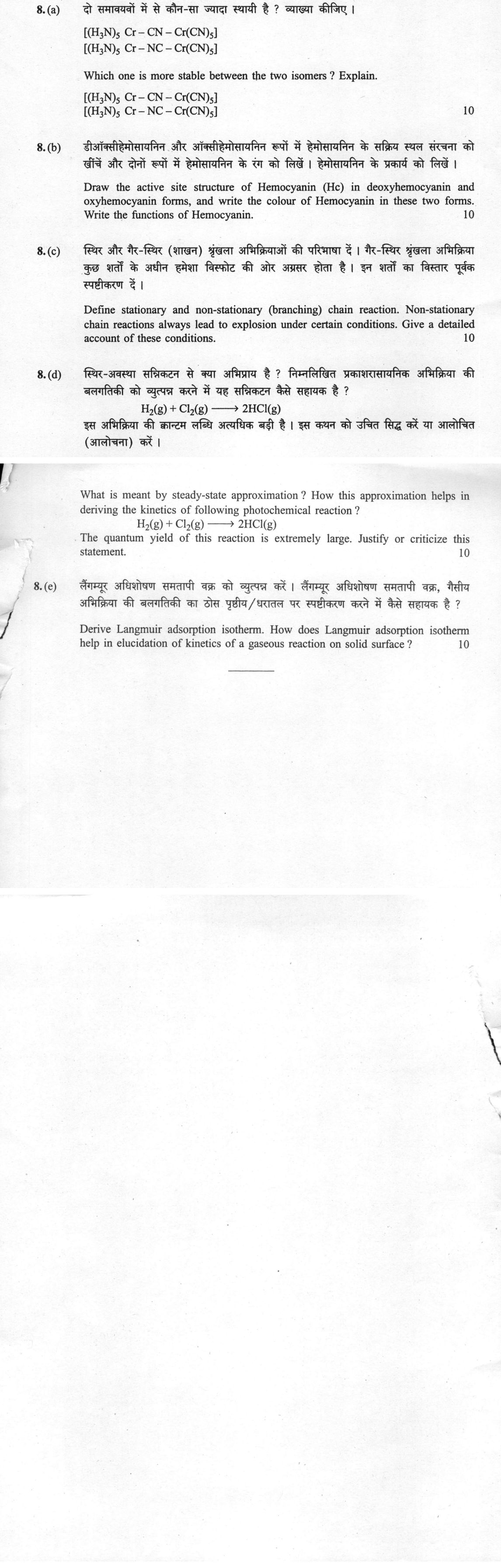
(a) Which one is more stable between the two isomers? Explain. [(H₃N)₅ Cr – CN – Cr(CN)₅] [(H₃N)₅ Cr – NC – Cr(CN)₅] 10…
Which one is more stable between the two isomers? Explain.
[(H₃N)₅ Cr – CN – Cr(CN)₅]
[(H₃N)₅ Cr – NC – Cr(CN)₅] 10 marks
Draw the active site structure of Hemocyanin (Hc) in deoxyhemocyanin and oxyhemocyanin forms, and write the colour of Hemocyanin in these two forms. Write the functions of Hemocyanin. 10 marks
Define stationary and non-stationary (branching) chain reaction. Non-stationary chain reactions always lead to explosion under certain conditions. Give a detailed account of these conditions. 10 marks
What is meant by steady-state approximation? How this approximation helps in deriving the kinetics of following photochemical reaction?
H₂(g) + Cl₂(g) → 2HCl(g)
The quantum yield of this reaction is extremely large. Justify or criticize this statement. 10 marks
Derive Langmuir adsorption isotherm. How does Langmuir adsorption isotherm help in elucidation of kinetics of a gaseous reaction on solid surface? 10 marks
हिंदी में प्रश्न पढ़ें
दो समावयवों में से कौन-सा ज्यादा स्थायी है? व्याख्या कीजिए।
[(H₃N)₅ Cr – CN – Cr(CN)₅]
[(H₃N)₅ Cr – NC – Cr(CN)₅] 10
डीऑक्सीहेमोसायनिन और ऑक्सीहेमोसायनिन रूपों में हेमोसायनिन के सक्रिय स्थल संरचना को खींचे और दोनों रूपों में हेमोसायनिन के रंग को लिखे। हेमोसायनिन के प्रकार्य को लिखे। 10
स्थिर और गैर-स्थिर (शाखन) श्रृंखला अभिक्रियाओं की परिभाषा दें। गैर-स्थिर श्रृंखला अभिक्रिया कुछ शर्तों के अधीन हमेशा विस्फोट की ओर अग्रसर होता है। इन शर्तों का विस्तार पूर्वक स्पष्टीकरण दें। 10
स्थिर-अवस्था सन्निकटन से क्या अभिप्राय है? निम्नलिखित प्रकाशरासायनिक अभिक्रिया की बलगतिकी को व्युत्पन्न करने में यह सन्निकटन कैसे सहायक है?
H₂(g) + Cl₂(g) → 2HCl(g)
इस अभिक्रिया की कांतम लंबी अत्यधिक बड़ी है। इस कथन को उचित सिद्ध करें या आलोचित (आलोचना) करें। 10
लैंगम्युर अधिशोषण समतापी वक्र को व्युत्पन्न करें। लैंगम्युर अधिशोषण समतापी वक्र, गैसीय अभिक्रिया की बलगतिकी का ठोस पृष्ठीय/धरातल पर स्पष्टीकरण करने में कैसे सहायक है? 10 marks
Model answer
Written by UPSC Answer Check against this question's marking rubric, to the expected length. UPSC does not publish answers for Mains — this is one way to score well, not an official key.
These parts connect coordination electronics, bioinorganic oxygen binding, radical chain kinetics and surface adsorption.
(a) Stability of the cyanide-bridged isomers. Cyanide is an ambidentate ligand because it can bind through carbon or nitrogen. The more stable isomer is [(H3N)5Cr–NC–Cr(CN)5]. In this structure the nitrogen end of the bridging cyanide is attached to the ammine-rich chromium centre, while the carbon end is attached to the cyanide-rich chromium centre. Cr(III) is a borderline Lewis acid, but its effective hardness is modified by the surrounding ligands: the [Cr(NH3)5] environment is relatively harder, whereas the [Cr(CN)5] environment is softer because cyanide is a soft donor. The harder nitrogen terminus therefore matches the harder ammine-rich centre, and the softer carbon terminus matches the softer cyanide-rich centre. This HSAB-compatible arrangement gives better orbital overlap and stronger Cr–N and Cr–C interactions. The alternative [(H3N)5Cr–CN–Cr(CN)5] places the harder nitrogen on the softer cyanide-rich centre and the softer carbon on the harder ammine-rich centre, so the donor-acceptor match is poorer and the isomer is less stable.
(b) Hemocyanin active site and function. Deoxyhemocyanin contains two Cu(I) centres, each approximately three-coordinate through histidine imidazole nitrogens, with no peroxide bridge and a Cu–Cu separation of about 4.6 Å. It may be represented as His3Cu(I) ··· Cu(I)His3. Because Cu(I) is d10, deoxyhemocyanin is colourless. On binding oxygen, both Cu(I) centres are oxidised to Cu(II) and O2 is reduced to a peroxo bridge. Oxyhemocyanin has a μ-η²:η² peroxo dicopper(II) core, His3Cu(II)–O–O–Cu(II)His3, in which each copper is coordinated by three histidines and two peroxo oxygen atoms. This form is blue because of ligand-to-metal charge-transfer transitions. Hemocyanin is the iron-free oxygen carrier of many arthropods and molluscs; it reversibly binds and transports oxygen in blood or haemolymph, and in some organisms also stores oxygen. It is not a heme protein and does not function as hemoglobin.
(c) Stationary and branching chain reactions. A stationary chain reaction is one in which the concentration of chain carriers remains constant because the rate of initiation equals the rate of termination; propagation continues at a steady rate, as in the photochemical reaction of H2 with Cl2 under constant light. A non-stationary or branching chain reaction is one in which each cycle produces more radicals than it consumes, so the radical concentration increases with time. If the branching factor α, the ratio of radical production by branching to radical loss, is greater than one, the chain length grows exponentially. A classic example is the H2–O2 system, where H + O2 gives OH + O and O + H2 gives OH + H, multiplying radicals. Explosion occurs when net branching exceeds termination. The necessary conditions are: a temperature high enough for the branching steps to be fast; a pressure between the lower and upper explosion limits, because at low pressure radical loss at walls and impurities dominates, while at high pressure three-body termination and heat removal can suppress net branching; a gas composition within the explosive range; a vessel radius above the critical radius, because a large surface-to-volume ratio enhances radical termination; and absence of inhibitors. When these conditions are met, radical multiplication and heat release reinforce each other, the induction period ends, and the reaction runs away as an explosion.
(d) Steady-state approximation in H2 + Cl2. The steady-state approximation assumes that a reactive intermediate is formed and consumed so rapidly that its concentration remains small and nearly constant, so d[intermediate]/dt is approximately zero. For the photochemical reaction H2 + Cl2 → 2HCl, a chain mechanism is: initiation, Cl2 + hν → 2Cl, with rate Ri = 2Ia; propagation, Cl + H2 → HCl + H (k1) and H + Cl2 → HCl + Cl (k2); termination, 2Cl → Cl2 (kt). Applying the approximation to H gives k1[Cl][H2] = k2[H][Cl2]. Applying it to Cl gives 2Ia + k2[H][Cl2] − k1[Cl][H2] − 2kt[Cl]^2 = 0. Substituting the H steady-state relation cancels the propagation terms and gives [Cl] = (Ia/kt)^1/2. The rate of HCl formation is then k1[Cl][H2] = k1(Ia/kt)^1/2[H2]. Since the absorbed light intensity Ia is proportional to [Cl2] when chlorine is the absorbing species, the rate law becomes rate = k[H2][Cl2]^1/2. If HCl inhibition is included, an additional step H + HCl → H2 + Cl introduces the denominator 1 + (k-1/k2)([HCl]/[Cl2]). The statement that the quantum yield is extremely large is justified: one photon creates two chlorine atoms, and each chlorine atom can propagate many cycles before termination. The quantum yield is therefore the chain length and can be 10^4 to 10^6, which is characteristic of photochemical chain reactions.
(e) Langmuir isotherm and surface kinetics. Let θ be the fraction of surface sites occupied by A. For adsorption A(g) + S ⇌ A-S, the adsorption rate is kaP_A(1 − θ) and the desorption rate is kdθ. At equilibrium, kaP_A(1 − θ) = kdθ, so θ/(1 − θ) = (ka/kd)P_A = KP_A, and θ = KP_A/(1 + KP_A). For competitive adsorption, θ_A = K_A P_A/(1 + K_A P_A + K_B P_B + ...). This isotherm is useful in surface kinetics because the rate of a surface reaction is proportional to the coverages of the reacting species. For a unimolecular surface reaction A* → products, rate = kθ_A = kK_A P_A/(1 + K_A P_A), giving first-order dependence at low pressure and zero-order at high pressure. For a bimolecular Langmuir-Hinshelwood reaction A* + B* → products, rate = kθ_Aθ_B = kK_AK_BP_AP_B/(1 + K_A P_A + K_B P_B)^2. For an Eley-Rideal reaction A(g) + B* → products, rate = kP_Aθ_B = kK_BP_AP_B/(1 + K_B P_B). Thus the pressure dependence of the rate reveals the surface coverage, the strength of adsorption, and whether the rate-determining step is unimolecular, bimolecular on the surface, or a gas-surface collision.
Thus, in each case the observed stability, colour, explosiveness, rate law or kinetic order follows directly from the controlling electronic, radical or surface-coverage mechanism.
What "Explain" is asking you to do
Make the working of something clear — what sets it off, what follows from what, and what it produces. Explain is the Commission's mechanism word: it dominates the technical papers and the “explain why” stems, where the marks sit in the causal chain and not in the label.
Structure that answers it
State what it is → the initiating condition → the chain of cause, step by step → an instance where it plays out → what the chain produces
Where marks are lost
Describing what something looks like instead of why it works that way. Naming the stages without linking them reads as description too.
How this answer will be evaluated
Approach
(a) explain: definition/context > points in order > small example > short close | (b) describe: define > structure or process in order > labelled diagram > significance | (c) account for: state the phenomenon > the causes in order of weight > conclusion | (d) explain: definition/context > points in order > small example > short close | (e) derive: given > assumptions > stepwise derivation > result > check Full marks: All parts fully answered with correct mechanisms, derivations, and justifications; structures drawn accurately; all command words addressed precisely.
Key points expected
- Identify [(H3N)5Cr-CN-Cr(CN)5] as more stable
- Explain C-end binding preference for Cr(III)
- Mention sigma-donor/acceptor properties of CN ligand
- Compare stability of C-bound vs N-bound linkage
- Draw deoxyhemocyanin active site (Cu(I) dimer)
- Draw oxyhemocyanin active site (Cu(II) dimer)
- State colors: colorless (deoxy) and blue (oxy)
- List functions: oxygen transport in invertebrates
Evaluation rubric
Each sub-part is marked on its own, against the marks and word limit printed on the paper.
- (a) Identify the more stable isomer and justify using electronic effects. 10 marks
explain— definition/context → points in order → small example → short close
Must cover
- Identify [(H3N)5Cr-CN-Cr(CN)5] as more stable
- Explain C-end binding preference for Cr(III)
- Mention sigma-donor/acceptor properties of CN ligand
- Compare stability of C-bound vs N-bound linkage
Loses marks
- Choosing the N-bound isomer as more stable
- Failing to explain the electronic basis
- Confusing the two isomers in the explanation
Earns more
- Reference to HSAB principle
- Mention of pi-backbonding effects
- Comparison of bond lengths/strengths
Extra mark
- Reference to specific spectroscopic data
- Mention of thermodynamic vs kinetic stability
- (b) Draw active site structures and state colors/functions of Hemocyanin. 10 marks
describe— define → structure or process in order → labelled diagram → significance
Must cover
- Draw deoxyhemocyanin active site (Cu(I) dimer)
- Draw oxyhemocyanin active site (Cu(II) dimer)
- State colors: colorless (deoxy) and blue (oxy)
- List functions: oxygen transport in invertebrates
Loses marks
- Drawing monomeric Cu instead of dimeric
- Wrong colors for the two forms
- Failing to show the O2 bridge in oxy form
Earns more
- Show coordination geometry of Cu centers
- Mention bridging ligands in active site
- Note on redox state change upon O2 binding
Extra mark
- Mention specific invertebrate examples
- Note on pH dependence of binding
- (c) Define chain reactions and explain conditions for explosion. 10 marks
account for— state the phenomenon → the causes in order of weight → conclusion
Must cover
- Define stationary chain reaction
- Define non-stationary (branching) chain reaction
- Explain conditions leading to explosion
- Mention role of branching factor in explosion
Loses marks
- Confusing stationary with non-stationary
- Failing to explain why branching leads to explosion
- No mention of specific conditions for explosion
Earns more
- Give example of branching chain reaction
- Mention induction period
- Discuss temperature and pressure effects
Extra mark
- Reference to specific explosion limits
- Mention of chain length in branching reactions
- (d) Explain steady-state approximation and apply to H2+Cl2 kinetics. 10 marks
explain— definition/context → points in order → small example → short close
Must cover
- Define steady-state approximation
- Apply SSA to derive rate law for H2+Cl2
- Show steps of photochemical mechanism
- Justify large quantum yield of reaction
Loses marks
- Failing to apply SSA correctly
- Wrong rate law derivation
- No justification for large quantum yield
Earns more
- Write all elementary steps of mechanism
- Show algebraic derivation clearly
- Mention role of light in initiation step
Extra mark
- Reference to specific quantum yield values
- Mention of chain length in this reaction
- (e) Derive Langmuir isotherm and explain its use in surface kinetics. 10 marks
derive— given → assumptions → stepwise derivation → result → check
Must cover
- State assumptions of Langmuir model
- Derive the Langmuir adsorption isotherm equation
- Explain how it helps in surface reaction kinetics
- Show relationship between coverage and rate
Loses marks
- Failing to state assumptions clearly
- Incorrect derivation of the isotherm
- No connection to reaction kinetics
Earns more
- Define surface coverage theta
- Show equilibrium between adsorption/desorption
- Mention limitations of the model
Extra mark
- Reference to specific surface reactions
- Mention of modified Langmuir models
Practice this exact question
Write your answer and it is marked point by point against the model answer above — what you covered, what you missed, what you got wrong.
Evaluate my answer →More from Chemistry 2022 Paper I
- Q5 (a) The rate Law for the reaction N₂O₂(g) → 2NO(g) is of first order in the concentration…
- Q6 (a) (i) Calculate the number of metal-metal bond in Cp₂Fe₂(CO)₄. (ii) Determine the struc…
- Q7 (a) Cite one example of an optically active tetracoordinated complex compound where the m…
- Q8 (a) Which one is more stable between the two isomers? Explain. [(H₃N)₅ Cr – CN – Cr(CN)₅]…