Paper I — Q3
(a) Identify the least stable ion of the following ions and justify your answer. OCN⁻ ONC⁻ SCN⁻ (10 marks) (b) A 74·6 g ice cube…
Identify the least stable ion of the following ions and justify your answer. OCN⁻ ONC⁻ SCN⁻ 10 marks
A 74·6 g ice cube floats in the sea. The temperature and pressure of the system and surroundings are 0°C and 1 atm. Calculate ΔS_syst, ΔS_surr and ΔS_univ for the melting of ice cube. What can you conclude about the nature of process from the value of ΔS_univ ? (The molar heat of fusion of water is 6·01 kJ/mol) 10 marks
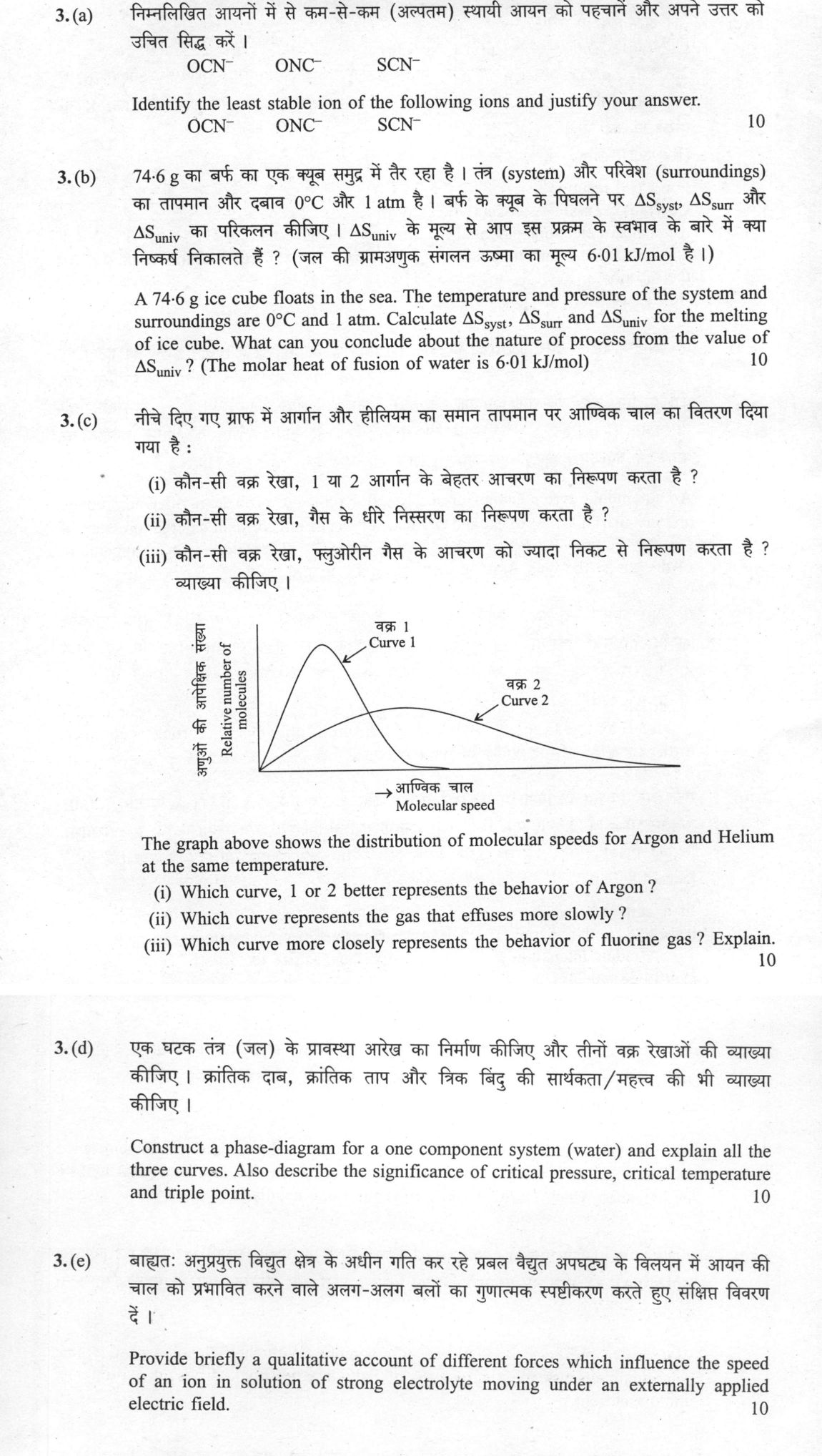
The graph above shows the distribution of molecular speeds for Argon and Helium at the same temperature. Which curve, 1 or 2 better represents the behavior of Argon ?
Which curve represents the gas that effuses more slowly ?
Which curve more closely represents the behavior of fluorine gas ? Explain. 10 marks
Construct a phase-diagram for a one component system (water) and explain all the three curves. Also describe the significance of critical pressure, critical temperature and triple point. 10 marks
Provide briefly a qualitative account of different forces which influence the speed of an ion in solution of strong electrolyte moving under an externally applied electric field. 10 marks
हिंदी में प्रश्न पढ़ें
निम्नलिखित आयनों में से कम-से-कम (अल्पतम) स्थायी आयन को पहचानें और अपने उत्तर को उचित सिद्ध करें । OCN⁻ ONC⁻ SCN⁻ (10 अंक)
74·6 g का बर्फ का एक क्यूब समुद्र में तैर रहा है । तंत्र (system) और परिवेश (surroundings) का तापमान और दबाब 0°C और 1 atm है । बर्फ के क्यूब के पिघलने पर ΔS_syst, ΔS_surr और ΔS_univ का परिकलन कीजिए । ΔS_univ के मूल्य से आप इस प्रक्रम के स्वभाव के बारे में क्या निष्कर्ष निकालते हैं ? (जल की ग्रामाणुक संगलन ऊष्मा का मूल्य 6·01 kJ/mol है ।) (10 अंक)
नीचे दिए गए ग्राफ में आर्गन और हीलियम का समान तापमान पर आण्विक चाल का वितरण दिया गया है : कौन-सी वक्र रेखा, 1 या 2 आर्गन के बेहतर आचरण का निरूपण करता है ?
कौन-सी वक्र रेखा, गैस के धीरे निस्सरण का निरूपण करता है ?
कौन-सी वक्र रेखा, फ्लुओरिन गैस के आचरण को ज्यादा निकट से निरूपण करता है ? व्याख्या कीजिए । (10 अंक)
एक घटक तंत्र (जल) के प्रावस्था आरेख का निर्माण कीजिए और तीनों वक्र रेखाओं की व्याख्या कीजिए । क्रांतिक दाब, क्रांतिक ताप और त्रिक बिंदु की सार्थकता/महत्व की भी व्याख्या कीजिए । (10 अंक)
बाहत: अनुप्रयुक्त विद्युत क्षेत्र के अधीन गति कर रहे प्रबल वैद्युत अपघट्य के विलयन में आयन की चाल को प्रभावित करने वाले अलग-अलग बलों का गुणात्मक स्पष्टीकरण करते हुए संक्षिप्त विवरण दें । (10 अंक)
The figure this question refers to, in words
The question paper is a scan and the diagram did not survive as text. This is the figure as read from the original page — every component, value and label — so the question can be worked from the text below.
(c) A graph showing the distribution of molecular speeds for Argon and Helium at the same temperature. The x-axis represents molecular speed and the y-axis represents the number of molecules (or probability density). There are two curves labeled 1 and 2. Curve 1 is shifted to the right and is lower/flatter compared to Curve 2, which is shifted to the left and is higher/sharper.
(d) A phase diagram for a one component system (water). The x-axis represents Temperature and the y-axis represents Pressure. The diagram contains three curves meeting at a central point (the triple point). One curve (solid-liquid) has a negative slope, extending from the triple point upwards and to the left. A second curve (liquid-gas) extends from the triple point upwards and to the right, ending at a critical point. A third curve (solid-gas) extends from the triple point downwards and to the left. The regions are labeled Solid, Liquid, and Gas.
Model answer
Written by UPSC Answer Check against this question's marking rubric, to the expected length. UPSC does not publish answers for Mains — this is one way to score well, not an official key.
These five parts connect molecular structure, kinetic theory, phase equilibrium and solution behaviour; in each case the macroscopic result follows from a balance of microscopic forces or thermodynamic potentials.
Part (a) The least stable ion is ONC⁻. In OCN⁻ the carbon is central and the valence electrons can be arranged in octet-satisfying resonance forms, O(−)–C≡N and O=C=N(−). The negative charge is delocalized over oxygen and nitrogen, and the contributor with the charge on oxygen is especially favourable because oxygen is more electronegative. In SCN⁻ the analogous forms, S(−)–C≡N and S=C=N(−), delocalize the charge over sulfur and nitrogen; sulfur is larger and more polarizable, so it can accommodate negative charge without excessive electron-electron repulsion, and the C–S and C–N multiple bonds are strong. Both OCN⁻ and SCN⁻ keep the central carbon neutral and avoid large charge separation. In ONC⁻ the required octet structures are much less favourable: the best form, O(−)–N(+)≡C(−), has charge separation and places negative charge on carbon as well as oxygen, while O=N=C(2−) puts a large negative charge on carbon and a positive charge on nitrogen. Thus the negative charge is not placed mainly on the most electronegative atom, and the resonance stabilization is weak; hence ONC⁻ is the least stable.
Part (b) Moles of ice = 74.6 g / 18.015 g/mol = 4.14 mol. At 0°C (273.15 K) melting is endothermic. The heat absorbed is q = 4.14 × 6.01 = 24.9 kJ. The molar entropy change is 6.01 kJ/mol / 273.15 K = 22.0 J/K/mol. For the whole cube, ΔS_syst = 4.14 × 22.0 = +91.1 J/K. The surroundings supply this heat at the same temperature, so ΔS_surr = −91.1 J/K. Therefore ΔS_univ = ΔS_syst + ΔS_surr = 0. On a molar basis the corresponding values are +22.0 J/K/mol and −22.0 J/K/mol. A zero total entropy change means the process is reversible and the ice-water system is at equilibrium at the melting point; there is no net driving force for melting or freezing.
Part (c) The Maxwell-Boltzmann peak is at u_mp = sqrt(2RT/M). At the same temperature the heavier gas has the smaller u_mp, so its curve is shifted to lower speed, is narrower and has a higher peak. For equal numbers of molecules the areas under the two curves are the same, so the heavier curve must be taller to compensate for its narrower width. Helium (M = 4 g/mol) is much lighter than argon (M = 40 g/mol); therefore He gives the broader, lower curve shifted to higher speed, and Ar gives the sharper, higher curve at lower speed. In the described sketch, curve 1 is the right-shifted, lower/flatter curve, so curve 1 represents He and curve 2 represents Ar. The gas that effuses more slowly is the heavier one, Ar, i.e. curve 2; by Graham’s law the effusion rate is proportional to 1/sqrt(M). Fluorine, F₂, has M = 38 g/mol, close to argon, so at the same temperature its distribution is closest to curve 2, the lower-speed, sharper curve.
Part (d) For a one-component system the phase diagram is plotted with pressure on the vertical axis and temperature on the horizontal axis. The regions are: solid at low temperature and high pressure, liquid between the fusion and vaporization curves, and gas at low pressure and high temperature. The three curves are boundaries where two phases coexist in equilibrium because their chemical potentials are equal. The solid-liquid (fusion) curve starts at the triple point and goes upward and to the left for water. Its slope is given by the Clapeyron equation, dP/dT = ΔH_fus/(T ΔV_fus). For water, melting decreases volume (ice is less dense than liquid water), so ΔV_fus is negative and the fusion curve has a negative slope; increasing pressure therefore favours the denser liquid and lowers the melting point slightly. The liquid-vapour (vaporization) curve runs from the triple point upward and to the right; it separates liquid from vapour and ends at the critical point. Along it, liquid and vapour have equal chemical potential; as temperature and pressure rise the density difference disappears. The solid-vapour (sublimation) curve runs from the triple point downward and to the left; below the triple-point pressure the stable condensed phase is solid, and heating causes direct solid-vapour transition. The triple point of water is at 0.01°C (273.16 K) and 0.006 atm (611 Pa); at this unique condition solid, liquid and vapour coexist. The critical point is at 374°C (647 K) and 218 atm (22.06 MPa); above the critical temperature no amount of pressure can produce a distinct liquid, and above the critical pressure the fluid is supercritical. The triple point fixes the coexistence condition and the reference for the Celsius scale, while the critical point marks the limit of the liquid-vapour boundary.
Part (e) In a strong electrolyte an ion under an applied field experiences several forces. The primary driving force is the electric force qE, which tends to accelerate the ion. In the solvent this acceleration is opposed by viscous drag; at the limiting low-field speed the drag balances the electric force, giving the limiting ionic mobility. The ion is surrounded by a solvation or hydration shell; the bound water increases the effective hydrodynamic radius and therefore increases friction, reducing speed. At finite concentration the ion is also surrounded by an ionic atmosphere of opposite charge. When the ion moves, the spherical atmosphere is distorted: it lags behind, producing a relaxation force that opposes the motion. In addition, the ionic atmosphere tends to move in the opposite direction to the ion and drags solvent with it; this electrophoretic effect increases the effective drag. Interionic attractions and, at higher concentrations, ion pairing or specific interactions further reduce the net mobility. Thus the observed speed is the result of the electric driving force reduced by solvation, viscous drag, relaxation, electrophoretic and interionic forces.
Thus, across all five parts, the explanation is the same in form: identify the relevant molecular or phase-level balance, compare the competing contributions, and the observed stability, entropy, speed, phase boundary or ionic mobility follows directly.
What "Explain" is asking you to do
Make the working of something clear — what sets it off, what follows from what, and what it produces. Explain is the Commission's mechanism word: it dominates the technical papers and the “explain why” stems, where the marks sit in the causal chain and not in the label.
Structure that answers it
State what it is → the initiating condition → the chain of cause, step by step → an instance where it plays out → what the chain produces
Where marks are lost
Describing what something looks like instead of why it works that way. Naming the stages without linking them reads as description too.
How this answer will be evaluated
Approach
(a) justify: claim > 3-4 reasons > evidence > conclusion | (b) calculate: given > formula > substitution > result with units > interpretation | (c(i)) explain: definition/context > points in order > small example > short close | (c(ii)) explain: definition/context > points in order > small example > short close | (c(iii)) explain: definition/context > points in order > small example > short close | (d) describe: define > structure or process in order > labelled diagram > significance | (e) account for: state the phenomenon > the causes in order of weight > conclusion Full marks: All parts fully answered with correct reasoning, calculations, and diagrams where required.
Key points expected
- Identify ONC⁻ as the least stable ion
- Justify using formal charge distribution
- Explain stability of OCN⁻ (negative charge on O)
- Explain stability of SCN⁻ (negative charge on terminal atom)
- Calculate moles of ice (74.6 g / 18 g/mol)
- Calculate ΔS_syst = n × ΔH_fus / T
- Calculate ΔS_surr = -ΔH_syst / T
- Calculate ΔS_univ = ΔS_syst + ΔS_surr
Evaluation rubric
Each sub-part is marked on its own, against the marks and word limit printed on the paper.
- (a) Identify the least stable ion among OCN⁻, ONC⁻, and SCN⁻ with reasoning. 10 marks
justify— claim → 3-4 reasons → evidence → conclusion
Must cover
- Identify ONC⁻ as the least stable ion
- Justify using formal charge distribution
- Explain stability of OCN⁻ (negative charge on O)
- Explain stability of SCN⁻ (negative charge on terminal atom)
Loses marks
- Identifying OCN⁻ or SCN⁻ as least stable
- Failing to justify with formal charges
- Ignoring resonance in stability argument
Earns more
- Mention resonance structures for all ions
- Compare electronegativity of terminal atoms
- Discuss octet rule satisfaction
Extra mark
- Draw Lewis structures for all three ions
- (b) Calculate ΔS_syst, ΔS_surr, and ΔS_univ for melting 74.6 g ice at 0°C, 1 atm. 10 marks
calculate— given → formula → substitution → result with units → interpretation
Must cover
- Calculate moles of ice (74.6 g / 18 g/mol)
- Calculate ΔS_syst = n × ΔH_fus / T
- Calculate ΔS_surr = -ΔH_syst / T
- Calculate ΔS_univ = ΔS_syst + ΔS_surr
Loses marks
- Wrong moles calculation
- Sign error in ΔS_surr
- Failing to conclude on process nature
Earns more
- State that ΔS_univ = 0 for reversible process
- Conclude process is at equilibrium
- Show units in all calculations
Extra mark
- Mention that melting at 0°C is reversible
- (c(i)) Identify which curve represents Argon and explain why.
explain— definition/context → points in order → small example → short close
Must cover
- Identify Curve 1 as Argon
- Explain heavier gas has lower average speed
- Relate mass to peak position in distribution
Loses marks
- Identifying Curve 2 as Argon
- Failing to relate mass to speed distribution
Earns more
- Mention Maxwell-Boltzmann distribution
- Note Curve 1 is narrower and taller
Extra mark
- Mention rms velocity formula
- (c(ii)) Identify which curve represents the gas that effuses more slowly.
explain— definition/context → points in order → small example → short close
Must cover
- Identify Curve 1 as slower effusing gas
- Apply Graham's law (rate ∝ 1/√M)
- Link lower speed to slower effusion
Loses marks
- Identifying Curve 2 as slower effusing
- Failing to apply Graham's law
Earns more
- Mention Graham's law explicitly
- Note Argon effuses slower than Helium
Extra mark
- Calculate relative effusion rates
- (c(iii)) Identify which curve represents fluorine gas and explain.
explain— definition/context → points in order → small example → short close
Must cover
- Identify Curve 1 as closer to F₂ behavior
- Compare molar mass of F₂ (38 g/mol) to Ar (40 g/mol)
- Explain similar masses give similar distributions
Loses marks
- Identifying Curve 2 as F₂
- Failing to compare molar masses
Earns more
- Note F₂ is diatomic but mass similar to Ar
- Mention Curve 1 is closer than Curve 2
Extra mark
- Calculate exact mass comparison
- (d) Construct water phase diagram, explain three curves, and significance of critical point and triple point. 10 marks
describe— define → structure or process in order → labelled diagram → significance
Must cover
- Draw P-T diagram with solid, liquid, gas regions
- Explain solid-liquid, liquid-gas, solid-gas curves
- Define triple point (0.01°C, 4.58 mmHg)
- Define critical point (374°C, 218 atm)
Loses marks
- Missing any of the three curves
- Wrong values for triple or critical point
- Failing to explain significance of points
Earns more
- Note negative slope of solid-liquid line for water
- Explain significance of triple point (all phases coexist)
- Explain critical point (no liquid-gas distinction)
Extra mark
- Label regions and points clearly on diagram
- (e) Qualitatively account for forces influencing ion speed in strong electrolyte under electric field. 10 marks
account for— state the phenomenon → the causes in order of weight → conclusion
Must cover
- Mention electrophoretic effect (ion-solvent friction)
- Mention relaxation effect (asymmetric ion atmosphere)
- Explain both effects reduce ion mobility
- Relate to Debye-Hückel-Onsager theory
Loses marks
- Mentioning only one effect
- Failing to explain mechanism of each effect
- Confusing with weak electrolyte behavior
Earns more
- Describe ion atmosphere formation
- Explain how field distorts ion atmosphere
- Mention both effects oppose applied field
Extra mark
- Mention limiting molar conductivity
Practice this exact question
Write your answer and it is marked point by point against the model answer above — what you covered, what you missed, what you got wrong.
Evaluate my answer →More from Chemistry 2022 Paper I
- Q1 1.(a) Compare average and most probable values of position of an electron in the ground s…
- Q2 2.(a) An automobile tyre contains air at 320×10³ Pa at 20°C. The stem valve is removed an…
- Q3 (a) Identify the least stable ion of the following ions and justify your answer. OCN⁻ ONC…
- Q4 (a) By using the following given data, find that under what conditions is H₂ in the state…
- Q5 (a) The rate Law for the reaction N₂O₂(g) → 2NO(g) is of first order in the concentration…
- Q6 (a) (i) Calculate the number of metal-metal bond in Cp₂Fe₂(CO)₄. (ii) Determine the struc…