Paper I — Q7
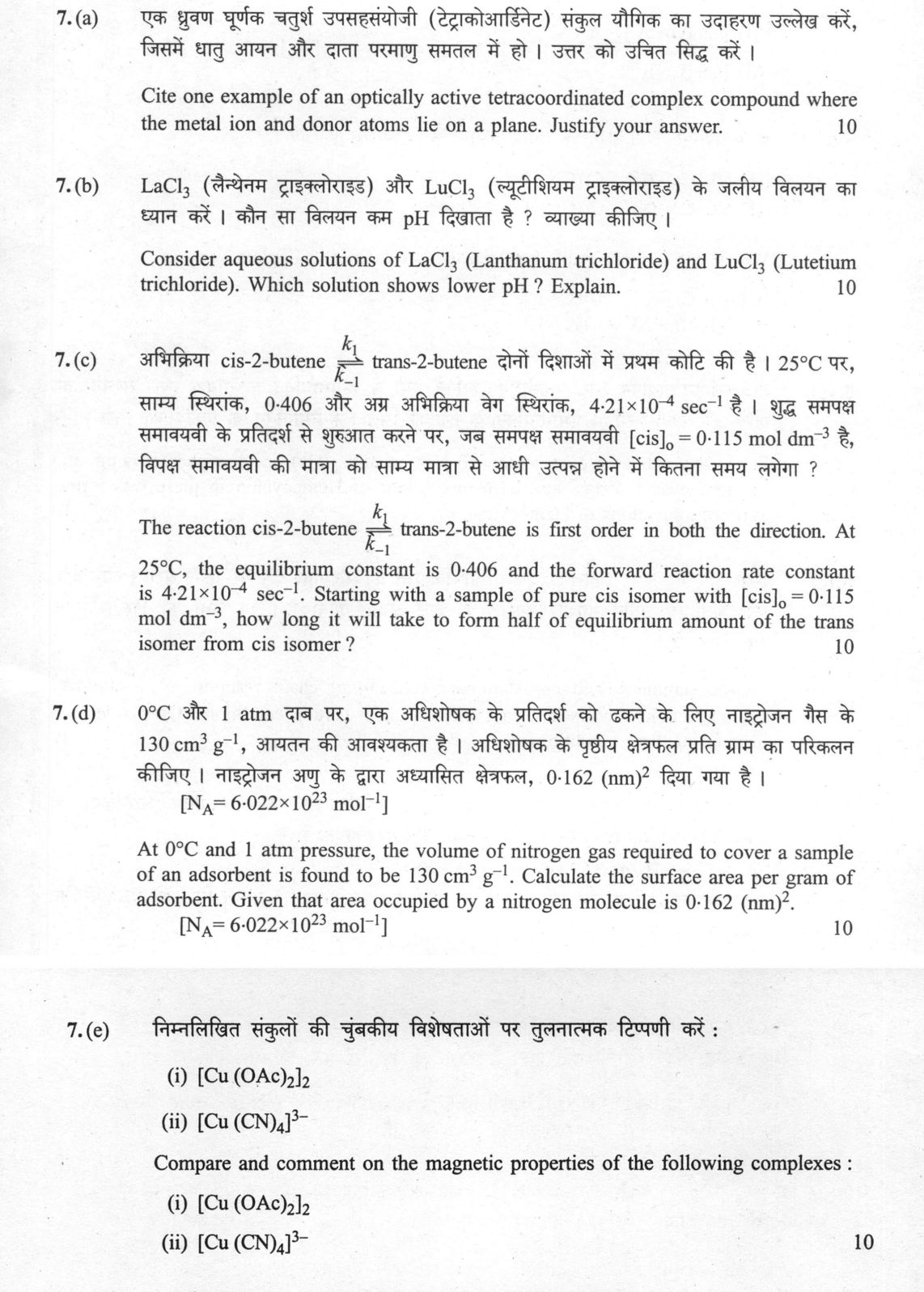
(a) Cite one example of an optically active tetracoordinated complex compound where the metal ion and donor atoms lie on a plane…
Cite one example of an optically active tetracoordinated complex compound where the metal ion and donor atoms lie on a plane. Justify your answer. 10 marks
Consider aqueous solutions of LaCl₃ (Lanthanum trichloride) and LuCl₃ (Lutetium trichloride). Which solution shows lower pH? Explain. 10 marks
The reaction cis-2-butene ⇄ trans-2-butene is first order in both the direction. At 25°C, the equilibrium constant is 0.406 and the forward reaction rate constant is 4.21×10⁻⁴ sec⁻¹. Starting with a sample of pure cis isomer with [cis]₀ = 0.115 mol dm⁻³, how long it will take to form half of equilibrium amount of the trans isomer from cis isomer? 10 marks
At 0°C and 1 atm pressure, the volume of nitrogen gas required to cover a sample of an adsorbent is found to be 130 cm³ g⁻¹. Calculate the surface area per gram of adsorbent. Given that area occupied by a nitrogen molecule is 0.162 (nm)².
[Nₐ = 6.022×10²³ mol⁻¹] 10 marks
Compare and comment on the magnetic properties of the following complexes:
[Cu (OAc)₂]₂
[Cu (CN)₄]³⁻ 10 marks
हिंदी में प्रश्न पढ़ें
एक ध्रुवण घूर्णक चतुष्ठ उपसहसंयोजी (टेट्राकोआर्डिनेट) संकुल यौगिक का उदाहरण उल्लेख करें, जिसमें धातु आयन और दाता परमाणु समतल में हों। उत्तर को उचित सिद्ध करें। 10
LaCl₃ (लैन्थेनम ट्राइक्लोराइड) और LuCl₃ (ल्यूटीशियम ट्राइक्लोराइड) के जलीय विलयन का ध्यान करें। कौन सा विलयन कम pH दिखाता है? व्याख्या कीजिए। 10
अभिक्रिया cis-2-butene ⇄ trans-2-butene दोनों दिशाओं में प्रथम कोटि की है। 25°C पर, साम्य स्थिरांक, 0.406 और अभिक्रिया वेग स्थिरांक, 4.21×10⁻⁴ sec⁻¹ है। शुद्ध समपक्ष समावयवी के प्रतिदर्श से शुरुआत करने पर, जब समपक्ष समावयवी [cis]₀ = 0.115 mol dm⁻³ है, विपक्ष समावयवी की मात्रा को साम्य मात्रा से आधी उत्पन्न होने में कितना समय लगेगा? 10 marks
0°C और 1 atm दाब पर, एक अधिशोषक के प्रतिदर्श को ढकने के लिए नाइट्रोजन गैस के 130 cm³ g⁻¹, आयतन की आवश्यकता है। अधिशोषक के पृष्ठीय क्षेत्रफल प्रति ग्राम का परिकलन कीजिए। नाइट्रोजन अणु के द्वारा अध्यासित क्षेत्रफल, 0.162 (nm)² दिया गया है।
[Nₐ = 6.022×10²³ mol⁻¹] 10
निम्नलिखित संकुलों की चुंबकीय विशेषताओं पर तुलनात्मक टिप्पणी करें:
[Cu (OAc)₂]₂
[Cu (CN)₄]³⁻ 10
Model answer
Written by UPSC Answer Check against this question's marking rubric, to the expected length. UPSC does not publish answers for Mains — this is one way to score well, not an official key.
(a) A suitable example is [Pt(en)(ox)], ethylenediamineoxalato(2−)platinum(II). Pt(II) is a d8 ion and is four-coordinate in a square-planar arrangement. The Pt atom and the four donor atoms, two nitrogen atoms of ethylenediamine and two oxygen atoms of oxalate, lie in one plane. The complex is nevertheless optically active because the two five-membered chelate rings cannot remain in that plane. They are puckered and twisted above and below the donor-atom plane. Since the two chelate ligands are different, the mirror image of one twisted arrangement cannot be superimposed on the original by any proper rotation; the molecule lacks a plane of symmetry, centre of inversion, or improper rotation axis. The two non-superimposable mirror-image forms, conventionally labelled Δ and Λ, are therefore enantiomers. The important point is that optical activity here does not require a tetrahedral array of donor atoms; it arises from the out-of-plane conformation of the chelate rings while the metal and donor atoms remain coplanar.
(b) In aqueous solution both salts give trivalent lanthanide aqua ions, [La(H2O)6]3+ and [Lu(H2O)6]3+. The relevant difference is ionic size. Across the lanthanide series, the 4f electrons shield the nuclear charge poorly, so the ionic radius contracts from La3+ to Lu3+. For six-coordinate ions, La3+ has a radius of about 1.032 Å and Lu3+ about 0.861 Å. Because Lu3+ is smaller while carrying the same +3 charge, its charge density is higher. In simple terms, the acidity of the aqua ion increases with ionic potential, charge divided by radius. Lu3+ therefore polarises the O–H bonds of the coordinated water molecules more strongly, making the protons more acidic. Hydrolysis occurs to a greater extent: [Lu(H2O)6]3+ + H2O ⇌ [Lu(H2O)5OH]2+ + H3O+. The larger La3+ ion polarises water less, so [La(H2O)6]3+ releases fewer hydronium ions. Consequently, the LuCl3 solution has a higher [H3O+] and a lower pH than the LaCl3 solution.
(c) Let x be the concentration of trans-2-butene formed from pure cis. The reversible first-order rate law is dx/dt = k_f([cis]0 − x) − kᵣ x. At equilibrium, k_f[cis]eq = kᵣ[trans]eq. The numerical value 0.406 is used as [cis]eq/[trans]eq, which is consistent with trans-2-butene being the more stable isomer; hence [trans]eq/[cis]eq = 1/0.406 = 2.46. Therefore kᵣ = k_f × 0.406 = 4.21 × 10⁻⁴ × 0.406 = 1.71 × 10⁻⁴ s⁻¹. The sum of the forward and reverse rate constants is k_f + kᵣ = 5.92 × 10⁻⁴ s⁻¹.
The integrated form for approach to equilibrium is x = x_eq(1 − e^−(k_f+kᵣ)t), where x_eq = [trans]eq. Since [cis]eq + [trans]eq = 0.115 mol dm⁻³ and [cis]eq/[trans]eq = 0.406, [trans]eq = 0.115/(1 + 0.406) = 0.0818 mol dm⁻³. Forming half of the equilibrium amount means x = x_eq/2. Substituting gives 1/2 = 1 − e^−(k_f+kᵣ)t, so e^−(k_f+kᵣ)t = 1/2 and t = ln 2/(k_f + kᵣ). Thus t = 0.693/(5.92 × 10⁻⁴) = 1.17 × 10³ s, or about 19.5 min. Because the required point is one-half of x_eq, the initial concentration cancels; only the sum of the first-order constants controls the time.
(d) The calculation assumes the reported nitrogen volume corresponds to a complete monolayer and that each molecule occupies the given cross-sectional area. Convert 130 cm³ g⁻¹ to 0.130 L g⁻¹. At 0°C and 1 atm, n = PV/RT = (1 atm × 0.130 L g⁻¹)/(0.082057 L atm mol⁻¹ K⁻¹ × 273.15 K) = 5.80 × 10⁻³ mol g⁻¹. The number of nitrogen molecules per gram is n N_A = 5.80 × 10⁻³ × 6.022 × 10²³ = 3.49 × 10²¹ molecules g⁻¹. Each molecule occupies 0.162 nm², which is 0.162 × 10⁻¹⁸ m² = 1.62 × 10⁻¹⁹ m². Multiplying the number of molecules by the area per molecule gives the surface area: 3.49 × 10²¹ × 1.62 × 10⁻¹⁹ = 5.66 × 10² m² g⁻¹. Hence the adsorbent has a surface area of about 566 m² g⁻¹.
(e) The two complexes differ in oxidation state, electron configuration, and magnetic coupling. In [Cu(OAc)2]2, copper is Cu(II), a d9 ion. Each Cu(II) centre has one unpaired electron, and the spin-only moment for an isolated Cu(II) ion would be about 1.73 BM. The acetate complex is a paddlewheel dimer in which two Cu(II) centres are held close together by bridging acetate groups. The unpaired d electrons on the two copper centres interact through the bridging acetate ligands by superexchange. This interaction is antiferromagnetic: the two spins prefer to be paired in a singlet ground state. Because the singlet state is diamagnetic, the observed magnetic moment is reduced relative to two independent Cu(II) ions; at room temperature the effective moment is about 1.4 BM per Cu, reflecting partial thermal population of the excited triplet state.
In [Cu(CN)4]3−, the charge balance gives Cu(I), which is d10. All ten d electrons are paired, and the complex is four-coordinate, commonly tetrahedral, with a closed-shell configuration. There is no unpaired electron and no antiferromagnetic coupling to consider, so the complex is diamagnetic with μ = 0. Thus the acetate dimer is paramagnetic but magnetically weakened by antiferromagnetic Cu–Cu coupling, whereas the cyanide complex is diamagnetic because of its d10 closed-shell Cu(I) centre.
What "Explain" is asking you to do
Make the working of something clear — what sets it off, what follows from what, and what it produces. Explain is the Commission's mechanism word: it dominates the technical papers and the “explain why” stems, where the marks sit in the causal chain and not in the label.
Structure that answers it
State what it is → the initiating condition → the chain of cause, step by step → an instance where it plays out → what the chain produces
Where marks are lost
Describing what something looks like instead of why it works that way. Naming the stages without linking them reads as description too.
How this answer will be evaluated
Approach
Framework: Concept > Structure or mechanism > Reasoning > Result. (a) justify: claim > 3-4 reasons > evidence > conclusion | (b) explain: definition/context > points in order > small example > short close | (c) calculate: given > formula > substitution > result with units > interpretation | (d) calculate: given > formula > substitution > result with units > interpretation | (e) compare: paired headings or table > key differences > significance > conclusion Full marks: Accurate application of concepts, correct calculations, clear justification, and proper use of chemical terminology.
Key points expected
- Identify a specific planar tetracoordinated complex
- State that metal and donor atoms are coplanar
- Explain the origin of optical activity (chirality)
- Justify why the planar geometry allows optical isomerism
- Identify which solution has the lower pH
- Relate acidity to the size/charge density of the cation
- Explain the effect of lanthanide contraction on ionic radius
- Link higher charge density to greater hydrolysis of water
Evaluation rubric
Each sub-part is marked on its own, against the marks and word limit printed on the paper.
- (a) Example of planar tetracoordinated optically active complex with justification. 10 marks
justify— claim → 3-4 reasons → evidence → conclusion
Must cover
- Identify a specific planar tetracoordinated complex
- State that metal and donor atoms are coplanar
- Explain the origin of optical activity (chirality)
- Justify why the planar geometry allows optical isomerism
Loses marks
- Citing a tetrahedral complex as the example
- Failing to explain why the planar structure is chiral
- Confusing optical activity with geometric isomerism
Earns more
- Mention specific ligand types (e.g., bidentate)
- Draw the structure showing the plane
- Reference specific symmetry elements (lack of mirror plane)
Extra mark
- Cite a specific named complex (e.g., a specific porphyrin or phthalocyanine derivative)
- (b) Comparison of pH of LaCl3 and LuCl3 solutions with explanation. 10 marks
explain— definition/context → points in order → small example → short close
Must cover
- Identify which solution has the lower pH
- Relate acidity to the size/charge density of the cation
- Explain the effect of lanthanide contraction on ionic radius
- Link higher charge density to greater hydrolysis of water
Loses marks
- Claiming LaCl3 has lower pH
- Ignoring the effect of ionic size on hydrolysis
- Failing to mention lanthanide contraction
Earns more
- Mention the specific trend in ionic radius from La to Lu
- Write the hydrolysis equation for the metal aqua ion
- Compare the Lewis acidity of La3+ and Lu3+
Extra mark
- Provide specific ionic radius values for La3+ and Lu3+
- (c) Time required to form half of equilibrium amount of trans isomer. 10 marks
calculate— given → formula → substitution → result with units → interpretation
Must cover
- Determine the equilibrium concentrations of cis and trans isomers
- Calculate the reverse rate constant (k-1) from K and k1
- Set up the integrated rate law for the reversible first-order reaction
- Solve for time (t) when [trans] = 0.5 * [trans]eq
Loses marks
- Treating the reaction as irreversible
- Incorrect calculation of equilibrium concentrations
- Using the wrong integrated rate law
Earns more
- Correctly calculating [cis]eq and [trans]eq
- Using the correct formula for reversible first-order kinetics
- Showing the substitution of values into the rate equation
Extra mark
- Verifying the result by checking the rate at that time
- (d) Surface area per gram of adsorbent from nitrogen adsorption data. 10 marks
calculate— given → formula → substitution → result with units → interpretation
Must cover
- Convert the volume of N2 to moles using STP conditions
- Calculate the number of N2 molecules using Avogadro's number
- Multiply the number of molecules by the area per molecule
- Convert the final area to appropriate units (e.g., m2/g)
Loses marks
- Using the wrong molar volume for gas at STP
- Failing to convert nm2 to m2
- Incorrect calculation of the number of molecules
Earns more
- Correctly using the molar volume of gas at STP (22.4 L/mol)
- Converting nm2 to m2 correctly
- Showing all unit conversions clearly
Extra mark
- Mentioning the assumption of monolayer coverage
- (e) Comparison of magnetic properties of [Cu(OAc)2]2 and [Cu(CN)4]3-. 10 marks
compare— paired headings or table → key differences → significance → conclusion
Must cover
- Determine the oxidation state of Cu in both complexes
- Identify the d-electron configuration of Cu in each complex
- Explain the magnetic behavior based on unpaired electrons
- Compare the ligand field strength of OAc- and CN-
Loses marks
- Incorrectly assigning the oxidation state of Cu
- Failing to relate magnetic properties to unpaired electrons
- Ignoring the difference in ligand field strength
Earns more
- Mentioning the geometry of each complex (e.g., square planar vs. distorted octahedral)
- Explaining the effect of ligand field on electron pairing
- Stating the magnetic moment for each complex
Extra mark
- Drawing the orbital splitting diagrams for each complex
Practice this exact question
Write your answer and it is marked point by point against the model answer above — what you covered, what you missed, what you got wrong.
Evaluate my answer →More from Chemistry 2022 Paper I
- Q4 (a) By using the following given data, find that under what conditions is H₂ in the state…
- Q5 (a) The rate Law for the reaction N₂O₂(g) → 2NO(g) is of first order in the concentration…
- Q6 (a) (i) Calculate the number of metal-metal bond in Cp₂Fe₂(CO)₄. (ii) Determine the struc…
- Q7 (a) Cite one example of an optically active tetracoordinated complex compound where the m…
- Q8 (a) Which one is more stable between the two isomers? Explain. [(H₃N)₅ Cr – CN – Cr(CN)₅]…